
Draught proofing a typical Irish house costs about €30 to €100 in materials if it is done by hand, or roughly €500 to €1,600 for a professional job covering the windows, external doors, loft hatch and an unused chimney, as an aggregate Irish market estimate including VAT. Single items are cheap: new seals on a modern window usually cost €40 to €90, a brush strip and seal on an external door €60 to €150, and sash windows €150 to €300 each because each one is fitted by hand. It is one of the cheapest ways to make a house feel warmer this winter, as long as the ventilation the house needs is left alone. Households who want the job done properly can post it under window sealing and insulation upgrades and compare quotes.

Draught proofing prices at a glance
The figures below are an aggregate Irish market estimate, VAT included, for labour and materials unless marked DIY.
| Job | Typical price |
|---|---|
| DIY materials for the main draughts in a typical house | €30–€100 |
| Replacing worn seals on a uPVC or aluminium window | €40–€90 per window |
| Draught proofing a timber sash window | €150–€300 per window |
| Brush strip, seals and threshold on an external door | €60–€150 per door |
| Letterbox flap and keyhole cover, fitted | €20–€50 |
| Sealing and insulating a loft hatch | €80–€200 |
| Sealing gaps in a suspended timber floor and skirting | €150–€400 per room |
| Chimney balloon (DIY) or fitted chimney cap with vent | €30–€60 / €150–€350 |
| Whole-house professional job, three-bed semi | €500–€1,600 |
A worked example: a three-bed semi with eight uPVC windows, a front and back door, a loft hatch and one unused fireplace. New window seals come to roughly €320–€720, the two doors €120–€300, the loft hatch €80–€200 and a chimney cap €150–€350, so a professional job lands at about €670–€1,570. The same house done by hand, with foam strips, door brushes, a letterbox flap and a chimney balloon, costs well under €150 in materials.
Where the draughts usually are
Most heat lost through draughts escapes through a short list of gaps. Checking them on a cold, windy day, with a hand or a lit incense stick held near each one, shows where the air is moving.
- Windows. Worn or flattened rubber seals on modern windows, and the gaps around the sashes of older timber windows.
- External doors. The gap under the door, around the frame, the letterbox and the keyhole.
- Loft hatch. Warm air rises straight into the attic through an unsealed hatch.
- Floors and skirting. Suspended timber floors in older houses let cold air up through the boards and the gap under the skirting.
- Unused chimneys. An open flue with no fire lit draws warm air out of the room all day.
- Pipework and cables. Holes where pipes and cables pass through walls, floors and ceilings, especially under sinks and behind boilers.
DIY or a professional?
Much of the work is well within reach of a careful homeowner: self-adhesive strips on doors and windows, a brush strip at the bottom of a door, a letterbox flap and a chimney balloon. Cheap foam strips may need replacing after a few years, so better-quality rubber or brush seals usually pay back the small extra cost.
A professional makes most sense for timber sash windows, where seals are routed into the frame so the windows still slide; for floors, where boards may need lifting; for a chimney cap, which means working at height; and for older or protected buildings, where the wrong materials can trap moisture. A tradesperson can also replace window seals with the right profile for the frame, which a generic strip from a DIY shop often fails to match.
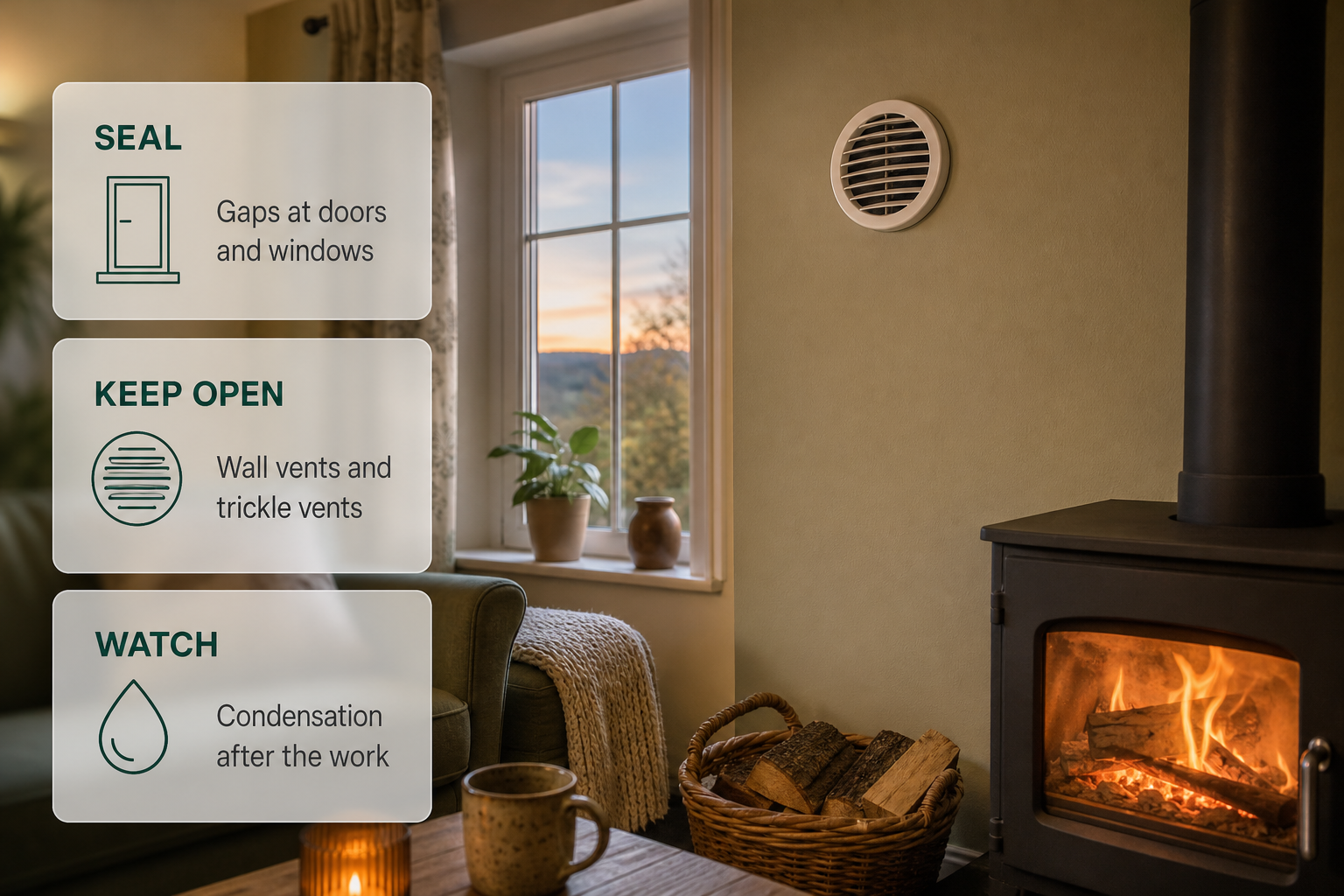
Do not block the ventilation the house needs
Draught proofing is about stopping air leaking through gaps that were never meant to be there. It is not about sealing the house completely. Wall vents, trickle vents in window frames, extractor fans and the air supply to any fire, stove or boiler are there on purpose. The HSE is direct about it: never block wall vents, because they are essential for good air quality in the home, and check that air vents are not blocked as part of carbon monoxide safety.
A few rules keep draught proofing safe:
- Leave all wall vents, trickle vents and fixed vents open.
- Do not seal rooms that have an open-flued gas appliance, a stove or an open fire without advice from the installer.
- Keep extractor fans in kitchens and bathrooms working, and use them.
- Remove a chimney balloon before ever lighting a fire.
- Watch for condensation after the work. Streaming windows or new mould mean the house needs more ventilation, not less.