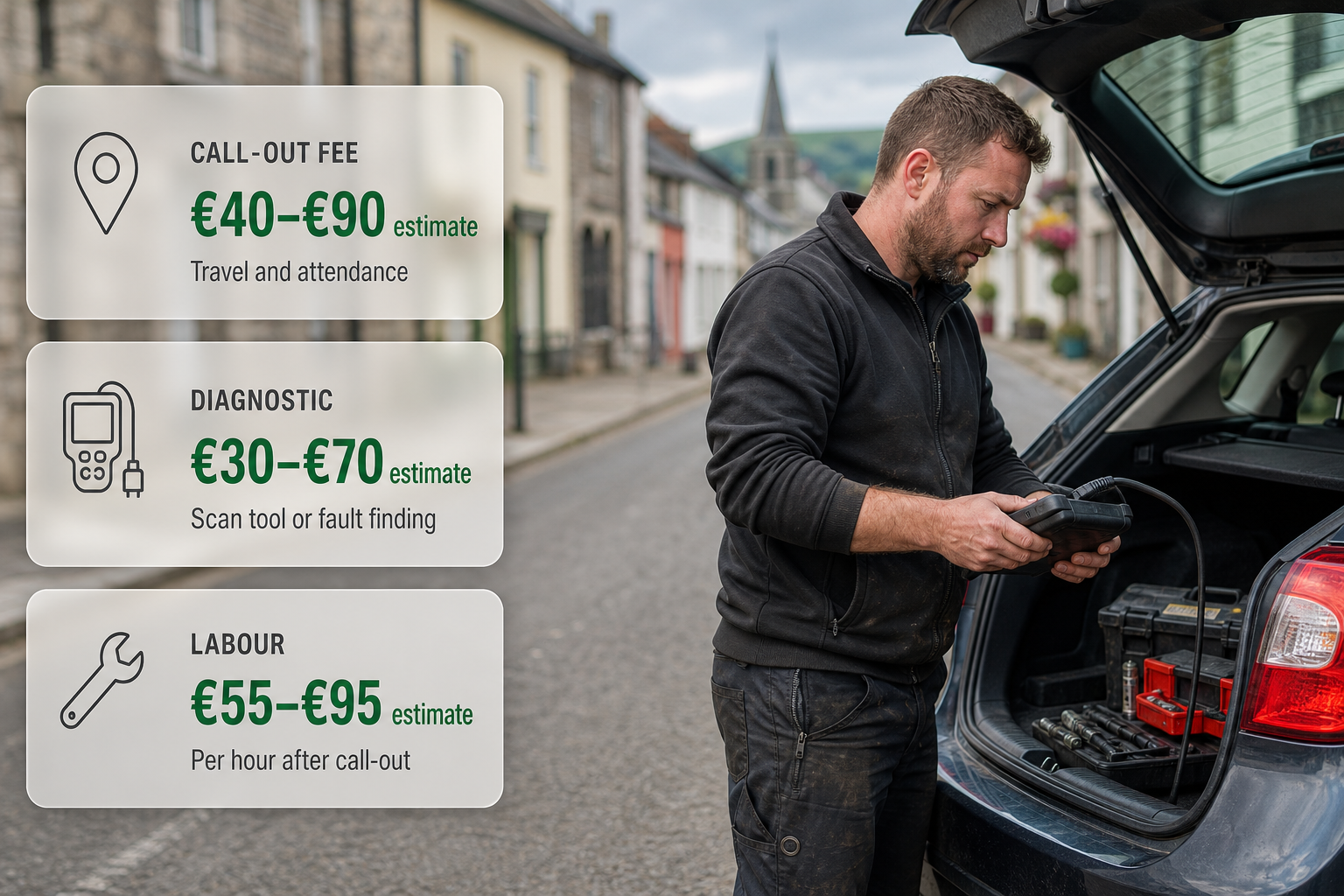
A mobile mechanic call-out fee in Ireland is an attendance charge rather than a repair price. An aggregate Irish market estimate puts it at €40 to €90 for travel and time on site during standard weekday hours, with diagnosis, labour and parts quoted separately on top. A fee in that band is fair when the amount, and what it does and does not include, is confirmed in writing before the mechanic sets out — the point at which a mobile mechanic call-out service should be able to give a straight answer.
What a call-out fee actually covers
A call-out fee is an attendance charge, not a repair price. It normally covers the trip from the mechanic's base to wherever the vehicle is parked or stopped, the return journey if the car cannot be repaired on site, the time spent on site before chargeable repair work begins, and a first look at the problem — a start-up attempt, a visual check or a short conversation about the symptoms. Some operators describe it as a minimum charge, meaning the first part of the work is absorbed into it rather than added on top.
What it rarely covers is fault finding that needs a scan tool, a road test or components removed; the labour needed to finish the repair; new parts; and the disposal of used oil, filters or coolant. Each of those belongs on its own line of a quote, and a call-out fee presented as the total price of a repair is a warning sign rather than a bargain.
Whether the attendance charge is reduced, or credited against the final bill, when the repair goes ahead is a commercial decision rather than a rule. Some operators credit it when the customer approves the repair on the same visit; others charge it regardless of what follows. The answer is worth requesting in writing before anyone sets out, because it changes what a fair total looks like.
What a fair call-out fee looks like in Ireland
No public tariff sets mobile mechanic charges in Ireland. The ranges below are an aggregate Irish market estimate for driver-facing call-out work, based on typical quoted figures rather than a published price list.
| Charge | Typical range |
|---|---|
| Call-out fee — travel and attendance, local area, standard weekday hours | €40–€90 |
| Diagnostic or assessment charge — scan tool, road test or fault finding | €30–€70 |
| Labour per hour after the call-out | €55–€95 |
| Parts, where the repair needs them | €20–€250 |
| Out-of-hours, weekend or emergency surcharge | €20–€60 |
| Disposal of used oil, filters or coolant | €10–€30 |
A local, weekday, non-urgent call-out normally sits at the lower end of the €40 to €90 band, while a long drive or a very-short-notice booking pushes it towards the top. Diagnosis is the charge most often confused with the call-out fee: a mechanic who connects a scan tool, reads live data or takes the vehicle on a short road test is doing work beyond attendance, and that work sits in the €30 to €70 range. Labour then runs at €55 to €95 an hour, with parts from €20 to €250 depending on the component and how quickly it can be sourced.
A worked example keeps the arithmetic honest. A car that will not start, parked 25 km away and booked for a weekday morning, might come in at a €50 call-out, a €45 diagnostic charge, one hour of labour at €70 and a replacement part at €60, giving a bill of €225 with no disposal charge because no fluids were changed. Every figure falls inside the ranges above — the test any quote should pass.
If the car will not start at all on a cold morning, what usually causes it and what you can check first is worth reading before you call. For when a mobile mechanic is the right choice over a garage, see mobile mechanics in Ireland: when to call and what to expect.
What changes a call-out fee
The figures in this section come from the same aggregate Irish market estimate.
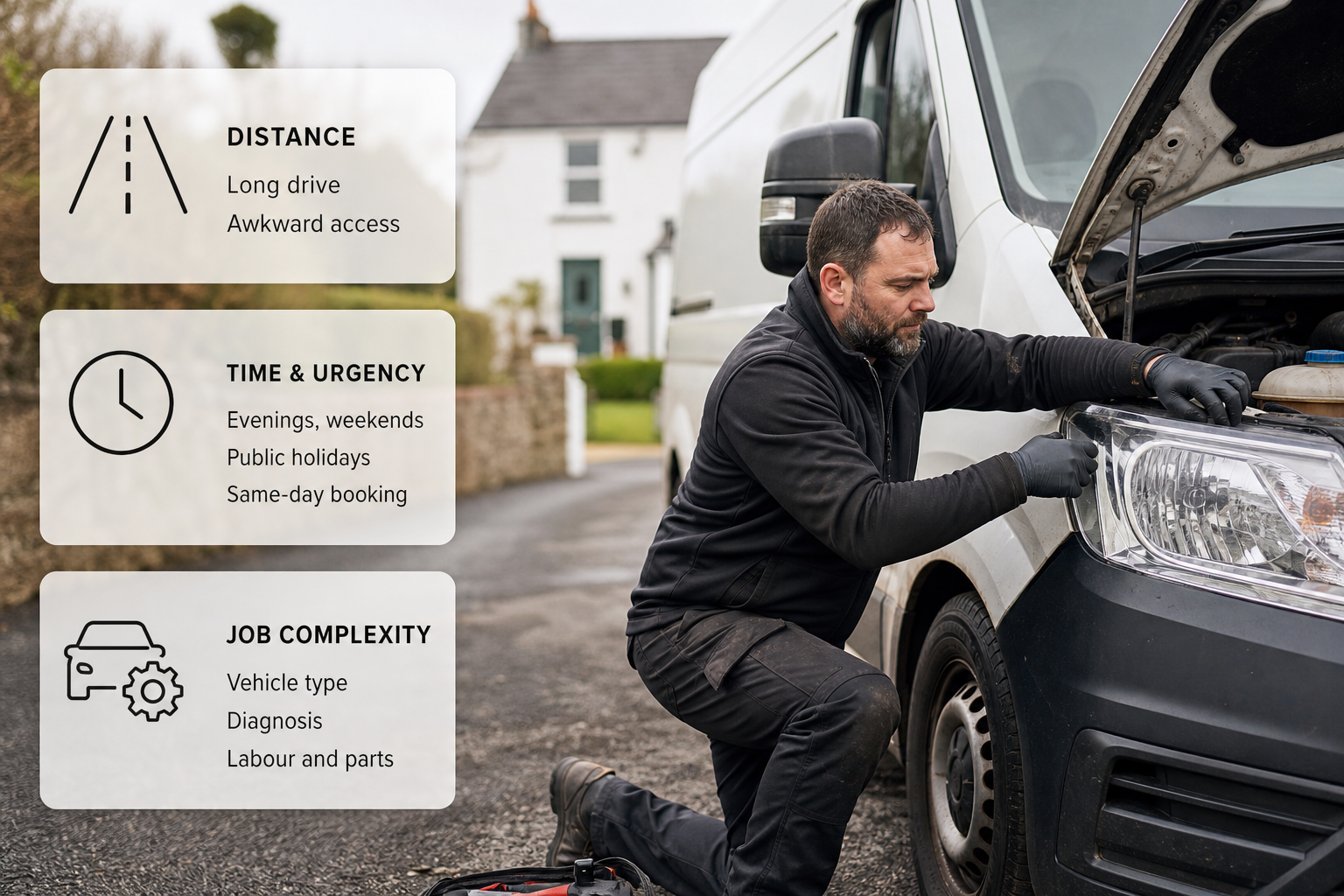
Distance. Most mobile mechanics work within a local radius and quote separately beyond it. A long drive, or an address with awkward access, pushes attendance towards the top of the €40 to €90 band, and the travel element is normally confirmed before the mechanic sets out rather than added afterwards. Mobile mechanics sit alongside the wider group of automotive services that travel to the customer, from battery work to tyre replacement.
Time of day. Evenings, weekends and public holidays are dearer than a standard weekday slot, and the surcharge sits in the €20 to €60 range shown above.
Urgency. A same-day booking, or a vehicle blocking a driveway, a workplace or a public road, is treated as priority work and priced as such.
Vehicle type. Light commercial vans, campervans, electric vehicles and older cars with awkwardly placed components take longer to assess and repair, so the labour element of the quote reflects that rather than the call-out fee itself.
Diagnosis. An intermittent fault, an electrical problem or a warning light with no obvious cause can take an hour or more to pin down, which moves the diagnostic charge towards the top of its €30 to €70 range.
Labour and parts. Labour is charged by the hour at €55 to €95, with parts on top at €20 to €250. Availability matters as much as price: a common component is quick to source, while a part that only comes through a main dealer can delay the job and lift the bill.
Quotes, estimates and consumer rights
A quote is a fixed price for described work; an estimate is a best guess that can move. CCPC guidance for car servicing and repairs states that consumers should get a detailed written quote before work begins and that the total cost must be provided before they agree to it. Where a total cost cannot be given in advance, the trader must explain how the price will be calculated, and where no price has been agreed, the trader must charge a reasonable price. In practice that means asking which of the two you are being given, requesting the call-out, diagnostic, labour, parts and disposal figures as separate lines, and making it clear that you want to be contacted before any additional work is carried out.