Car Won't Start in Cold Weather? What to Check First
Most cold-morning no-starts are down to a weak battery. Check the crank and terminals, then diesel glow plugs, and know when to stop and call for help.
/9 min read
A car that will not start on a cold morning is most often beaten by its own battery, but thick cold oil, worn glow plugs on a diesel, and a tired starter or alternator all produce the same silence. The checks below run in priority order: what to listen for, what to look at under the bonnet, how to tell a battery fault from a starter fault, and the point at which turning the key again does more harm than good. If the car still will not fire, mobile mechanic services from a local trade, or a breakdown service, are the next step.
Why a cold morning defeats a car
A lead-acid battery works by chemical reaction, and cold slows that reaction down. A battery that turned the engine over without complaint in summer may be short of usable current on the first frosty morning, so a battery that has been quietly weakening for months often picks the coldest night of the year to give up.
Engine oil thickens as the temperature falls, so the starter motor has to turn a stiffer engine at exactly the moment the battery can supply least. Cold weather does not create faults so much as expose them.
A worn starter motor or a weak alternator behaves the same way. A tired starter draws more current as the engine becomes harder to turn, and an alternator that undercharges leaves the battery short before the cold snap even arrives.
Diesel cars add a complication of their own. There is no spark plug: the engine relies on compression heat to ignite the fuel, and a glow plug pre-heats the combustion chamber for a cold start. Worn glow plugs, or a tired relay, make the first start of the day long and lumpy, though the engine usually settles once warm. In a hard frost, diesel can also start to wax in the filter, and a filter carrying dirt or water will pass cold fuel poorly.
Petrol engines are not immune to fuel trouble. A petrol engine needs fuel, air and a spark, and an engine cranked over and over can flood: the plugs get wet, the mixture becomes too rich, and every extra attempt takes the car further from starting.
What to check first, in priority order
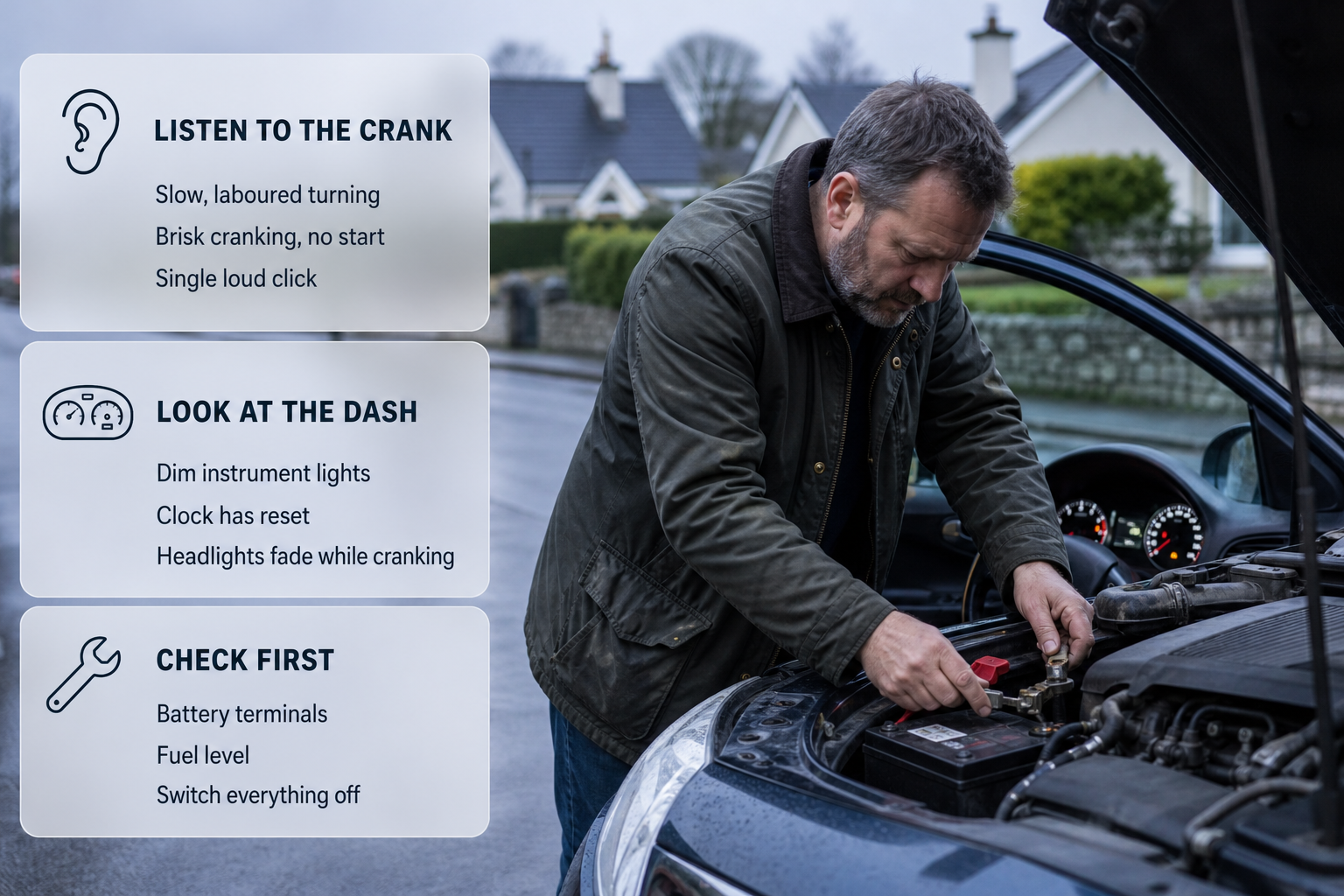
Listen to the crank. Slow, laboured turning that gets slower with each attempt points to the battery. Brisk cranking with no start points away from the battery and towards fuel, spark or glow plugs. A single loud click, or nothing at all, suggests a very flat battery, a sticking starter solenoid or an immobiliser problem.
Look at the dash and the lights. Dim instrument lights, a clock that has reset, a radio that has lost its stations, or headlights that fade while cranking all point to low voltage.
Check the battery terminals. Loose clamps and white or greenish powder on the posts are common. Cleaning and tightening them with the ignition off is safe and can be the whole cure on an older car.
Think about what was left on. An interior light, a boot light that never went out, a dash camera, the alarm or a charger left in the socket can drain a battery overnight.
Check the fuel level. A tank kept very low invites condensation, and a car parked on a slope with little fuel may not pick up. Confirm the right fuel went in at the last fill.
Switch everything off. Headlights, blower, radio, heated screens and chargers all compete with the starter for current, so turn them off before the next attempt.
Try in short bursts, then stop. Crank briefly rather than grinding away, and pause between attempts so the battery recovers and the starter cools. If each attempt is weaker than the last, the battery is telling the driver to stop.
How to tell battery failure from starter failure
Battery: the crank slows with every attempt, the dash lights dim while cranking, jump leads get the car going, and relays click. The car usually started fine the day before, often after a run of short trips.
Starter: the lights stay bright, one click is followed by nothing, and even with jump leads fitted and the donor engine running the engine will not turn over. On an older car a tap on the starter body sometimes frees a sticking solenoid, but on a modern car with undertrays that is rarely practical.
Charging fault: the car starts on jump leads and runs, but will not restart the next morning without help. Other clues are a battery warning light while driving, lights that brighten and dim with revs, a slipping belt, and a pattern of very short journeys that never recharge the battery fully.
What diesel drivers should check first
The glow plug light. Wait for it to go out before cranking. If it never appears, or cold starting is rough and smoky but fine once warm, the glow plugs or their relay are the likely culprits.
The fuel filter. A diesel filter part-blocked with dirt, or carrying water, passes cold fuel poorly. Many have a drain, and a garage can check for contamination.
Current demand. A diesel needs more current to turn than a petrol of the same size, so a battery that is merely tired will let a petrol car start and leave a diesel stranded.
Priming after a dry tank. A diesel that has run out usually needs priming with the hand primer or primer bulb before it will fire. Cranking an empty system simply flattens the battery.
Why repeated attempts make things worse
Every crank pulls a heavy current from the battery, and a battery that is already low drops further with each go, so the fifth attempt is always weaker than the first.
On a petrol engine, repeated attempts wet the spark plugs and wash oil from the cylinder walls. On a diesel, unburnt fuel finds its way into the exhaust, where it can damage emissions components over time, and some can reach the engine oil. The starter motor and solenoid also heat up, and the cables get hot.
The practical rule is short bursts, a pause in between, and then a decision: jump start, leave it until it is milder, or call for help.
Jump-starting safely
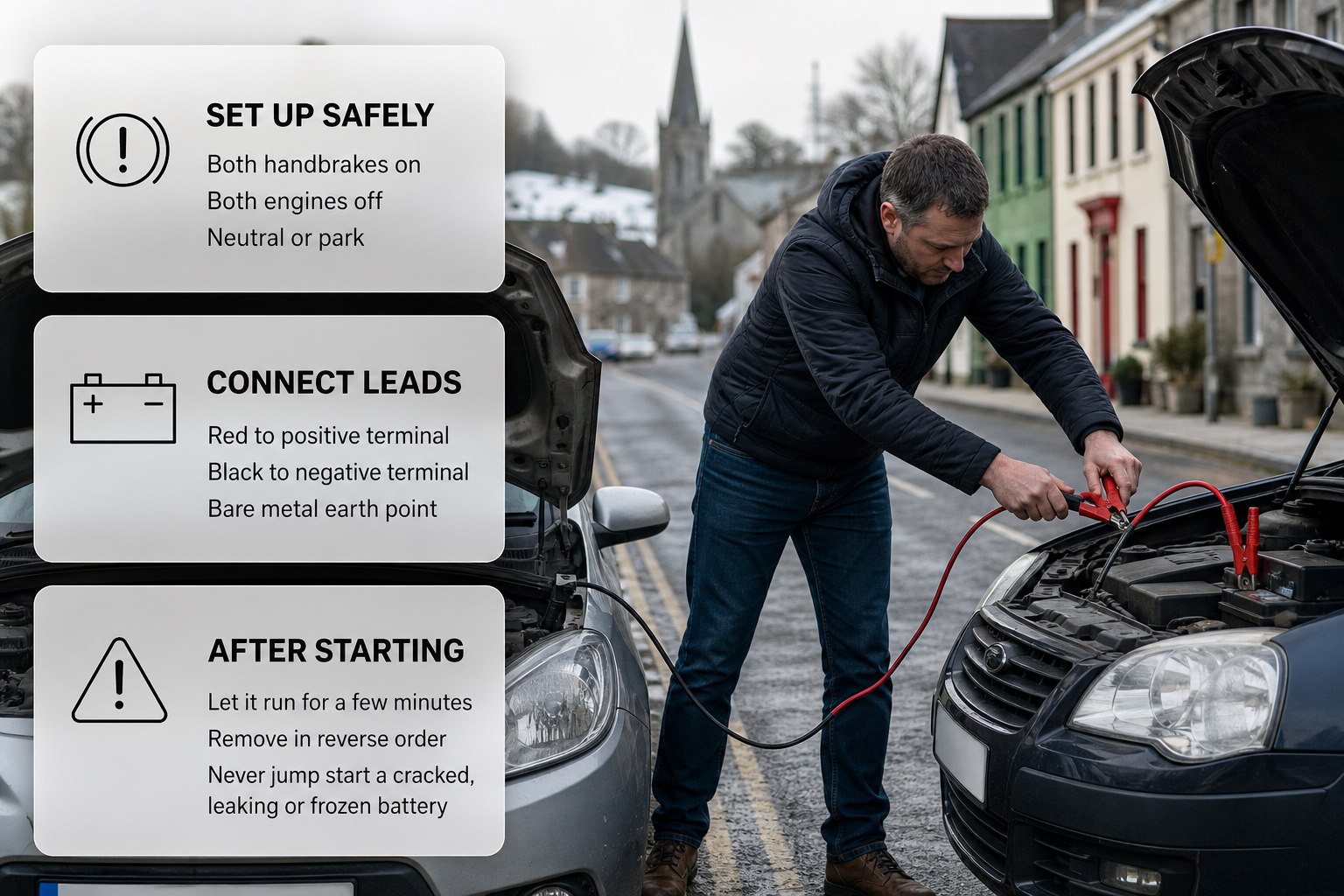
Park the two cars so the leads reach comfortably, with both handbrakes on, both engines off, and both gearboxes in neutral or park.
Connect the red lead to the positive terminal of the flat battery, then the other end to the positive terminal of the good battery.
Connect the black lead to the negative terminal of the good battery, then the other end to a bare metal earth point on the car with the flat battery, well away from the battery, fuel lines and moving parts.
Start the donor engine, let it run for a few minutes, then try the car with the flat battery.
Remove the leads in reverse order. Keep them clear of belts and fans, never lean over a battery while connecting, and wear eye protection and gloves.
Never jump start a battery that is cracked, leaking or frozen, because a frozen battery can burst. Hybrid and electric cars follow the handbook: they normally have a specific jump start point for the small auxiliary battery, and the high-voltage system is not something a driver should touch. If the handbook is not to hand, call for assistance instead.
Short winter trips and a battery that never catches up
A winter journey of a few minutes does not replace the charge the starter used. Lights, heater, demister, wipers and heated seats draw current while the alternator is still catching up, so a week of short hops can leave the battery lower on Friday than it was on Monday.
Two habits fix most of it: give the car one longer run each week, long enough for the engine to reach full working temperature, and keep the terminals clean, the clamp bolts tight and a smear of petroleum jelly on the posts. A maintenance charger helps a car that sits for days. Where the problem has gone beyond a jump start, automotive services from a local garage or mobile trade cover battery testing, charging faults and glow plug work.
Preventing repeat no-starts across several cold mornings
The morning after the first hard frost is usually fine. It is the third or fourth that catches people out, because the battery has started a cold engine again and again without ever being fully recharged.
Met Éireann's winter guidance advises getting the vehicle serviced before winter sets in and watching for signs of leakages on the ground under the car.
Alongside a service, these habits cut the odds of a repeat:
Have the battery tested before winter if it is a few years old, and replace it before it strands the car.
Keep the tank respectably filled to limit condensation.
Deal with glow plug faults in autumn rather than on the first freezing morning.
Check the oil is at the right level and the grade the handbook specifies, because the wrong grade is harder to turn when cold.
Switch off heaters, lights and heated screens before switching off the ignition at night.
Use a maintenance charger on a car that sits for days, and park in a garage or sheltered spot where possible.
Keep jump leads, a torch and a scraper in the boot.
If the car still will not start
When the crank is getting weaker, when there is a burning smell, when a warning light comes on, when the battery looks damaged, or when the car has stood for weeks, stop trying and arrange help. Breakdown assistance recovers a car from the roadside; a mobile mechanic can test the battery, charging system and glow plugs at home and replace what is needed. Posting a job and listing on ShamFix is free and there is no commission, with a subscription planned for the future. ShamFix does not check or certify tradespeople, profiles are filled in by tradespeople themselves, so homeowners should check registrations themselves and read reviews before work starts. ShamFix is one route to local help, and whichever route is taken, it is worth asking what will be tested and whether the old parts are returned.
FAQ
Why does the car start perfectly in summer but not on a frosty morning?
Batteries lose usable capacity in the cold while the engine becomes harder to turn, so a battery that was only just coping in mild weather runs out of margin. Nothing new has been added to the car; the cold simply removes the slack.
Should the accelerator be pumped while cranking?
On a modern fuel-injected petrol or diesel, no. Pumping can flood a petrol engine and confuse the electronics on a diesel, and it does not help a cold start.
How far should the car be driven after a jump start?
Further than a lap around the block. A proper run lets the alternator replace what the start used, and switching off soon afterwards often means another no-start later the same day.
Can a hybrid or electric car be jump started with leads?
Only through the jump start point for the small auxiliary battery, and only by following the handbook, because the high-voltage system must not be touched. Some models will not accept a traditional jump start at all.
When is a mobile mechanic a better call than breakdown assistance?
If the car is on a driveway or in a car park and the likely fault is the battery, charging system or glow plugs, a mobile mechanic can test and often fix it on the spot. Breakdown assistance suits a car stranded on a road, or a fault that needs a workshop. More on what a mobile mechanic can and cannot do is in mobile mechanics in Ireland.