
ShamFix
Back to insights

How to stop window condensation: an Irish guide

Stop window condensation by cutting moisture, airing briefly and keeping steady heat — and learn how to tell it from leaks, failed glazing or rising damp.

9 min read
How to stop window condensation: an Irish guide

Window condensation is moisture from the air inside a home landing on glass that is colder than the air around it, and it stops when the moisture is reduced, the air is changed, and the rooms are kept gently warm instead of being left to go cold. The quickest low-cost actions are practical rather than technical — lids on pots, laundry dried outdoors or in a vented dryer, extractor fans that actually run, and short bursts of ventilation at the times you make most steam. Wiping the glass each morning protects sills and frames, but it only treats the symptom.

What actually causes condensation on Irish windows

Every case needs the same combination: moisture in the air, a surface cold enough to condense it, and air that is not moving.

Moisture comes from ordinary living — showers and baths, boiling pots, drying clothes indoors, and breathing. Together these add far more water vapour to a closed-up home than most people expect.

Cold surfaces are usually the glass, the frame, or the cold corner beside the window. Single glazing, older frames without a thermal break, north-facing rooms and windows with the curtains closed all day are the usual suspects.

Still air is what catches people out. A home with trickle vents taped over, an extractor fan that no longer pulls, and doors and windows shut tight will hold its moisture until it finds the coldest surface in the room — normally the window. The classic sign is a film of water on the room side of the glass first thing in the morning, heaviest in bedrooms, kitchens and bathrooms, clearing once the room is aired and warmed. If it clears with ventilation and heat, it is condensation rather than a building defect. If it does not clear, or it comes with staining, salt marks or a musty smell, work through the diagnosis below instead of spending money on windows.

Infographic showing quick practical steps to reduce window condensation in an Irish home.

Fast, low-cost actions that reduce condensation today

  1. Air the home in short bursts. Open windows on opposite sides for a few minutes, several times a day, and again straight after cooking or showering. A short burst replaces damp air without chilling the walls and furniture the way a window left open all day does.
  2. Put lids on pots and run the kitchen extractor while you cook and for a few minutes afterwards.
  3. Run the bathroom fan through the shower and afterwards, with the bathroom door closed so steam does not drift through the house.
  4. Dry laundry outdoors, in a vented dryer, or in one room with the window open and the door shut. Washing dried on radiators in a closed room is one of the biggest single sources of window condensation in Irish homes.
  5. Keep trickle vents open all year. They are designed to trickle, not to blast, and taping them over in winter traps the moisture you are trying to remove.
  6. Wipe the glass each morning with a cloth, wring it out into the sink, and never leave the wet cloth sitting on the sill.
  7. Give the window room to breathe. Leave a gap between curtains and glass, keep curtains off radiators, and pull furniture slightly away from external walls.

If water is also getting in around the frame, or the window no longer closes tightly, a local window and door repair service can reseal and readjust it.

Balancing ventilation and heating without wasting heat

Heating alone will not solve condensation: warm air holds more moisture, and if that moisture has nowhere to go it settles on the next cold surface. Ventilation alone in a cold house leaves surfaces cold enough for water to form anyway, so the two have to work together.

  • Keep heat steady rather than dramatic. A moderate, consistent temperature in the rooms you use works better than letting the house go cold and then blasting the heating, because warm glass and warm walls stay above the point at which moisture condenses. Lower and longer also costs less than short, hard bursts.
  • Set a ventilation rhythm. A short burst of cross-ventilation several times a day, trickle vents left open, and extractor fans in the kitchen and bathroom cover most homes. Leave internal doors open during the day so air can move, but close the bathroom door while showering.
  • Watch the air, not just the glass. An inexpensive hygrometer left on a shelf shows how damp the air in a room is running, and the trend matters more than a single reading. Aim for roughly 40 to 60 per cent relative humidity in living rooms and bedrooms. If it climbs through the week, the answer is more airing and fewer moisture sources — not more heat, which gives the air a greater capacity to carry water.
  • Do not block radiators with sofas, drying racks or long curtains. Heat that goes into the back of a sofa does not warm the room, and the wall behind it stays cold.
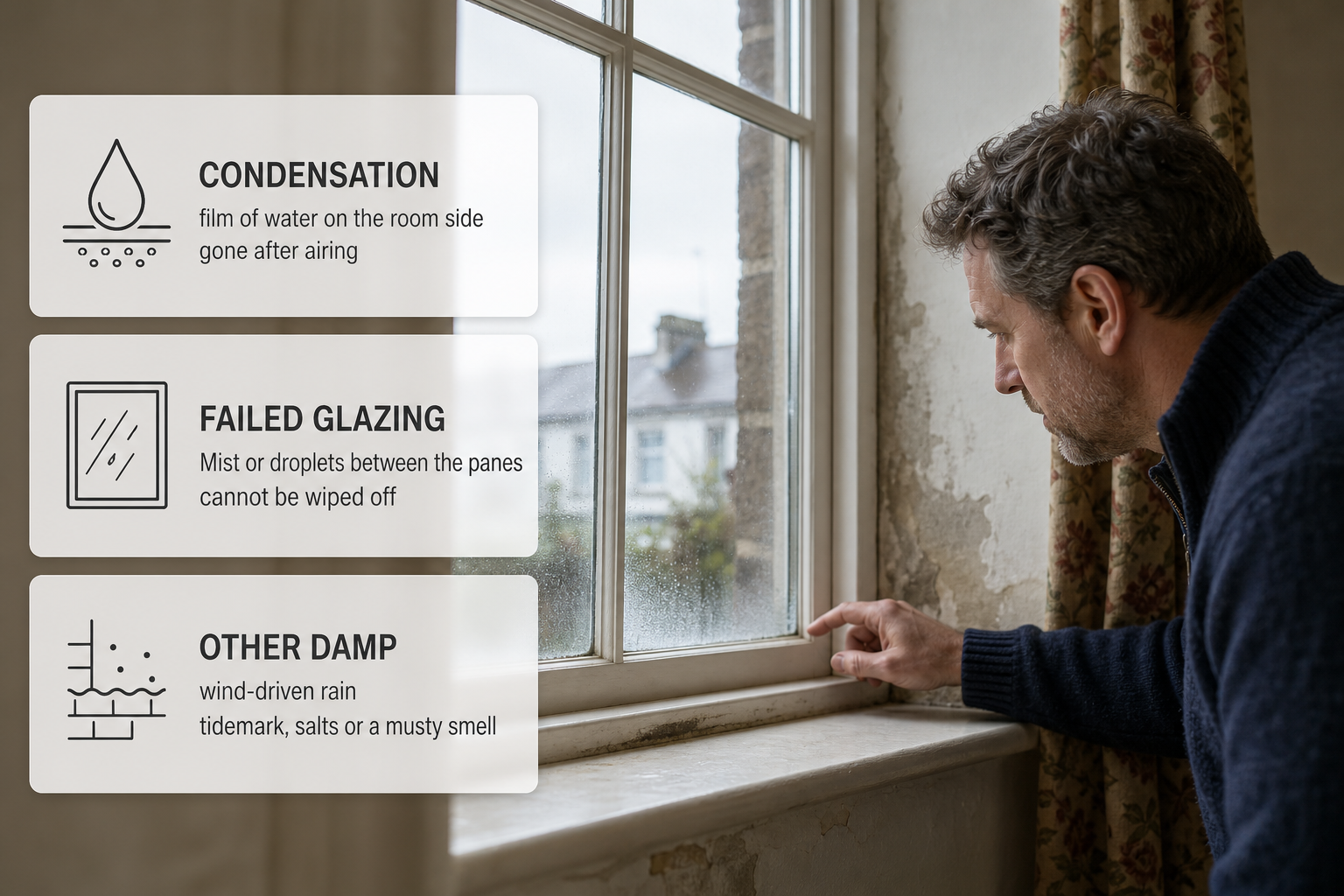
Infographic comparing condensation with leaks, failed glazing and rising damp around windows in an Irish home.

Telling condensation from a leak, failed glazing, damp or rising damp

Getting the diagnosis right saves money and stops you replacing a window that only needed a seal.

What you see Most likely cause What to check
A film of water on the room side of the glass, worst on cold mornings, gone after airing Ordinary condensation Moisture sources, ventilation, steady heat
Mist or droplets between the panes that cannot be wiped off Failed sealed unit in the glazing The seal has gone and the unit itself needs replacing
Water on the inner sill during wind-driven rain, staining on the reveal beside the frame Penetrating damp from a failed seal or blocked drainage Frame sealant, drainage slots, cracked render, gutters and downpipes above
A damp patch starting low on a ground-floor wall and creeping upward, often with a tidemark, salts or a musty smell Rising damp Needs diagnosis on site by a damp specialist
Damp spreading from a bathroom, under a bath, or below a roof valley Plumbing or roof leak Trace and stop the source first

Mould on reveals, sills and curtains in those same cold spots is usually condensation that has been running for weeks. Clean it with a damp cloth and a mild detergent solution, dry the surface afterwards, and put the effort into the moisture and ventilation problem — painting over it without fixing the cause only hides it. Heavier mould on a ceiling is covered in how to remove mould from a bathroom ceiling.


Insulation, cold bridges and the window itself

The glass is often the coldest surface, but it is not always the culprit. Where insulation is missing or broken — around window reveals, under sills, at lintels, or where an extension meets an older wall — that patch of wall becomes a thermal bridge and condensation forms there instead, sometimes as a dark stain or a line of mould at the corner of the frame. Attic and wall insulation raise the temperature of those surfaces and move the problem.

  • Draught-proofing helps, but not if it seals the home completely. Brush seals and draught strips on windows and doors cut heat loss; keep ventilation paths such as trickle vents and extractor fans working.
  • Secondary glazing can suit period single-glazed windows where replacement is not appropriate, warming the inner surface and cutting both condensation and draughts.
  • Watch what internal wall insulation does to the cold points in a room. Moving insulation inside can push the cold bridge elsewhere, so take advice before committing.
  • Fix the small jobs that soak a wall: a leaking gutter, a cracked sill, a failed sealant line. Small home services tasks like these are often the difference between a dry window and one that keeps coming back.

When older or damaged windows need repair or replacement

Repair is usually the first and cheapest option. A failed sealed unit can often be replaced within the existing frame rather than replacing the whole window; worn gaskets, draught seals, hinges and handles can be renewed so the window closes and seals properly again; and sealant lines can be cut out and replaced and timber sills sanded, treated and repainted before rot takes hold.

Replacement starts to make sense where there is widespread timber rot, single glazing throughout, frames that no longer close or seal, or several failed units at once, and where comfort, noise or energy bills matter too. One caution: replacing windows without sorting out ventilation and moisture at the same time does not remove the condensation — it often moves it to the next coldest surface, typically a wall or a corner.

Condensation in rented homes

In the private rented sector, the first step is to put the problem in writing to the landlord or letting agent, describing what you see, when it appears and how long it has gone on, with photographs, and to keep a copy. Where a broken or poorly fitting window is not repaired, or the home cannot be ventilated properly and nothing changes, the Residential Tenancies Board handles disputes between tenants and landlords about repairs and standards, so confirm the current process and the options available with the Board, as the position can change.

FAQ

Why does one window run with water while others stay dry?

The moisture in the air is spread evenly through the house; it condenses only where a surface is cold enough. A single-glazed landing window, a frame without a thermal break, glass with a curtain closed against it, or a corner where insulation is thin will run with water while a warmer window in the same home stays dry. Warming the coldest spot on its own tends to move the problem along rather than solve it, which is why ventilation and steady heat matter more than any single window.

Will a dehumidifier stop window condensation?

An electric dehumidifier in a closed room can take a useful amount of water out of the air and is a reasonable short-term measure in a bedroom or a drying area. Empty and clean the tank regularly, and remember that it treats the symptom: if a room is not ventilated and the window is not repaired, the condensation returns once the machine is switched off. Chemical or salt-based units are only worth using in very small enclosed spaces such as wardrobes.

Can condensation damage the window frame itself?

Yes. Water sitting on timber sills and frames softens paint, stains the timber and can lead to rot, and it also encourages mould on the plaster reveals and skirtings around the window. Wiping the glass and sills each morning costs nothing and is the simplest way to prevent that damage.

The mist is inside the glass of my double glazing — is that condensation?

No. Water or mist trapped between the panes means the sealed unit has failed and the desiccant inside can no longer absorb moisture, so it cannot be wiped away or ventilated out. Once a glazing specialist confirms the unit has failed, the usual repair is to replace that unit within the existing frame rather than the whole window. Prices: window repair cost.

Does replacing windows on their own stop condensation?

Rarely on its own. New glazing warms the inner surface, which helps, but if cooking, showering and laundry keep loading the air with moisture and nothing is ventilated, the water simply shows up somewhere colder — a wall, a corner or a ceiling. Get moisture and ventilation under control first, then let the window upgrade do the rest.

Getting the problem fixed for good

Once ventilation, heat and moisture sources are under control, most window condensation stops and stays away. Where a window still needs attention — a failed unit, a frame that will not seal, timber starting to rot — a homeowner can describe the job on ShamFix and local tradespeople can respond with their own information. Posting a job and listing it on ShamFix is free and there is no commission, and a subscription is planned for the future. ShamFix does not check or certify tradespeople and profiles are filled in by tradespeople themselves, so check any registration that applies to the work and read reviews before hiring.

Keep reading

Do New Windows Reduce Noise? An Irish Guide

Do New Windows Reduce Noise? An Irish Guide

Yes — new windows usually cut outside noise noticeably. Here's what actually decides how much quieter your home becomes, and which specs matter most.

9 min read