Yes — new windows usually cut outside noise noticeably. Here's what actually decides how much quieter your home becomes, and which specs matter most.
/9 min read
Yes, new windows usually make an Irish home noticeably quieter, most obviously where old single glazing or failed double glazing is replaced by a well-made unit that is fitted carefully. How much quieter depends on the glass build-up, the seals, the vents and the quality of the fitting, not on whether the unit is labelled double or triple. The replacement itself is carried out by local window and door installation tradespeople, and the specification the homeowner agrees with them is what decides the result.
How much quieter a new window typically is
Typical figures help before any conversation with a supplier. Taken across the whole window rather than the glass alone, they look like this:
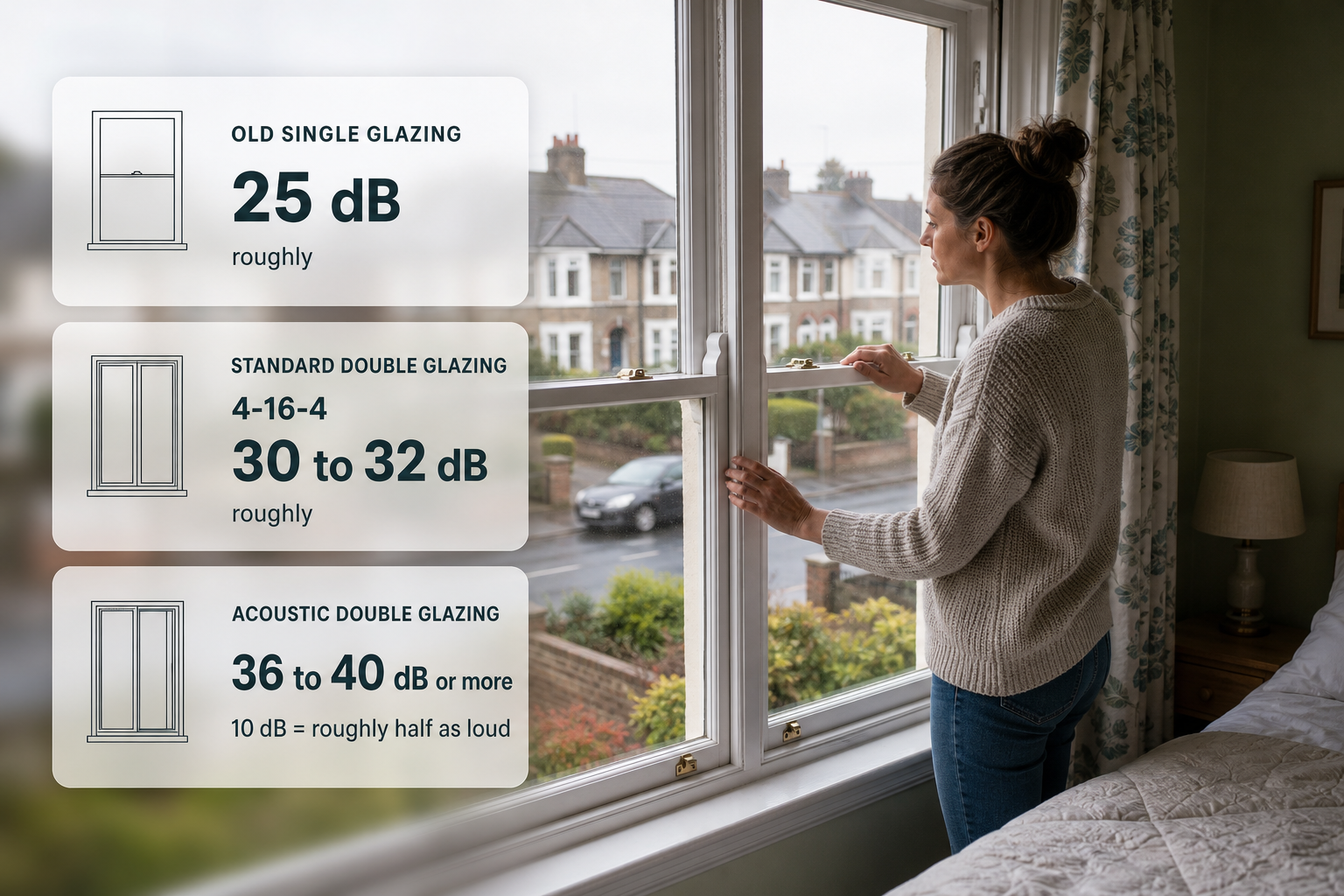
old single glazing: roughly 25 dB
standard double glazing built as 4 mm glass, a 16 mm cavity and 4 mm glass (written 4-16-4): roughly 30 to 32 dB
acoustic double glazing with laminated glass and panes of different thickness, for example 6.8 mm laminated paired with 4 mm: roughly 36 to 40 dB or more
A reduction of about 10 dB is heard as roughly half as loud. That is why the move from single glazing to a decent double unit is usually the most dramatic change a household notices, while the further step from standard double to a laminated acoustic double adds a similar amount again and is often the difference between hearing a road and being woken by it.
The rating behind those numbers is Rw, a single figure for how much sound a window holds back across a range of frequencies, so a higher number means more noise kept outside. Rw+Ctr reweights the same measurement for low-frequency noise, which is why it usually comes out a few decibels lower and why it is the more honest figure for traffic rumble, engine noise and distant motorway hum. Homeowners should ask for the Rw or Rw+Ctr of the complete window, frame included, rather than a figure quoted for the glass alone.
Comparing the realistic options
No one option suits every house, and the limits matter as much as the gains.
Option
Typical noise reduction
Best for
Limits
Keep the existing windows and renew seals, gaskets and hinges
No change to the glass; roughly 1 to 3 dB from closing gaps
Sound windows that are simply draughty
Glass and frame weaknesses remain
Secondary glazing added inside the existing window
Roughly 5 to 12 dB on top of what the existing window already gives
Flats, rentals and protected structures where the original windows must stay
Needs a clear reveal, and access for cleaning and opening
Standard double glazing, 4-16-4
Roughly 30 to 32 dB
General replacement where noise is moderate
Weak on low-frequency rumble
Acoustic double with laminated, asymmetric glass, such as 6.8 mm laminated with 4 mm
Roughly 36 to 40 dB or more
Bedrooms and living rooms facing a busy road
Heavier units and deeper frames than a standard double
Standard triple with equal 4 mm panes
Roughly 32 to 36 dB
Cold, exposed sites where heat retention matters most
Equal thin panes resonate together, so the gain over a good acoustic double can be small
Acoustic triple, laminated and asymmetric panes with wider cavities
Mid-40s dB and above
Roads carrying heavy goods vehicles, buses or constant traffic
The heaviest and deepest units available; frame and hinges must be up to it
Why standard triple is often no quieter than good acoustic double
Three panes of equal thickness, say 4-12-4-12-4, tend to vibrate at similar frequencies and reinforce each other's movement. At those frequencies the extra pane adds little to the sound reduction, so a standard triple can measure barely better than a well-made acoustic double at traffic noise. Splitting the thicknesses and adding a laminated pane with a plastic interlayer damps that vibration and spreads the weak points across the frequency range. A window described as triple is simply a window with three panes; it is not automatically a quieter window.
The weak points that undo good glass
Excellent glass loses much of its advantage through openings in the assembly. An open trickle vent is a deliberate hole in the window. Hardened or worn gaskets and draught strips let air, and sound with it, pass around the sash. Gaps between the frame and the wall, missing sealant or poorly fitted foam, and reveals left unsealed back to the plaster all carry noise indoors. Letterboxes, wall vents, old extractor ducts and unused cable holes are just as damaging. Fitting quality is not a detail; a well-specified unit installed with slack tolerances can underperform a cheaper unit installed tightly, level and properly sealed.
Acoustic trickle vents and ventilation
Modern windows are airtight, and airtight rooms need background ventilation to control condensation and damp. An ordinary trickle vent left open is one of the single biggest noise leaks in a bedroom. Acoustic trickle vents use baffled, lined channels that let air through while absorbing some of the sound, so they perform better than a standard vent but worse than a fully closed one. The practical approach is to fit acoustic vents in the noisy rooms, keep them at the minimum setting that keeps the room fresh, and open the window fully for short bursts to purge the air rather than leaving it ajar all night. A vent feeding an open fire or a fuel-burning appliance should not be blocked.
Bedrooms facing a road: what to prioritise
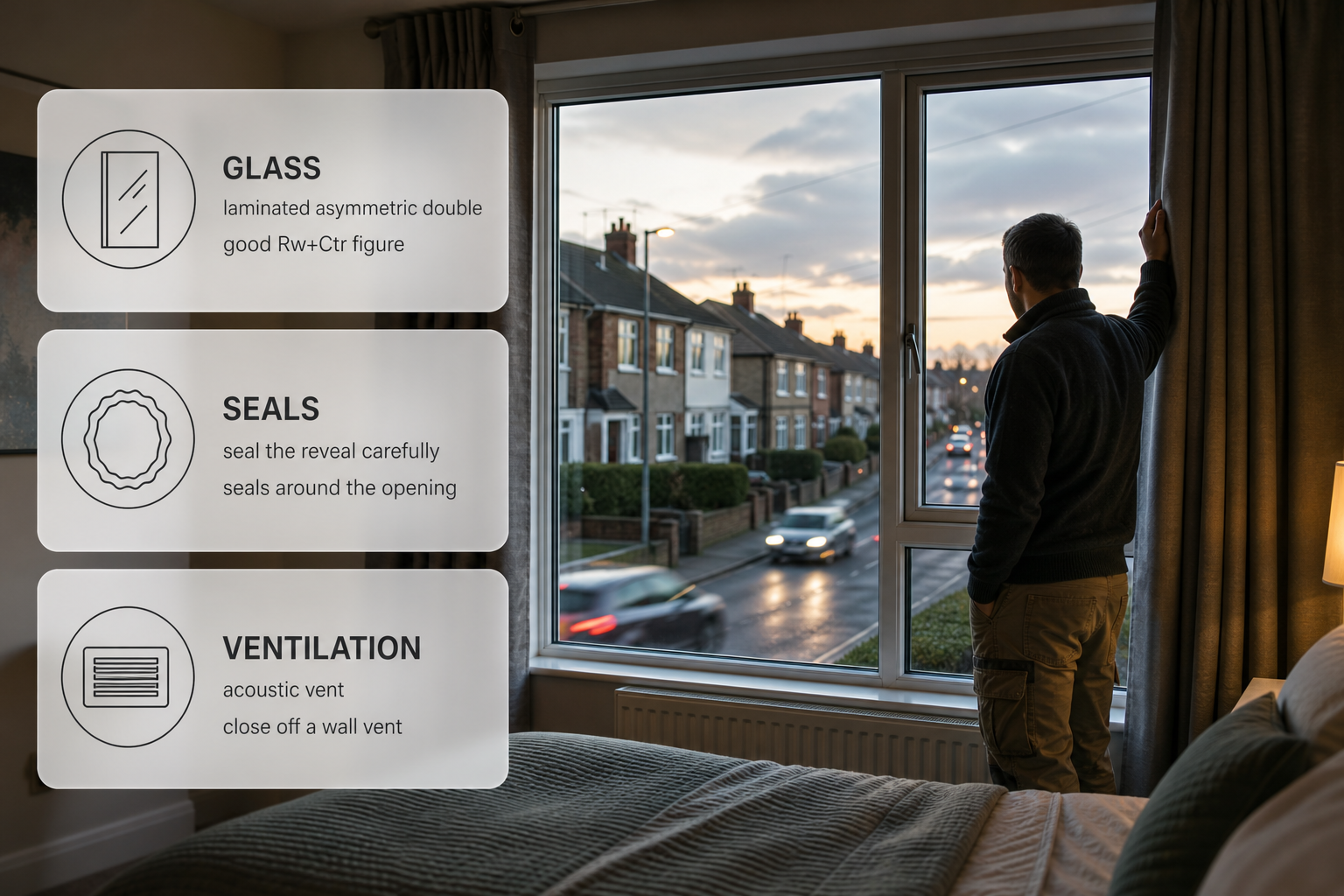
A bedroom is usually the room where noise costs the most sleep, so it is normally the first room to upgrade, ahead of a hallway or a spare room. As an example, a bedroom with single glazing above a busy road, one trickle vent and one old wall vent gives three targets at once: the glass, the seals around the opening, and the ventilation path. Choosing a laminated asymmetric double with a good Rw+Ctr figure, having the installers seal the reveal carefully, and fitting an acoustic vent in place of the standard one addresses all three. Closing off a wall vent that is no longer needed also helps, once it is confirmed that nothing in the room needs that air supply. Heavy curtains and soft furnishings absorb a little echo inside the room, but they do nothing for the sound still passing through the glass, so they are a finishing touch rather than a solution.
Secondary glazing: flats, rentals and protected structures
Where the original windows must stay, secondary glazing adds an independent pane inside the existing one, leaving an air gap that does real acoustic work. It suits apartments where the façade cannot be changed, rentals, where a removable inner pane is easier to agree with a landlord than new windows, and older buildings where the existing frames are part of the character of the house. Gains of roughly 5 to 12 dB on top of the existing window are realistic, depending on the depth of the gap and the thickness of the new pane. The system needs enough reveal depth to fit without blocking the opening, and enough access to clean and operate both sets of glass. For a protected structure, any change that affects its character is a matter for the local authority, which decides whether permission is needed, and the owner confirms the position with it before ordering anything.
What new windows cannot fix
Sound also travels through walls, roofs, floors and ceilings, and around a window rather than through it. Low-frequency rumble from lorries, buses and motorbikes passes through masonry almost as easily as through glass, which is why a room can still feel noisy after an excellent window has been fitted. Semi-detached and terraced houses can carry noise along shared walls. If a room remains loud after new windows and a properly sealed install, the next useful step is a survey by an acoustic consultant who can identify where the sound is actually entering. An open window, of course, lets in everything.
Balancing acoustic and thermal performance
Most homeowners are buying comfort on two fronts at once, and the two do not always pull in the same direction. Laminated glass and wider cavities help both sound and heat loss, so an acoustic unit is rarely a poor thermal choice. The tension comes with ventilation: a well-sealed, airtight window holds heat in but needs trickle vents to stay healthy, and vents let noise in. Weight is the other consideration, since laminated units are heavy and demand stronger hinges, deeper frames and careful fixing. The sensible approach is to choose the glazing for the noisy rooms by its Rw or Rw+Ctr, accept that rooms on quiet sides may need less, and treat each elevation on its own merits rather than ordering one specification for the whole house.
FAQ
Does double glazing stop traffic noise completely?
No window removes it completely, and the goal is usually to make a room comfortable for sleeping and for hearing a television at normal volume. The hardest sounds to block are the deep, low-frequency ones from buses, lorries and motorbikes, and those also travel through walls. That is why a laminated pane of a different thickness in the unit usually does more for a road-facing room than an extra pane of ordinary glass of the same thickness.
Can thicker glass be fitted into windows that are already in place?
Often it can, provided the rebate is deep enough and the hinges can carry the extra weight, which is why a supplier or joiner measures the frame before ordering anything. Upgrading the glass in sound existing frames is generally less disruptive than replacing the whole window. It only works when the frame itself is solid, square and airtight, since a twisted frame will leak regardless of the glass inside it.
Do acoustic trickle vents really make a difference?
They help, but only relative to a standard vent. A baffled acoustic vent lets fresh air in while absorbing part of the sound, so it performs better than a plain opening and worse than a closed window. Where a room needs continuous ventilation, fitting acoustic vents and leaving them at a low setting is a reasonable compromise; leaving a standard vent wide open largely cancels out the benefit of good glazing.
Is it worth replacing windows in one room only?
Very often yes, and starting with the room where noise disturbs sleep most is a practical way to spend the budget. Two points are worth planning for: windows on the same elevation usually look better if they match, and rooms with different window specifications will ventilate at slightly different rates. Where the disturbance is only in one bedroom, a single well-specified window can transform that room.
Choosing and getting the work done
Homeowners can approach the decision by writing down the rooms that are actually noisy, asking for the Rw or Rw+Ctr of the complete window in each quote, and insisting that vents, seals and reveals are part of the conversation rather than an afterthought. Prices for triple-glazed units are set out in the triple-glazed windows price list, fitting times in how long window installation takes, and window replacement done alongside other construction and home renovation work is best planned as part of that job. On ShamFix, posting a job and listing it is free and there is no commission, and a subscription is planned for the future. ShamFix does not check or certify tradespeople, and profiles are filled in by tradespeople themselves, so homeowners should check registrations themselves and read reviews before agreeing to any work.
Stop window condensation by cutting moisture, airing briefly and keeping steady heat — and learn how to tell it from leaks, failed glazing or rising damp.
9 min read
Next step
Find local help
Browse people offering this work in your county and post a job.