A genuine Irish price list doesn't exist, but a standard triple-glazed uPVC casement commonly falls around €750–€950 per window supplied and fitted, while a larger or more complex opening can reach €1,200–€1,800. A typical three-bedroom semi-detached home may land around €3,900–€5,000, depending entirely on the number and size of openings.
Those are aggregate Irish market estimates, not quotations. The published Irish range of roughly €450–€620 per square metre is only a starting point, because every real price is built from a measured survey, the frame, opening type, glass specification, access and finishing work. The practical next step is to find window installers and post the job, then ask each one for the same written specification.
Why There Is No Fixed Triple Glazed Windows Price List Ireland
A window isn't priced like a standard appliance. Two openings in the same house can require different glass, hardware, reinforcement and installation time, even when both are described casually as “triple glazed”. A phone price for “all the windows in a three-bedroom semi” is therefore a budget guess, not a genuine quotation.
The useful starting price bands
For a standard triple-glazed uPVC casement supplied and fitted, an aggregate Irish market estimate is €750–€950 per window. A larger opening, tilt-and-turn unit, bay window, French door or other complex arrangement may sit around €1,200–€1,800, depending on its dimensions, hardware and structural requirements.
Whole-house pricing has to be treated separately, and the only honest way to build it is from the per-window band above rather than from a headline "house price". Seven standard openings on a semi-detached home work out at roughly €5,300–€6,700 supplied and fitted, and twelve on a detached home at roughly €9,000–€11,400, before any larger or complex opening is added at its own rate. Those totals are aggregate Irish market estimates, not a supplier tariff, and a single bay window or patio door can move them by more than the county does.
| Project scope | Aggregate Irish market estimate | What changes the figure |
|---|---|---|
| Standard triple-glazed uPVC casement | €750–€950 per window supplied and fitted | Size, opening configuration, glass and hardware |
| Larger or complex opening | €1,200–€1,800 per opening | Span, weight, access, doors and reinforcement |
| Semi-detached home with seven windows | €5,300–€6,700 overall | Number of openings, frame material and making good |
| Detached home with 12 windows | €9,000–€11,400 overall | Larger elevations, access and specification |
The same Irish guidance gives a broad triple-glazing range of €450–€620 per square metre, but a square-metre rate can't capture every cost. Installation, removal, waste, internal reveals, external trims, sills and access can alter the final total substantially.
Regional and property effects
Regional variation exists, but the windows themselves don't become different because a project is in one county rather than another. Dublin and commuter counties tend to sit towards the upper end of a market band, while a remote address can attract delivery or travel costs that offset a lower local labour rate.
Access often matters more than county. Upper-floor scaffolding, restricted parking, narrow side access and difficult waste removal can change the bill more than modest differences in installation rates. A measured survey records these conditions before the installer commits to a fixed figure.
Practical rule: Treat any published “price list” as a budget guide. The real comparison starts when every opening is measured and specified in the same way.
What Drives the Price of New Windows in Ireland
Frame material is usually the largest price driver, often more influential than the number of panes. A basic uPVC frame with standard openings can cost considerably less than a hardwood or alu-clad installation, even when both use similar triple-glazed units.
Frame materials from lower to higher cost
The usual cost order is uPVC, aluminium, alu-clad timber and hardwood timber. Exact multipliers aren't reliable across every design, so the following should be read as relative market positioning, not a fixed tariff:
- uPVC is normally the lowest-cost option. It offers low maintenance and works well for many standard casement windows.
- Aluminium generally carries a premium, particularly for wide or tall openings. The premium buys slimmer sightlines, stronger sections and greater suitability for larger spans.
- Alu-clad timber costs more again. It combines a timber interior with an aluminium exterior, giving the room a warmer finish while reducing exposure of the timber to weather.
- Hardwood timber is typically at the upper end. The appeal is appearance, repairability and the feel of a substantial natural frame, but the specification and finish require closer attention.
Material and glazing interact, which is why a frame description alone isn't enough. On aggregate Irish market estimates, moving from A-rated double to triple glazing in the same uPVC frame adds roughly a fifth to a quarter to the unit price, while moving from white uPVC to a woodgrain or foiled finish adds a similar step again before the glazing is even considered. Supply-only figures quoted in the market sit well below the supplied-and-fitted band above, so the two should never be compared with each other.
Size, opening type and specification
A fixed light is usually simpler than an opener because it needs less hardware. Tilt-and-turn windows, sliding units, French doors, rooflights and large panes can require heavier fittings, stronger frames and more careful handling.
The glass specification also matters. A buyer should ask for the low-emissivity coating, cavity gas, cavity width and spacer-bar type. Argon is commonly specified, while krypton may be considered in narrower cavities. A warm-edge spacer reduces edge cold-bridging compared with a basic aluminium spacer.
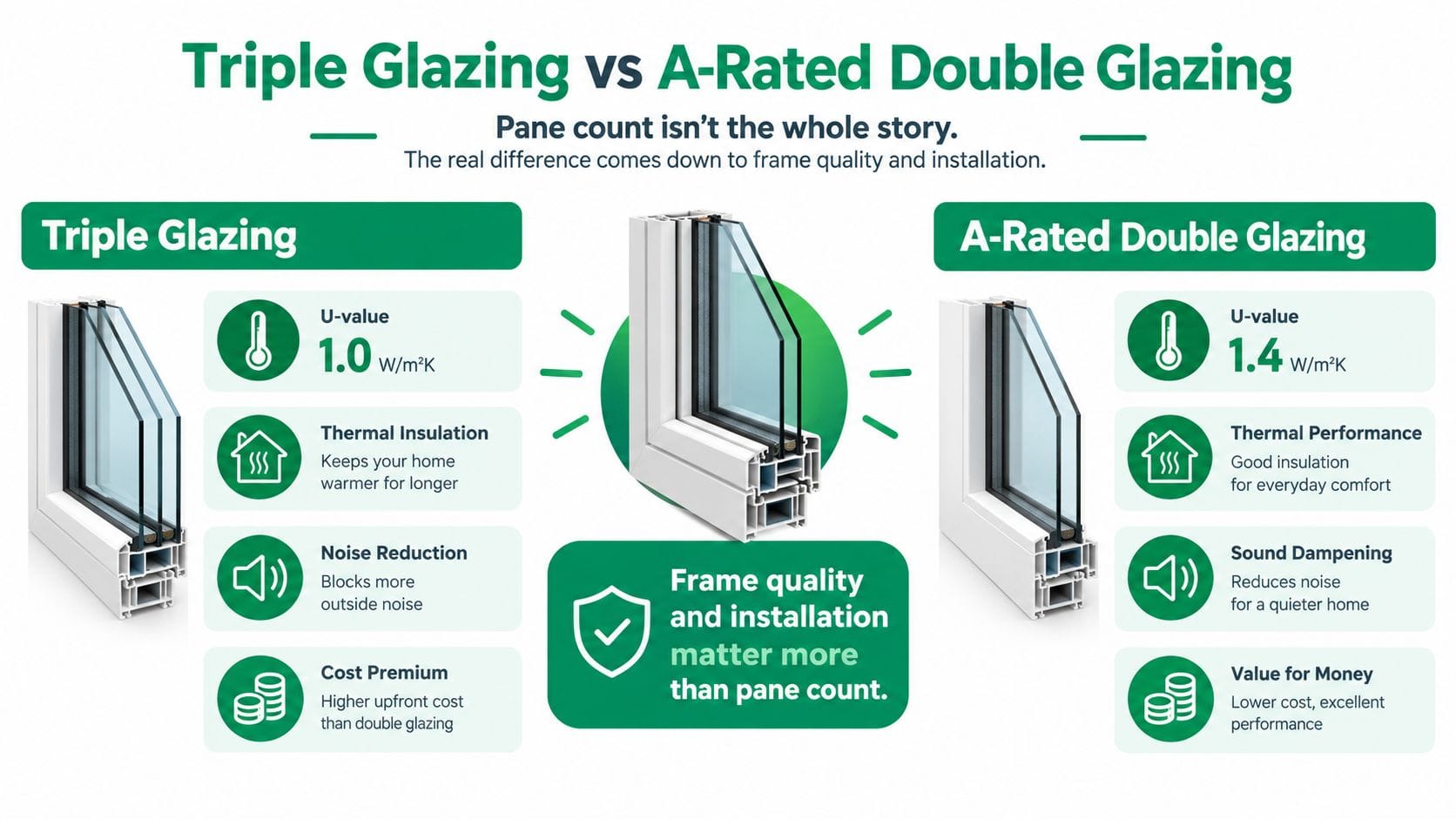
The specification should finish with the number that allows proper comparison: the whole-window U-value. A quote that says only “triple glazed” hasn't explained the window's actual thermal performance.
On an exposed or coastal site, the material label is only part of the decision. Salt-laden wind affects hardware, seals and finishes, so the guarantee should be checked for coastal exclusions, maintenance requirements and limits on exposure.
Triple Glazing vs A-Rated Double Glazing
The number of panes is an unreliable shortcut. A well-made A-rated double-glazed window in a good frame can perform better than a poorly specified triple-glazed unit in a weak frame or badly installed opening.
The comparison should use the whole-window U-value, which includes the glass, frame and edge detail. Typical triple-glazed windows sit around 0.7–1.0 W/m²K, against the 1.4 W/m²K or better standard that SEAI sets for replacement windows under its grant, which is also the level to check against Technical Guidance Document L. The buyer should also compare the Window Energy Performance rating where the supplier provides one.
What the premium buys
Irish pricing guidance commonly places triple glazing €100–€300 per window above double glazing, with €150–€200 a common upgrade range. Another Irish example gives triple glazing at €750–€950 per window fitted, compared with €600–€750 for double glazing. The premium is easier to justify where the extra insulation improves comfort or solves a specific site problem, rather than where the existing A-rated double glazing already performs well.
Triple glazing can make particular sense in exposed locations, north-facing rooms that feel cold, homes beside busy roads and properties using a heat pump. It can also help where occupants prioritise a warmer internal glass surface and reduced draught sensation. Noise performance still depends on the glass thicknesses, frame, seals and installation, so “triple” alone isn't an acoustic specification.
A-rated double glazing may be enough for a sheltered home with sound existing windows, a limited retrofit budget or other higher-priority defects such as poor airtightness, missing insulation or inadequate ventilation. The right question is not whether triple glazing is universally better. It's whether the improvement solves a problem that matters in that particular dwelling.
None of this replaces a measured quotation: the specification decisions only become real once an installer has surveyed every opening on the house.
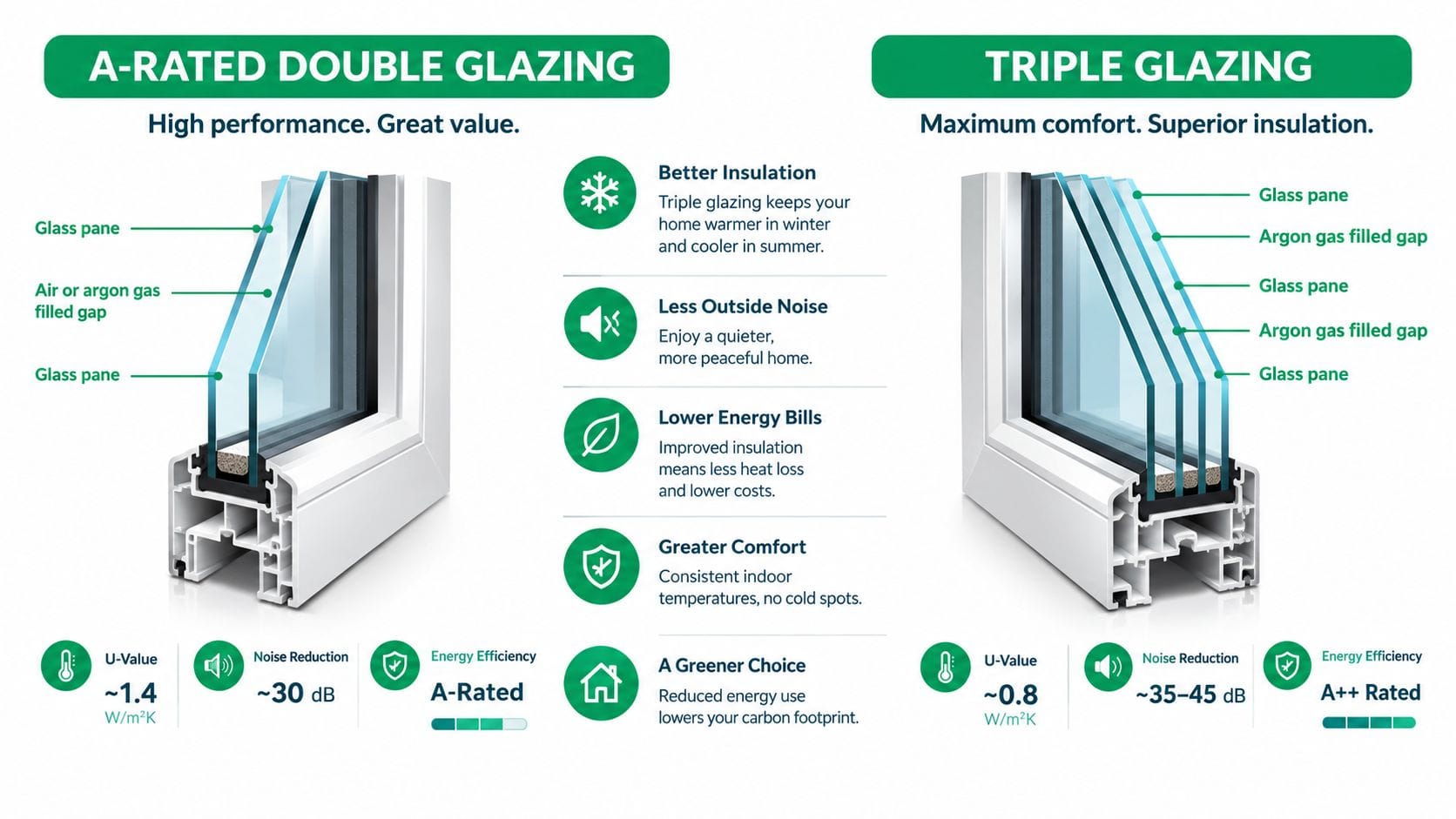
Triple Glazing vs A-Rated Double Glazing Decision Table
| Criteria | Triple Glazing | A-Rated Double Glazing |
|---|---|---|
| Thermal insulation | Usually stronger whole-window performance, provided the frame and installation are also well specified | Can provide strong performance at a lower upfront cost |
| Comfort | Particularly useful in colder, exposed or north-facing rooms | Often sufficient in sheltered rooms with good existing performance |
| Noise | May help, but acoustic glass and installation details remain decisive | Acoustic double glazing may be a better targeted specification in some cases |
| Upfront cost | Usually carries an upgrade premium per window | Lower starting cost |
| Grant fit | Qualifies where the window meets 1.4 W/m²K or better and the home meets the scheme conditions | Equally eligible where it meets the same 1.4 W/m²K standard |
| Best buying test | Whole-window U-value and Window Energy Performance rating | Same whole-window measures, not pane count |