
ShamFix
Back to insights

How Long Does Window Installation Take in Ireland?

Fitting a standard window takes one to three hours on site, a whole house one to three days, and ordering adds four to twelve weeks.

9 min read
How Long Does Window Installation Take in Ireland?

How long window installation takes depends on two separate clocks: the hours a crew spends fitting windows on site, and the weeks between placing the order and the fitting date. As a rough typical guide, a standard window takes about one to three hours to fit, a typical three-bedroom semi-detached house is usually finished in one to three days, and the wait from order to fitting commonly runs from four to six weeks for standard sizes, rising to six to ten weeks for made-to-measure units and longer for shaped ones. Anyone arranging a window and door installation should plan around both periods, because the ordering stage is normally the longer of the two.

Fitting time on site versus the wait for the order

The fitting stage is short and visible: the old unit comes out, the opening is prepared, the new frame is set, levelled, packed, fixed and sealed, the trims go back on and the crew moves to the next opening. The lead time is invisible but usually longer, covering a survey, manufacture of the frames and glazing, delivery, and a slot in the fitting crew's diary.

Typical order-to-fitting lead times:

  • Standard casement or tilt-and-turn windows in common sizes and colours: about four to six weeks.
  • Made-to-measure sizes, non-standard colours, triple glazing, timber or aluminium-clad frames: about six to ten weeks.
  • Arched, angled or very large units, or a whole house ordered in the busiest spring period: eight to twelve weeks.

These are typical figures rather than fixed rules. A local order can come forward if there is a cancellation, and a bespoke one can slip if a component is delayed. The practical point is that the diary note belongs on the order date, not on the day the crew arrives.
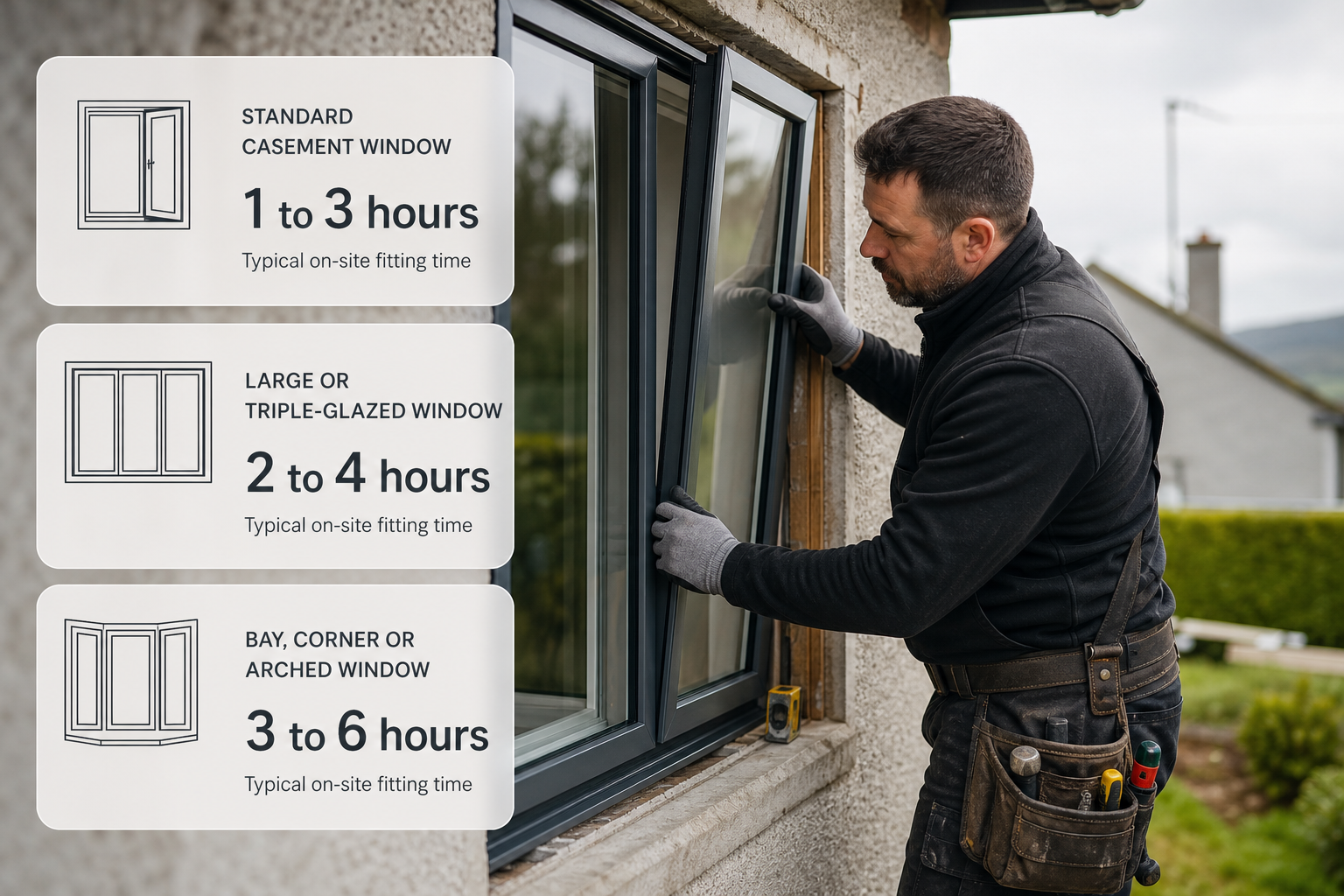
Infographic showing typical on-site fitting times per window type beside a window installer at an Irish home.

How long fitting takes per window

The table below is a typical guide for a two-person crew working on a straightforward opening with reasonable access.

Window or door type Typical on-site fitting time
Small fixed or top-hung window 1 to 1.5 hours
Standard casement window 1 to 3 hours
Large or triple-glazed window 2 to 4 hours
Bay, corner or arched window 3 to 6 hours
Patio or French door 2 to 4 hours
Composite or timber entrance door 2 to 4 hours

Removing an old window usually adds 20 to 45 minutes per opening, and making good the internal reveal adds roughly another 20 to 45 minutes spread across the job. A working day for most crews covers five to eight openings, fewer in midwinter or where access is awkward.
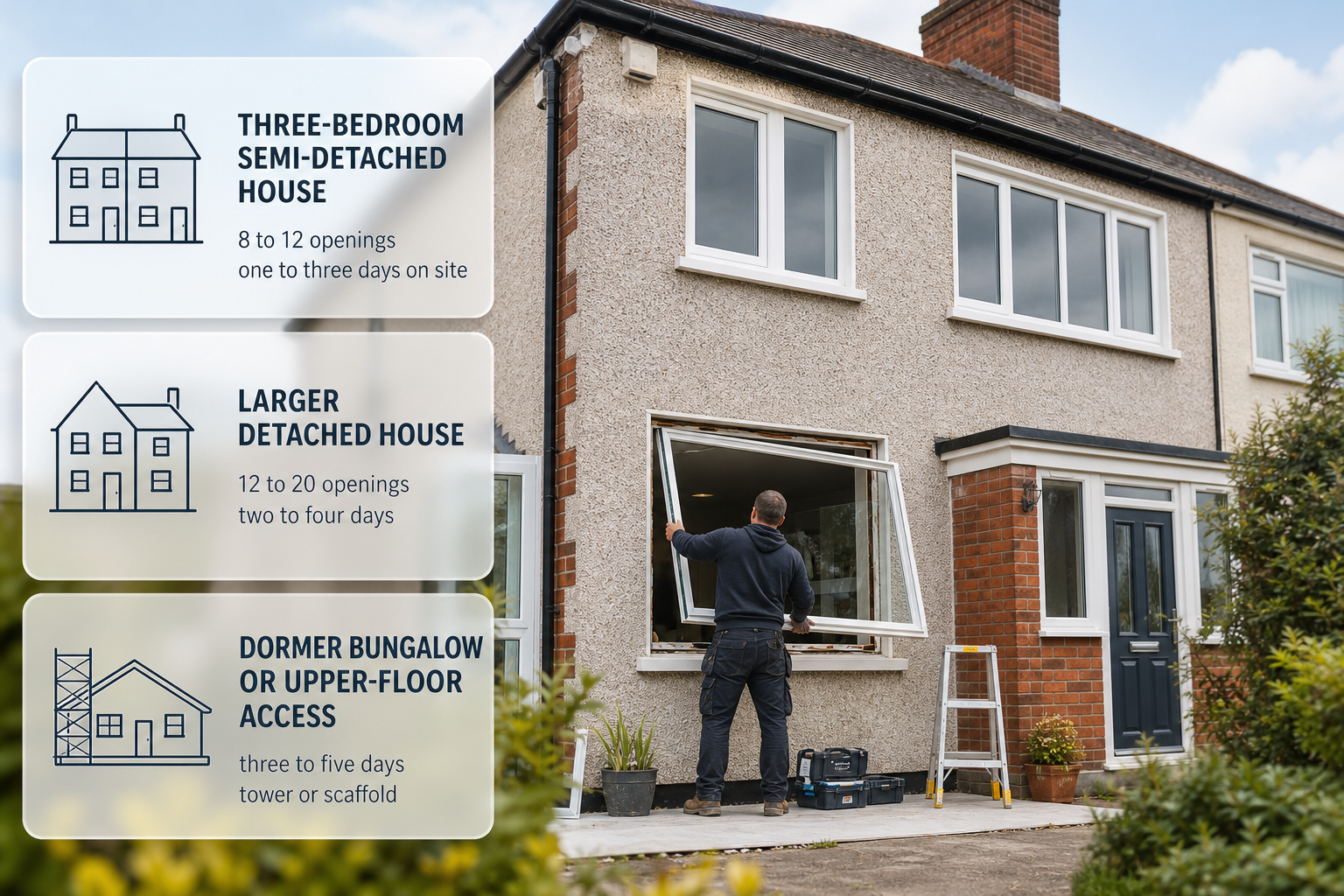
Infographic showing typical whole-house window installation times at an Irish semi-detached home.

How long a whole house takes

Whole-house times depend on the number of openings, the number of floors and how complex the units are.

  • A three-bedroom semi-detached house with eight to twelve openings: one to three days on site.
  • A larger detached house with twelve to twenty openings: two to four days.
  • A dormer bungalow or a house where upper-floor windows need a tower or scaffold: three to five days.
  • A house with several bays, arched units or full-height glazing: five days or more, often split over two visits.

A second crew working at the same time can shorten the on-site time considerably where parking and access allow. Internal finishing, such as patching plaster or painting around reveals, is often left to a later day or to a separate tradesperson, which is why a house can still feel unfinished a week after the windows are in.

What makes a job take longer

Access and upper floors

Ground-floor windows are the quickest, because tools, frames and materials can be kept close by. Anything above the first floor usually means a tower, a platform or scaffolding, and that equipment has to be delivered, erected and removed. Roughly an extra half day to a full day is typical where scaffolding is needed across the front and back of a house.

Condition of the openings

Sound plaster and straight, square openings are the fastest to work with. Crumbling reveals, rotten timbers, damaged lintels, uneven blockwork or a frame that has been rendered over can each add an hour or more per opening. Where the size of the opening has to change, a builder is normally brought in and the work grows into a longer project.

Frame material and glazing type

Standard uPVC casements with double glazing are the lightest and quickest to handle. Timber and aluminium-clad frames are heavier and often need more careful packing and fixing, and triple-glazed units weigh more again, so a larger window may need a third pair of hands or a lifting aid.

Custom sizes and shapes

Non-standard widths, full-height units and shaped frames take longer to make and longer to fit. Anything beyond a straightforward rectangle should be expected to add to the lead time as well as to the hours on site.

Weather and time of year

External sealant and expanding foam need a reasonably dry surface, so heavy rain can push the external sealing of a window to a later visit even after the frame is in. High wind is the bigger obstacle at height and can stop upper-floor work for the day. Winter also shortens the working day, so a crew that fits seven windows in June may fit four or five in December.

Removal and disposal of the old windows

Old timber sash windows with weights and pulleys, or frames bedded into concrete, take longer to free than a screw-fixed uPVC unit. The old frames and glass then have to be carried out, loaded and taken away, and that handling is part of the day's work even though it produces no visible result.

Making good and finishing

Internal sealant, trims, plaster patching and paint touch-ups come last and are what homeowners notice most afterwards. Rushing them is the main reason a fast job looks untidy a year later, so an extra half day at the end is usually worth accepting.

Where windows are one part of a bigger construction and home renovation project, the fitting slot also has to be sequenced around blockwork, rendering and plastering, and that coordination, rather than the fitting itself, is what stretches the overall schedule.


Getting the house ready before the crew arrives

Preparation is the homeowner's job, and it saves real time on the day:

  • Curtains, blinds and curtain poles come down and are stored clear of the work area.
  • Furniture moves at least a metre back from each window, and sills are emptied.
  • Pictures, mirrors and wall-mounted televisions come off the walls beside the openings.
  • Rugs are rolled up and floors and stairs are covered along the route the crew will carry frames.
  • The driveway is cleared for a van, plus a skip or trailer if old frames are being taken away.
  • Pets go into a closed room, and small children are best out of the house for the day.
  • One adult should be at home, with a phone number and any gate or alarm codes passed on.
  • In cold weather the heating goes on and blankets or coats stay to hand, because each opening stays open while it is being worked on.

Disruption to expect, and whether to move out

Fitting is noisy, dusty and draughty, but it is also short and moves from room to room. Each opening is typically open to the weather for an hour or more while the old unit comes out and the new one is set, sealed and trimmed. External doors are usually fitted early in the day so the house can be secured by evening, and crews normally leave one or two rooms usable at all times.

Most homeowners stay at home for the work. Moving out is worth considering in a few cases: a whole house fitted in a single day with several openings open at once, very large openings where part of the wall is temporarily exposed, or a household with a baby, someone with a respiratory condition, or pets that cannot be kept clear of open gaps. Where the job runs over several days, planning meals and sleep around the rooms still in use makes the week far easier.

Planning checks in Ireland

Planning permission may be required for development depending on the type and scale of the works, as set out in Government of Ireland guidance, so the check belongs before the order is placed rather than after. Homes that are protected structures are a separate case: works there can require planning permission and must respect the building's special character, which in practice affects window design, materials, profiles and glazing bars. The definitive answer comes from the local authority planning section, and homeowners should confirm current requirements with it before a final design is agreed.

After the fitting: finishing and handover

Once the frames are in, the remaining time goes on sealing, internal trims, plaster patching and clearing up. Sealant needs to cure before it is painted, so painting around reveals is usually left to a later day and arranged separately. Handles, locking points, restrictors and trickle vents should all be tested on the day, in the presence of the crew.

A short walk-around at the end catches snags while the crew is still on site: each window should open and close smoothly, with no gaps in the internal or external seal, clear drainage slots, and keys and documentation handed over. Where only a handle, a seal or a misted unit has failed, a repair may be enough; see window repair cost.

Posting the job and what happens next

Posting a job and listing it on ShamFix is free and there is no commission, and a subscription is planned for the future. ShamFix does not check or certify tradespeople and profiles are filled in by tradespeople themselves, so homeowners should check registrations themselves and read reviews before agreeing a start date. Anyone who wants timelines in writing can post a window installation job on ShamFix and let local tradespeople respond with their own lead time and fitting estimate.

FAQ

Can a whole house of windows be fitted in one day?

It happens, but mainly on bungalows or small houses with six to eight straightforward ground-floor openings, and usually when a second crew is on site. On a typical three-bedroom semi-detached house, one to three days is the realistic expectation, and squeezing more than five or six openings into a single day tends to show up later in hurried sealing and unfinished reveals.

Does rain or wind stop window installation?

Light rain rarely stops the work, because most of the fitting happens inside the opening itself. External sealing is the part most exposed to the weather, and sealant and foam need a dry surface to bond, so a very wet day can push that step to a later visit. High wind at height is the more likely cause of a delay and can add a day to an upper-floor job.

How far ahead should windows be ordered?

The order lead time, not the fitting time, sets the date. Standard units typically arrive in four to six weeks, while made-to-measure and triple-glazed ones commonly take six to ten weeks, so a homeowner who wants windows in before winter should be ordering by late summer. Spring and early summer are the busiest periods, and booking the fitting slot at the same time as the order avoids a second wait.

Do replacement windows need planning permission in Ireland?

For many homes replacement is a straightforward matter, but whether permission is needed depends on the type and scale of the works, so the local authority planning department is the place to ask. Protected structures are treated differently and their special character has to be respected, which can shape the design that is allowed. The check is quick and is best done before the order is placed.

Keep reading

Do New Windows Reduce Noise? An Irish Guide

Do New Windows Reduce Noise? An Irish Guide

Yes — new windows usually cut outside noise noticeably. Here's what actually decides how much quieter your home becomes, and which specs matter most.

9 min read