Window Repair Cost in Ireland: A Guide for Homeowners
Most window repairs cost €95 to €500 depending on the fault: what handles, locks, seals and sealed units should cost, and when to repair not replace.
/10 min read
A single-fault repair on a window in an Irish home normally costs between €95 and €500, an aggregate Irish market estimate for repair-only work on domestic windows. The bottom of that band covers a new handle set, a catch or a seal, while the top covers re-cording a sash or an out-of-hours board-up call-out. Because each opening is priced separately, describing the fault, the window type and the access clearly on a window and door repair request is the quickest way to get comparable figures rather than a guess over the phone.
What window repairs cost in Ireland
Aggregate Irish market estimate for common repair-only jobs on domestic windows. Ranges are per window during normal working hours on an accessible window unless the row says otherwise.
Repair
What the price covers
Typical range
Handle, catch or handle-set replacement
New part, fitting and adjustment of the closing point
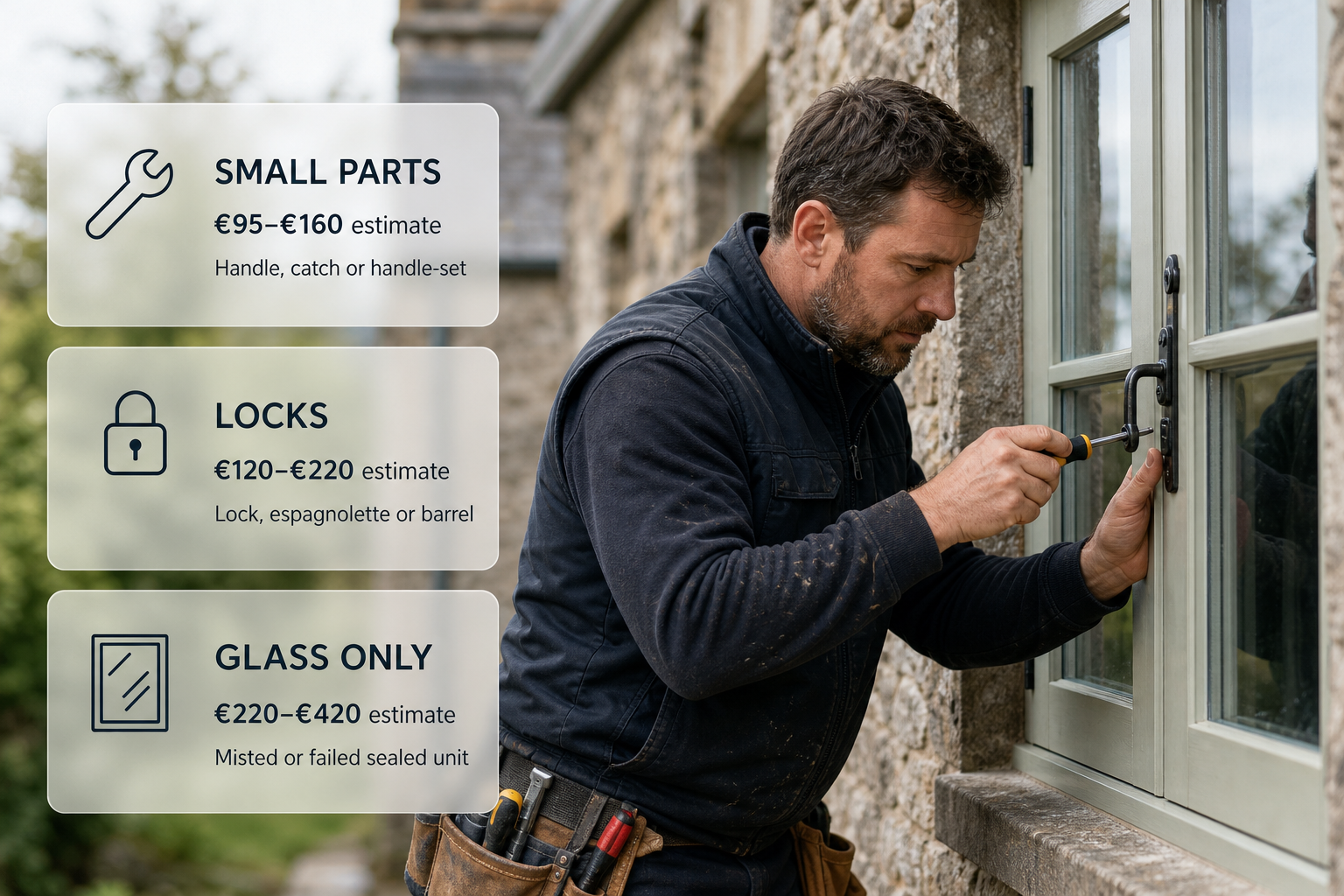
€95–€160
Lock, espagnolette or barrel repair
Mechanism, gearbox or lock barrel freed or replaced
€120–€220
Hinge, dropped-sash and opening-geometry work
Per hinge at the lower end; re-cording, re-hanging or rebuilding a sash per window at the upper end
€110–€500
Seal and draught-proofing renewal
New gaskets or brush seals, silicone where needed
€130–€240
Misted or failed sealed unit, glass only
Made-to-measure double-glazed unit fitted into the existing frame
€220–€420
Emergency make-safe or board-up call-out
Out-of-hours attendance, boarding and securing the opening
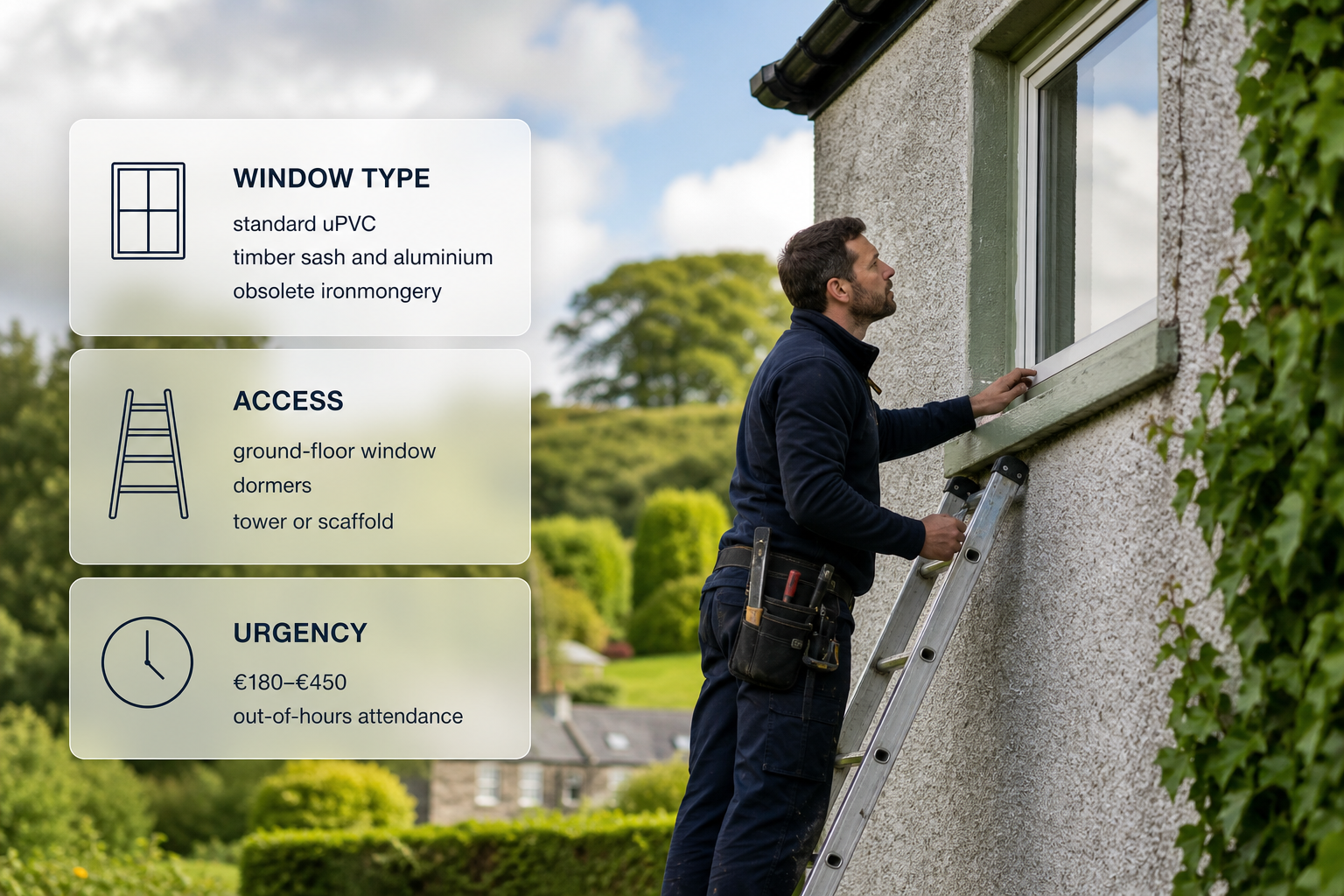
€180–€450
The row that matches the actual fault is the figure to hold a quote against. A number at the top of a row is not automatically overpriced, because access, part availability and urgency all sit inside the same band, but a figure well above the band needs a written explanation before any work starts.
Handles, catches and small parts
A handle set, a catch or a small closing component is the cheapest fault to put right and the one most often quoted as a full window replacement. A replacement handle set sits in the €95–€160 row and, on a standard uPVC window, the part is usually carried in the van, so the price is dominated by the minimum charge or the call-out rather than the component itself. Fitting means removing the old fixings, seating the new handle square to the frame, adjusting the closing point and checking that the window still locks. Where a stiff handle has been forced for months and the mechanism behind it has bent, the job moves into the hinge and opening-geometry row at €110–€500, because the window has to be re-set and adjusted rather than simply given a new handle.
Locks and locking mechanisms
A lock or espagnolette mechanism that has seized, jammed or lost its key sits in the €120–€220 row. The work usually involves freeing or replacing the gearbox, the locking strip or the barrel, and on uPVC the barrel can often be changed without disturbing the frame, which keeps the job quick. Timber and aluminium windows take longer because the lock case is set into the sash and the surrounding timber or metal has to be eased to reach it. If the key turns but the window will not pull tight against the seal, the fault is more likely alignment than the lock, and the quote should say which of the two is being fixed.
Hinges, dropped sashes and opening problems
Hinge work is priced per hinge at the bottom of the €110–€500 row, because each hinge has to be removed, aligned and re-fixed, and a dropped sash usually needs the whole opening adjusted afterwards. A window with two or three worn hinges therefore costs more than a single per-hinge figure. Timber sash windows sit at the top of the same row: re-cording, replacing balances and freeing a sash that has been painted shut all require the sash to come out of the frame. A window that no longer closes squarely, shows daylight at one corner or needs lifting with both hands is normally in this band rather than the small-parts band.
Seals and draught-proofing
Replacement gaskets, brush seals and bubble seals are priced per window in the €130–€240 band, and the work is mostly labour because the materials themselves are inexpensive. The old seal is pulled out of the rebate, the channel is cleaned, the new seal is pressed into place and the window is checked to make sure it still closes and locks. Draught-proofing a whole house is quoted window by window, so the per-window figure applies to each opening rather than to the property as a whole. Where the draught comes from a gap between the frame and the wall rather than from the window itself, that is a separate making-good job and should appear as its own line on the quote.
Glass-only replacement of a misted sealed unit
A misted, cloudy or visibly wet double-glazed unit has failed at its edge seal, while the frame, hinges and handles are usually still sound. The glazing is measured, made to size and fitted into the existing frame, which is the row priced at €220–€420 per unit. In a standard Irish terraced house, a failed unit in a ground-floor front room is the clearest example, and the work normally lands at the lower end of that range; first-floor windows, timber beads that must be re-made or a unit that has to be carried through the house sit towards the upper end. Because the frame is reused, this is the single repair that saves most against replacement, and a glass-only price is worth asking for before accepting a quote for a complete new window. How to tell a failed unit from ordinary condensation is covered in how to stop window condensation.
Emergency make-safe and board-up work
An out-of-hours call-out to make a broken window safe, board an opening up or secure a door after a break-in sits in the €180–€450 band, and the figure depends on the time of day, the size of the opening and whether boarding has to be supplied. Make-safe work is temporary: it keeps rain and intruders out until a proper repair can be done, and the permanent repair is then quoted separately from one of the other rows in the table. Whether an emergency attendance is covered varies from policy to policy, so homeowners should confirm current cover with their insurer rather than assuming a claim will pay, and should keep photographs and receipts in case a claim is made.
What moves the price up or down
Window type matters most. Parts for standard uPVC openings are cheap and quick to fit, while timber sash and aluminium work take longer, and obsolete ironmongery on older frames may have to be sourced or re-made, pushing a small-parts job from the €95–€160 band towards the upper part of the €110–€500 row. Access is next: a ground-floor window with a clear approach is the least expensive to work on, while dormers, windows above a conservatory, narrow side passages and anything needing a tower or scaffold add time and often a separate charge. Urgency shows up in the €180–€450 band, where an out-of-hours attendance sits at the top and the same board-up booked for the next working morning normally falls at the bottom.
Parts, labour and call-out charges explain the rest. Sealed units are made to measure, so a pattern or non-standard size costs more than a common one, and many tradespeople apply a minimum charge or fold travel into the job, which is why one handle can cost about the same as two. Asking whether the call-out is included is the most useful question before comparing any two figures. VAT is the last trap: domestic repair quotes may be given with or without it, so ask each tradesperson to state on the written quote whether VAT is included. Repairs are often booked alongside other home services at the same address, and combining jobs reduces the travel and set-up element of each one.
Dublin prices compared with the rest of Ireland
Within the same ranges, quotes in Dublin and the larger urban areas tend to sit at the upper end of each row, while smaller towns and rural areas tend to sit at the lower end. The gap comes from travel time, parking, congestion, van running costs and the volume of work available rather than from different parts prices: the same handle component fits a Dublin window and a country-town window, and it is the labour and travel around it that change. A homeowner outside the cities who is quoted at the top of a row should ask what in the job justifies it rather than assuming the figure is fixed.
When repair beats replacement
Replacing the glass, a sash or a single part is a repair, not a new window. That distinction matters when a tradesperson quotes for a new window because a handle, a hinge or a sealed unit has failed, since those faults sit inside the rows above and rarely justify a whole new unit. Repair is normally the better value where the frame is sound, the opening is square, the glass unit is the only failure and the window is part of a matching set that would be expensive to break up. Replacement starts to make more sense where the frame itself has rotted, where a timber sill or rail is soft, where the same window has been repaired repeatedly, or where every moving part is worn. Getting a repair figure first costs nothing and gives something concrete to weigh against a replacement price.
How to compare quotes and spot an overpriced job
Ask every tradesperson to quote the same described fault in writing, with parts, labour, call-out and VAT listed separately.
Hold each figure against the row in the table that matches the fault, and ask for an explanation of anything well above the top of that row.
Be cautious of a quote for a complete new window where the described fault is a handle, a lock or a seal.
Be equally cautious of a very low figure that omits making good, disposal of the old part or VAT, because it usually reappears later as an extra.
Ask who supplies the part, whether it carries a warranty and how long the workmanship is guaranteed.
Ask what happens if the fault turns out to be worse once the window is opened up, and have that possibility priced before work starts.
Do not pay the full balance before the work is finished and checked; a deposit for a made-to-measure sealed unit is normal, full payment in advance is not.
Two or three comparable quotes for the identical fault remain the only reliable way to judge whether a figure is fair.
FAQ
Can a window be repaired without taking the whole frame out?
For most faults, yes. Handles, locks, hinges and seals are all worked on with the frame left in the wall, and a failed sealed unit is fitted into the existing frame once the beads are removed. Sash work needs the sash itself taken out, but the outer frame normally stays put. A repair that requires the frame to come out usually means the surrounding timber has rotted, which is closer to a replacement judgement than a repair.
Is a deposit normal before work starts?
A deposit is reasonable where money has to be committed up front, most obviously for a made-to-measure sealed unit that is ordered to the homeowner's measurements and cannot be returned. For a handle, a seal or a lock that the tradesperson keeps in stock, there is nothing to order and nothing to deposit. Anyone asked for the full amount before the first visit should treat it as a warning sign and get another quote.
Who supplies and guarantees the new part?
Either arrangement works, but the guarantee differs. Where the tradesperson supplies the component, the part and the fitting are normally covered together, so there is one person to call if it fails. Where the homeowner buys the part, the supplier's warranty covers the component and the tradesperson's covers only the fitting. Agree in writing which of the two is happening before the work is booked.
Are older timber windows worth repairing?
Often they are, because the frame is the expensive part and many older sashes are sound even when the hardware is not. Re-cording, new balances, new beads and fresh draught seals can bring a timber sash back into everyday use at a fraction of a replacement price. The judgement turns on the timber itself: soft sills, rot at the bottom rail or a frame that has twisted out of shape are the faults that push the decision the other way.
Getting window repair quotes
The most reliable way to price a repair is to describe the fault, the window type and the access in plain terms, then compare figures given for the same job at the same address. Posting a job and listing it on ShamFix is free and there is no commission, and a subscription is planned for the future. ShamFix does not check or certify tradespeople, and profiles are filled in by tradespeople themselves, so homeowners should check registrations themselves and read reviews before agreeing to any work.
Stop window condensation by cutting moisture, airing briefly and keeping steady heat — and learn how to tell it from leaks, failed glazing or rising damp.
9 min read
Next step
Find local help
Browse people offering this work in your county and post a job.