Vacuum first, test any cleaner on a hidden patch, then clean fabric, leather or synthetic leather gently and dry the seat fully.
/8 min read
Cleaning car seats safely comes down to a short routine: vacuum first, work out what the seat is made of, test any cleaner on a hidden patch, clean gently with a barely damp cloth, and dry the seat completely before anyone sits on it again. Fabric, leather and synthetic leather each react differently to water and chemicals, so no single bottle suits all three. Where a seat is heavily soiled, or where the owner would rather not spend a Saturday on it, a car wash and detailing service can take the work on.
How to Clean Car Seats Step by Step
Clear the space first. Remove child seats, mats and loose items, park in shade and open the doors. Direct sun dries cleaner into the weave and drives it deeper into the seams.
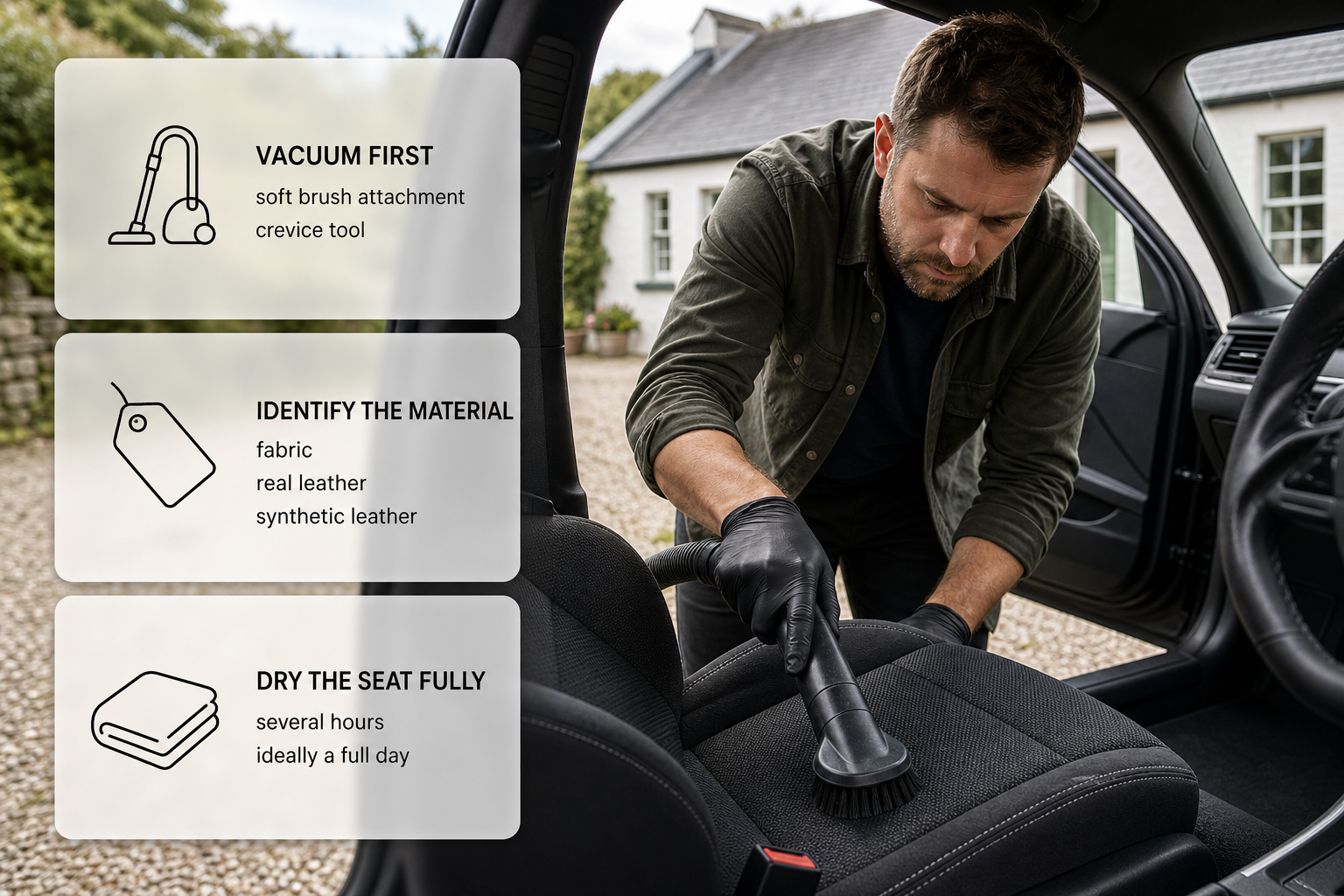
Vacuum before anything gets wet. Use a soft brush attachment on low suction across the seat base, backrest and bolsters, then a crevice tool for the gap where the base meets the backrest and for the rails. Grit left in place is ground into the fabric as soon as a cloth touches it.
Identify the material. The care label or the owner's manual will say whether the upholstery is fabric, real leather or synthetic leather. While checking, note whether the seat has a side airbag, a heated element or an occupancy sensor, because each of those changes how wet the seat should ever get.
Test any cleaner on a hidden patch. Under the seat or at the back of the base is ideal. Put a little product on a white cloth, leave it for a few minutes, then look for colour on the cloth, bleaching, darkening or a stiff feel on the fabric.
Clean gently, one section at a time. Work from the top of the seat downwards with a wrung-out cloth rather than a wet one, and never pour or spray liquid directly onto upholstery. Repeated light passes lift more dirt than one hard scrub.
Dry the seat fully. Blot with a dry towel, leave doors and windows open, and run the air conditioning on fresh air or point a fan at the seats. Hairdryers, heaters and a closed car in the sun all cause problems. Foam holds water longer than the surface suggests, so allow several hours, ideally a full day, before refitting a child seat or switching on the heated seat.
Cleaning Fabric Car Seats
Fabric is the most forgiving material in a car. A mild liquid detergent diluted in warm water, or an upholstery cleaner made for car interiors, is usually enough: foam a small amount onto a cloth or soft brush, work in circles over one panel, then blot with a clean dry microfibre cloth. Rinse with a cloth wrung out in clean water, because detergent residue attracts fresh dirt, and repeat the whole pass rather than scrubbing harder. Keep the foam damp rather than soaked so it never reaches the padding underneath. Heavy pet hair has its own guide to removing dog hair from car seats and is best lifted off before any liquid goes on.
Cleaning Leather Car Seats
Real leather carries a finish that water and strong chemicals will strip. A pH-neutral leather cleaner, or a very dilute mild soap solution, applied with a soft cloth and wiped off with a clean damp cloth, is enough for routine marks; a conditioner is worth using only if the vehicle or seat manufacturer recommends one. Keep liquid out of perforations and stitched seams, and buff the surface dry rather than letting it sit wet. Avoid washing-up liquid, household degreasers, glass cleaner, alcohol-based sanitisers and disinfectant wipes, bleach and abrasive pads: they dull the colour, dry the surface and encourage cracking.
Cleaning Synthetic Leather Seats
Synthetic leather is a plastic coating over a fabric backing. Warm water with a drop of mild soap on a microfibre cloth handles most marks, and a diluted pH-neutral cleaner deals with greasy ones. Wipe dry straight away, because water left standing can leave marks on some finishes, and use cooled boiled or filtered water if the tap supply is hard. Avoid alcohol, solvents, bleach, abrasive cream cleaners and furniture polish; a conditioner made for real leather is unnecessary here and leaves a film that attracts dirt. Scrub lightly, because the coating wears through first at corners and bolster edges.
Mud, Crumbs, Food and Drink Spills
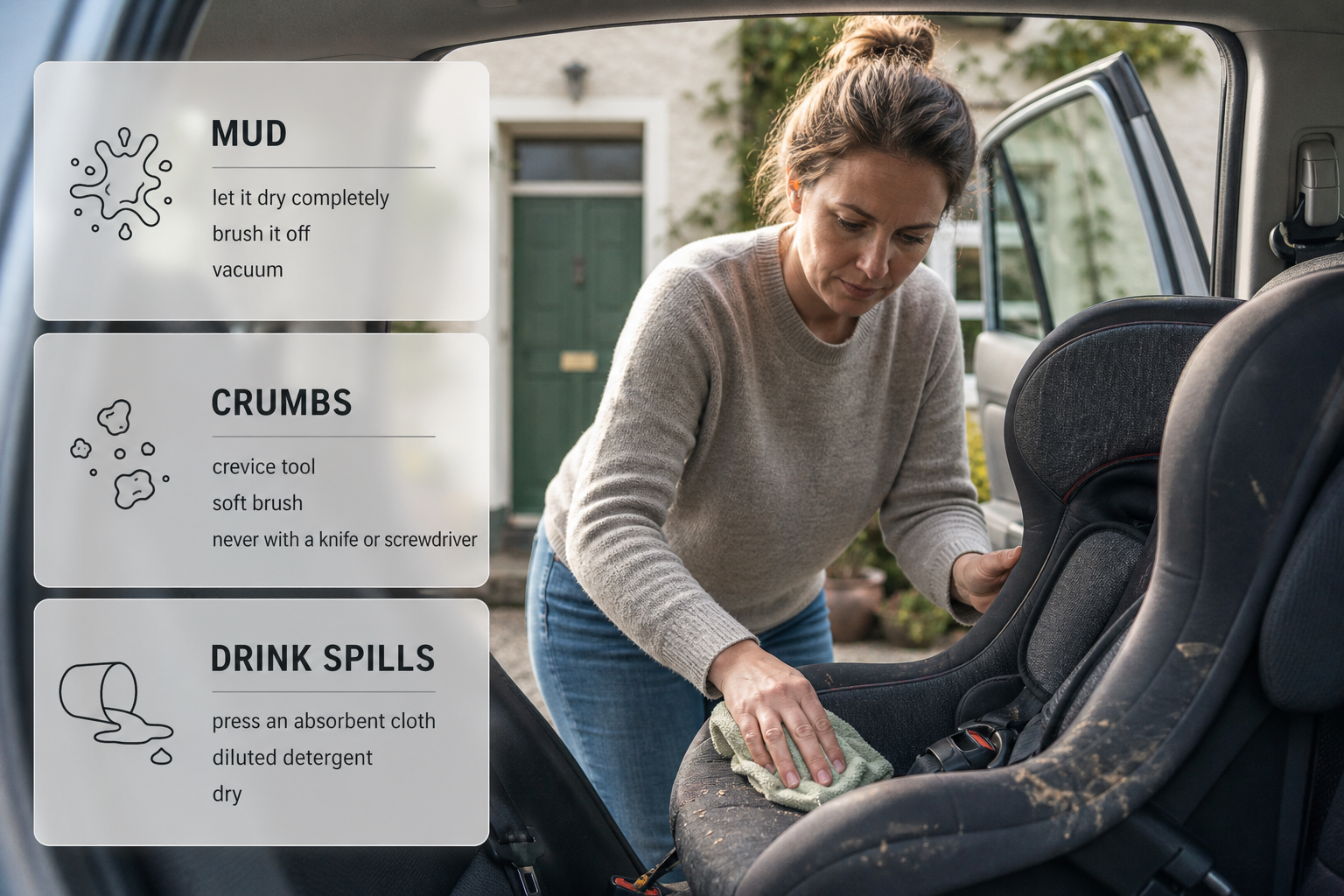
Mud: let it dry completely, brush it off, vacuum, then treat whatever remains with diluted detergent.
Crumbs: vacuum with the crevice tool and loosen packed crumbs from seams with a soft brush, never with a knife or screwdriver.
Dry food and sticky sweets: lift with a plastic edge such as an old card, vacuum, then spot clean.
Greasy food: a small amount of diluted detergent, blotted rather than rubbed, then repeated with a clean cloth.
Drink spills: press an absorbent cloth onto the spill instead of wiping, so it does not spread. Follow with diluted detergent, then a cloth wrung out in clean water, then dry. Milk, juice and fizzy drinks are the ones that turn into a smell if left, so treat them the same day if possible.
Chewing gum: harden it with a bag of ice, then lift it off; solvent-based removers have no place on leather or synthetic leather.
Removing Everyday Odours
Smells live in moisture and organic matter left in the padding, so removal and drying do more than fragrance ever will. Air the car with the windows open and the air conditioning on fresh air rather than recirculation, replace a stale cabin filter, and sprinkle bicarbonate of soda over dry fabric, leave it for a few hours and vacuum it out. Chasing a smell with repeated soaking usually makes it worse, because wet foam is what keeps it alive. Mould and damp are covered in the guide to mould in a car interior. Drivers who would rather hand the job over can compare automotive services through ShamFix, which lists car care alongside other vehicle work.
When Steam Is Suitable and When It Is Not
Steam suits fabric upholstery. A low-moisture machine with a brush attachment lifts grease, embedded grime and odour-causing bacteria, and revives flattened fibres; the head should keep moving, one pass at a time, with a cloth or extraction straight afterwards and full drying as in the steps above. It is not suitable for real leather or synthetic leather, where heat and moisture dry out and crack the finish, and it is a poor choice for suede-like microfibre fabrics. Steam should also stay away from airbag seams, heated seat elements, occupancy sensors, glued seams and plastic trim. Child seat covers and harnesses should only be steamed if the manufacturer's care label allows it, which is unusual.
Cleaning Child Car Seats Safely
The care label and the seat's own instruction manual decide everything here, so read them before opening any cleaner. If the manual specifies hand washing, a temperature limit or no machine washing, follow it exactly; covers that are not meant for the washing machine should be cleaned by hand in mild detergent, rinsed, and air dried away from direct heat. Remove covers only in the way the manual describes and photograph the harness routing first. Wipe the shell and buckle recess with a damp cloth and vacuum crumbs out of the buckle, but never soak the harness webbing, which is a load-bearing part that soaking or harsh chemicals can affect. If the webbing is frayed or the buckle sticks, speak to the seat manufacturer rather than treating it with cleaner. Refit everything only once it is completely dry.
Avoiding Damage to Airbags, Heated Seats and Seat Sensors
Side airbags deploy through a seam on the outer edge of the backrest. Do not scrub or steam that seam, do not push fingers or tools into it, and do not let liquid run towards it.
Heated seats have thin elements just under the cover. Avoid soaking the seat, scrubbing hard, kneeling on it while wet or using anything sharp, and leave the heating switched off until the seat is dry.
Occupancy and belt sensors sit in the base and the buckle. A damp cloth is fine, a wet seat is not, and spills should be blotted immediately.
General rules: spray onto the cloth rather than the seat, use the least water that works, never a hose or pressure washer indoors, and do not leave covers off permanently.
Cleaning itself is a cosmetic job and does not change how a car performs on the road. Whether any particular item matters at test time is a question for the National Car Test operator and the Road Safety Authority, and drivers can confirm the detail with them.
FAQ
Should the seats be taken out of the car to clean them?
Usually not. Removing seats can disturb the wiring for occupancy sensors, belt tensioners and heated elements, and refitting them wrongly is a worse outcome than a slightly awkward clean. Reaching under the seat with the crevice tool and cleaning in place is the safer route for a homeowner, while a workshop or detailing provider has the equipment to lift a seat properly if it is genuinely necessary.
Are baby wipes safe on leather or synthetic leather?
Occasionally, but they are not ideal. Some wipes contain alcohol, perfume or other additives that dry out a leather finish and leave a film behind, and the same applies to synthetic leather. A cloth dampened with plain water, followed by a pH-neutral cleaner when one is needed, does the job with fewer surprises.
How long do seats take to dry, and can the process be hurried?
Surface fabric can feel dry within an hour while the padding underneath is still damp, so plan on several hours and preferably a full day. Open windows, fresh-air ventilation and a fan speed things up safely. Heaters and hairdryers dry the surface too quickly and can warp covers or damage heating elements, which is why they are best avoided.
Can a wet seat cause electrical faults?
Water that reaches wiring, sensor pads or heated elements can trigger warning lights and odd behaviour, which is why the advice throughout is to keep cloths wrung out and never pour liquid. If a warning light appears after cleaning, stop using the seat functions and have the car checked rather than waiting for it to clear on its own.
Getting a Deep Clean Done
Seats that are badly stained, smell of smoke or have been soaked by a leak usually need extraction equipment that few homes have. Posting a job and listing on ShamFix is free and there is no commission, and a subscription is planned for the future. ShamFix does not check or certify tradespeople, and profiles are filled in by tradespeople themselves, so homeowners should check registrations themselves and read reviews before booking. Interior cleaning prices are covered in the car interior cleaning cost guide.