ShamFix
Back to insights

How to Remove Dog Hair from Car Seats: Irish Guide

Loosen the hair first, then vacuum: a step-by-step way to clear dog hair from fabric, leather, heated and perforated car seats safely.

9 min read
How to Remove Dog Hair from Car Seats: Irish Guide

Dog hair comes out of a car seat most safely when it is loosened first and vacuumed second, so the reliable DIY order is to gather the hair with a rubber-bristled brush, a squeegee or a damp rubber glove, lift it away by hand, and then vacuum in slow, overlapping passes. Fabric seats, carpets and mats take that dry-first approach well, while leather, heated and perforated seats need softer tools, less moisture and more patience around stitching and holes. Households that would rather not work near airbag seams, seat wiring or fitted child seats can book car interior cleaning instead.
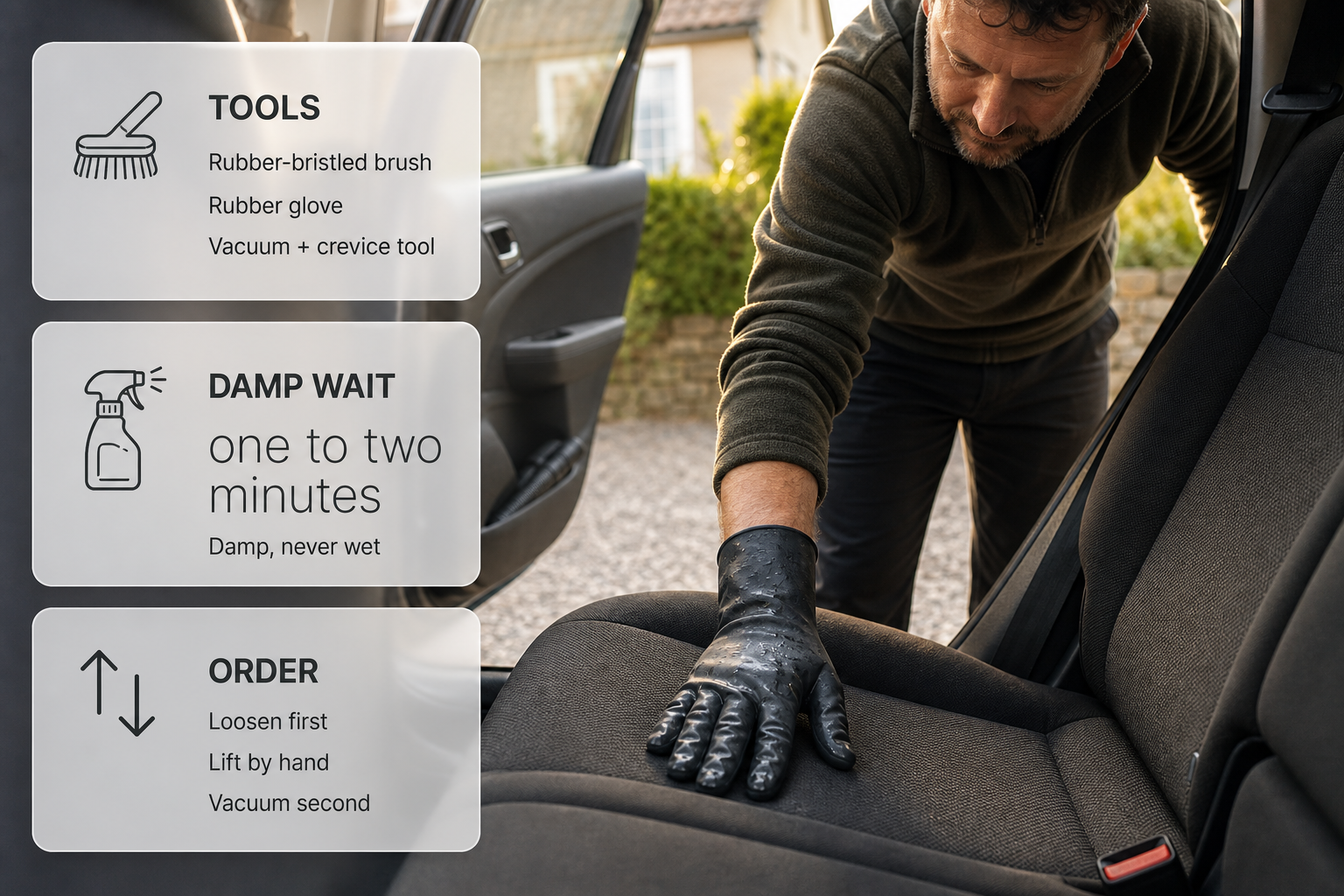
Infographic showing the basic order for removing dog hair from car seats with simple tools and the one to two minute damp-wait step.

The basic method: loosen the hair, then lift it

Work on one seat at a time, starting at the top. The tools that treat car upholstery most kindly are a rubber-bristled pet-hair brush, a rubber squeegee, a clean rubber glove worn damp, a soft upholstery brush, a vacuum with a crevice tool and a soft brush attachment, a lint roller, a spray bottle of plain water and a few microfibre cloths. Gloves keep grit and dander off the hands, eye protection matters when working under seats where dust falls towards the face, and a dust mask is sensible for anyone who reacts to pet dander.

Mist the surface lightly with water — damp, never wet — and leave it for one to two minutes so the fibres release their grip on the hair. Drag the rubber tool or the damp glove in short strokes in one direction, gathering the hair into a visible line, then lift that line off by hand and drop it into a bin. Repeat the passes at right angles, because hair lies in different directions across a seat base, a seat back and a headrest. For hair that has been pressed into the pile for months, small circles with the damp glove work better than pressing hard.

Vacuum afterwards with the brush attachment in slow, overlapping passes, then switch to the crevice tool for the gap between the seat base and backrest, the seat rails and the space underneath. Keep suction moderate on fabric and light on anything perforated. If a stain needs an upholstery shampoo, follow the dwell time printed on that product and never let it dry on the surface.

Finish by airing the car: open the doors, let the fabric dry completely and run the blower with the windows down for a few minutes. Fabric that is still damp when a cover, child seat or passenger goes back on will smell musty within a day or two, and in Irish weather a full dry can take several hours.

Fabric seats, carpets and mats

Work downwards: headrests and seat backs, then the seat base, then the carpet and finally the mats, which are best taken out of the car and beaten away from it. Car carpet has a short looped pile that traps hair well below the surface, so short strokes with the rubber tool, followed by the brush attachment, lift more than suction alone. Wash rubber mats with warm soapy water, rinse them and let them dry fully outside the car before refitting, since a damp mat under a seat is a common source of musty smells. Finish with the crevice tool along the door sills and under the seat rails, and put the collected hair straight into a closed bin rather than shaking it back into the cabin.

Leather and delicate finishes

Hair sits on top of leather but collects in stitching, folds and perforations. A soft detailing brush followed by a vacuum with a soft brush head is the gentle route, then a barely damp microfibre cloth drawn along the seams. Rubber squeegees can drag and mark leather, and abrasive pads, wire brushes and household solvents have no place on a car interior. Test any cleaner on a hidden area first, follow its label directions, wipe the residue off with a clean damp cloth and buff dry with a dry microfibre. Leather should never be left wet, and stitching should never be scrubbed.

When hair is mixed with mud, sand or salt

Let everything dry completely before touching it. Dried mud and sand brush off, while wet mud smears and drives grit into the fabric like sandpaper, dulling fibres and marking leather. Once dry, loosen the surface with a soft brush, vacuum, and treat any marks with a cleaner made for that material, blotting rather than scrubbing. Salt carried in from coastal walks or gritted winter roads draws moisture into fabric, so wipe hard surfaces and let the seats dry fully. Where mud or salt has soaked through the upholstery, extraction equipment lifts far more than a household vacuum, and that is one of the jobs homeowners list under automotive services.

Child seats and seat-mounted airbag zones

Take a fitted child seat out before cleaning underneath it, and refit it only once everything is dry, following the child seat manufacturer's own instructions. The Competition and Consumer Protection Commission has warned that product add-ons or accessories for car seats should only be used when they have been tested and approved by the car seat manufacturer (Competition and Consumer Protection Commission). Vacuum around anchor points and seat rails with the crevice tool rather than pushing anything into them. Where a side airbag deploys from the outer edge of a seat back, that seam has to stay clear: no protective mats, covers or hanging organisers tucked over it, and no tools or hard objects pushed into it. Wipe seat belts with a just-damp cloth only and let them dry before they retract. Nothing under a seat should be unplugged or unbolted during a clean; if a seat has to come out, that is work for a professional.

Heated and perforated seats

Perforated trim lets hair and grit drop through the holes, so the vacuum should do the work at low suction with a soft brush head. Pressing a flat nozzle against the surface pushes grit further in, and dragging a rubber scraper across perforations can tear the trim, so a soft brush and a barely damp cloth are the safer pair. Keep sprays off the surface so the holes do not fill with liquid, and avoid leather conditioners that can clog them. Heated seats carry elements and wiring beneath the upholstery, so keep moisture to a minimum, skip steam, and never scrub hard over the seating area. Let the seat dry completely before the heater is switched on, and if a heated seat develops a fault or warning after cleaning, have it checked rather than continuing to use it.

Prevention when a dog travels in the car every day

A washable, fitted cover or hammock on the seat the dog uses catches most of the hair, provided it does not sit over an airbag seam or interfere with a child seat. Grooming the dog outdoors before a journey helps most during spring and autumn, when shedding peaks. Microfibre throws hold less hair than fleece, and a lint roller kept in the door pocket deals with the passenger seat in seconds. Vent slats, the gear lever and door cards collect dander as well as hair, so they are worth a weekly wipe, and mats are best shaken out away from the car rather than inside it.

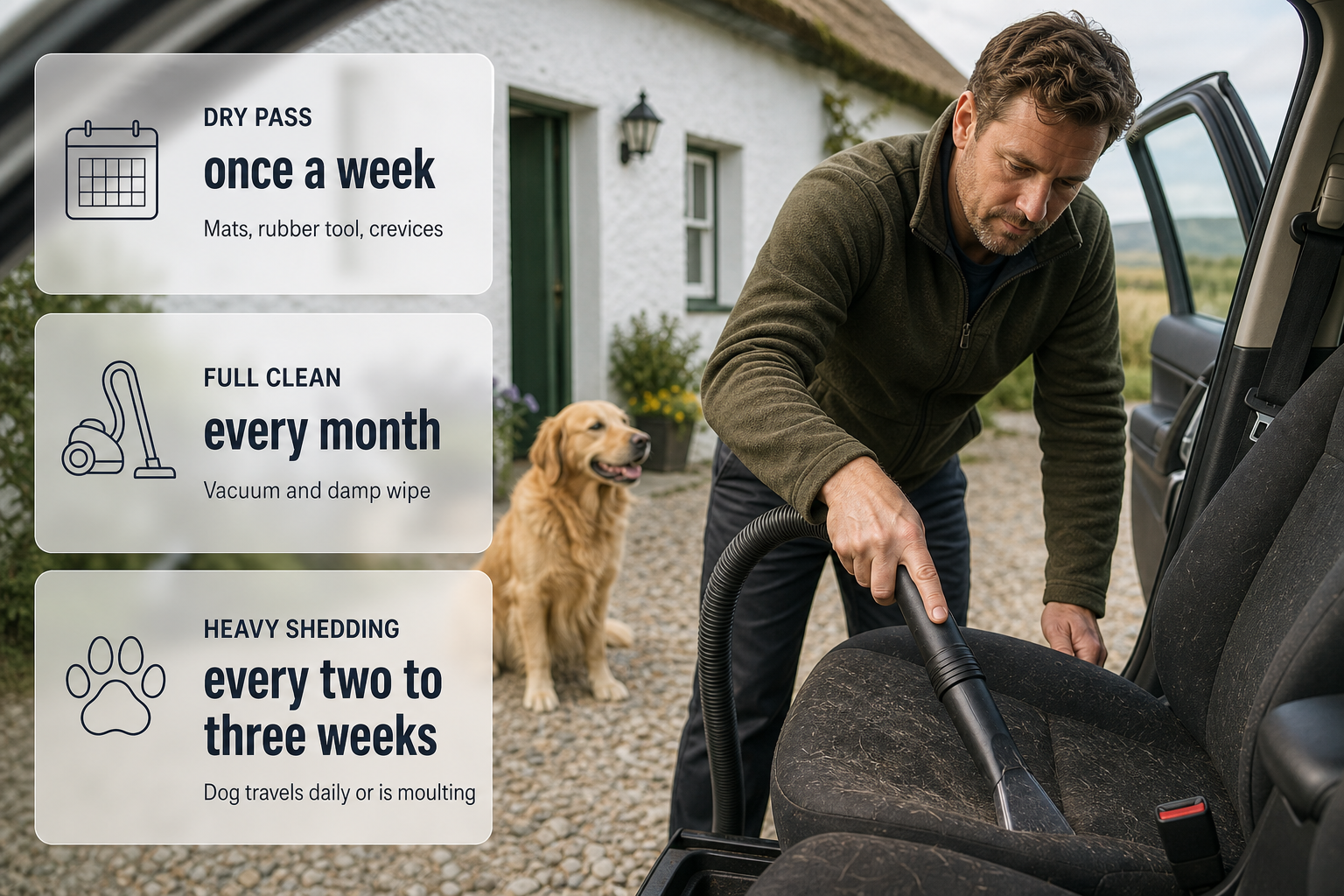
Infographic showing how often to remove dog hair from car seats and the key follow-up steps to reduce allergy triggers.

How often to clean, and cutting allergy triggers afterwards

A dry pass once a week — shaking the mats, running the rubber tool over the dog's usual spot and vacuuming the crevices — keeps hair from building up, while a full vacuum and a damp wipe of hard surfaces every month suits most households, and every two to three weeks is more realistic where a dog travels daily or is moulting. Dander and dried saliva on the hair, rather than the hair itself, are what usually set off allergies, so the finish matters: empty the vacuum canister or bag outside, wipe the dash, steering wheel and door cards with a damp microfibre, wash mats and covers separately and dry them fully, and air the car with the windows open and the fan on fresh air. Check the cabin air filter when the car is serviced, skip scented fresheners that mask odours without removing allergens, and give the seats a second quick vacuum a few days later to catch dander that has settled again.

When a mobile valet or interior cleaner is worth using

Hair worked into the pile over years, mud or salt that has soaked through, spills, lingering odours, and seats that are perforated, heated or fitted with child seats are the cases where professional extraction and drying equipment earns its place, and a mobile valet can usually work at the kerb while the car stays at home or at work. A clear job post gets accurate responses: the make, model and seat material, whether the seats are heated or perforated, how many seats are affected, whether a dog travels daily, whether child seats are fitted, and whether there is any spill or smell. It is worth asking which products will be used on leather or perforated trim, and confirming that the interior will be dry before the car is driven.

Listing the job

Homeowners who decide to hand the work over can post it on ShamFix. Posting a job and listing on ShamFix is free and there is no commission, and a subscription is planned for the future. ShamFix does not check or certify tradespeople and profiles are filled in by tradespeople themselves, so homeowners should check registrations themselves and read reviews before booking.

FAQ

Can an ordinary household vacuum pull dog hair out of a car seat?

Suction on its own rarely lifts hair that has been woven into the pile, which is why loosening it first makes the vacuum far more effective. A brush attachment is a better choice than a rotating beater bar, which can fray car fabric and catch on loose threads, and the nozzle should be kept moving rather than held in one spot. Work slowly, because hair that has already been gathered into lines comes away in a few passes.

Is steam safe for loosening hair on heated or perforated seats?

Steam combines heat and moisture, which is a poor match for heated seat elements, perforated leather and the adhesives around trim, so this is normally a task for a professional who knows the seat type. If a seat is plain unheated fabric, any steam use should be brief and followed by thorough drying before the car is used. Test on a hidden area first and stop if the fabric feels damp through.

How do you clear hair from seat belts, vents and seat rails?

Wrap a microfibre cloth around a blunt plastic card or the crevice tool and draw it along the belt webbing in short strokes. Vent slats come clean with a soft dry brush and a damp cloth worked around them, and seat rails are best followed with the crevice tool and then wiped. Belt webbing should never be soaked — a damp cloth is enough, and it needs to be dry before it retracts.

Does the hair itself cause the allergy symptoms?

The usual triggers are dander and dried saliva carried on the hair, so removing the visible hair helps but the fine dust matters just as much. A vacuum with a fine filter, plus damp wiping of hard surfaces, captures more than dry brushing, which lifts dust back into the air. Air the car out afterwards rather than closing it up straight away.

Keep reading