
A domestic air-to-water heat pump in Ireland typically costs €9,000 to €14,000 fully installed before grant, and the SEAI Heat Pump System grant has been worth up to €12,500 since 3 February 2026. For a typical three-bed semi, that usually leaves a much lower out-of-pocket figure, but only if the house qualifies for the full support stack and the quote includes the complete retrofit work, not just the shiny unit on the wall.
That's the part most homeowners miss when the first quote lands on the kitchen table. One installer prices the obvious bits, another prices the whole job, and the gap looks bigger than it should. In Ireland, heat pump installation cost is not one number. It's a bundle of unit size, cylinder changes, emitter upgrades, electrical work, insulation readiness, and grant eligibility, all mixed together in one figure.
Why Two Quotes for the Same Heat Pump Can Differ by €4,000
Two installers can walk into the same three-bed semi, look at the same old oil boiler, and come back with prices that are miles apart. That's normal. One quote is often for the pump alone, the other is for the pump, the cylinder, the radiator work, the electrical work, the controls, the commissioning, and the awkward bits nobody likes putting in writing.
The spread is usually in the retrofit, not the box
The outdoor unit is only one part of the job. The larger swing comes from what the house needs to run well at low flow temperatures, especially in older Irish homes where radiators and controls were never designed for a heat pump. That is why a headline price can look tidy while the final bill climbs once the installer starts counting the enabling work.
SEAI has built the Irish market around grants and retrofit readiness rather than a simple appliance sale, so comparison has to start there. The grant structure itself is the first sign that the unit is only part of the story, because the funding is designed to offset only part of the project, not erase the full cost (SEAI grant structure explained).
Practical rule: if a quote looks unusually clean, it probably leaves something out.
What this guide does differently
The right comparison is not “which installer is cheapest”, it's “which quote includes the full compatible system”. That means looking for the cylinder, emitter changes, electrical upgrades, controls, siting, condensate drainage, and any insulation or fabric work that makes the system viable. A cheap number on a cold house is usually the incomplete number.
The Irish baseline used throughout here is straightforward. A domestic air-to-water system sits around €9,000 to €14,000 installed before grant, a three-bed semi commonly lands at €12,000 to €18,000 before grant, and a four-bed detached tends to move toward €14,000 to €18,000+ before grant. Once the grant stack is applied, the homeowner's out-of-pocket figure drops sharply where the home qualifies, but the quote still has to be judged on scope, not just the sticker.
What an Air-to-Water Heat Pump Does
An air-to-water heat pump pulls heat from the outdoor air and moves it into water for the home's heating and hot water. A fridge running in reverse is the cleanest comparison, because the machine is taking heat from outside and sending it through the radiators and cylinder instead of pushing it out of the back.
Why air-to-water is the standard domestic choice in Ireland
For most Irish retrofits, air-to-water is the sensible default because it avoids groundworks and ties into the existing wet heating system. That matters in a housing stock full of radiator circuits, oil boilers, and mixed-quality insulation, because the installer can work with what's already there rather than excavating the garden for a ground loop.
Air-to-air systems are different. They can heat rooms, but they do not provide the same domestic hot water setup. Ground-source systems can be very effective, but they need trenches or boreholes, which pushes the job into a different cost and disruption category altogether. For a standard home retrofit, air-to-water is the practical system, not the exotic one.
What the installer fits
A proper domestic installation normally centres on four pieces. There's the outdoor unit, the indoor hydraulic unit, the hot water cylinder, and the controls that manage flow temperatures and hot water priority. If any of those are missing from a quote, the homeowner should ask why.
The unit matters less than the sizing and commissioning. A badly matched heat pump is an expensive radiator.
That is why Irish homeowners should resist brand-led shopping. The right question is not which label is on the casing, it is whether the system is sized for the house, paired with the right emitters, and set up to run efficiently at low temperatures. A neat brochure does not heat a leaky sitting room in January.
The Complete Cost Breakdown Behind the Headline Price
The headline price on a heat pump quote can be misleading because it often leaves out the parts that make the system work in the first place. The pump is one line item. The rest of the bill is the house being changed so that pump can do the job.
What usually sits inside the total
A full domestic air-to-water installation cost in Ireland normally includes the unit itself, a heat-pump-compatible cylinder, radiator or emitter changes for low flow temperatures, electrical work, controls, commissioning, and the plumbing needed to tie the system together. The cost range used throughout this article, €9,000 to €14,000 before grant, assumes a straightforward home needs a workable version of those elements, not a cut-price fit that leaves comfort or hot water performance behind. In practice, that figure is the starting point, not the final one.
| Component | Typical Share of Bill | Notes |
|---|---|---|
| Outdoor and indoor heat pump equipment | Large | The core plant, sized to the home's heat load |
| Hot water cylinder | Medium | Often replaced with a heat-pump-compatible unit |
| Emitters or radiators | Medium to large | Needed where existing radiators can't run well at low temperatures |
| Electrical work | Variable | Consumer-unit or wiring upgrades may be needed |
| Controls and commissioning | Smaller but essential | Set-up, balancing, and system calibration |
| Pipework, drainage and siting | Variable | Includes condensate drainage and outdoor placement |
| VAT and finishing work | Often overlooked | Check whether it's included in the quote |
The cheap quote usually leaves out the awkward work
The parts that get hidden are usually the ones that cost time and labour. Electrical upgrades, making good after pipe runs, access issues, waste removal, and any insulation work can sit outside the headline number. The same goes for scaffold, if it's needed, and for awkward outdoor-unit placement or pipe routes.
A homeowner gets caught out when the quote looks neat on paper but does not cover the full job. Once the installer adds the compatible cylinder, emitter swaps, controls, and finishing work, the total climbs back into the sort of bill you should expect for a proper retrofit.
What Pushes a Heat Pump Installation Up or Down the Price Bands
The same heat pump can land in very different price bands because the house sets the terms. Three things move the bill most, property size and heat load, insulation and heat loss, and the retrofit scope around the unit. Miss one of those and the quote stops being a comparison.
Property size changes the hardware
A three-bed semi usually needs less plant than a four-bed detached. The bigger house needs more emitters, longer pipe runs, and often a larger heat pump to cover the heat load. That's why the typical pre-grant figure for a three-bed semi sits at €12,000 to €18,000, while a four-bed detached tends to edge toward €14,000 to €18,000+.
Heat loss decides whether the quote is honest
A leaky house is the worst place to cheap out. If the building fabric is weak, the installer either has to size the system upward or push for insulation work first. For older homes built before 2007, SEAI's heat-loss requirement ties into a Heat Loss Indicator of 2.3 W/(K·m²) or lower, which is the kind of threshold that decides whether a project is ready or still needs fabric work.
The retrofit scope changes the final band
The cost shifts sit in the emitters, cylinder, consumer unit, and controls. A clean quote can look tempting if it only covers the unit, but the home still needs to perform when the weather turns cold. That's why a full job is usually more expensive than the first number suggests, and why the cheapest bid is often the least complete.
The structure of the SEAI grant stack reflects that reality. SEAI's 2026 heat pump grant path sits inside a wider retrofit conversation, not a quick appliance swap. That is the right frame for Irish homes, because the house has to be ready for the system, not the other way around.
How the SEAI Grant Stack Changes the Out-of-Pocket Figure
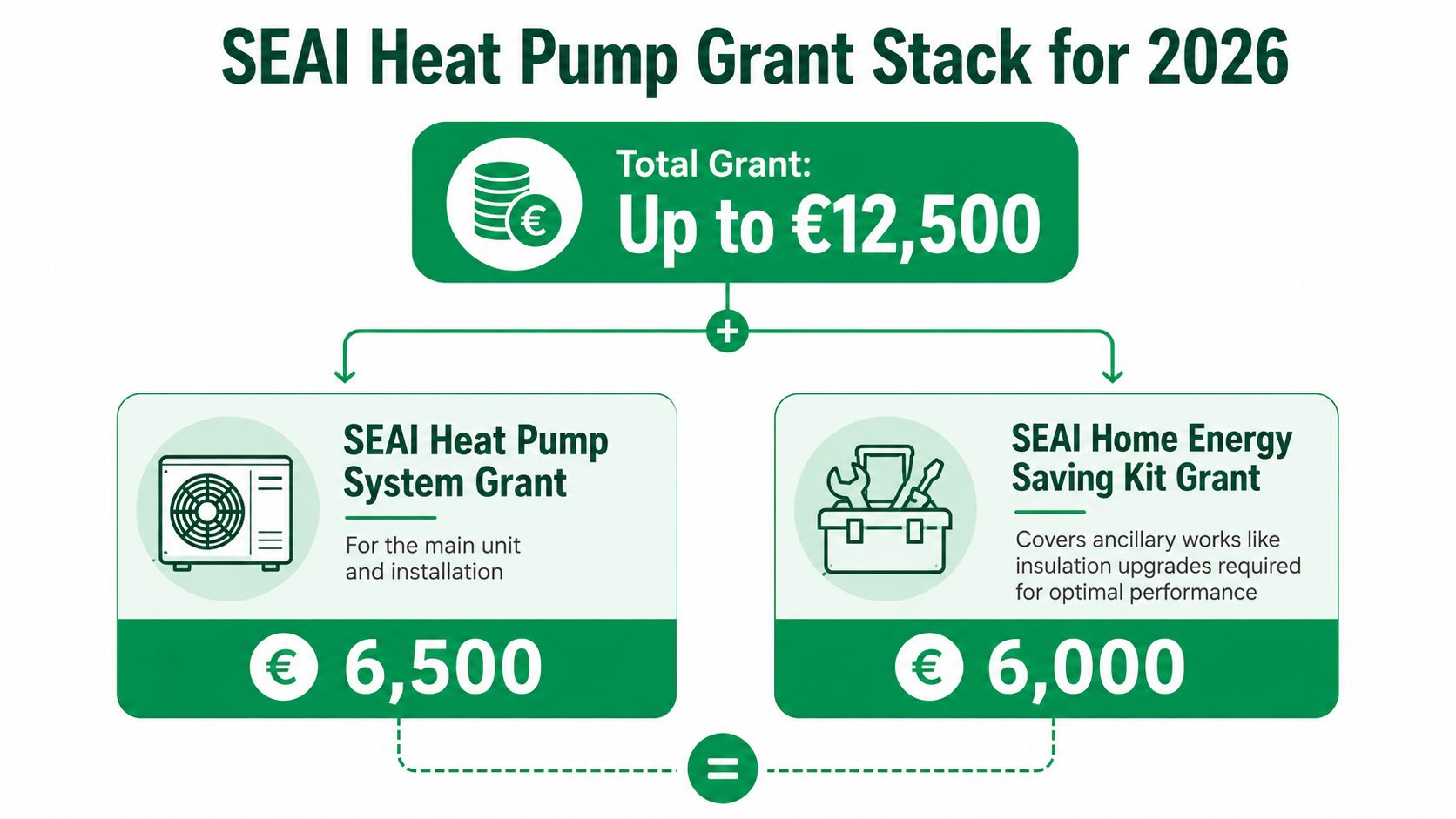
The headline price gets stripped back to the bit that matters, the amount the homeowner has to find after grant support. The SEAI Heat Pump System grant is worth up to €12,500, and that is why a project that looks steep on paper can become far more manageable once the grant stack is applied properly.
What the stack contains
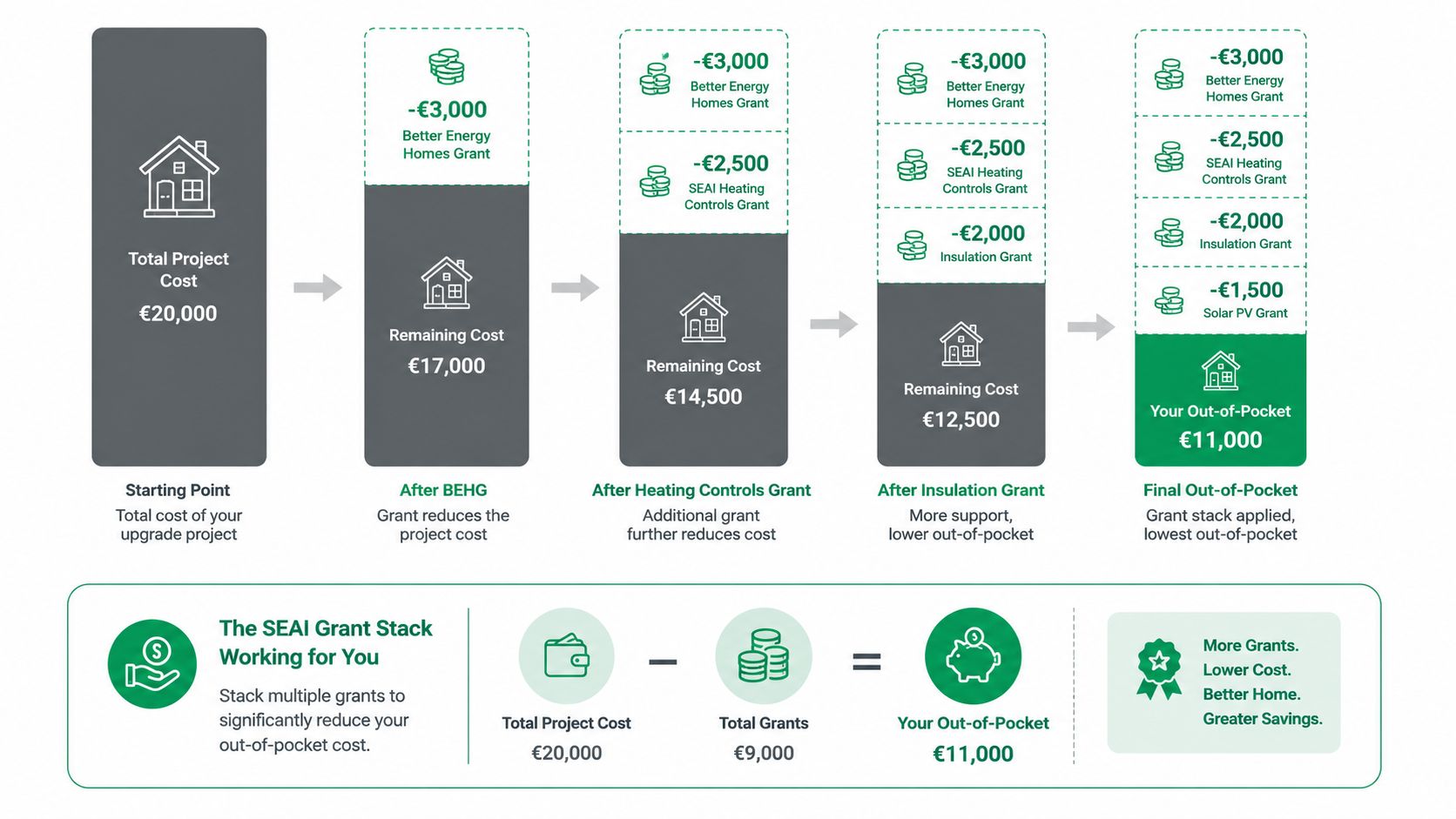
The support is split across the job, not handed over as one blanket payment. The package can include €6,500 for the heat pump, €2,000 for central heating upgrades where needed, and a €4,000 Renewable Heat Bonus when the home is moving off oil, gas, solid fuel, or electric storage heating. There is also a €200 Technical Assessment grant and €50 towards the post-works BER. That combination can make a real dent in the bill, but only where the home qualifies for the full route and the work is handled in the right sequence (SEAI system grant details).
Hard rule: grant approval has to be in place before work starts.
The sequence matters because the grant is tied to the assessment, the upgrade path, and the sign-off at the end. A homeowner who skips the assessment stage is not just missing paperwork, they are risking the whole application. A proper BER assessor and energy rating service is part of getting that pathway right, because the house has to be documented before the system is installed, not after.
The eligibility rules that matter
The installer has to be SEAI-registered, and the home must have been built and occupied before 2021. That is not admin for the sake of admin. It decides whether the project is treated as a qualifying retrofit or just a straight equipment change, and the grant only follows the qualifying route.
The cap catches people out on replacement work. If the job is replacing an existing heat pump, the grant is capped at €6,500 for most homes and €4,500 for apartments. There is no Renewable Heat Bonus and no central heating grant on that route. Owners who assume a like-for-like swap gets the full stack are usually the ones who get a nasty surprise when the quote comes back.
A good quote should show the grant position clearly, line by line. It should separate the system cost, the qualifying add-ons, and the final amount the homeowner is expected to pay. If the before-and-after figures are blurred together, the scope is muddy and the number is not worth trusting.
Two Worked Examples for a Typical Irish Home
These are typical illustrations, not real quotes, not invoices, and not platform data. They show how the same grant can produce very different outcomes once the house, emitters, and bonus eligibility are taken seriously.
Example one, a three-bed semi with the cylinder already sorted
A three-bed semi with a suitable cylinder already in place and a straightforward retrofit scope can land around €12,000 to €18,000 before grant. Where the home qualifies for the full SEAI stack, the out-of-pocket figure can fall to roughly €1,500 to €5,000.
That is the kind of result homeowners expect when the property is already reasonably prepared. The quote still has to include the right controls, commissioning, and electrical checks, but the bill is lighter because fewer upgrade items are being added on top.
Example two, a four-bed detached needing more work
A four-bed detached with emitter upgrades and a cylinder swap usually lands higher, around €14,000 to €18,000+ before grant. After the grant, the homeowner might still be looking at roughly €1,500 to €7,500 out of pocket, depending on whether the full stack is available and how much retrofit work sits around the unit.
The difference is not the brand on the box. It's the house. More rooms mean more emitters, more pipe runs, and more system capacity. A cold, draughty home also pushes the price up because the installer has to solve the heat-loss problem instead of pretending it doesn't exist.
What the examples prove
The same grant does not produce the same final price in every house. A tidy retrofit with the right conditions can leave a much smaller balance, while a larger or leakier home stays noticeably dearer even after support. That is why the cheapest quote on a cold house is usually the incomplete one.
Running Costs, VAT and How to Think About Payback
Upfront cost is only half the question. Once the system is in, the true test is whether it runs sensibly and whether the household can make the numbers work against what it used to burn.
Running costs depend on control, weather and demand
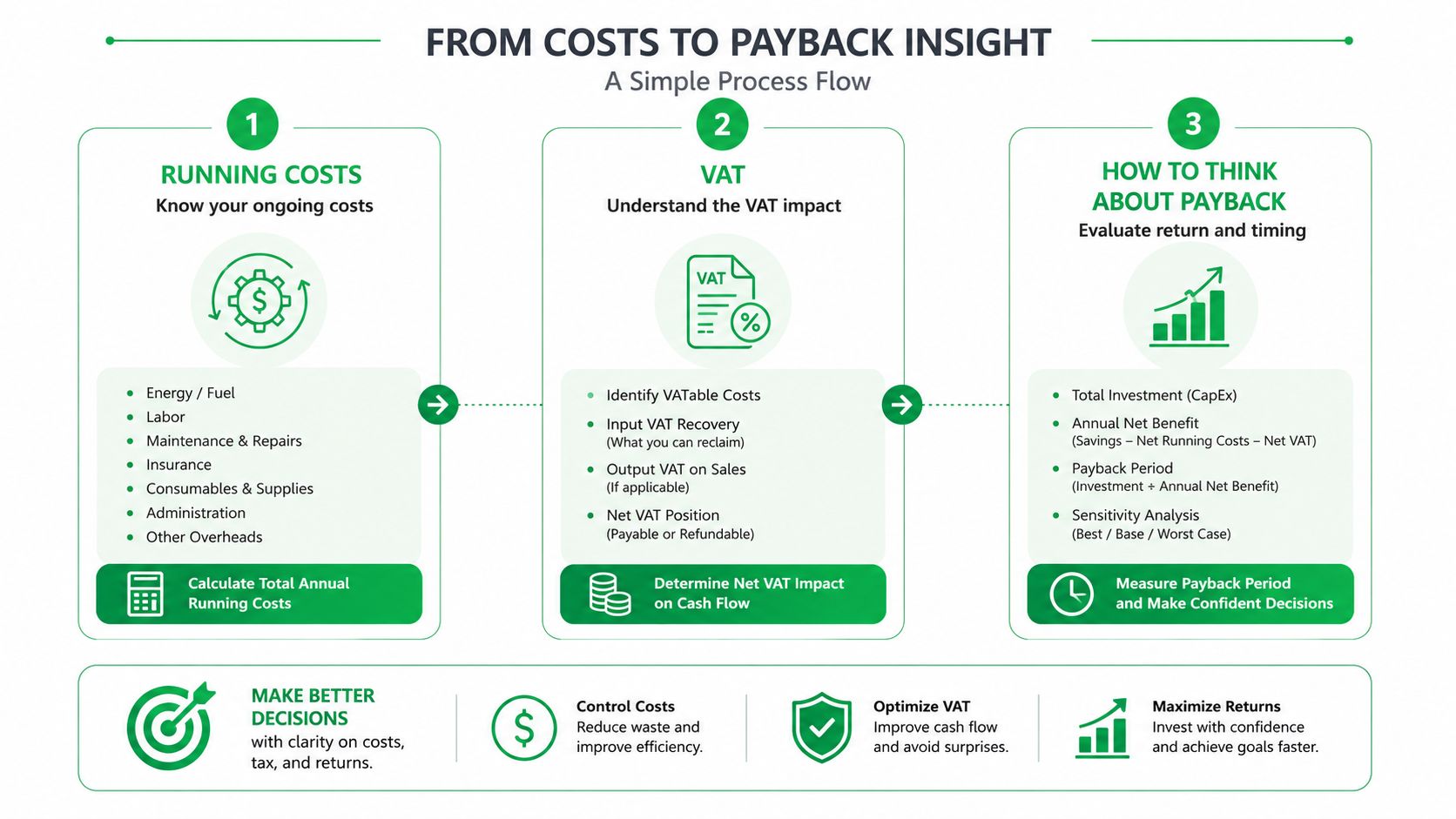
An air-to-water heat pump typically delivers several units of heat for every unit of electricity used, but the exact running cost depends on the home's heat demand, the tariff, and how the system is controlled. A well-tuned system in a decent envelope behaves very differently from one in a draughty house with the thermostat left to fight the building all day.
VAT still matters on the invoice
Most domestic heat pump installation work in a residential dwelling is subject to 13.5% VAT, and any quote should show whether VAT is included. Residential solar PV is a different category and has been 0% since May 2023, so homeowners shouldn't let anyone blur those rules together. The quote has to be read line by line, not guessed at from the headline total.
Payback should be treated as a simple formula
The clean way to think about payback is straightforward. Out-of-pocket cost minus realistic annual running-cost savings gives the payback framework, and the comparison should be against the system being replaced, whether that's oil, gas, or electric storage heating. The key is to use real household usage, not someone else's anecdote.
SEAI approval also affects financing sequencing, because approval needs to be in place before work starts. That means the homeowner should line up the assessment, the grant pathway, and the quote acceptance in the right order, rather than signing first and hoping the paperwork catches up later.
Comparing Heat Pump Quotes and Choosing an Installer on ShamFix
A proper comparison starts with the paperwork, not the sales pitch. The installer should be SEAI-registered for the grant path, Safe Electric registered for electrical work where relevant, and RGI registered if gas is being decommissioned. Those are the registrations that matter to the homeowner, because the trade carries responsibility for its own compliance.

What a serious quote should spell out
The quote should name the unit, cylinder, emitter changes, electrical work, condensate drainage, controls, and commissioning. It should also list exclusions in plain English, including scaffold, access, making good, waste removal, and any insulation work. If VAT is included, that should be stated clearly.
A homeowner should also ask who handles the SEAI paperwork and what commissioning documents will be handed over at the end. That paperwork matters because a heat pump is only as good as the set-up and the record of what was done.
Check registrations first: SEAI for the grant path, Safe Electric for electrical work, and RGI where gas is involved.
Demand a written scope: the quote should say exactly what's included and what's excluded.
Ask about VAT: the total should make clear whether VAT is inside or outside the price.
Request proof and completion docs: insurance, references, and the commissioning report should be part of the handover.
Compare like for like: if one installer includes the cylinder and another doesn't, the cheaper number is not cheaper.
ShamFix can be used to collect local quotes and read two-sided reviews from other homeowners, which is useful when the installer list is growing and the price spread is wide. It does not replace the homeowner's own checks, but it does make comparison less messy.
Are you a heat pump installer in Ireland? Listing is free during Phase 1, with 0% commission and no per-lead credits. Join ShamFix so your business can be among the first found as local demand grows.