Gas fireplace servicing in Ireland is regulated work that must be carried out by a Registered Gas Installer (RGI), and annual servicing is the standard recommendation for a domestic gas fire in regular use. That matters because carbon monoxide still kills an average of six people in Ireland every year, so a gas fire service is a safety check on combustion, flueing and shut-off systems, not just a clean-up.
A lot of householders only think about the fire when the weather turns cold, the pilot won't stay lit, or a black mark appears above the surround. That's usually the moment the job stops feeling cosmetic and starts feeling urgent. In practice, a proper gas fireplace service is about making sure the fire is burning correctly, venting safely and leaving a written record behind if questions ever come up later.
find registered gas installers and post your job
What a Gas Fireplace Service Is in Ireland
You turn the fire on for the first proper cold evening of the year. The flame catches, but it looks uneven, there's a faint smell you can't place, and you start wondering whether the appliance is merely dusty or whether something more serious is going on.
That is the job of a gas fireplace service in Ireland. It is a safety inspection, a performance check, and a written record of the condition of the fire, the gas supply feeding it, and the route the fumes take out of the house.
Under the Irish gas safety rules, domestic natural gas work such as servicing and repair must be carried out by a Registered Gas Installer, with limited exceptions set out in the Commission for Energy Regulation decision paper. For a householder, the practical point is simple. If someone is opening the appliance, testing it, adjusting it, or signing it off as safe, that is regulated gas work.
A proper service goes well beyond cleaning the visible parts. The installer is checking whether the fire is burning the right amount of gas, whether the flue is carrying combustion products away properly, and whether safety devices still do their job if the room conditions change. Those checks tie directly to carbon monoxide risk. If a fire is burning badly or spilling fumes back into the room, the problem is no longer about heat output or appearance.
The service usually includes checks such as:
- Gas rate and operating pressure, to confirm the appliance is being fed correctly
- Flue performance and spillage testing, to see whether fumes are leaving the room as they should
- The oxygen depletion sensor, which is designed to shut the fire down if the air conditions around it become unsafe
- Burner, pilot and ignition condition, to spot poor combustion or unreliable lighting
- Seals, glass and closure panels, where fitted, to make sure the appliance is still sound
- Service paperwork, so there is a record of what was checked, what was found, and whether any further work is needed
Gas Networks Ireland says gas appliances and pipework should only be installed, serviced, checked, repaired or removed by an RGI, and it recommends regular servicing on its boiler and appliance service safety page.
The paperwork matters more than many homeowners realise. If there is ever a safety query, a claim after damage, or a question from an insurer, “someone had a quick look at it” is not much use. A dated service record from an RGI is the part that shows the appliance was examined as a gas appliance, not just cleaned like a decorative feature.
What the RGI Actually Checks During the Visit
A proper service is more like an MOT than a quick clean. The RGI is not only looking for dirt or a part that has worn out. They are checking whether the fire is burning the right amount of gas, sending fumes up the flue, and shutting itself down if room conditions become unsafe.
The visit normally starts with the appliance made safe, then opened up as far as the model allows. Before any instruments come out, the installer studies the fire itself, the area around it, and the visible flue route. A lot can be learned from marks and wear alone.
First look at the appliance and the room
This first inspection often gives the early warning signs. Soot on the glass, staining above the opening, fluff around the pilot, cracked fuel-effect pieces, damaged seals, or a covered air vent can each point to a combustion or flue problem.
Common faults on domestic gas fires include:
- Dust or lint blocking burner ports or the pilot assembly
- An oxygen depletion sensor that is dirty or drifting out of tolerance
- Worn glass or door seals on glass-fronted models
- Debris, bird nesting or other restriction in the flue
- A weak thermocouple or failed ignition electrode
- Glass sooting or flame staining that suggests incomplete combustion
A yellow, lazy flame is a warning sign. So is any sign that fumes may have spilled back into the room.
Gas rate and working pressure
Next comes the part many householders never see explained. The installer checks gas rate and working pressure.
Gas rate is how much gas the fire is using while it runs. Working pressure is the pressure available at the appliance under load. If either is wrong, the fire may still light and produce heat, but it may not be burning cleanly. A bit like a cooker ring with too much or too little gas, it can look near enough right while still operating badly.
That matters because carbon monoxide risk often starts here. An under-supplied or over-supplied appliance can produce an unstable flame pattern, poor combustion, and extra soot. The service is meant to catch that before it turns into a room safety issue.
Flue flow and spillage testing
The flue check is one of the most serious parts of the visit. The question is plain enough. Are the combustion gases getting out of the house, or are they spilling back into the room?
On an open-flued gas fire, the RGI may carry out a smoke test, a spillage test around the diverter area, or other checks suited to the appliance. Different fires call for slightly different methods, but the goal is the same. The fire must discharge safely.
If a spillage test fails, the appliance should not be treated as a small nuisance. It may be putting combustion products into the living room. That is the point where carbon monoxide stops being an abstract warning and becomes a real household risk.
The practical consequence for a householder is that the installer's registration number should be confirmed before the appointment is made, not after the work has been done.
Oxygen depletion sensor and shut-off behaviour
Many gas fires have an oxygen depletion sensor built into the pilot assembly. It works like a guard standing at the door. If the air conditions around the fire become unsafe for proper combustion, it is designed to stop the gas flow.
During the service, the installer checks that this safety device is behaving properly and that the pilot remains stable. If the pilot drops out again and again, the cause might be dirt, a weakening thermocouple, a sensor fault, or poor combustion affecting the pilot flame itself. Guesswork is no use here.
Seals, ignition and burner condition
The last stage is the hands-on check of the working parts. The burner is inspected, the pilot area may be cleaned, ignition is tested, and the fire is reassembled and relit if it is safe to do so.
The RGI is looking for:
- A steady pilot flame
- Reliable ignition
- A clean, even flame picture across the burner
- No leaks at joints or disturbed fittings
- Sound glass, panels and seals where the design uses them
Then comes the bit homeowners often underestimate. The paperwork. If the fire fails a safety check, needs remedial work, or is safe to return to use, that should be recorded clearly. In Ireland, that record can matter later if there is a safety complaint, a carbon monoxide question, or an insurance claim after damage. A verbal “it looked grand” does not carry much weight. A dated service record from an RGI does.
How Long a Service Takes and What to Expect
You book a routine service expecting a quick clean and a tick on a form. Then the installer spends longer than expected at the fire, testing, waiting, relighting, and writing notes. That usually means the visit is being done properly, not dragged out for show.
For one domestic gas fire, a normal service often takes around 45 minutes to an hour from arrival to written record. If the appliance is easy to reach and everything behaves as it should, it can be shorter. If the pilot is dirty, the flue test is slow to settle, or the engineer needs to confirm why the fire has been cutting out, the visit can run longer.
A proper service has a rhythm to it. First comes a quick chat about what you have noticed in day-to-day use. After that, the fire is isolated and opened up. Then the checks are carried out in order, followed by cleaning where needed, reassembly, relighting, and paperwork at the end.
What you see from the room is only half the story. Some of the most important parts are the quiet ones. Waiting for readings to stabilise. Checking for flue spillage. Confirming the gas rate matches what the appliance is meant to burn. Making sure safety devices shut the fire down if conditions become unsafe. Those steps are part of how an RGI works out whether the fire is safe to leave in use, especially where carbon monoxide risk is concerned.
What the householder can expect on the day
- A short conversation first. If the fire has been sooting, smelling odd, going out, or leaving marks above the opening, say so early. Small clues help explain what the later tests are showing.
- Safe access to the appliance. The engineer will turn off what needs turning off, remove the front or case as the model allows, and get access to the burner and pilot area.
- Testing, then hands-on work. This is usually the longest part. It may include supply checks, combustion-related safety checks, and flue performance checks before anything is cleaned or adjusted.
- Cleaning and reassembly. Dust, lint, and debris around the pilot and burner can interfere with proper operation, so these areas are dealt with carefully rather than given a quick wipe.
- Relight and final checks. Once reassembled, the fire is tested again in operation.
- Written outcome. You should be told clearly whether the appliance is safe to use, needs repair, or must remain off.
That last part matters more than many homeowners realise.
If the fire fails a safety check, the visit can stop being a routine service and become a safety call. An issue with flue pull, incomplete combustion, or an oxygen depletion sensor that is not behaving properly is not the sort of thing an installer should shrug off. In Ireland, the written record of what was found and what advice was given can matter later if there is a carbon monoxide concern, a dispute about whether the appliance was safe, or an insurance claim after damage.
What can make the visit run over
The usual reasons are straightforward enough:
- Poor access to the fire or chimney opening
- A pilot or burner area clogged with dust or lint
- A flue spillage test that raises concern
- Intermittent ignition or a pilot that will not hold
- Damaged seals, loose fittings, or worn parts
- Any result that needs to be checked twice before the fire is put back into service
Parts can add time as well, though often not on the same visit. A standard service fee usually covers the inspection, testing, routine cleaning, and paperwork. If a thermocouple, seal, or other component needs replacement, that is usually repair work rather than part of the basic service.
The practical point is simple. The fire may be switched off for only a short while during a normal appointment. If the service uncovers a fault tied to combustion or flue safety, it should stay off until the problem is fixed. That is inconvenience, yes, but it is also the difference between a room heater that is safe to use and one that could spill carbon monoxide back into the house.
Warning Signs That Mean an Earlier Service Call
You light the fire on a cold evening, and something feels off. The flame looks wrong, the room feels a bit heavy, or the pilot drops out again. That is the point to stop using it and get it checked sooner, not wait for the annual date in the diary.
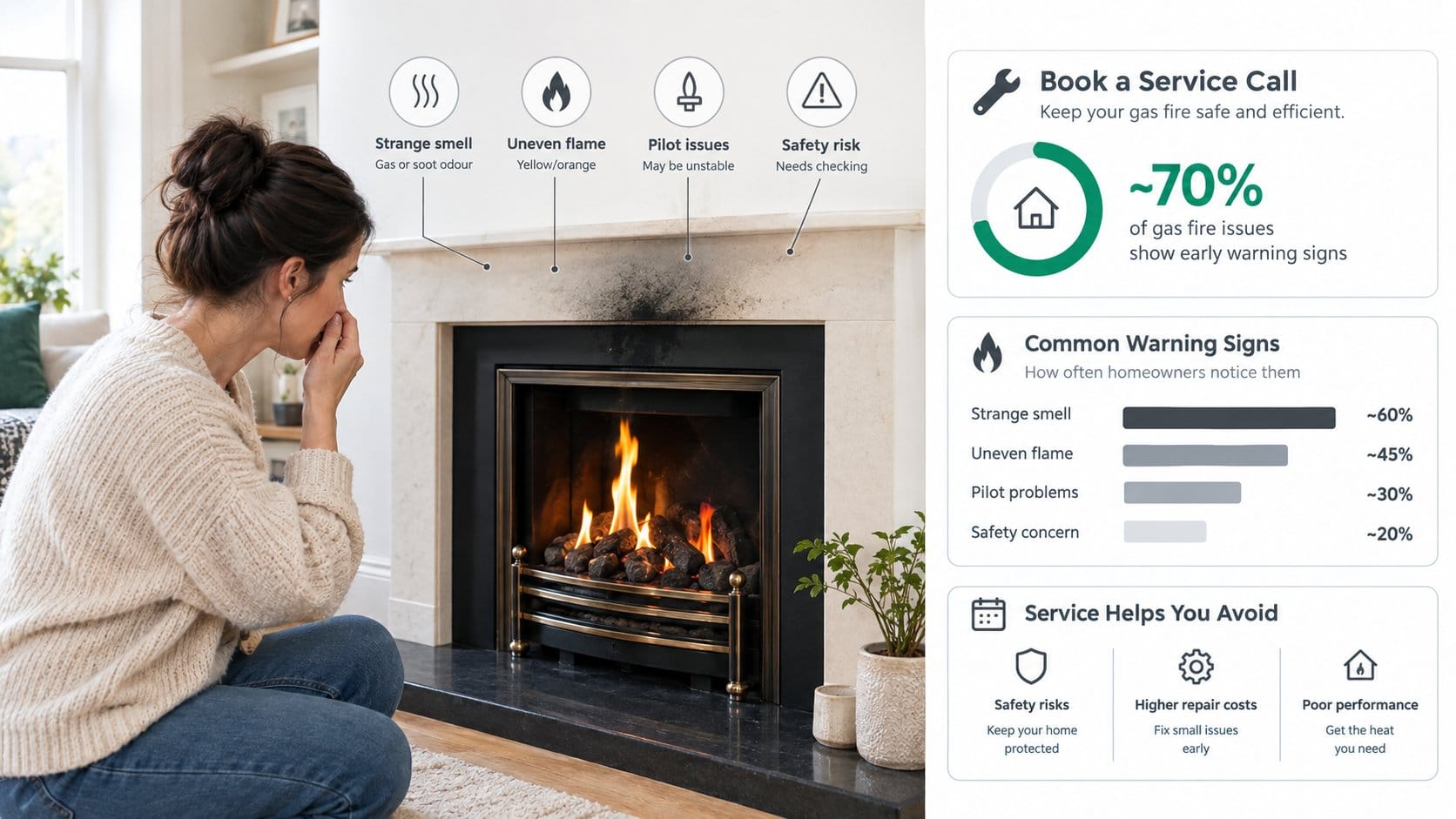
A gas fire usually gives a few clues before a fault shows up on a test. Some of those clues point straight at the checks an RGI will do during service, especially flue spillage, gas rate, and whether the oxygen depletion sensor is shutting the appliance down as it should. If one of those parts of the safety chain is off, carbon monoxide risk can rise without much warning.
Signs you can see
Marks around the fire opening matter. Stains, soot or discolouring around a gas fire are a recognised warning sign that may point to a blocked flue or chimney.
Other visual signs often mean the fire is not burning as cleanly as it should:
- A lazy yellow or orange flame where the normal flame picture should be sharper and steadier
- Blackening on the glass or soot deposits around the fuel bed or front of the fire
- Condensation or dampness after lighting
- A pilot flame that will not stay lit
- Burn marks or staining above the appliance opening
A flame change matters because the burner needs the right mix of gas and air, much like a cooker ring that burns cleanly when it is set up properly. If that balance is off, the RGI may find over-gassing, poor aeration, dirt in the burner, or a flue problem affecting combustion.
Signs you can smell
Any unusual smell during operation deserves respect.
The first question is simple. Does it smell like gas, or does it smell like fumes, damp soot, or stale combustion products? A householder does not need to diagnose which is which, but that difference helps you judge urgency.
- If you smell gas, stop using the appliance and treat it as urgent.
- If the smell appears only when the fire is running, switch it off and book a prompt service visit.
- If the smell is new after months or years of normal use, do not assume it will clear by itself.
That smell can tie back to the same service checks already discussed. A spillage test can show whether fumes are leaving through the flue as they should. The oxygen depletion sensor is there to cut the fire off if room conditions become unsafe. If the appliance is smelling odd and cutting out, that safety device may be reacting to a real problem rather than acting up.
Signs you notice while using it
Some faults show themselves in behaviour rather than marks or smells.
Book an earlier call if:
- The fire cuts out during use
- The pilot keeps going out
- The room feels stuffy or headache-inducing when the fire is on
- The flame picture has changed from what you are used to
- Ignition has become unreliable
- You have moved into the house and there is no recent service record
The oxygen depletion sensor is a good example here. It works a bit like a guard at the door. If the room conditions are wrong, it should stop the fire. Repeated shutdowns do not automatically mean the sensor itself is faulty. They can mean the appliance is starved of air, the flue is not clearing products of combustion properly, or the fire is burning poorly.
One more plain point. If there is ever a carbon monoxide concern, the written record of when the fire was checked, what fault was found, and whether the appliance was turned off can matter later with insurers as well as from a safety point of view in an Irish home.
Typical Service Cost in Ireland
A routine gas fire service in Ireland usually sits around €80 to €150 including VAT for a straightforward visit on a standard domestic appliance, with no parts fitted and no repair work needed. That band is an aggregate Irish market estimate rather than a published tariff, so treat it as a working range and not a fixed price. The final figure often depends on where the house is, how awkward the fire is to access, and whether the appliance can be serviced in the normal way or needs extra investigation.
That price is for more than a quick wipe and a glance at the flame. A proper service includes the checks that tell an installer whether the fire is burning safely and whether fumes are leaving the room as they should. If a quote looks unusually cheap, ask a plain question. Does it include the safety testing, the written record, and VAT, which on this kind of domestic repair and maintenance work is normally the reduced 13.5% rate?
What the service fee normally covers
In most cases, the service charge covers:
- Call-out and time on site
- Routine safety checks and operating checks
- Basic cleaning within the service scope
- Testing and putting the appliance back into service if it is safe
- Written service paperwork
That paperwork matters. If there is ever a carbon monoxide concern, a dispute after a fault, or an insurance question after damage in the home, the record shows what was checked, what was found, and whether the fire was left safe to use.
Repairs are normally separate from the service fee. If the installer finds a failed part or a safety problem, the visit can turn from a service into a fault call.
Common extras include:
- Replacement parts, such as a thermocouple, oxygen depletion sensor, seals, ignition components, or glass where applicable
- Repair labour beyond the normal service visit
- Follow-up work if the flue or chimney arrangement needs further investigation
That is one reason two households can get very different bills from what sounded like the same job on the phone.
| Item |
Typical Irish Range |
What It Covers |
| Routine annual gas fire service |
€80 to €150 including VAT |
Standard visit for a domestic gas fire, including normal checks, basic cleaning and written record |
| Replacement parts |
Quoted separately |
Items such as seals, thermocouple, oxygen depletion sensor, ignition parts or glass |
| Remedial repair work |
Quoted separately |
Extra labour if a defect is found during the service |
| Flue or chimney-related follow-up |
Quoted separately |
Further checks or corrective work if venting raises concern |
A gas fire service and a boiler service are not interchangeable, and the two jobs should be kept separate. A boiler and a gas fire both burn gas, but the fault pattern is different, and the risk checks on a room-sealed boiler are not the same as the checks on an open-flued fire sitting in a living room.
A cheap quote can cost more later if it skips the flue test, misses a poor gas rate, or leaves you with no paperwork to show the appliance was properly checked.
Preparing for the Visit and After the Engineer Leaves
The easiest service visits usually start before the engineer knocks. If the fire is boxed in by furniture, the meter is hard to get at, or nobody can say what fault has been happening, time gets burned on access and guesswork instead of checks.
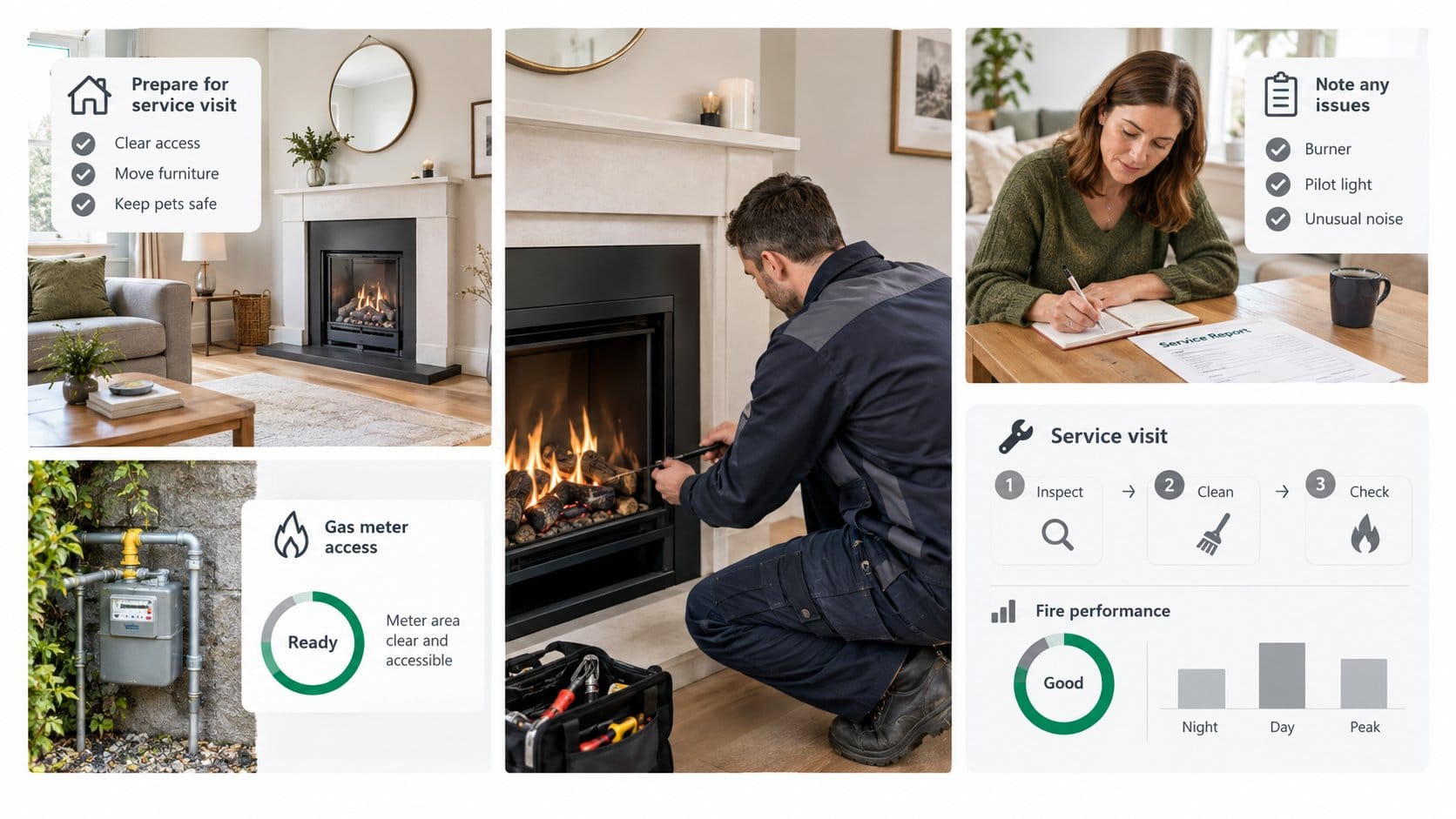
A good way to look at it is this. The engineer is trying to build a clear safety picture of one appliance on one day. The more plainly the setup and recent history are laid out, the easier it is to confirm whether the fire is burning properly, venting properly and shutting down properly if something goes wrong.
Before the appointment
Start with access. Move chairs, logs, baskets, ornaments and anything else away from the fire and hearth area. If the meter is in a press, under stairs or outside in a box, make sure it can be reached without delay.
Have any old paperwork nearby if you still have it. Previous service sheets, repair notes and the appliance manual can help if the engineer needs to check model details, earlier defects or past parts changes.
Keep pets and small children out of the room while the fire is being worked on. Parts may be removed, test equipment may be set up, and the appliance can be left open for a time.
One more thing helps more than people expect. Write down the fault as if you were explaining it to someone over the phone. “Pilot lights but main burner does not stay on” is far better than “acting up again”. Small details often point towards the right check straight away, whether that is gas rate, ignition, flue behaviour or the oxygen depletion sensor.
What to look for before the engineer leaves
Do not just take a quick “that's grand now” at the door and leave it at that. Ask what was checked, what was found and whether the fire was left safe for normal use.
The paperwork matters because it is the written version of the visit. It should identify the appliance, record the checks carried out, note any defects and make the outcome clear. Safe to use, further work needed, or unsafe to use should not be left vague.
If a fault was found, the report should say what the fault is in plain terms. If the engineer has concerns about combustion, flue pull, spillage, burner condition or a safety device such as the oxygen depletion sensor, get that written down. Carbon monoxide problems are often about a chain of smaller faults rather than one dramatic failure, so the wording matters.
Irish gas safety guidance treats servicing as regulated work with RGI responsibility, and RGI guidance for householders also frames annual gas appliance servicing and safety inspection as part of the same broader safety routine in its consumer gas safety leaflet.
Why the record matters after the visit
A service record is not just a receipt. It is closer to a snapshot of the appliance's safety condition on that date.
That becomes important later if there is a breakdown, a landlord and tenant disagreement, or an insurance query after smoke or carbon monoxide concerns. In Ireland, insurers often want to see that gas appliances were maintained properly. If there is no paper trail, you are left trying to prove something after the fact, which is never the easy moment to start looking.
For landlords, keep the report with the tenancy and maintenance file. For owner-occupiers, keep it with the rest of the home documents and take a photo of it as a backup.
If the paperwork says remedial work is required, leave the fire off until that work is done. Ask for the defect to be itemised clearly, ask what parts of the appliance were affected, and keep the follow-up record with the original report once the job is finished.
see the wider category and post a task
Annual Service in the Wider Home Safety Picture
You book the gas fire service, the engineer leaves, and the house feels sorted for another year. Fair enough. But a gas fire sits inside a wider safety chain, and that chain is only as strong as its weakest link. If the flue is restricted, the wall vent has been covered, or the CO alarm battery is flat, the service record on its own will not protect the people in the room.
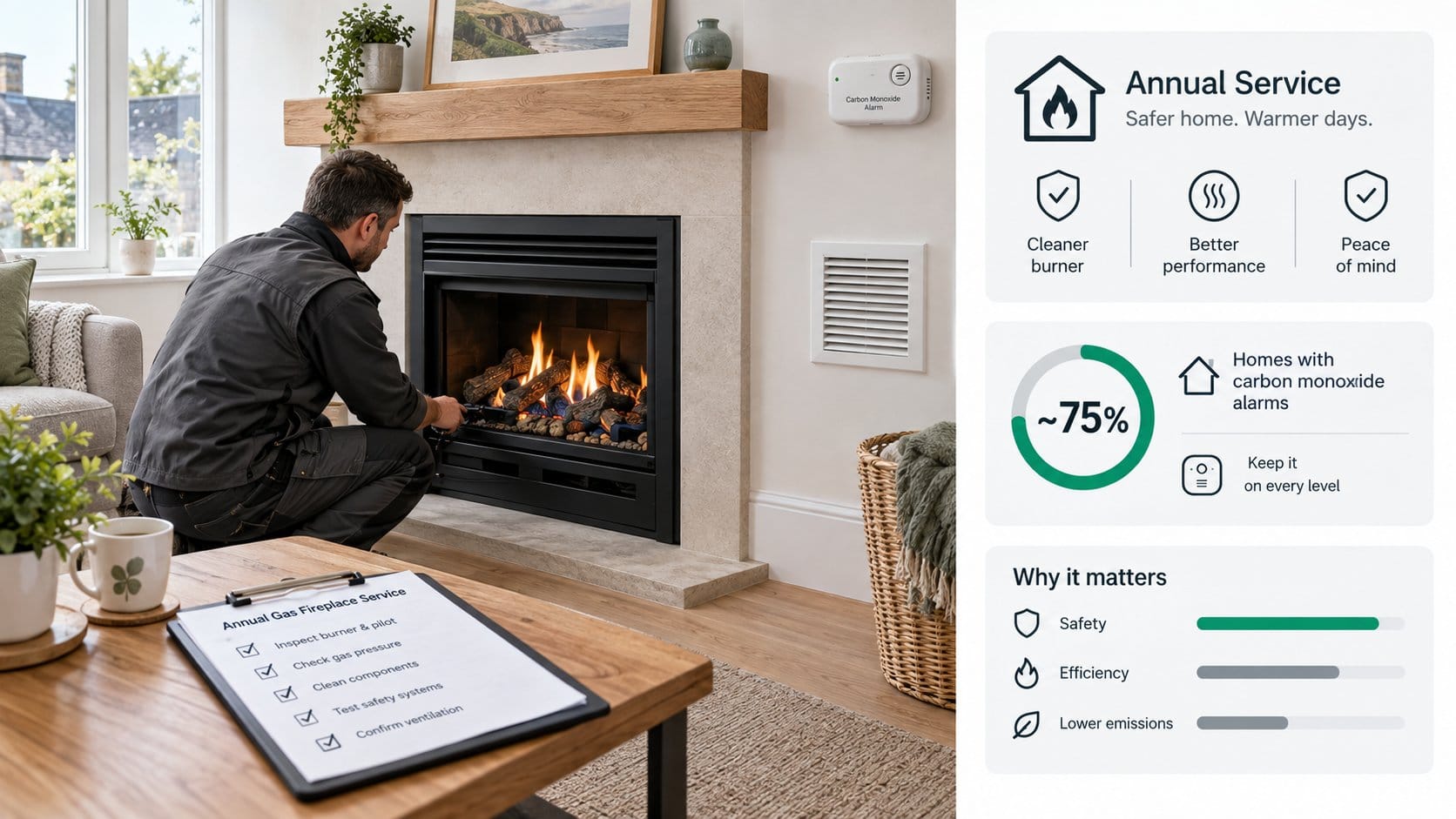
Carbon monoxide alarm, ventilation and flue condition
In the Republic of Ireland, guidance linked to building regulations requires carbon monoxide alarms for new or replacement open-flued or flueless combustion appliances. The alarm must comply with I.S. EN 50291. The document that applies in Ireland is Technical Guidance Document J to the Building Regulations, published on gov.ie, which also sets out where alarms should be fitted in homes with these appliance types. That guidance, rather than a manufacturer's summary, is the one to check.
That matters more than homeowners often expect. An open-flued gas fire works a bit like a chimney-driven breathing system. It needs the right air coming in and the right fumes going out. Change the room, and you can change the fire. New windows, a blocked vent, a chimney obstruction, or even decorating work around the fireplace can upset that balance.
Gas Networks Ireland appliance safety guidance advises householders to keep flues and chimneys clear and never block room ventilators. A properly placed and regularly tested CO alarm gives you an early warning. It does not replace servicing, and it does not fix a poor flue pull or a ventilation problem.
Why faults are often found at service time
This is the part that ties the annual service to real risk.
During a proper visit, the RGI is not only cleaning and checking visible parts. They are looking at whether the fire is burning cleanly, whether fumes are going where they should, and whether safety devices still react properly if conditions turn unsafe. If the gas rate is off, the appliance can burn badly. If a flue spillage test fails, combustion products can enter the room instead of leaving through the chimney or flue. If the oxygen depletion sensor is weak or failing, the fire may not shut down as it should when the room air becomes unsafe.
That is how carbon monoxide risk can build in an ordinary sitting room without much drama first.
The warning signs are often small:
- Sooting or discolouration on the glass
- A lazy yellow flame
- A pilot that won't stay lit
- A room that feels wrong when the fire is running
Those signs do not diagnose the fault on their own, but they are enough reason to stop using the fire and get it checked.
If a broader household safety concern is also in the picture, such as uncertainty about fixed wiring, it should be booked as a separate inspection with the right trade rather than folded into the gas fire visit.
The annual checklist that actually matters
A sensible autumn routine for a home with a gas fire is simple:
- Book the annual gas fireplace service
- Test the CO alarm
- Make sure vents haven't been blocked or covered
- Pay attention to stains, fumes, or odd smells near the fireplace or flue route
- File the service report where it can be found later
The paperwork matters here as well. If there is later a breakdown, a tenant dispute, or an insurance query after smoke or carbon monoxide concerns, being able to show that the fire was serviced and any defects were followed up puts facts on the table. In Ireland, that can make an awkward conversation much more straightforward.
A short final note on using the platform. The how ShamFix works for homeowners and for providers page explains the basic setup. A customer posts a task describing the job, the area and the timing, then receives responses from local providers. A tradesperson or company can register as a provider, list the services they cover and respond to tasks in their area. Profiles are self-filled and ShamFix does not vet or verify providers, so the householder still checks the RGI registration themselves before any gas work starts.
If the fire is due a service, has started sooting, or needs remedial work after an inspection, ShamFix gives householders one place to describe the job and hear back from local providers. It suits this kind of work because a gas fire service often starts as a routine check and turns into follow-up repair, parts replacement or a second visit once the fault is identified.