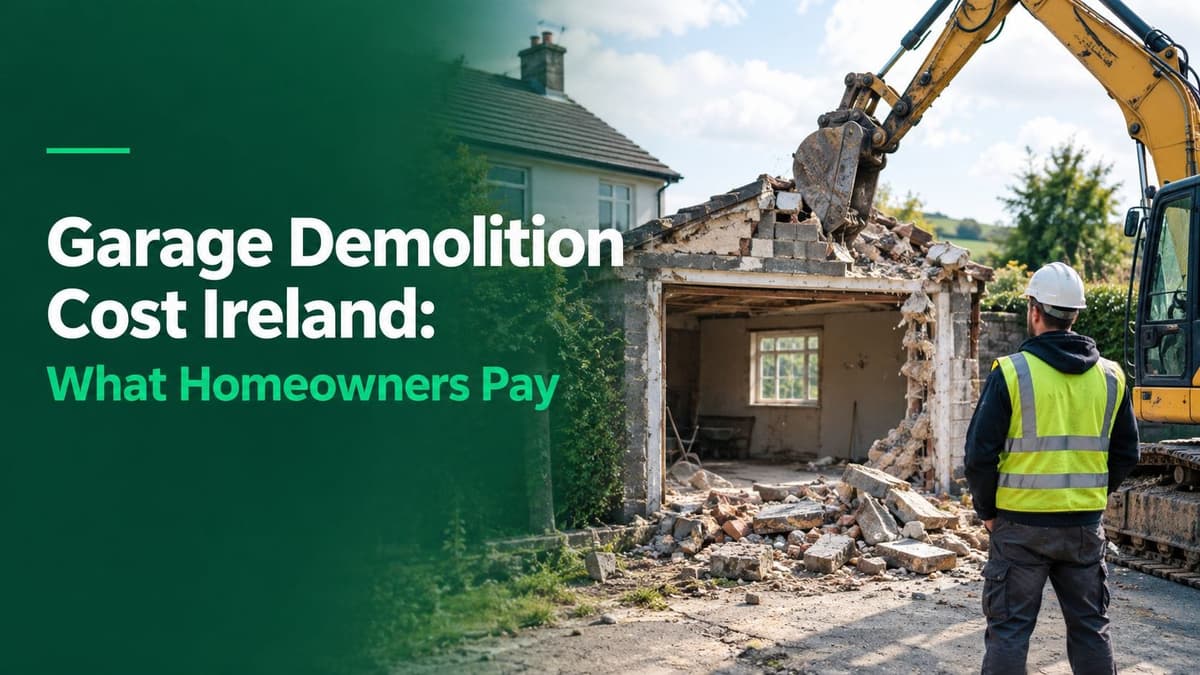
A standard garage demolition in Ireland usually lands at €2,000 to €4,000 for the knock-down, with waste handling and site access often deciding where a job ends up inside that band. If the garage has asbestos-cement roofing or panels, the final figure can climb sharply, and that is the line item that most often turns a manageable job into a costly one.
Find demolition contractors and post your job
A homeowner looking at an old block garage, a prefab outbuilding, or a detached structure tucked behind the house needs the blunt answer first. The visible building is rarely the whole bill. Asbestos removal, skip hire, slab break-out, and making good are the parts that move the quote.
How Much Garage Demolition Costs in Ireland Right Now
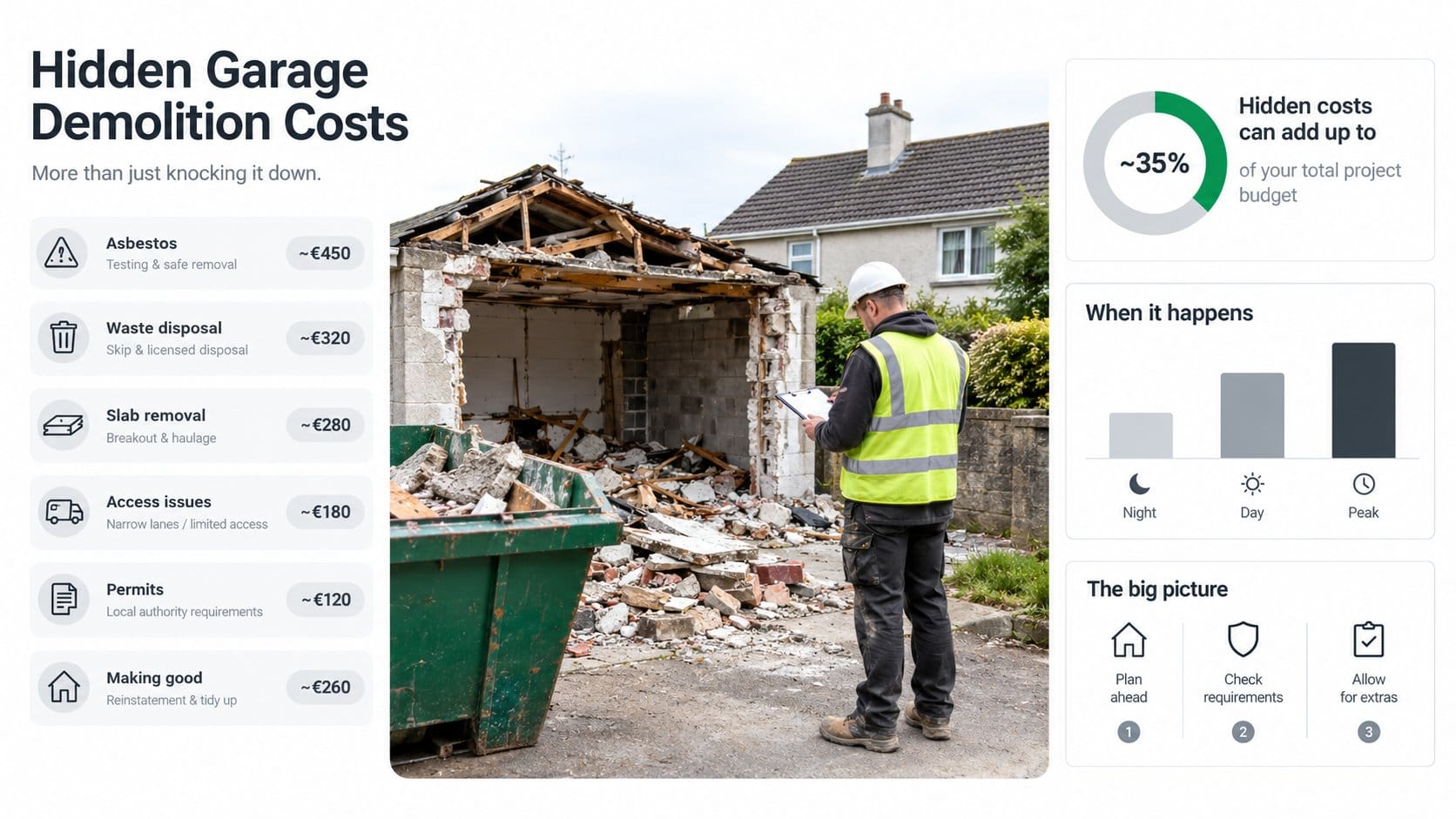
A typical Irish garage demolition guide puts a standard garage at €2,000 to €4,000, but that should be read as the base knock-down price, not the finished bill, because the same guide says skip hire adds about €300 to €600 per skip and asbestos removal can add €2,000 to €10,000 depending on extent. In plain terms, the cheap quote is often only the structure coming down, not the messy end of the job. The written quote after a site visit is the only figure worth trusting for a real property.
Practical rule: if the price looks tidy and the garage is older, assume something has been left out until the contractor states otherwise in writing.
The headline price normally covers labour, machine time, and basic waste handling. It often does not cover breaking out the concrete slab, removing foundations, dealing with asbestos, traffic management, or reinstating the ground after the garage is gone. That is why two garages that look similar from the street can produce very different quotes.
Irish rebuilding guidance helps explain the scale of the structure being removed. The Society of Chartered Surveyors Ireland lists garage allowances of about €24,480 for a single attached garage and €43,790 for a double attached garage on average,. Those are rebuild figures, not demolition figures, but they show why size, construction type, and whether the slab comes out all affect the end price.
| Garage Scenario | Indicative Price (€) | Main Cost Driver |
|---|---|---|
| Standard single garage | 2,000 to 4,000 | Labour, machine time, skip hire |
| Older garage with asbestos roof or panels | 4,000 to 10,000+ | Survey, licensed removal, waste treatment |
| Larger double garage | Higher than a single garage | Extra volume, more waste, more labour |
| Tight-access or slab-out job | Higher than a basic knock-down | Manual work, slab break-out, making good |
Most straightforward jobs sit toward the lower end of the range. Anything involving an older roof, narrow access, mixed waste, or a shared wall climbs fast. The rest of the price is hidden in the material.
Typical Garage Types and What They Cost to Knock
A homeowner can usually place the garage into one of four buckets, and that matters more than the label on the planning drawing. A neat block-built garage is one job. An older asbestos-cement roof is another. A prefab shed with lightweight panels feels different again once waste is counted.
| Garage Type | Typical Size | Indicative Cost (€) | Notes |
|---|---|---|---|
| Single concrete-block garage | One car | 2,000 to 4,000 | Most common base case, usually the cleanest quote |
| Double concrete-block garage | Two cars | Higher than a single garage | More rubble, more skip space, more machine time |
| Prefab concrete-panel garage | Varies | Usually sits around the single-garage range unless access is awkward | Faster to break down, but panel handling and disposal still matter |
| Older asbestos-cement roof garage | Varies | Can move into the higher band quickly | Survey, licensed removal, sealed waste, specialist handling |
A block garage often takes the shortest explanation from a contractor. Knock it, load it, haul it away, and the bill stays close to the base figure if access is easy. A double garage changes the maths because the waste volume rises and the disposal line grows with it.
Prefab garages can look cheaper on paper, but they are not always cheaper in practice. The panels, fixings, and roof materials still have to come off safely, and if the build sits awkwardly on the site, labour rises quickly. The structure itself is not the main price driver. The material mix is.
Older garages deserve special attention because the roof or wall panels may contain asbestos-cement. If the garage was built or altered before the late 1990s, that risk should be taken seriously rather than guessed away. A quote that ignores that possibility is not a complete quote.
Asbestos in Older Garages and Why It Changes the Price
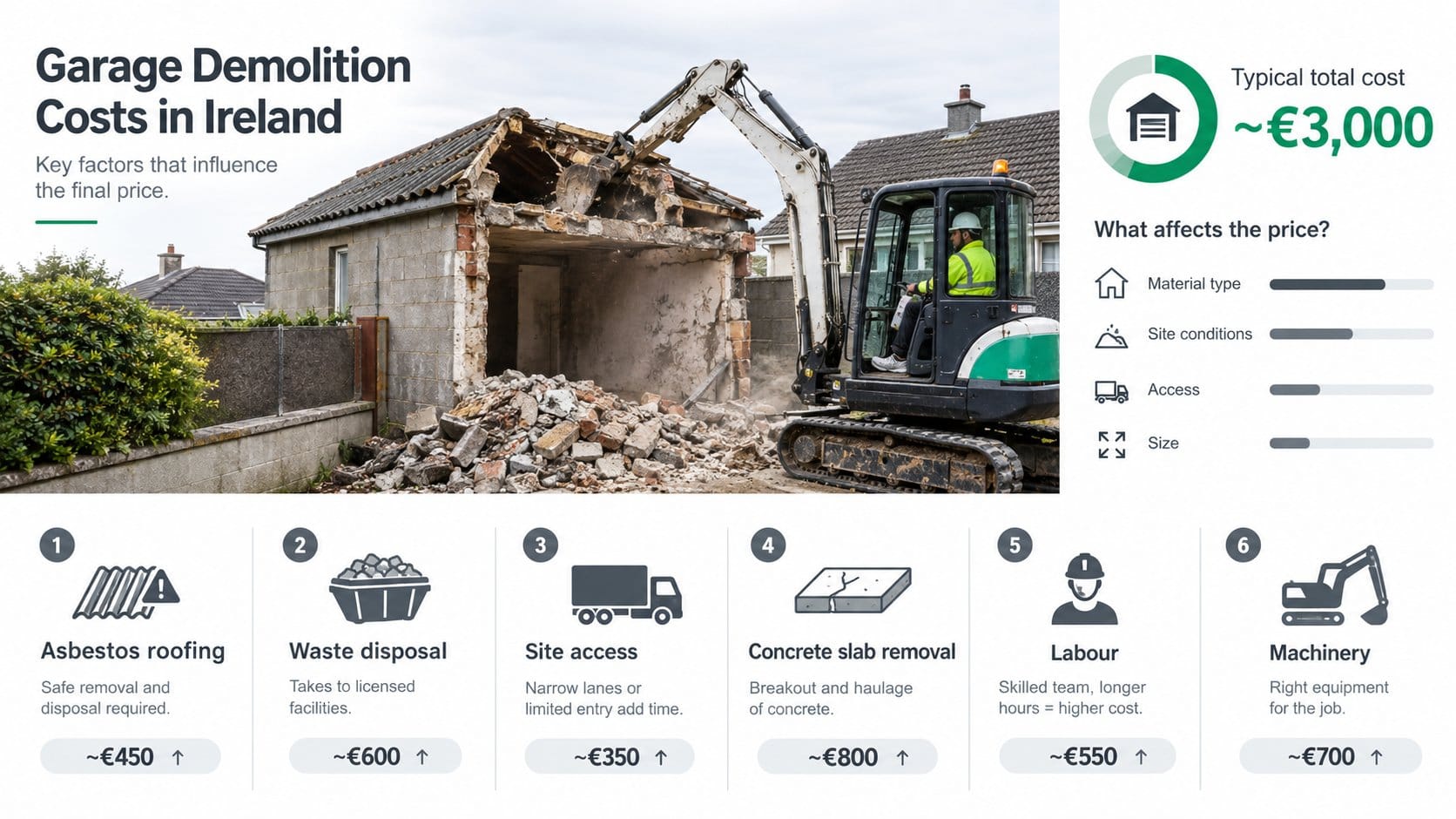
Asbestos is the line item that separates a routine garage knock-down from a proper controlled removal job. In older Irish garages, asbestos-cement sheeting can hide in the roof, wall panels, soffits, or lean-to sections, and it often looks like ordinary grey corrugated material to anyone who is not trained to identify it. That is why the price can jump so hard once a survey confirms what is on the building.
The legal and practical side is not optional. An asbestos survey is needed to identify the material, only a licensed asbestos contractor should remove it where required, and the waste has to move through the correct documented channel to a licensed facility. A garage roof that looks cheap to remove can become expensive once the containment, packaging, transport, and disposal steps are added.
The price shock comes from the roof, not the walls. On a single garage, asbestos work can add a separate project on top of the demolition itself.
For a homeowner, the budget impact is direct. A typical asbestos roof on a single garage can add €1,500 to €3,500 on top of the knock-down, and the total climbs further if the sheets are broken, the access is poor, or the structure has more than one asbestos component. That is before any replacement roof, new structure, or driveway work is even considered.
A quote that leaves asbestos vague, or says “allowance if found,” is not good enough. The homeowner should insist that the quote states whether an asbestos survey is included, who removes the material, how the waste is documented, and what happens if the survey finds more than expected. Anything less leaves the final price open-ended.
The Other Cost Drivers That Quietly Stack Up
Waste is usually the next big bill after asbestos. Irish EPA-linked disposal guidance shows just how much the material mix matters, with indicative disposal rates in Mayo of about €25 per tonne for inert construction and demolition waste versus about €275 per tonne for plasterboard recycling (EPA-linked planning document). For a garage, that means clean concrete and masonry behave very differently from mixed rubble, timber, plasterboard, or roof material.
A single garage commonly throws up enough rubble that skip space has to be planned properly, and the contractor must send construction and demolition waste to a licensed or authorised facility with the right documentation. The homeowner should expect the waste line to rise if the garage includes mixed materials, awkward loading, or extra haul distance. That is not padding, it is the job.
Good demolition pricing is a waste calculation as much as a wrecking calculation. If the waste stream is messy, the quote moves.
Access changes labour. A detached garage on open ground is a short job for a mini-excavator. A terraced site, a yard with no side access, or a garage boxed in by walls forces hand demolition, more barrowing, and slower loading. That is where a quote starts to drift upward even when the building itself is small.
The slab is another hidden cost. Some quotes include only the superstructure and leave the concrete base in place. Others price removal and disposal of the slab and foundations, which can materially change the bill. If the end goal is a new driveway, patio, or extension, the price should spell out what happens to the base and how the ground is left afterward.
A skip standing on a public road can also need a local authority permit, and that is one of the easiest charges to miss when comparing quotes. Parking restrictions, tighter streets, and extra handling all stack on top of the base demolition figure. One skipped line item can make a cheap quote expensive very quickly.
A man-with-a-van service is the kind of thing homeowners sometimes use for smaller clear-outs, but garage demolition waste is a more controlled job because the contractor must deal with heavier rubble, licensed disposal, and documentation.
Planning Permission and Permit Basics for a Garage
Most domestic garage demolition in Ireland is usually treated as exempted development, so a formal planning application is often not needed. That said, the homeowner has to confirm the position with the local authority before work starts, because the exceptions matter more than the rule. A garage that looks simple can still fall into a permission case if it sits on a boundary or forms part of a protected or shared structure.
Attached garages and terrace situations deserve special care. If the garage shares a wall with the house, abuts another building in separate ownership, or forms part of a terrace arrangement, planning permission may be required. Garages attached to, or within the curtilage of, a protected structure also need closer checking, and demolition of protected structures involves a separate notice process.
| Situation | Planning Permission Needed? | Notes |
|---|---|---|
| Detached domestic garage | Usually no | Confirm exempted development with the local authority |
| Attached garage | Often yes | Shared walls and boundary issues change the position |
| Terraced or abutting another building | Yes in many cases | Separate ownership is a key trigger |
| Garage on or attached to a protected structure | Yes | Extra notice and authority involvement apply |
| Garage in a conservation-sensitive setting | Often yes | Local authority advice matters before any works |
Skip permits are separate from planning. A public-road skip needs its own council process, and utility disconnection is a separate safety step again. Electricity, gas, and water should be dealt with before demolition starts, especially where the garage has lighting, sockets, or a live feed from the house.
The practical rule is simple. Planning tells the homeowner whether the structure can come down. Permits, utility shut-offs, and waste channels tell the contractor how the job is carried out.
Urban Versus Rural Sites and How Location Shapes the Quote
A rural garage job is usually the cleaner one. There is room for a mini-excavator, room for a skip or grab lorry on private ground, and less time spent moving waste by hand. That is why a straightforward single garage in a rural setting often sits around €1,800 to €3,000 when access is open and the waste stream is simple.
An urban garage can be the same size and still cost more. Narrow streets, no rear access, terraced layouts, and the need for a skip permit on a public road all push the quote up. If parking is restricted or a temporary parking suspension is needed, the job becomes slower and more expensive because the crew is working around the street as much as the building.
Access is not a minor detail. It decides whether the work is machine-led or hand-led.
A tight suburban plot sits in the middle. There might be a side passage, but it could be too narrow for machinery, or it may only allow small plant and extra labour. The quote often lands between the rural and urban extremes because the contractor can use some equipment, but not all of it.
| Factor | Rural Site | Urban Site |
|---|---|---|
| Machine access | Usually straightforward | Often restricted |
| Waste loading | Easier on private ground | More hand loading and barrowing |
| Skip location | Usually on site | Often on street with permit |
| Labour time | Lower | Higher |
| Typical price shape | Lower end of the range | Higher end of the range |
A contractor ten kilometres away can price the same job differently from one across town because access, parking, and disposal routes all change the economics. Homeowners should gather two or three written quotes from local firms and compare the scope line by line, not just the bottom line.
How to Compare Quotes and Avoid an Incomplete One
A proper demolition quote should read like a scope of work, not a guess. It needs to say whether the contractor visited the site, what exactly is coming down, whether the slab and foundations are included, and how waste will be removed and documented. If asbestos is possible, the quote should say who surveys it, who removes it, and how the price changes if it is found.
The VAT position needs checking. Residential demolition labour is generally subject to 13.5% VAT, and the homeowner should confirm that the quote shows whether VAT is included or excluded. A low number that omits VAT is not a bargain, it is a future argument.
A good quote also needs a variations clause. Garage demolition can change if hidden asbestos appears, if the foundation is deeper than expected, or if the garage turns out to share a wall or footing with another structure. The written scope should state how that change is priced before work starts.
A cheap quote is only useful if it is complete. Missing waste, missing VAT, or missing slab removal turns the headline price into fiction.
A homeowner should ask for three things in writing before accepting a job:
- Scope: the garage, the roof, the slab, and the final ground condition.
- Waste evidence: the waste route, licensed facility details, and transfer notes.
- Insurance and permissions: public liability cover, any permit responsibilities, and confirmation that the contractor is handling the demolition legally.
That same written discipline is exactly why tools like how ShamFix connects Irish homeowners with local providers matter in a market where quotes are easy to dress up and hard to compare. A structured enquiry helps the homeowner ask the same questions of every contractor and spot the omission straight away.
The lowest bid is usually the one with something missing. The homeowner should not reward that with a fast yes.
Key Takeaways and Where to Go Next
A normal garage demolition cost in Ireland starts around €2,000 to €4,000 for a straightforward single garage, but that figure only covers the basic knock-down side of the job. Asbestos is the line item that most often pushes the price into €6,000 to €10,000+ territory, and waste, access, slab removal, and making good all stack on top of the headline number. That is the honest bottom line.
The safest route is simple. Confirm whether the garage is exempted development with the local authority, treat older asbestos-cement roofs and panels as a real risk, and insist on a written quote that spells out VAT, waste documentation, and any possible variations. If the contractor can't put that on paper, the quote is not ready.
For homeowners planning a bigger project after the garage comes down, for wider construction and renovation work, find tradespeople and post a task. A demolition job often becomes the first step in a driveway rebuild, extension, or full site clearance, so the next trade needs to be priced with the same discipline.
Get three written quotes, ask about asbestos first, and keep a contingency in mind instead of chasing the cheapest figure on the page.
ShamFix helps Irish homeowners compare local providers for jobs like garage demolition, and it keeps the conversation tied to written quotes, scope, and clear expectations. You can post your task on ShamFix to start comparing local options for the work.