
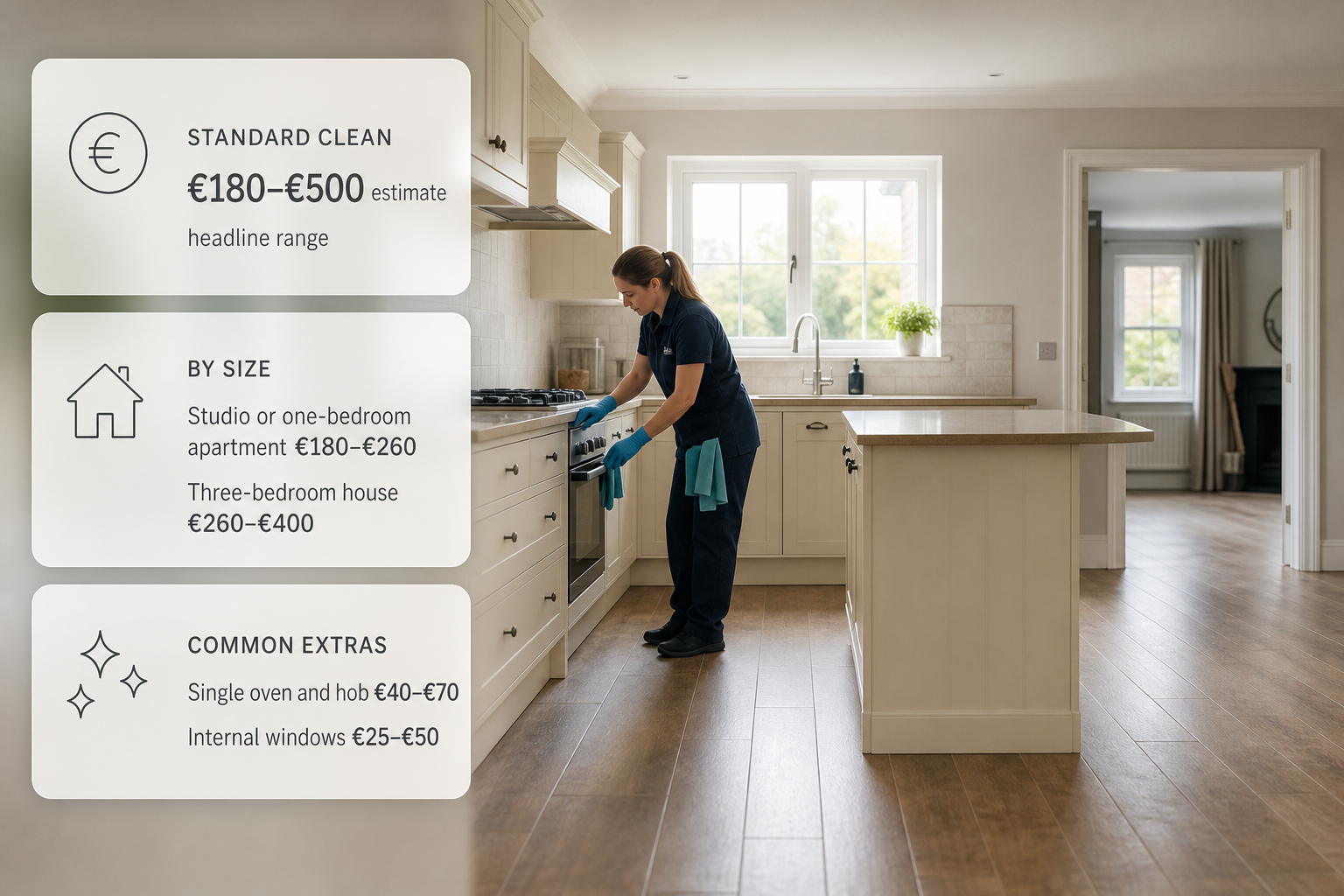
Professional end of tenancy cleaning in Ireland typically costs between €180 and €500, and that headline figure is an aggregate Irish market estimate for a standard clean of an empty home rather than a fixed price. The standard that matters at the end of a tenancy is that the dwelling is left reasonably clean and tidy: where it is not, the Residential Tenancies Board's good landlord and tenant guide sets out that the tenant can arrange the cleaning or the landlord can arrange it and deduct the cost from the deposit. A professional clean becomes a requirement only where the lease asks for that standard, or where the condition of the property means an ordinary clean will not bring it back to a reasonable state.
What a standard end of tenancy clean includes
A standard end of tenancy clean is a full clean of an empty property, and it normally covers:
- Kitchen — cupboard doors and frames wiped inside and out, worktops, splashback, sink and taps descaled, hob, extractor hood and filter, and the outsides of the fridge, freezer, washing machine and dishwasher. Cleaning the insides of appliances is usually an extra.
- Bathrooms — tiles and grout scrubbed, shower screen and tray descaled, toilet cleaned inside and out, silicone and seals wiped, extractor vent cleaned, mirrors polished.
- Throughout — skirting boards, doors and frames, handles, light switches, sockets, radiators, banisters, inside windows and sills, wardrobe interiors, shelves and mirrors.
- Floors — vacuumed and mopped, including under beds and behind any furniture that has been left behind.
- Finishing — bins emptied, cobwebs removed, light fittings dusted, and balconies, patios or utility areas swept.
Some jobs sit outside a standard clean and are quoted separately: carpet shampooing or steam cleaning, oven interiors, external windows, gardens, garages, attics and sheds. A standard clean also assumes the property is in reasonable order to begin with. Homes with pets, heavy smoking, mould, limescale or building dust take longer, and the quote reflects that. Tenants and landlords who want a price for one specific property can post the job for end of tenancy cleaning and compare the quotes that come back.
What end of tenancy cleaning costs in Ireland
The figures in this section are an aggregate Irish market estimate for professional end of tenancy cleaning, and the line items are the ones that normally appear on a quote.
| Item on a typical quote | Range |
|---|---|
| Labour only (one or two cleaners) | €140–€380 |
| Materials and consumables (products, cloths, bags) | €20–€60 |
| Preparation and access (furniture moved, high-level dusting, balcony or utility area) | €10–€40 |
| Waste removal and contingency allowance | €10–€20 |
The four lines make up the headline range: the low ends total €180 and the high ends total €500.
Typical totals by property size, from the same estimate:
- Studio or one-bedroom apartment: €180–€260
- Two-bedroom apartment or small house: €210–€320
- Three-bedroom house: €260–€400
- Four-bedroom house or larger: €320–€500
Common extras, charged on top of the clean and quoted from the same estimate:
- Single oven and hob: €40–€70
- Double oven or range cooker: €70–€110
- Carpet shampoo or steam clean: €25–€45 per room
- Internal windows: €25–€50
- Fridge, freezer or washing machine cleaned inside: €25–€40
A three-bedroom house priced at €330, with a single oven clean at €55 and internal windows at €35, comes to €420, and every figure there falls inside the ranges above. Quotes in Dublin tend to sit at the top of these bands, and the same job in a city-centre apartment with stairs or restricted parking is often priced at the upper end for its size. Before accepting any figure, ask whether it includes VAT, because some cleaners quote a net price and add VAT at invoicing, and a quote given as an hourly or day rate only becomes a total once the work is finished.
What pushes an end of tenancy cleaning quote up or down
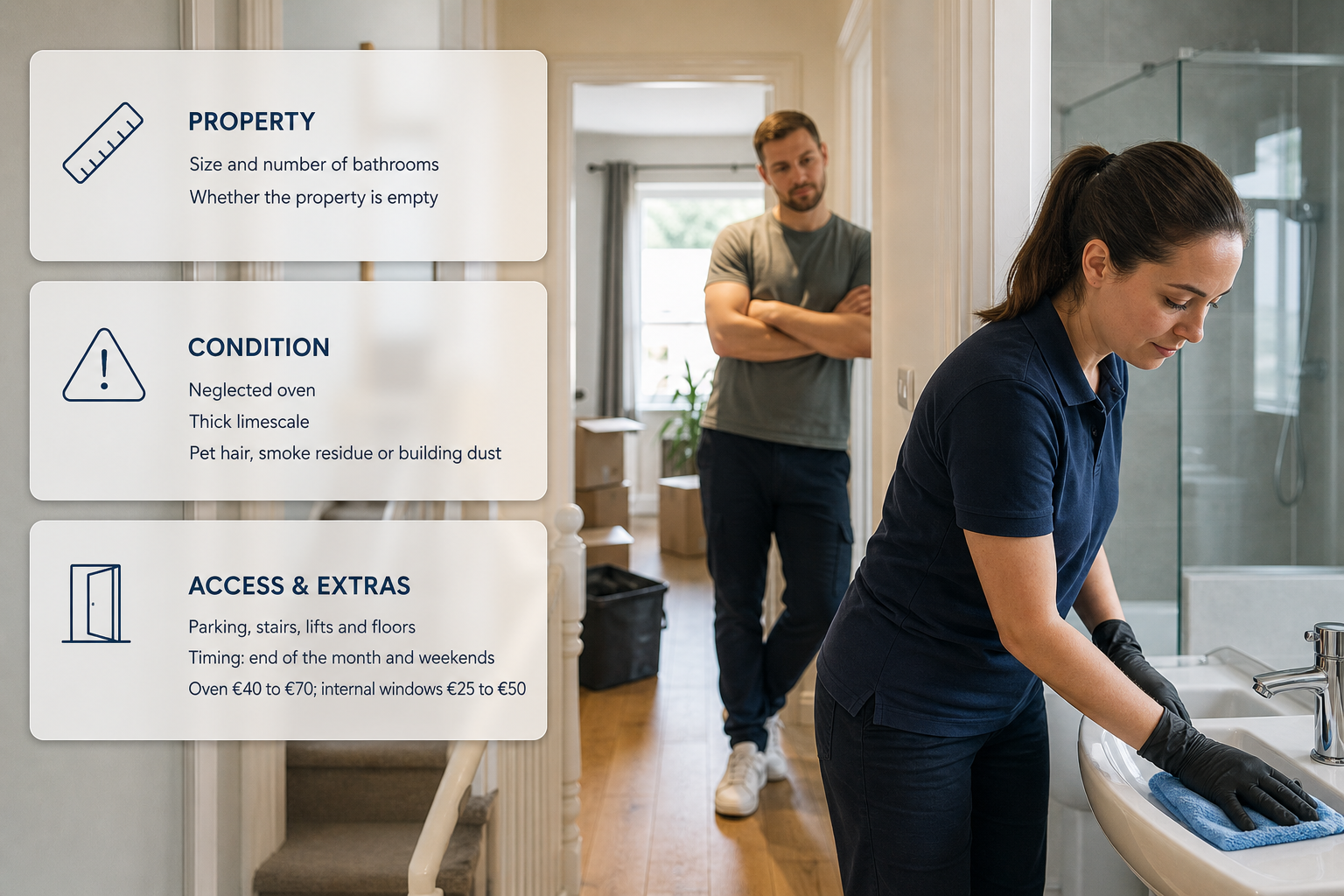
Condition matters as much as floor area when a cleaner works out a price, and the same three-bedroom house can be quoted at either end of its band depending on how it was left. The things that move a quote most are:
- Size and the number of bathrooms, which add both time and materials.
- Condition: a neglected oven, thick limescale, pet hair, smoke residue or building dust all add hours.
- Whether the property is empty, and whether bulky items have been taken away.
- Access: parking, stairs, lifts and the number of floors.
- Timing: the end of the month and weekends are the busiest slots.
- Whether the cleaner brings products and equipment or uses whatever is in the property.
- Extras, charged at the rates in the add-ons list above, so an oven at €40 to €70 and internal windows at €25 to €50 are worth costing in from the start rather than discovering later.
Landlords pricing several properties at once can look at the wider cleaning services category, where end of tenancy work sits alongside regular domestic cleaning.
When a professional clean is actually required
A tenancy agreement may ask for the property to be returned in a particular condition, and some agreements name a professional clean specifically. The baseline that applies either way is a reasonably clean and tidy dwelling, so the useful question is not whether a cleaner was used but whether the property was left in the state a reasonable person would expect it in after someone had cleaned it. The RTB advises tenants to check whether there are conditions on returning the deposit when they are moving out, which is the point at which a lease clause about cleaning matters most (Residential Tenancies Board tenant checklist). Where a tenant believes a clause asks for more than is reasonable, the sensible step is to raise it in writing before the move-out date and keep a copy of the exchange; where the lease asks for a receipt, the invoice from the clean is the evidence.