
In Ireland, a standard annual gas boiler service typically costs €70 to €180, with a market average around €130, while oil boiler servicing commonly costs €60 to €160. The final bill depends on what the engineer checks, which parts are included, whether VAT is added, and whether the visit uncovers repair work.
A homeowner booking in September or October may have three quotes open on a phone, with one showing €90, another near €130, and a third closer to €180. Those figures can all be realistic, but they may not describe the same service. A low headline fee might cover a short inspection, while a higher price could include broader testing, cleaning, documentation, or additional cover.
The useful question isn't “What is the boiler service cost in Ireland?” It's, “What does the quoted price include, and what can be added before the invoice is issued?”
What Boiler Servicing Costs in Ireland Right Now
Selectra Ireland reports an average boiler service cost of about €130, while Switcher.ie places a typical gas boiler service between €70 and €180 and an oil boiler service between €60 and €100. Other Irish published pricing extends the oil range to €160, so homeowners should treat €60 to €160 as a practical national market band rather than assume that gas and oil work are priced identically. See the Irish boiler service cost guidance from Selectra for the gas-service benchmark.
These figures describe a routine annual visit on a working boiler, with no major remedial repair. A standard visit is different from an emergency breakdown call-out, extended fault-finding, or a service bundled with parts and breakdown protection.
| Fuel type | Low (€) | Average (€) | High (€) |
|---|---|---|---|
| Gas | 70 | 130 | 180 |
| Oil | 60 | Not established as a single national average | 160 |
Bord Gáis Energy's published prices show why a care plan can sit above the ordinary service range. Its one-off gas boiler service is listed at €179 annually, while Complete Boiler Care +1 is €199 annually and 365 Boiler Care is €229 annually. The higher plans include broader protection, and the €229 option includes labour and parts cover up to €1,200 in the contract year, according to Bord Gáis Energy's boiler care information.
A quote below €60 for gas or €50 for oil deserves careful checking. It may exclude VAT, parts, cleaning, combustion analysis, or additional labour. The cheapest advertised service isn't automatically the cheapest completed job.
What an Annual Boiler Service Includes
A proper annual service should give the homeowner a clear record of the appliance's condition, not just a quick visual glance. The engineer normally starts with the casing, accessible pipework, flue route, condensate components, pressure gauge and visible signs of leakage or corrosion.
For a gas boiler, combustion and flue checks are central. The engineer should use a flue gas analyser to assess combustion readings, including carbon monoxide and carbon dioxide levels, and confirm that the appliance is operating safely. Oil servicing usually involves checking the burner, nozzle, pump pressure and oil filter. Cleaning key components, such as the heat exchanger and burner assembly, helps the engineer assess whether deposits are affecting operation.
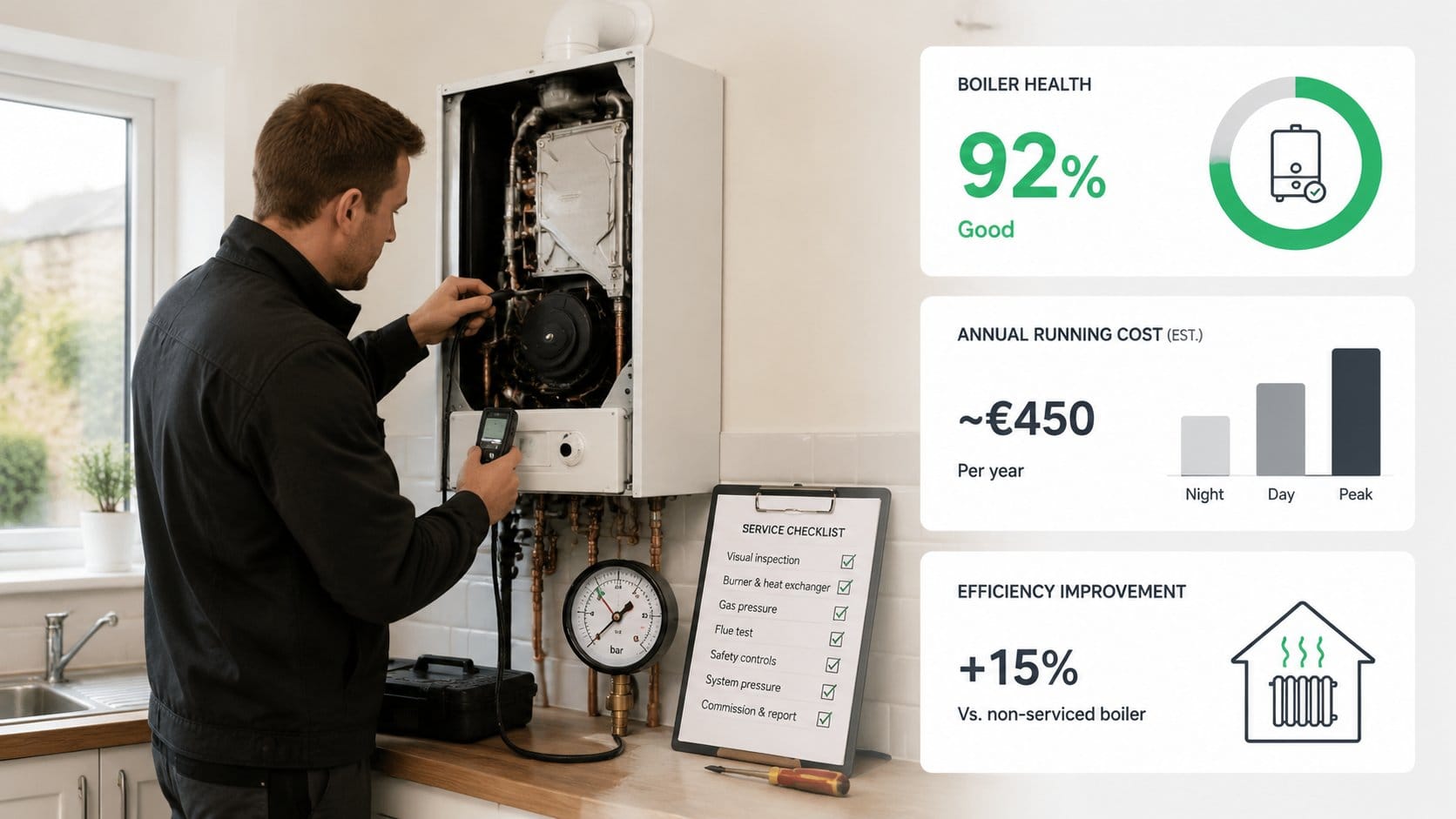
The service should also include safety checks before and after the work. For gas appliances, that can include a gas tightness check where relevant, safe flue operation, ventilation and combustion verification. The engineer should check that the system runs correctly after reassembly and note any fault codes or abnormal readings.
A useful service record identifies the appliance, records the work completed, and lists recommendations separately from the routine service. It should make clear whether a replacement seal, electrode, filter, nozzle or other repair is immediately required, or whether it can be monitored.
Practical rule: A written service record and a clear list of excluded repairs are as important as the price on the quote.
What Moves the Price Up or Down
Fuel type is one of the first price differences to examine. Gas servicing often centres on combustion analysis, flue performance and appliance cleaning. Oil servicing commonly involves consumables such as a new nozzle and oil filter, so the labour price and the final parts bill need to be considered together.
The boiler's age and design affect the time required. An older appliance, a non-condensing model, or a boiler with restricted access may need more dismantling, cleaning or inspection. Model-specific seals, electrodes, filters and other parts can also change the final amount without making the original service quote misleading, provided the quote explains what is included.
Location matters too. An attic installation, a boiler inside a tight kitchen cupboard, or a rural address requiring substantial travel can increase the time or call-out element. A national band is useful for budgeting, but it can't account for every access problem.
| Cost driver | Effect on price | Direction |
|---|---|---|
| Fuel type | Oil visits may include nozzle and filter work | Usually higher final bill for oil when consumables are needed |
| Boiler age | Older appliances can need extra cleaning or parts | Up |
| Access | Tight cupboards, attic locations and difficult flue access take longer | Up |
| Visit model | A one-off visit and a care plan may include different cover | Either |
| Timing | Winter breakdown demand can affect availability and call-out pricing | Often up |
| Service scope | Diagnostics, cleaning and post-service labour broaden the job | Up |
Bord Gáis Energy illustrates how labour exposure can be priced separately. One of its plans covers the first 45 minutes on site, then applies €25 for each additional 15 minutes, as set out in its published boiler care terms. That doesn't establish a universal Irish rate, but it shows why a short standard visit and a longer fault-finding appointment shouldn't be compared as though they were identical.
Annual contracts can appear attractive, but the small print matters. Some include call-out protection or parts cover, while others cover only a defined visit. A one-off service may be better value for a reliable boiler that rarely needs attention.
Headline Fee vs Final Bill
The headline service fee is usually the starting point, not a promise that every possible repair is included. If the boiler completes its checks quickly and needs no parts, the invoice may stay close to the quoted amount. If the engineer finds unsafe combustion, corrosion, a leak, a worn ignition component or a failed control, those issues should be priced separately.
Oil boilers demonstrate the difference clearly. A service may include inspection and cleaning, but a replacement nozzle or filter can still be itemised as a consumable. Gas appliances may require a thermistor, ignition electrode, seal or another model-specific component. The homeowner should receive an explanation before additional work begins.
A useful quote separates four elements:
- Service labour: The routine inspection, testing and cleaning included in the visit.
- Additional labour: Time spent on fault-finding, dismantling or repairs beyond the service scope.
- Parts and consumables: Items such as nozzles, filters, seals or electrodes.
- VAT: Boiler servicing generally carries 13.5% VAT, so the quote should state whether that tax is already included.
| Line item | Typical add-on cost | What triggers it |
|---|---|---|
| Extra labour | Provider's stated time-based charge | The visit runs beyond the included service |
| Oil consumables | Itemised by the provider | Nozzle, filter or other service parts require replacement |
| Gas parts | Itemised by model and part | Thermistor, electrode, seal or similar component fails |
| VAT | 13.5% where applicable | The advertised figure excludes VAT |
Published Irish pricing supports treating scope as the key issue. Hydroflow lists a boiler service at €120 excluding VAT and an extended boiler service at €290 to €390, showing how a broader job can sit well above routine maintenance pricing. A homeowner comparing quotes should therefore ask whether the service is standard or extended before judging value.
A routine service can uncover a repair, but the repair shouldn't be folded into the service fee. The written invoice should distinguish maintenance from corrective work.
RGI, OFTEC and Safety Rules Homeowners Need to Know
A gas boiler service in the Republic of Ireland should be carried out by a Registered Gas Installer, usually called an RGI. Before booking, ask for the engineer's registration details and confirm them on the Register of Gas Installers of Ireland. You can also check RGI registration before hiring, rather than relying on a professional-looking advertisement.
Oil boilers follow a different system. The homeowner should choose a competent oil technician, such as an OFTEC-registered technician, and request evidence that the registration is current. The registration applies to the individual or business doing the work, not automatically to a marketplace that passes on an enquiry.
A suitable carbon monoxide alarm should be installed in the correct location and tested regularly according to the manufacturer's instructions. Carbon monoxide cannot be seen or smelled. The alarm provides an early warning, but it does not replace proper servicing, ventilation and flue checks.
Gas boiler servicing is not suitable work for an unregistered tradesperson. Check registration before the visit, not after a problem occurs.
Landlords have extra responsibilities in rental properties, including gas safety checks connected with tenancy requirements. The exact duty depends on the property and the rules that apply, so landlords should follow current Irish official guidance and keep service records with the rental paperwork.
The customer still needs to confirm the relevant registration before any gas work begins.
How to Hire a Heating Engineer Without Overpaying
Start by giving every engineer the same information. The boiler's fuel type, make, model, approximate age and location help providers prepare comparable quotes. A gas boiler in a kitchen cupboard isn't necessarily the same job as an oil boiler in an accessible utility room.
The next step is registration. Gas customers should request the engineer's RGI details and check them on the RGII register. Oil customers should ask for OFTEC registration or other evidence of suitable competence. ShamFix doesn't vet or verify registrations, so the homeowner remains responsible for checking the details.
A written quotation should answer these questions:
- Is the price for a standard annual service or an extended diagnostic visit?
- Is VAT included?
- Are cleaning, flue or combustion checks included?
- Are oil nozzles and filters included, or charged separately?
- What hourly or time-based labour charge applies if the visit runs over?
- Will the engineer provide a service record?
Comparing a €70 quote with a €130 quote only makes sense if both describe the same work. A lower figure that excludes parts, cleaning or testing may produce a higher finished bill once those items are added.
Red flags include a refusal to provide registration details, a cash-only demand without paperwork, pressure to approve an unexplained repair immediately, or a quote that doesn't state whether VAT is included. Organising these questions in advance helps homeowners get clear, comparable answers before booking.
A Quick Pricing Checklist and Where to Find an Engineer
A homeowner can reduce confusion by treating the booking as a short verification exercise rather than choosing the first low figure.
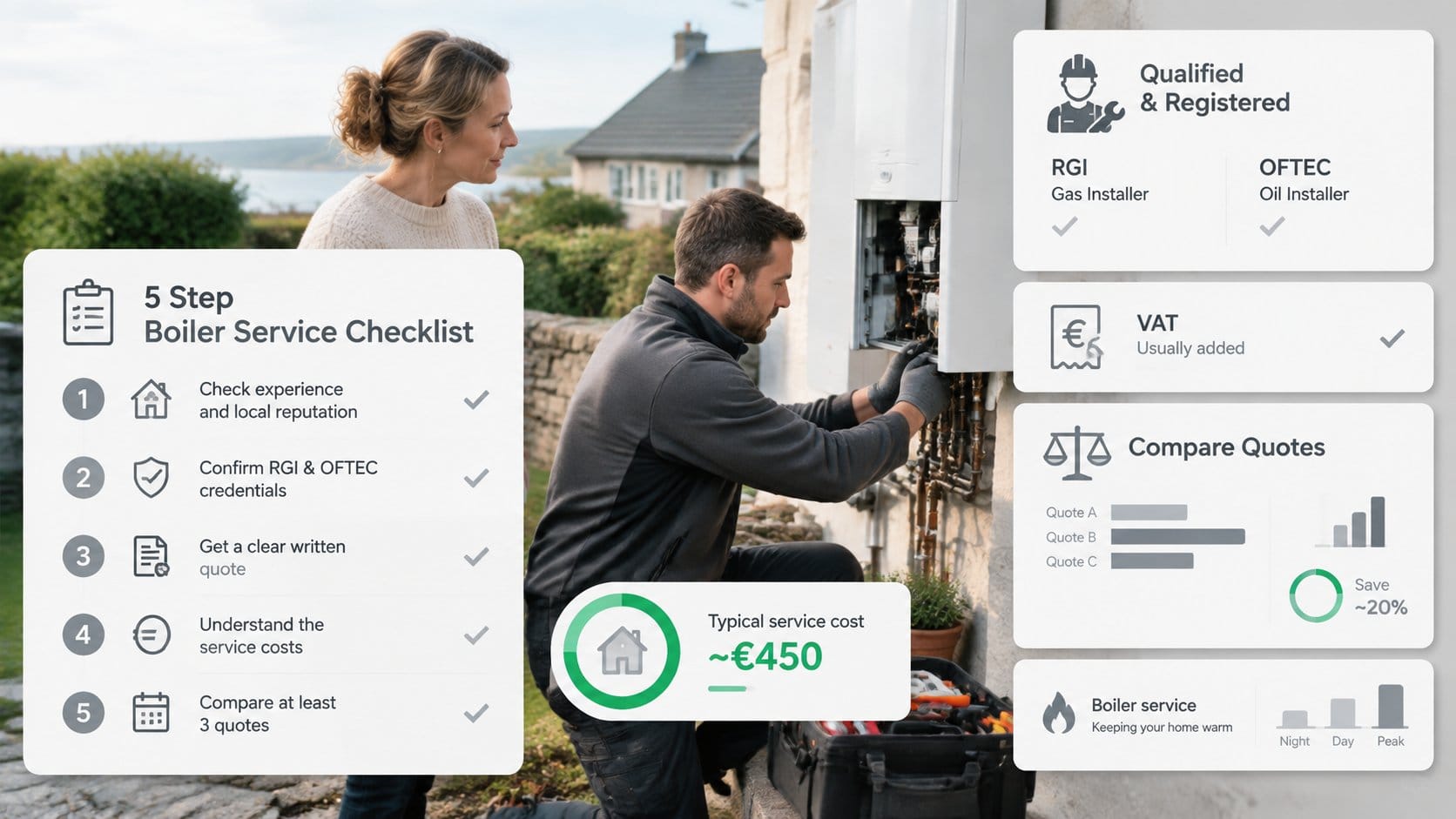
- Confirm registration: Check an RGI listing for gas work or OFTEC registration for oil work before agreeing to the appointment.
- Request a written quote: Make sure the document describes the annual service, cleaning, testing, call-out terms and any exclusions.
- Check the range: Use the Irish gas and oil bands as a starting point, then account for access, boiler condition and parts.
- Ask about VAT: Confirm whether the quoted amount includes 13.5% VAT.
- Keep the record: Ask for a written service record showing readings, faults and recommendations.
The quote should also state whether the price is flat-rate or time-based. Bord Gáis Energy's published structure, with the first 45 minutes included on one plan and €25 per additional 15 minutes, demonstrates why the time allowance should be visible before work starts. A low price can be reasonable if it covers a clearly defined visit, but it shouldn't be treated as comparable with a broader care package.
Parts deserve their own line. For an oil boiler, the homeowner should ask whether the nozzle and filter are included. For a gas boiler, the provider should identify any model-specific seals, electrodes or other components that may be recommended after inspection. Repairs, if required, should be quoted separately from the annual service wherever possible.
Two or three like-for-like written quotes can reveal whether a difference comes from genuine scope or just a different pricing model. Word-of-mouth referrals, independent reviews, and the official RGI and OFTEC directories can all help a homeowner identify suitable local heating providers. Homeowners can post the job on ShamFix to get quotes, or browse local heating providers; ShamFix only connects homeowners with providers and doesn't service boilers, employ engineers, issue quotes, set prices, offer discounts, or hold job records.
The most useful booking decision is the one that leaves no uncertainty about registration, scope, parts, VAT and paperwork.
Are you a heating engineer in Ireland?
Heating engineers can list their services on ShamFix so homeowners can find local providers through the marketplace. ShamFix doesn't vet or verify registration documents, so each provider remains responsible for its credentials. Create your provider profile. Listing on ShamFix is free and there's no commission; a subscription is planned for the future.