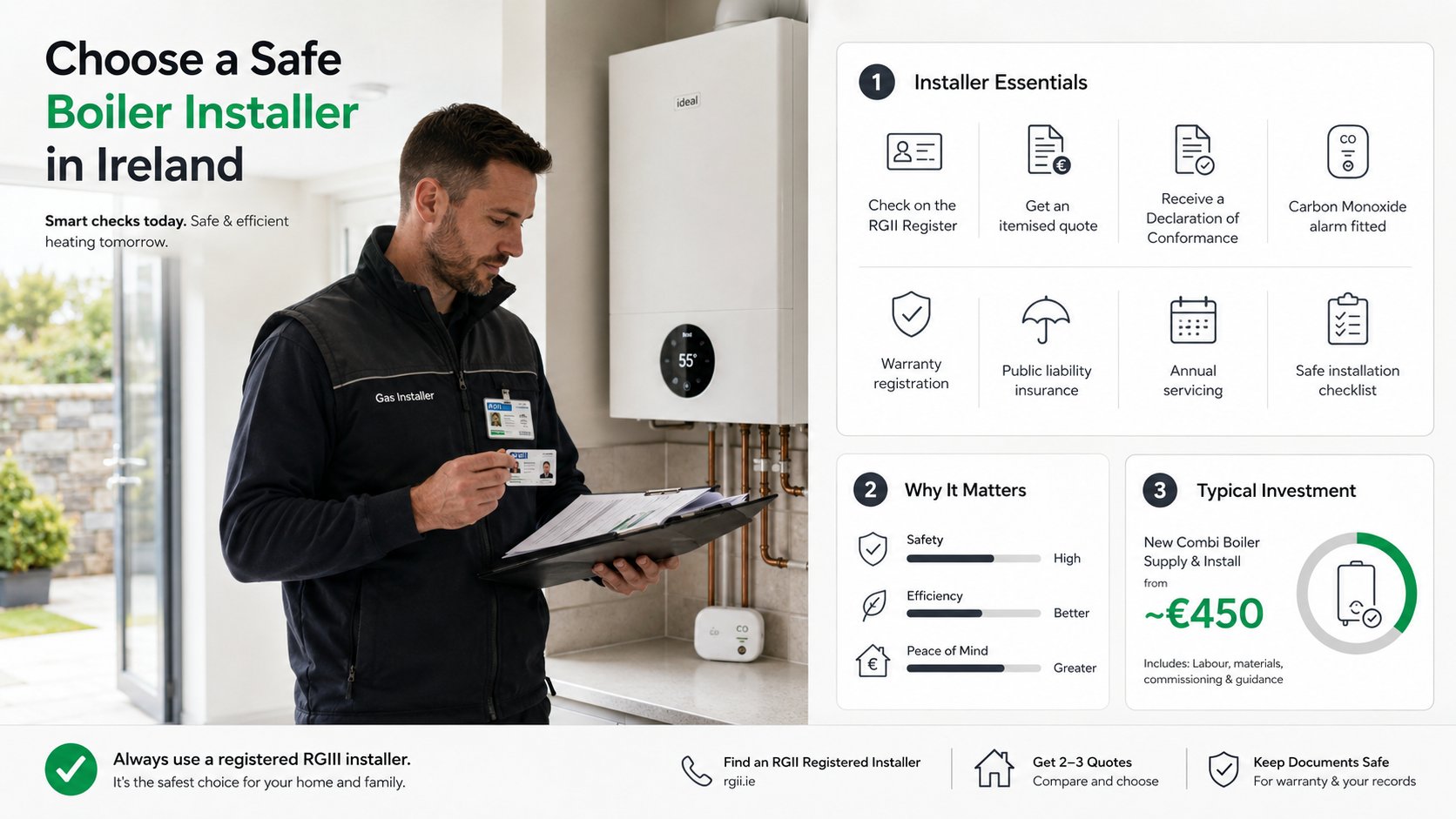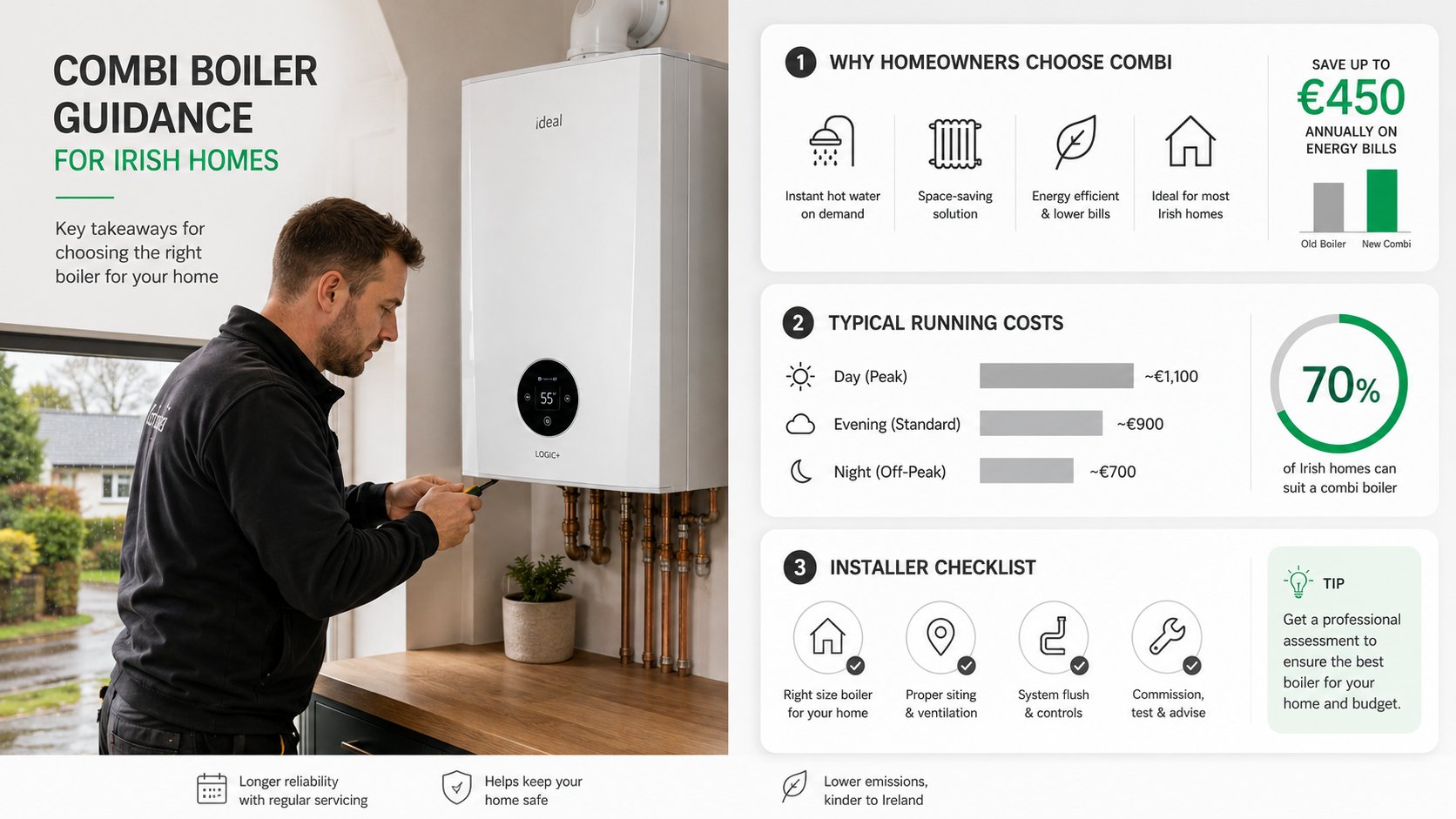
There's no SEAI grant for a gas or oil combi boiler replacement in Ireland, all gas boiler work must be done by an RGI on the RGII register, and a like-for-like combi replacement typically sits in a €2,000 to €3,200 band before flue, relocation or conversion extras. That is the practical starting point for a homeowner who's staring at a boiler that keeps cutting out and wondering whether to replace it, repair it, or move to a heat pump.
A three-bed semi in Cork is a familiar version of that decision. The house might have two bathrooms, decent mains pressure, and some insulation upgrades already done, which makes a combi look convenient on paper, especially if the old cylinder and tank setup takes up space. The harder question is whether the current layout and hot-water demand still suit a combi, or whether the money is better spent on a different heating path.
A homeowner in that position usually wants four answers at once. Whether the house still fits a combi, what the work legally involves, what the quote should really include, and whether the replacement should be another boiler or a move towards a heat pump.
A Three-Bed Semi and a Big Heating Decision
A 1990s three-bed semi often lands in the middle of this debate. It's not tiny, but it's not a large house with endless plant space either, and the family using it may be trying to solve a very ordinary problem, a boiler that's unreliable before winter, a bathroom routine that's getting more demanding, and a budget that can't stretch to guesswork.
The real question is not just boiler type
A combi boiler can make sense in a house like that if the mains pressure is sound, the family doesn't regularly need several hot-water outlets at once, and the heating system already suits a compact appliance. A system boiler may be better if the house has busier mornings, more than one bathroom in regular use, or a layout that already depends on stored hot water. A heat pump enters the conversation if the homeowner is willing to think beyond a like-for-like swap and examine insulation, emitters and long-term running costs.
Practical rule: the right decision usually comes down to the home's hot-water pattern, not to the age of the existing boiler alone.
The confusing part is that a combi looks simpler because it removes the cylinder and tank. That simplicity is real, but it doesn't automatically make it the best fit for every Irish home. The rest of the decision is about pressure, demand, compliance and the actual price of getting the work done properly.
In a house that has already had some insulation work done, the temptation is to assume the cheaper immediate fix is always sensible. Sometimes it is. Sometimes it just delays the bigger choice. That's why the next step is understanding what a combi does, and what it doesn't do.
What a Combi Boiler Does and When It Fits an Irish Home
A combi boiler is a combination boiler that provides domestic hot water directly, without a separate hot-water cylinder. In Ireland's HARP boiler database, that class includes both instantaneous combination boilers and storage combination boilers, and the database exists to support the Dwelling Energy Assessment Procedure (DEAP) for Irish dwelling energy ratings, with published data updated monthly. In practical terms, Irish dwelling-energy calculations treat combi boilers as their own boiler class, not as a generic box on the wall.
How it differs from system and heat-only boilers
A system boiler heats water and stores it in a cylinder, which helps when several taps or showers need hot water around the same time. A regular or heat-only boiler usually works with a tank in the attic and a hot-water cylinder, so it belongs to the older stored-water setup that many Irish homes are moving away from. A combi skips that storage layer and heats water on demand from the mains, which saves space and suits a simpler layout.
That space-saving advantage is also why combis are usually discussed for smaller homes, or homes where a separate cylinder would be awkward. The trade-off is flow rate. One shower often needs 10 to 12 litres per minute, and a combi has to respond to that draw while still serving the heating side of the house. If two showers and a dishwasher are all drawing at once, a smaller combi can feel stretched and someone may end up with lukewarm water.
When a combi is a good fit, and when it isn't
A combi usually suits a home with good mains pressure, limited simultaneous hot-water demand, and enough confidence that one appliance can cover both space heating and domestic hot water without a storage cylinder. It is a weaker match where pressure is poor, where the household regularly needs multiple bathrooms at once, or where the house is already being planned for a heat pump retrofit.
A combi is a convenience choice, not a universal upgrade. The right output depends on the home's demand, not just the number of bedrooms.
The sizing point matters. Boiler output should be matched to the house's heat loss and hot-water behaviour, not chosen because a quote looks neat. For a homeowner, that means asking how the boiler will behave on a cold morning, not just how it sounds in a sales line.
RGI Rules and Safety Essentials in Ireland
Irish gas work has a hard legal boundary. Installation, replacement, service, and commissioning of a gas boiler must be done by a Registered Gas Installer (RGI), and the engineer should be checked directly on the live RGII register before any work starts. The boiler database and DEAP system treat combi boilers as a formal category, but the safety side is separate, the person doing the work has to be properly registered.
What the homeowner should insist on
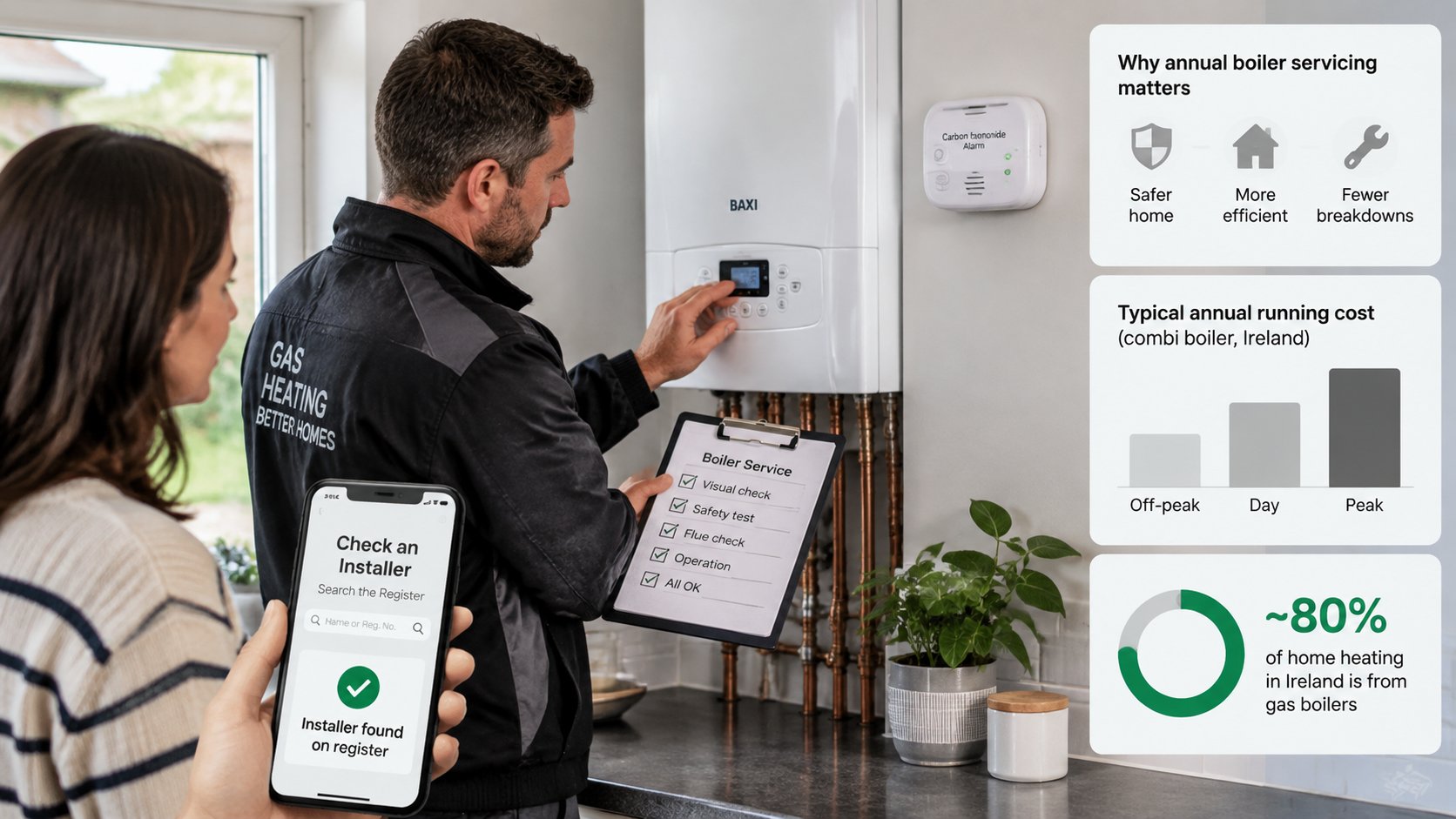
The first check is simple. Confirm the installer's RGI status on the RGII register, not just on a van sign or a social media page. If the work is gas-related and the person is not on that register, the job is not being done legally.
The second step is paperwork. A Declaration of Conformance should be issued on completion, and the homeowner should keep it with the boiler manual and warranty papers. That document matters because it shows the installation was carried out under the right gas-safety framework.
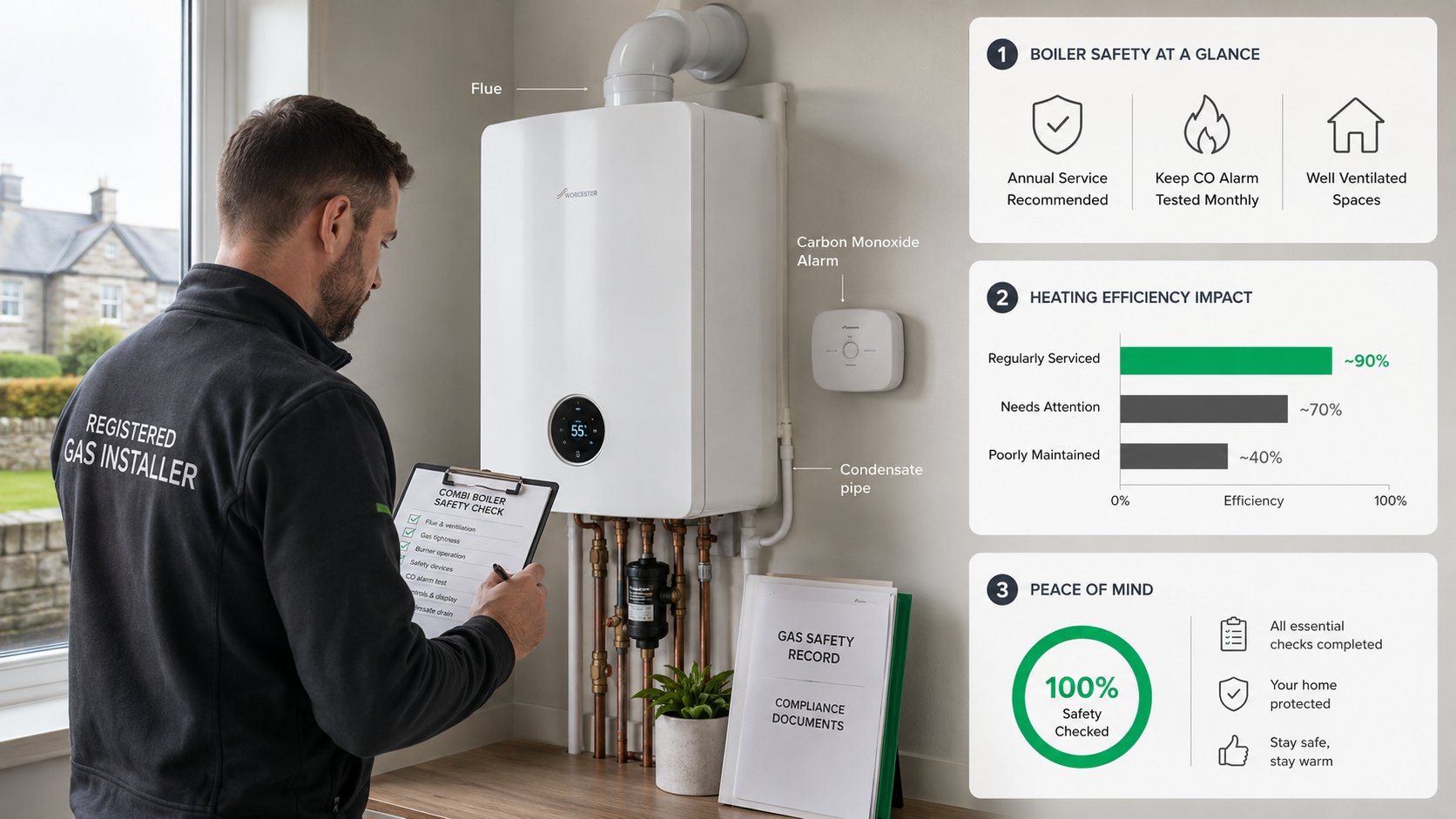
The third step is carbon monoxide protection. SEAI's domestic heating guidance says all condensing boilers require a drain connection for condensate, and a working carbon monoxide alarm should be fitted and tested. That alarm isn't decoration. It's part of basic household safety around combustion appliances.
The fourth check is servicing. SEAI says an annual boiler safety check and service for gas boilers should be carried out by an RGI, and it's illegal for anyone who isn't an RGI to service gas boilers. That annual check is also the cleanest way to keep the appliance operating as intended and to stay inside most warranty conditions.
Switching from a system or regular boiler to a combi
A move to a combi is not just a change of appliance. In a home with a system boiler or a regular (conventional) boiler, the installer may also be changing how hot water is produced and how parts of the existing layout are used. That usually means looking beyond the boiler itself to the cylinder, any attic tank, the route of the hot-water pipework, the controls and the flue position.
The first practical question is whether the house will still suit instant hot water from the mains. If showers already weaken when another tap is opened, or if the household often uses more than one bathroom at the same time, that is a sign to question whether a combi will feel like an upgrade in daily use. The second question is what existing parts are being removed, left disconnected or worked around. Old cylinder spaces, boxed-in pipe runs and former tank areas can all affect the scope of work.
Homeowners should also ask whether the current flue route, condensate path and gas pipe run are usable for the new boiler location, and whether the radiator side of the system shows signs of sludge or uneven heating that should be dealt with at the same time. A conversion can absolutely make sense, but it needs to be planned as a house-layout change, not mistaken for a simple like-for-like swap.
What Really Drives Combi Boiler Installation Costs
A straight combi-for-combi swap is the cleanest cost scenario. The Plumbers in Ireland 2026 boiler cost guide places that kind of replacement in the €2,000 to €3,200 band, and newer Dublin replacements can sit toward the upper end when labour and local conditions are included. That range is the starting point, not the whole bill, because the quote can move quickly once the job stops being a simple swap.
| Job Type | Typical Cost (€) | What Is Included |
|---|---|---|
| Like-for-like combi replacement | €2,000 to €3,200 | Boiler supply and installation in the same location, basic replacement labour, standard commissioning |
| Conversion from system or heat-only setup | Higher than a straight swap | Removal of older stored-water components, pipe alterations, cylinder-related changes, extra labour |
| Relocation or flue changes | Higher again | Flue repositioning, terminal changes, and extra making-good work |
The extras that move a quote
The biggest price shifters are usually conversion work, boiler relocation, flue alterations, controls upgrades, gas-line work, condensate routing, and any power-flush needed for older radiators. A homeowner replacing a tired system boiler with a combi is not just buying a new appliance, they're often paying to reconfigure how the house stores, heats and moves water.
A better quote will separate the boiler itself from the labour and the supporting work. It should show whether the flue is being reused, whether the condensate route needs a new drain connection, whether the controls are being upgraded, and whether making-good is included. The cheap quote is often the one that leaves out the messy parts.
Irish residential boiler installation is generally subject to 13.5% VAT, so the quote should state clearly whether VAT is included. If it doesn't, the final bill can feel very different from the headline price.
A homeowner comparing quotes should also ask what output is being supplied. A boiler that is too small, or too aggressive in cycling, can create more comfort problems than it solves.