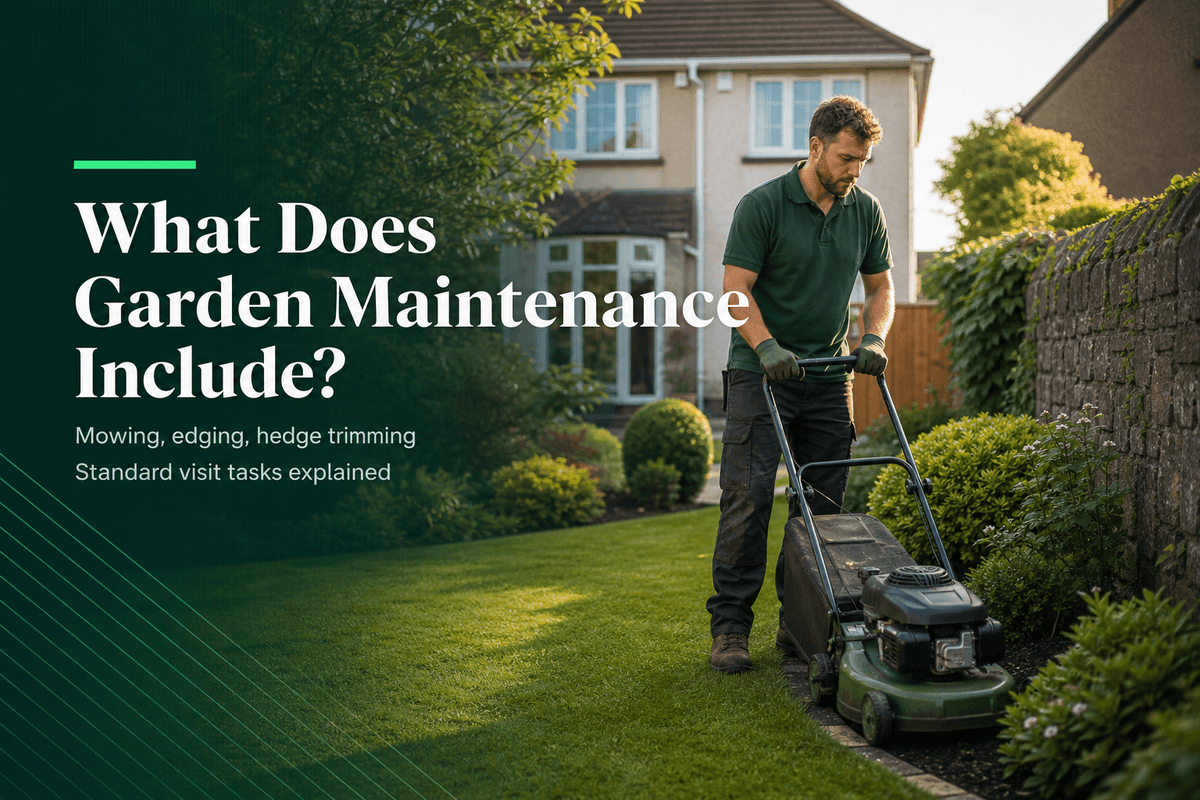
Garden maintenance is the routine outdoor upkeep of a home garden: the repeating jobs that keep grass, hedges, beds, paths and planted areas in order. It differs from landscaping, which builds new features, and from a one-off clearance, which rescues a garden that has been let go. A standard service normally covers mowing and edging, hedge and shrub trimming, weeding, seasonal leaf clearing and the handling of the green waste those jobs produce, with planting and deeper tidy-ups added as the seasons change, so homeowners booking a garden maintenance service should agree in advance which tasks fall inside the standard visit and which are quoted separately.
What a standard garden maintenance visit usually includes
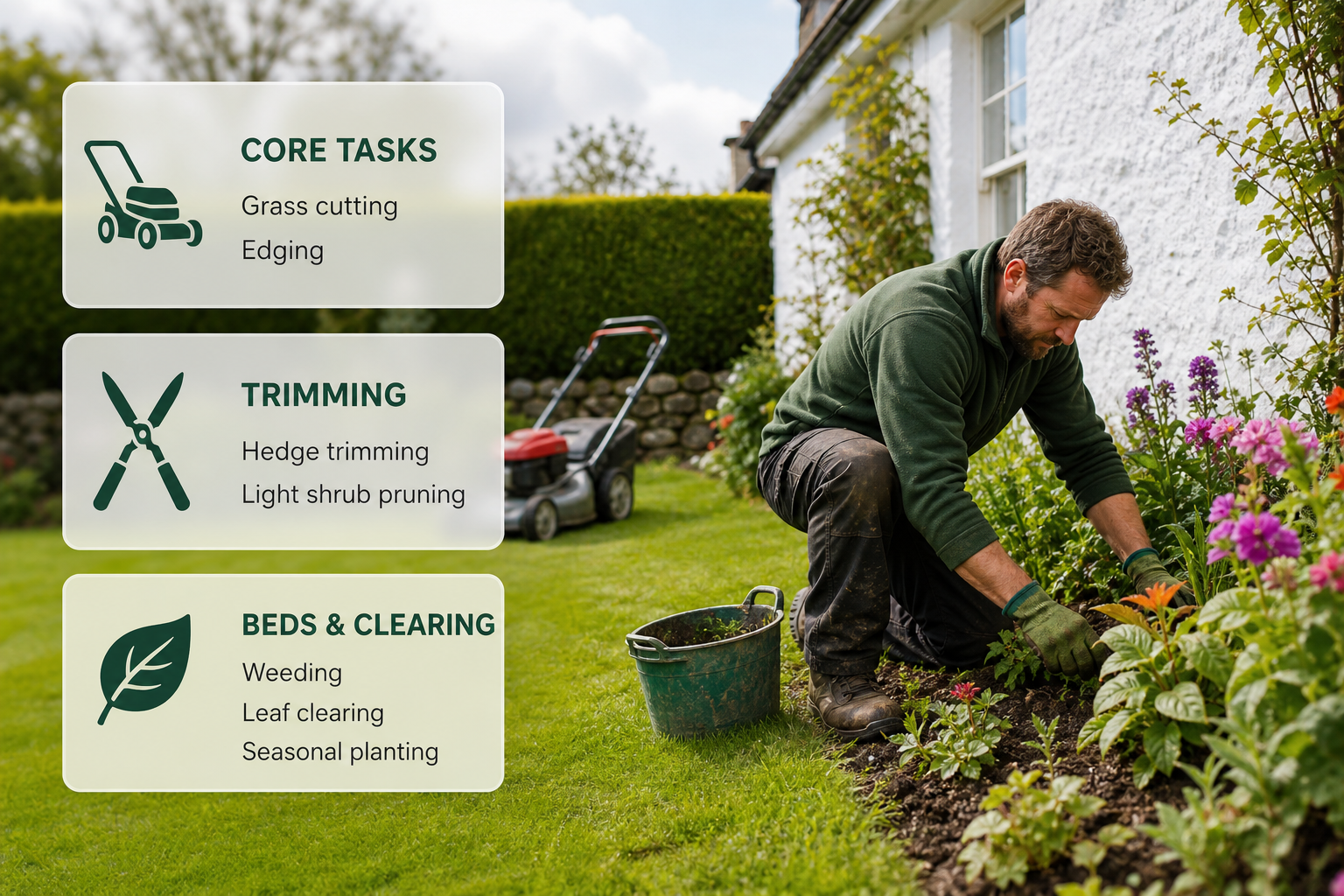
A routine visit is built around repeating tasks rather than a fixed list of everything growing in the garden. The usual core is:
- Grass cutting, with a mower on open lawns and a strimmer around trees, walls and furniture.
- Edging, keeping the line between lawn and path or bed sharp so the garden reads as tidy even before anything is planted.
- Hedge trimming and light shrub pruning, keeping growth within the hedge's existing line and within safe reach from the ground.
- Weeding of beds, borders, gravel, patios and paving joints, plus deadheading to keep flowering plants producing.
- Leaf clearing and the sweeping or blowing of paths, drives and decking, particularly in autumn and after storms.
- Seasonal planting and bed work, such as replacing annual bedding, tidying perennials or planting bulbs.
- A general check of the garden that flags anything needing a different trade, such as a leaning fence or a diseased tree.
Visits are generally sold either as a set number of hours or by the task, and they repeat on an agreed schedule. The gardener normally supplies the machinery, fuel and basic hand tools, while the homeowner provides access to water and power where those are needed.
What is normally excluded from a standard visit
The gap between what a homeowner expects and what a standard visit covers is the most common source of disagreement, so it is worth naming the exclusions up front. A routine maintenance visit does not normally include:
- Tree felling, heavy crown reduction, stump grinding or any work needing climbing or specialist arboricultural equipment.
- Hard landscaping of any kind: laying patios, paths or kerbs, building walls, installing drainage, or fitting fences, gates and decking.
- Lawn renovation as a project, such as scarifying, hollow tining, overseeding or treating moss and weeds across a whole lawn.
- Chemical treatments, including professional weedkillers and pesticides.
- Garden design, planting plans, and the supply of large trees, shrubs or quantities of topsoil and compost.
- One-off clearance of a severely overgrown site, which is a project rather than a maintenance visit.
- Gutter clearing, roof work, pressure washing and window cleaning, which belong to other trades.
- Disposal of very large volumes of waste, which is normally agreed separately.
Some of these tasks can be added to a maintenance visit by arrangement, and others are better handled by a specialist. The practical test is whether the job is repeatable and light enough to be done inside a normal visit, or whether it is a construction or clearance project.
Green waste: included, extra, or left on site
Green waste is the single item most often queried by homeowners. Grass clippings, hedge trimmings, prunings and leaves all have to go somewhere, and where they go is a matter of what was agreed rather than a rule.
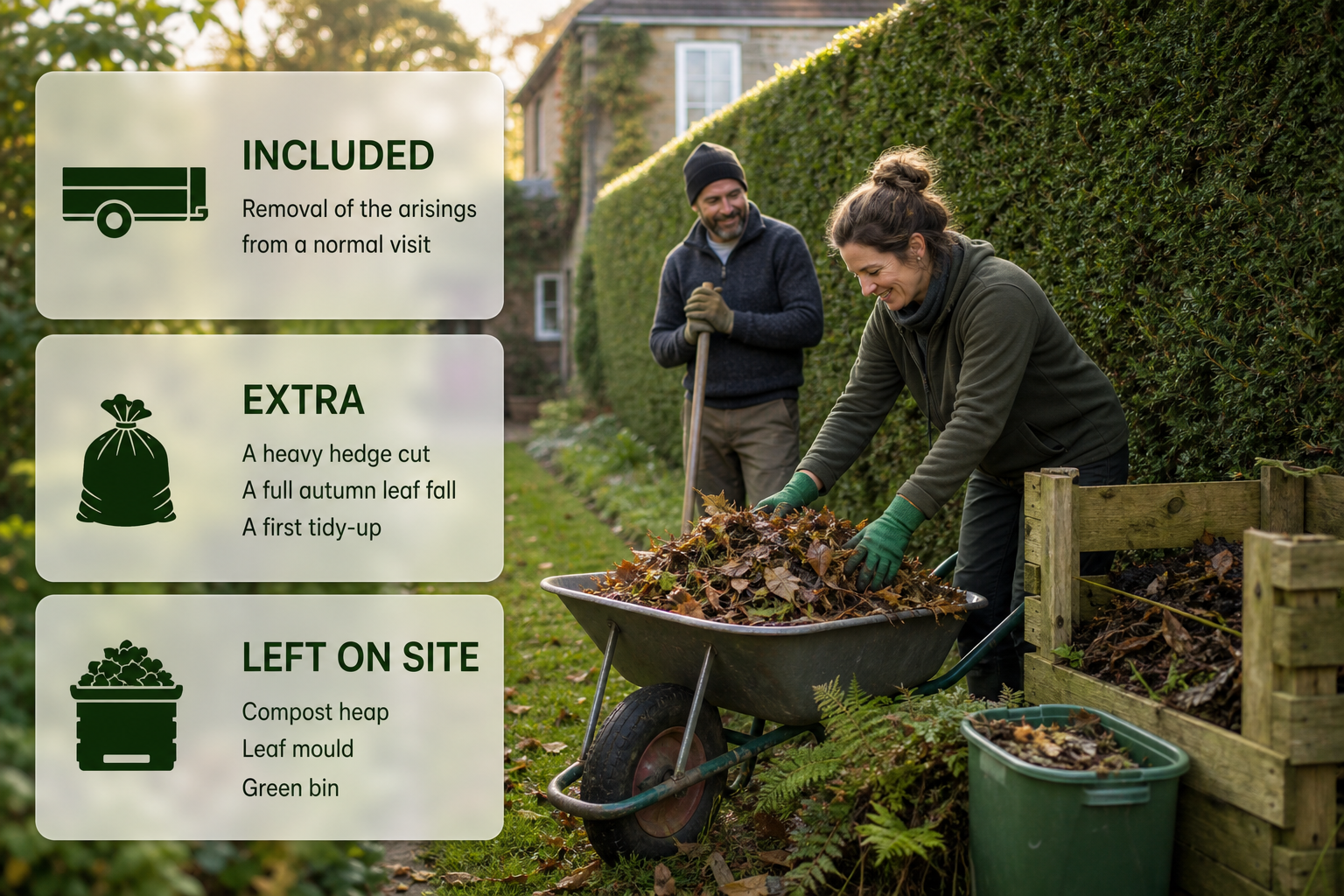
A gardener who arrives with a trailer and has a regular disposal route may include removal of the arisings from a normal visit. Where the volume is larger — a heavy hedge cut, a full autumn leaf fall, or a first tidy-up of an overgrown border — removal is commonly treated as an extra, because the load is larger and the trip to dispose of it is a separate job. A third option is to leave the material on site: clippings can go on a compost heap, leaves can be kept as leaf mould, and prunings can be stacked. Homeowners with a green bin or access to a local civic amenity site can often deal with modest volumes themselves.
The point to settle before the first visit is simple: who takes the waste away, and from what volume that changes. That single question removes most of the confusion around green waste.
Where maintenance ends and landscaping begins
Maintenance keeps an established garden in the condition it is already in. Landscaping changes what is there: new beds, new surfaces, new planting schemes, new levels. A one-off clearance sits between the two, because it restores a neglected garden to a state that can then be maintained.
In practice, the distinction matters for two reasons. First, the skills and equipment differ: a maintenance gardener works with mowers, strimmers and hand tools, while landscaping involves excavation, hard materials and construction. Second, the work pattern differs: maintenance repeats, while landscaping and clearance are projects with a start and a finish. A homeowner who has just had a new lawn laid or a border replanted may find that the same provider can maintain it afterwards, since garden maintenance sits alongside other routine home services around a house.