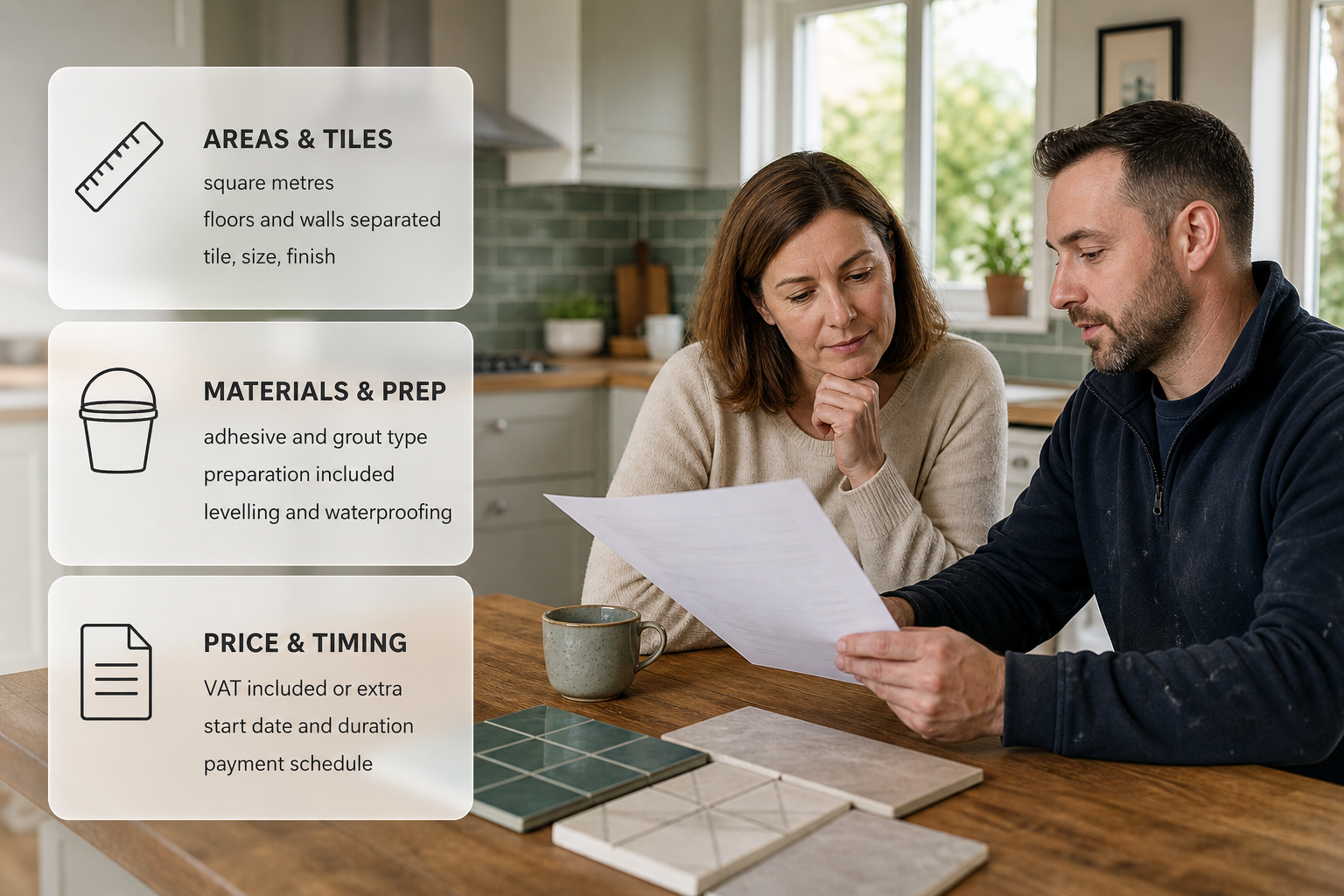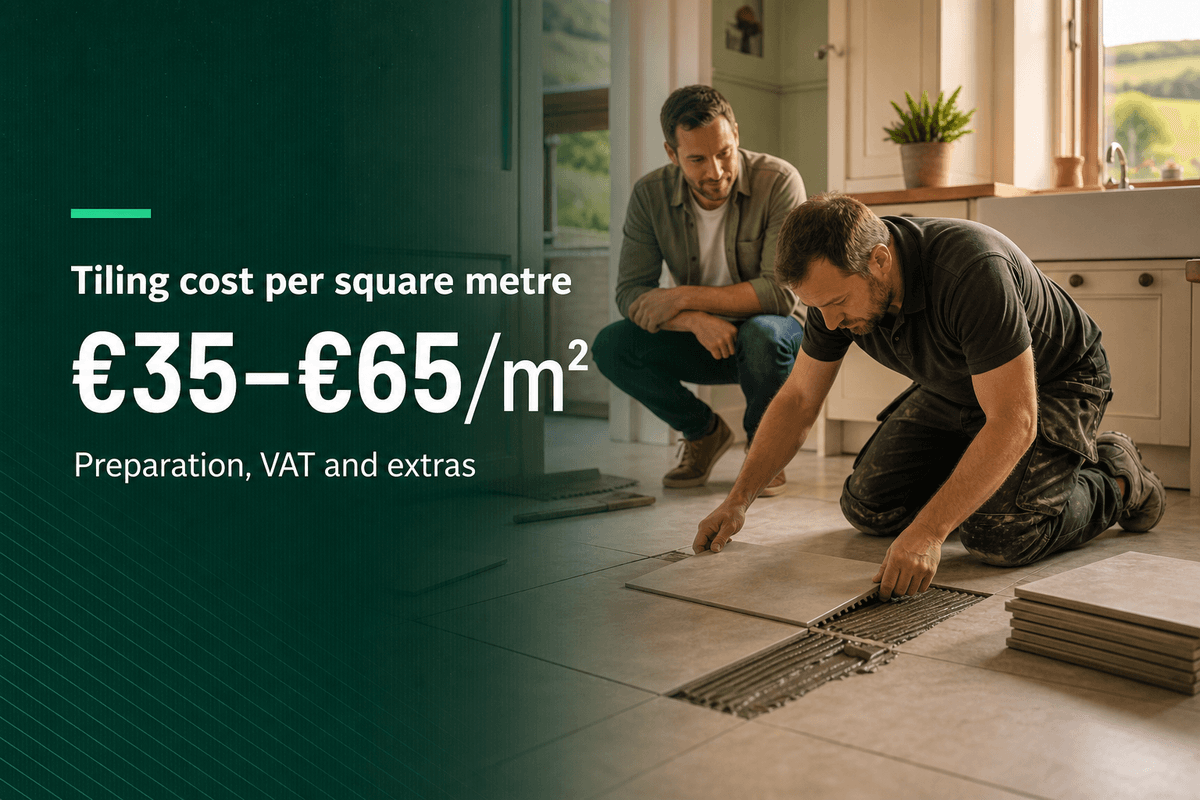
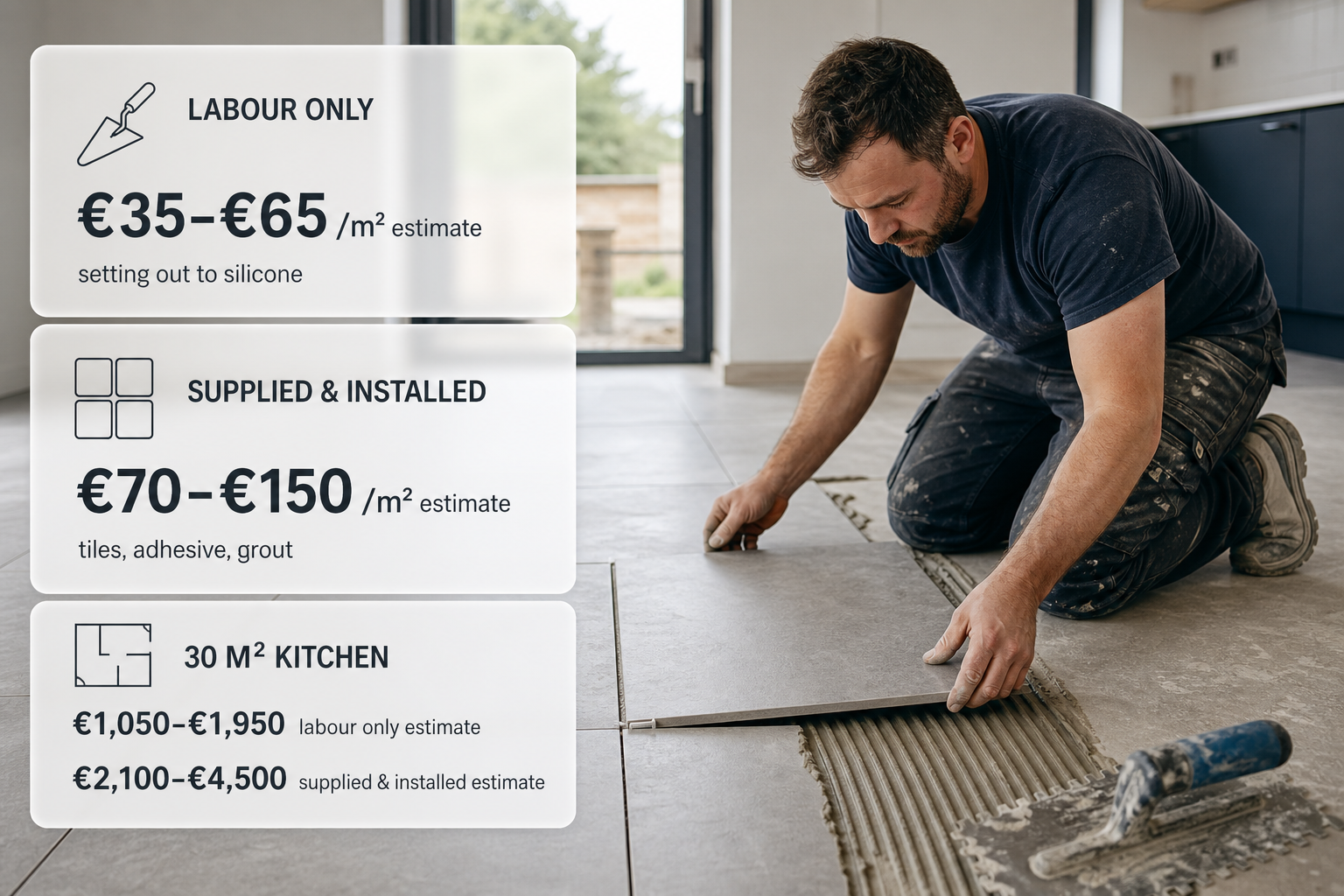
Tiling in Ireland usually costs €35 to €65 per square metre for labour alone, and €70 to €150 per square metre when the tiler supplies tiles, adhesive and grout as well. What separates two quotes for the same room is rarely the tile: it is the preparation underneath, the amount of cutting the layout needs, and whether VAT is included. The breakdown below is set out the way a quote should be, so quotes for tiling services can be compared line by line rather than on the headline figure alone.
Tiling cost per square metre: the headline ranges
The figures here are an aggregate Irish market estimate for everyday indoor tiling in Irish homes — floors and walls, ceramic and porcelain, standard and large formats, booked directly with a tiler.
| Line item | Range per m² |
|---|---|
| Labour only (setting out, cutting, fixing, grouting, silicone) | €35–€65 |
| Tiles, adhesive and grout supplied by the tiler | €20–€50 |
| Surface preparation, priming and levelling | €10–€25 |
| Waterproofing in wet areas | €5–€10 |
| Removal and disposal of old tiles (extra, where needed) | €15–€35 |
| Waste and offcut allowance (extra, on the tile order) | 5%–10% |
The first four lines build the supplied-and-installed headline, and they add up exactly: €35 + €20 + €10 + €5 = €70 per m² at the low end, and €65 + €50 + €25 + €10 = €150 per m² at the high end. Removal and the waste allowance sit outside that headline, because many jobs need neither.
A clear 30 m² kitchen floor therefore comes to roughly €1,050 to €1,950 for labour only, or €2,100 to €4,500 supplied and installed. Lifting an old tiled floor first would add about €450 to €1,050 on a job that size.
Rates are charged on the tiled area measured across the face of the tiles, not the floor area of the room. A window, doorway or toilet reduces the measured area but adds cutting, so a small room full of obstacles can cost more per billed square metre than a large clear floor.
What changes the rate per square metre
Tile type. Basic ceramic is the cheapest item on the materials line above, porcelain sits mid-range, and natural stone such as marble or limestone pushes towards the top, as it is heavier, more fragile and often needs sealing.
Tile size. Small tiles mean more joints, more grout and more time, so they attract labour at the upper end of the labour line in the table above. Very large formats of 600 x 1200 mm and beyond need two people, suction lifters, back-buttering and often clip levelling, and they land at the same upper end. Mid-sized tiles around 300 x 600 or 600 x 600 are most often priced in the lower half.
Pattern. A straight grid or stacked layout is fastest to set out and cheapest to lay. Brick bond adds a little. Herringbone, chevron and basketweave need far more cutting and create more waste, so both the labour line and the waste allowance sit at their highest.
Mosaics. Sheets of small tiles on a mesh backing are used where drains or curves make large tiles impractical. They are slow to bed, the joints are numerous and grout use is high, so mosaics usually sit at the top of the labour range and above it where the shape is complicated.
Grout and adhesive. Cement-based grout is standard and inexpensive. Epoxy grout costs more on the materials line and takes longer to apply, but it resists staining, which matters in a kitchen or shower.
Kitchens, bathrooms and the room around the tiles
Kitchen floors are usually the most predictable job in the house: a flat, clear slab, large tiles, few cuts and no waterproofing, so quotes often sit in the lower half of the ranges above. A splashback is a small area, but it is cut around sockets, hobs and extractor hoods and carries more labour per square metre.
Bathrooms are the opposite. The measured area is small but the job is dense: waterproofing, cuts around the waste, shower tray, pipework and door frames, plus wall tiling at a chosen height. Wall tiles also need more support and levelling than a floor, so expect a bathroom quote near the top of the ranges and ask for floor and wall areas to be priced separately.
Where tiling is part of a wider construction and home renovation project, it should be priced after the screed, studwork and sanitary ware are settled. Tiling a floor that is still moving, or around fittings about to be replaced, wastes money twice.
Extras: preparation, levelling, waterproofing and removal
- Preparation. Stripping old vinyl, timber or tiles, scraping off adhesive, filling cracks, sanding and priming. This is the preparation line in the table above, and it is the one most often understated in a cheap quote.
- Levelling. Self-levelling compound poured and left to cure before tiling starts. Thin pours sit inside the preparation line; badly dipped or sloped floors can push past it, and a timber floor may need an overlay board first.
- Waterproofing. A tanking system applied to shower walls and wet room floors, with tape at corners and joints. This is the waterproofing line above, and a full wet room costs more than a standard shower enclosure.
- Removal and disposal. Old tiles are heavy, dusty and awkward. The removal line covers lifting and carting away, and it can rise where access is poor or a skip is needed.
- Trims, thresholds and silicone. Small items individually, but they appear on every quote and should be listed rather than assumed.
When a small bathroom is quoted as a fixed total
A four or five square metre bathroom looks tiny on paper, but setting out, mixing, cutting, cleaning and travel take close to a full day whatever the area. Charged at the low end of the labour range, such a job would come to a few hundred euro, which is why many tilers quote a small bathroom as a fixed total instead.
A fixed total is not a bad deal by itself. What matters is that it is itemised — labour, tiles, adhesive and grout, preparation, waterproofing, removal and VAT shown separately — so it can be checked against the per square metre ranges above. Ask what the total assumes about the surface underneath, and what happens if a wall turns out to be out of plumb.