Aggregate Irish market estimate: a new patio in Ireland generally costs €85 to €250 per square metre installed, which puts most domestic projects between €2,500 and €12,500. Excavation, the depth of the base, access and drainage move a job between the lower and upper end of that spread more often than the paving choice itself. Knowing what each line of a quote buys makes it much easier to compare patio and landscaping construction work from different contractors on a like-for-like basis.
What a typical patio costs in Ireland
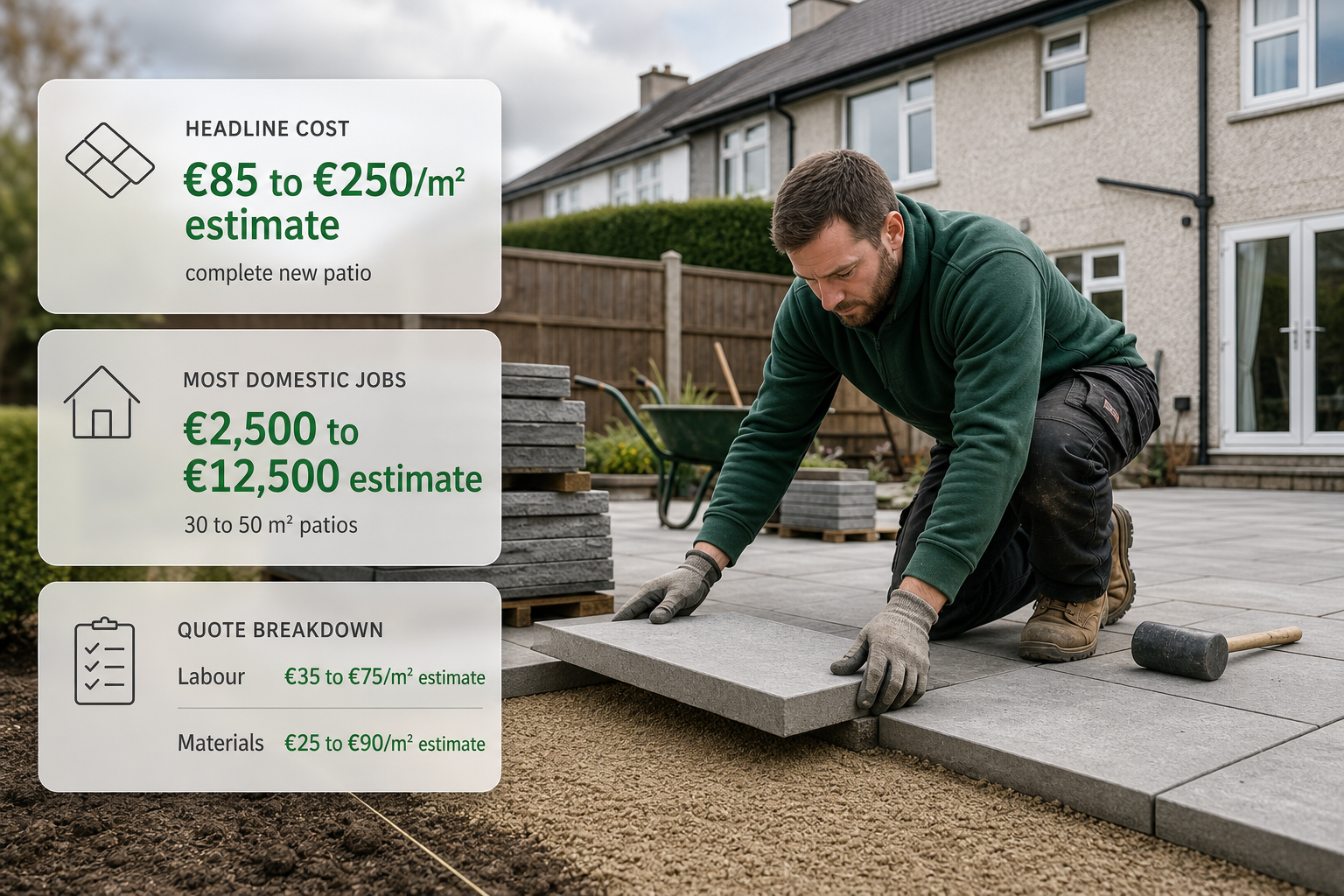
Aggregate Irish market estimate: budget €85 to €250 per square metre for a complete new patio, or roughly €2,500 to €12,500 for the 30 to 50 square metre patios that make up most domestic jobs. That headline is really the sum of several separate items, and it is easier to check when they are shown apart.
The table below gives the same aggregate Irish market estimate broken down the way a homeowner would expect to see it on an itemised quote.
| Quote item | Typical range |
|---|---|
| Labour only — setting out, laying, cutting and pointing | €35 to €75 per m² |
| Paving materials — concrete slabs, block paving, porcelain, natural stone | €25 to €90 per m² |
| Base preparation and excavation — dig-out, hardcore, compaction, laying course | €20 to €45 per m² |
| Edging, kerbs and steps | €15 to €35 per linear metre; €150 to €450 per step |
| Waste removal and skip hire | €250 to €650 per project |
| Drainage additions — channel drain, soakaway, extra falls | €400 to €1,500 per project |
Labour, materials and base preparation together make up the €85 to €250 per square metre headline. Steps, drainage and waste removal sit outside the per-square-metre figure, and they are often where a final bill drifts away from the original estimate. Most contractors also allow a contingency of 10–15% of the total for buried obstructions, extra hardcore or levels that turn out steeper than expected.
What a patio quote usually includes and what it leaves out
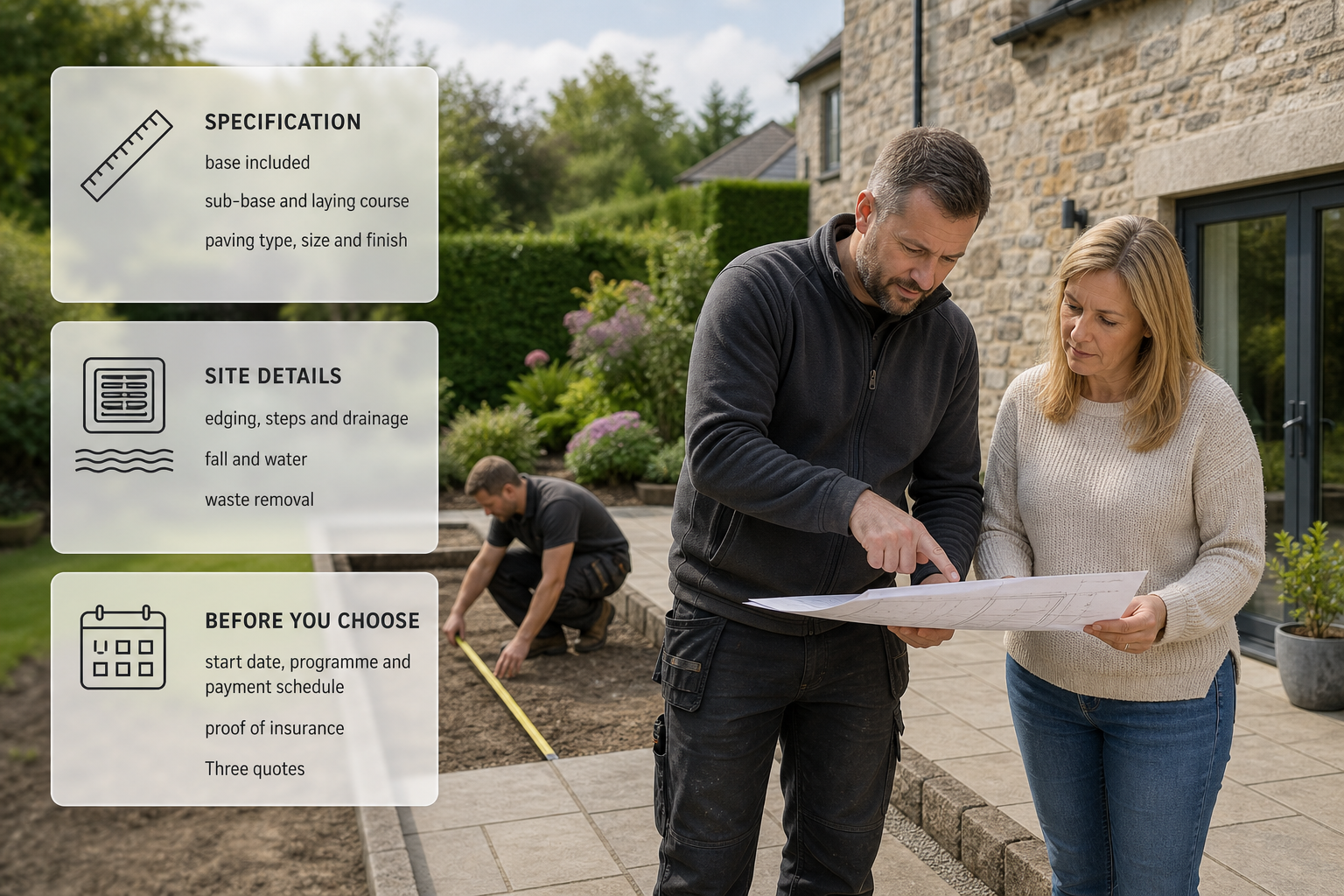
A properly itemised patio quote normally covers setting out, excavation to the required depth, supply and compaction of a hardcore sub-base, a laying course of sand, grit or mortar, the paving itself, cutting at edges and around services, jointing or pointing, edge restraint, and clearance of the spoil.
What is left out matters just as much. Tree and shrub removal, new connections to the public drainage system, garden lighting and other electrical work, retaining walls, raised beds and lawn reinstatement are usually separate, and any permission fees are the homeowner's. Where a price looks unusually low, it is worth checking whether the base has been priced at all, whether waste removal is included in the €250 to €650 per project range, and whether edging and steps have simply been omitted.
What moves the cost
Material choice. Concrete slabs and block paving sit towards the bottom of the €25 to €90 per square metre materials range, while porcelain and natural stone sit at the top. Smaller formats, mixed sizes and heavy patterns take longer to lay, which shows up towards the top of the €35 to €75 per square metre labour range rather than in the materials line.
Size and shape. The rate per square metre usually falls as the patio grows, because setting out, machine hire and a skip are spread over more ground. A very small patio carries the same fixed costs over fewer square metres, which is why a 12 square metre job can be dearer per square metre than a 50 square metre one even though its total lands well below the €2,500 to €12,500 band.
Labour and access. If a mini-digger can reach the back garden, excavation and carting away are quick. If every barrow has to pass through a side gate, a garage or the house, hours climb and the job moves towards the top of the €35 to €75 per square metre labour range.
Excavation and ground conditions. Made ground, soft fill, heavy clay, rock or buried concrete all change how much has to be dug out and replaced with compacted hardcore. Rock breaking or removal of an old slab foundation is normally charged as extra within the base preparation line, and it is one of the most common reasons a final bill exceeds the estimate.
Base preparation. This is the part of a patio that cannot be seen afterwards and the easiest place to cut corners. The sub-base should be hardcore laid in layers and compacted with a plate compactor, with the laying course on top bringing everything to level and to the required fall. A thin or poorly compacted base is what makes slabs rock, sink or crack within a season or two.
Drainage and falls. Every patio needs a fall away from the house, and where the ground cannot take water, or where the patio meets a door threshold, a channel drain or soakaway may be needed. That work sits at €400 to €1,500 per project in the table above, and it is the item most often missing from a cheap quote.
Edging and steps. Edge restraint stops the paving spreading, and it is charged at €15 to €35 per linear metre. Steps add €150 to €450 each, with the figure rising where the step needs its own foundation, a wall or a matching stone face.
Waste removal. Spoil, old paving and offcuts have to go somewhere. Skip hire and disposal typically fall between €250 and €650 per project, and the figure moves towards the top of that range where there is no driveway access for the skip or where the soil is heavy and wet.
Small and large patio examples
Three typical jobs illustrate how the aggregate Irish market estimate ranges above combine. A small 15 square metre patio in standard concrete slabs, with straightforward access and no steps, generally comes in at €1,300 to €2,100, or roughly €87 to €140 per square metre. A mid-sized 30 square metre patio in block paving with edging and a skip typically costs €2,600 to €4,800. A large 60 square metre porcelain patio with steps and a channel drain usually lands between €10,500 and €15,000, at the upper end of the per-square-metre range because of the material and the extra work.
Patios rarely stand alone. Steps, retaining walls, drainage and a new lawn often follow, and homeowners planning that wider work can look at construction and home renovation services when they want one point of contact for several jobs.