
Laminate flooring that lifts at the edges shows up as a ridge along a plank joint, a board sitting proud of its neighbours, or a hollow, springy patch near a wall or doorway. The most common cause is straightforward: the boards have no room to move, so as the floor expands it pushes against itself and rides up at the weakest point, while moisture, uneven subfloors and edges trapped by skirting or trims drive the rest. The cause has to be identified before anything is repaired, because boards that need lifting and relaying are work for a local flooring installation service.
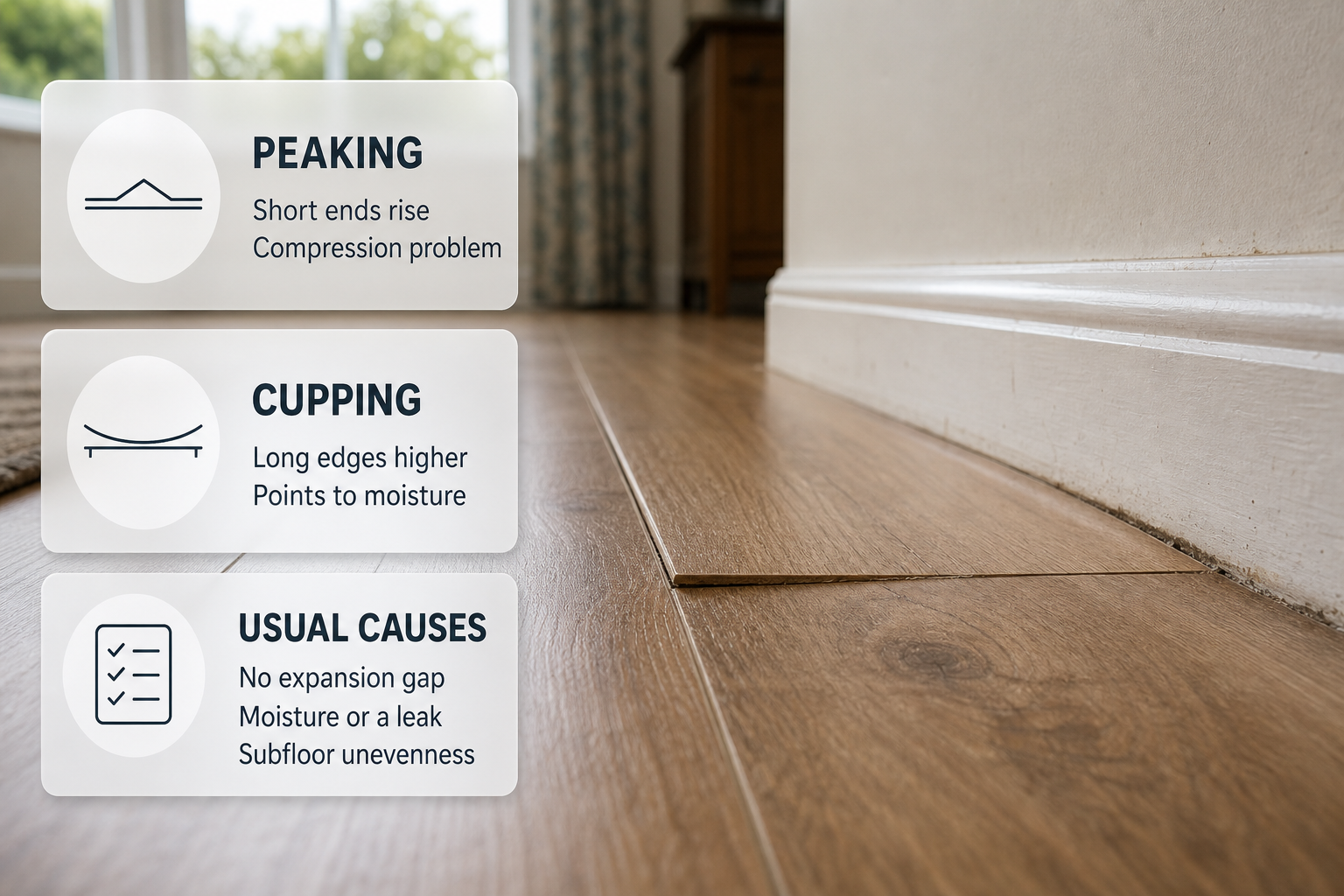
What edge lifting looks like, and the usual causes
Two different faults get described as lifting, and telling them apart shapes everything that follows.
Peaking is when the short ends of two boards rise into a ridge at the joint while the board surfaces either side stay flat. It is a compression problem: the floor has expanded with nowhere to go, so the joints climb.
Cupping is when the long edges of a board sit higher than its middle, giving a shallow dished or washboard look across the floor. That points to moisture reaching the boards, usually from below or from a leak.
Behind those patterns sit a small number of causes:
- No expansion gap. Laminate is a floating floor and needs a gap between board edges and every wall. Boards cut tight to the skirting, or a gap since filled with plaster, grout, sealant or debris, leave the floor with no slack.
- Moisture or a leak. Spills, wet mopping, a slow radiator or appliance leak, a damp concrete slab and rising damp all swell the board core. Laminate cores are dense fibreboard, and once they take on water they do not return to shape.
- Skirting, beading or trims pinning the floor. Scotia, beading or skirting pinned or screwed through the boards rather than fixed to the wall clamps the floor down and blocks movement.
- Subfloor unevenness. A hollow, dipping or ridged subfloor leaves some boards bearing load and others floating, so joints open and lift.
- Doorway and threshold pressure. Door bars, threshold strips and radiator pipe collars sitting tight against the boards trap the floor, and doorways are often where lifting appears first.
- Fixed furniture. Kitchen islands, fitted units and heavy static furniture laid over the floor remove the space the floor expands into.
How to tell which cause is most likely
Work through these checks before touching anything, because the pattern usually gives the answer away.
Start with where the ridge runs. Lifting that follows a wall line, or sits just in front of a doorway, points to a trapped edge. Lifting in the middle of a room, particularly near a kitchen or bathroom wall, points to moisture.
Check the wall edge. If beading can be eased away, look at the gap between the board edge and the wall: debris, hardened sealant or a board cut flush to the skirting confirms a missing or blocked gap. If nails pass through the beading into the boards themselves, the floor is pinned.
Look for wet evidence. Staining on the skirting, a musty smell, dark patches on a concrete floor, a nearby radiator or appliance connection, or boards cupped across their width all suggest moisture. A swollen board usually sits slightly thicker at the damaged area.
Test the feel underfoot. Walk the area slowly. A springy or hollow section, or a joint that flexes when stepped on, suggests the slab or timber deck below is not flat or is moving.
Check the timing. Lifting that appeared during a humid spell, after a cold snap with the heating running hard, or after a plumbing incident is telling you something, as is a ridge that returns after somebody has already fixed it once.
The flatness a laminate floor needs is set by the board manufacturer's installation instructions rather than by a single Irish rule, so the required tolerance for a particular product is confirmed with those instructions or with the fitter doing the work.
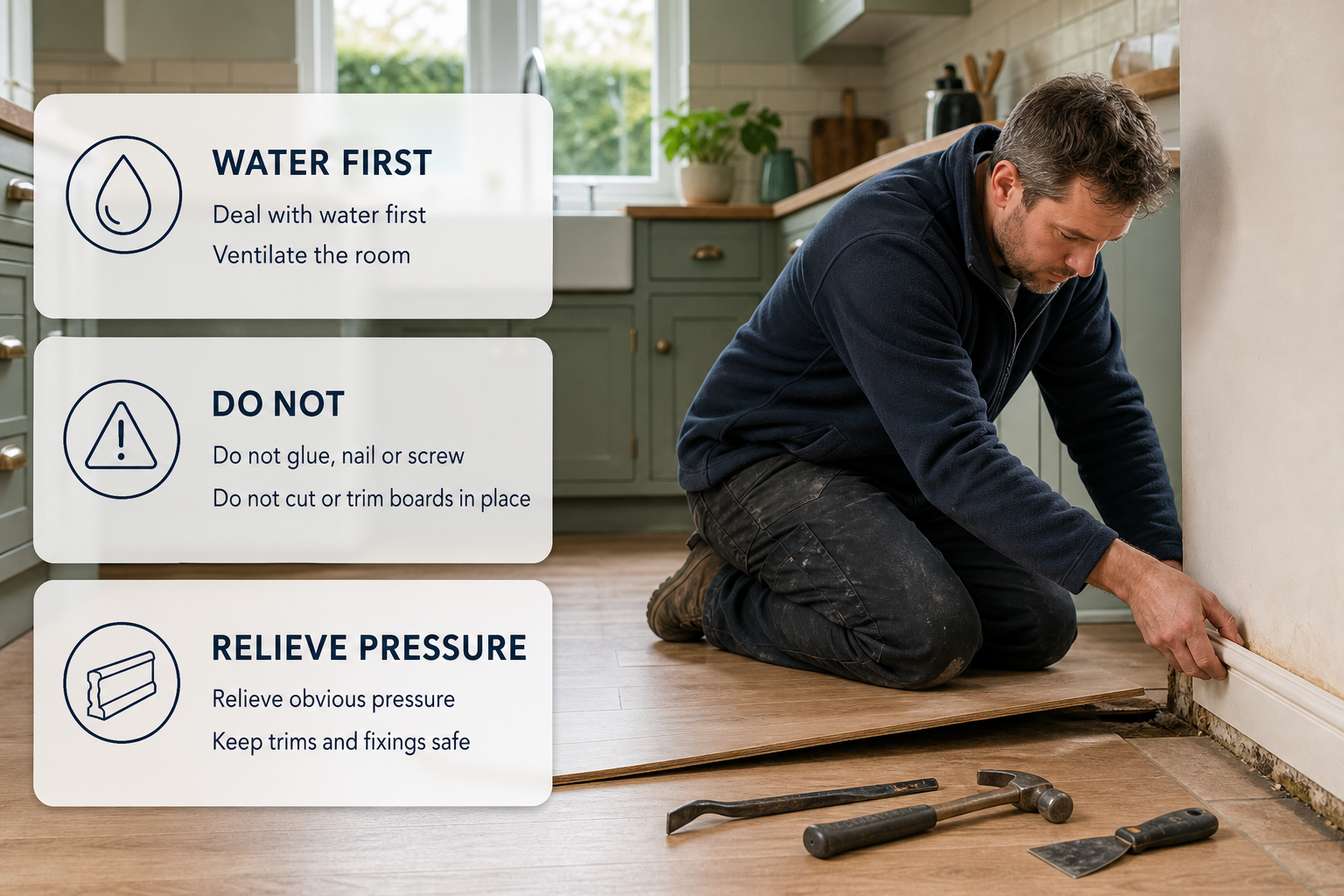
Safe steps to take before a repair
The principle is to remove the cause rather than the symptom, and to avoid anything irreversible.
- Deal with water first. Dry up spills, ventilate the room, and if a pipe, radiator or appliance connection is dripping, have that looked at before the floor.
- Do not glue, nail or screw a lifted board down. It may flatten briefly, but the pressure returns and the joint is often damaged in the attempt. Fixings also complicate any later complaint.
- Relieve obvious pressure. Where beading or a door bar sits tight against the boards, easing that trim off lets the floor move and can reduce the ridge. Keep the trims and fixings safe to refit.
- Do not cut or trim boards in place. A proper expansion gap can only be formed by lifting the affected run, because a saw run along a fitted floor damages the joint and the board face.
- Protect the area and steady the room. Keep heavy furniture and foot traffic off a bouncing section, avoid dragging items across a lifted seam, and keep the room at a normal indoor temperature with some ventilation.
- Use basic protection when handling trims and fixings: gloves, eye protection, and a dust mask if any cutting or sanding is involved.
Photograph and note everything as you go, because a record made before the repair is worth more than one made afterwards.
Repair or replacement: which is realistic
A single localised ridge caused by a trapped edge or a closed-up gap is often repairable. A fitter can lift the affected run, restore the movement gap, check the underlay and refit the same boards, provided the locking joints are intact.
Replacement of boards, or of a whole section, is the realistic answer when:
- the board core has swelled or crumbled, since laminate does not dry back flat;
- locking tongues are cracked or snapped, so the joint no longer holds;
- several boards are cupped across their width, which points to moisture rather than fitting;
- a leak has soaked a run of floor, or mould has taken hold in the underlay;
- boards were cut tight under skirting or units, so the run has to come up to reinstate a proper gap.
Where moisture is the cause, that has to be resolved first. New boards laid over a damp slab, a leaking pipe or a wet subfloor simply repeat the fault.