Most tiled bathrooms take three to six working days once surfaces are ready, with walls slower than floors. Here's how to plan the timeline.
/8 min read
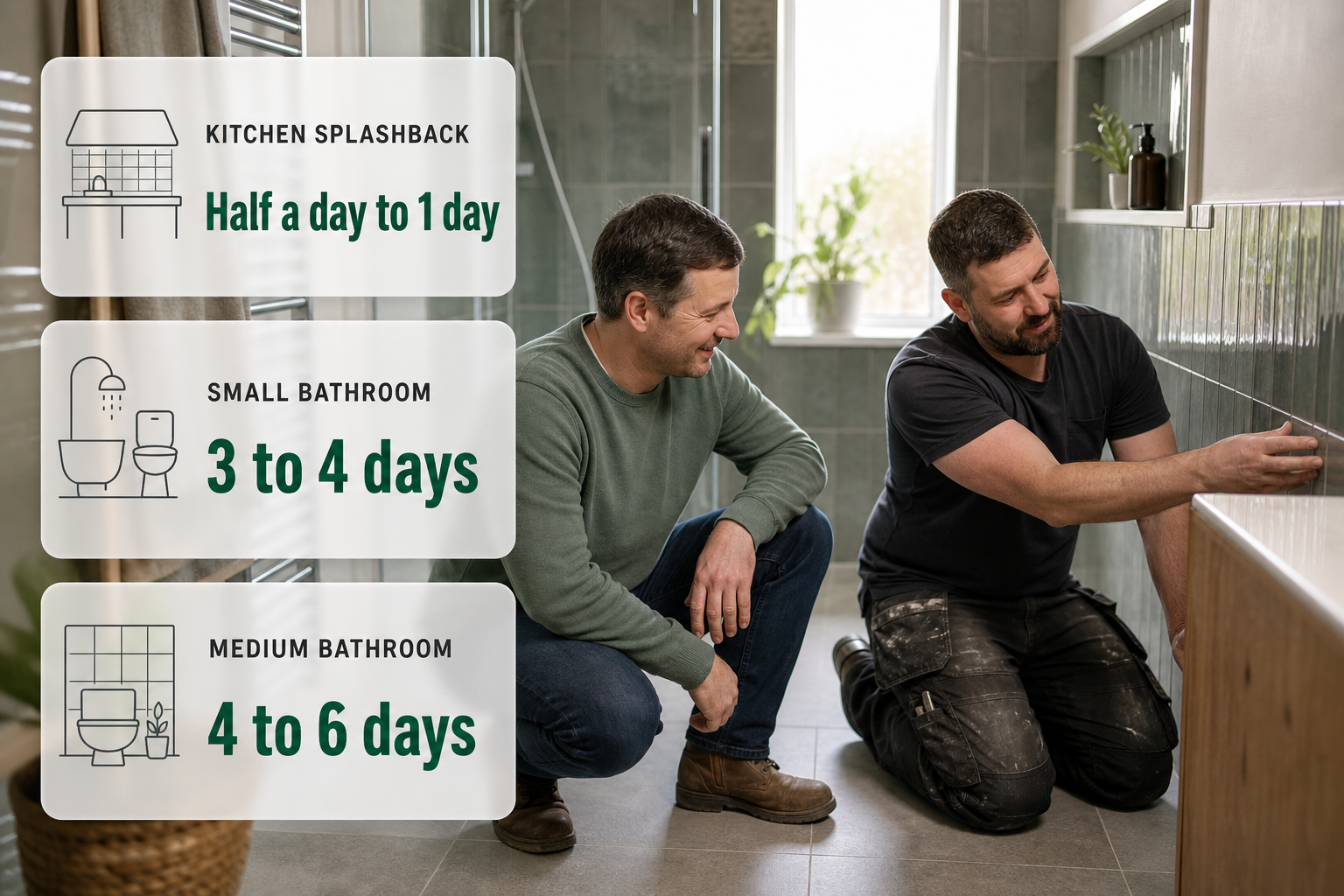
For most Irish homes, tiling is the shortest stretch of a bathroom or kitchen refurbishment, yet the calendar rarely matches the tiling days alone: a small bathroom usually takes three to four working days of tiling once the surfaces are ready, a medium bathroom four to six, and a large bathroom or wet room six to nine. Wall tiling generally runs slower per square metre than floor tiling because of the extra setting out, cutting and fittings, and none of those figures includes preparation or the drying time that follows. Homeowners planning ahead can compare local tiling services and ask each tradesperson how many working days they allow for setting out, tiling and grouting.
Wall tiling versus floor tiling: where the hours go
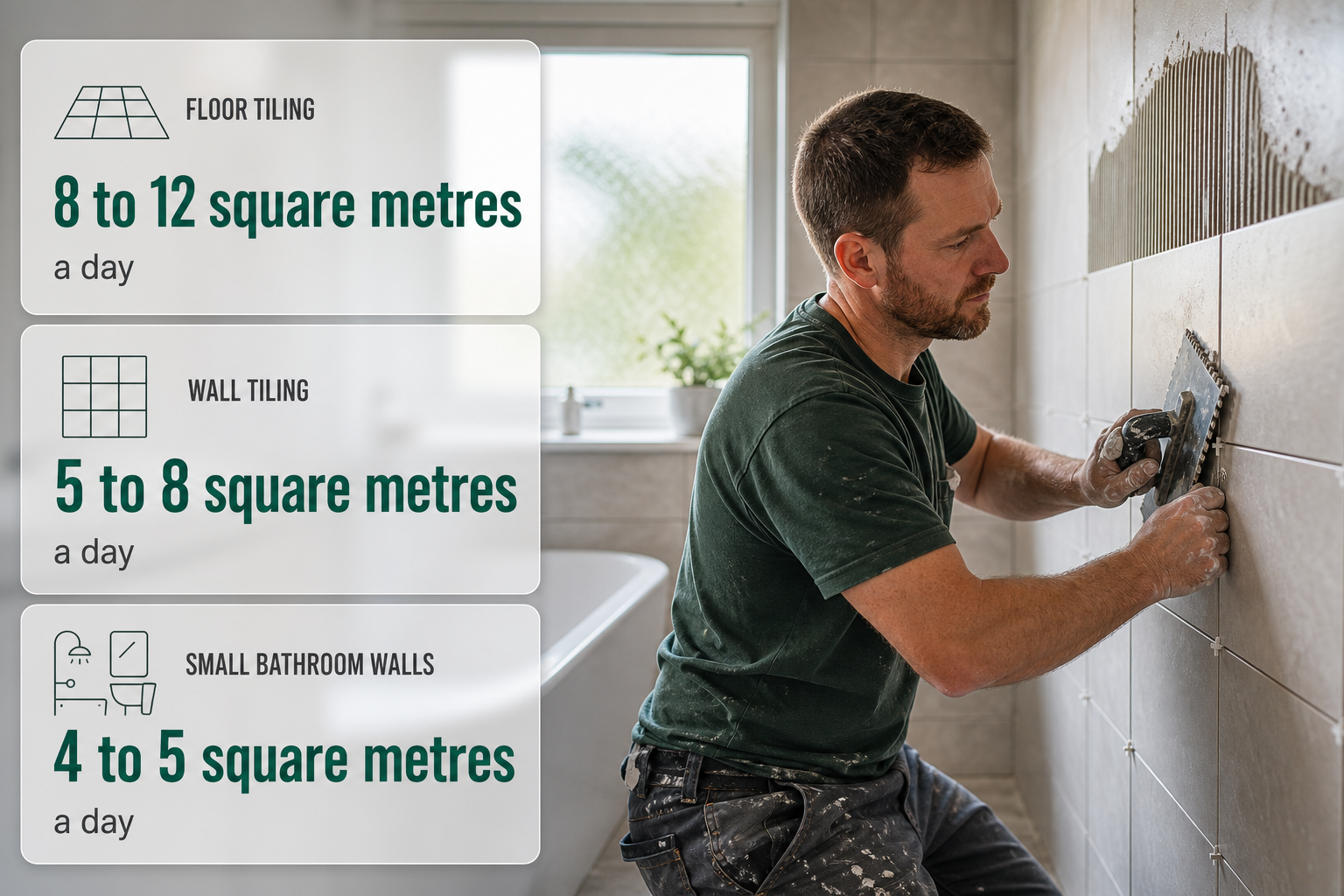
A single tiler working on flat, prepared surfaces will usually lay about 8 to 12 square metres of standard floor tiles in a day, and about 5 to 8 square metres on a wall. The gap comes from the work around the tiles rather than the tiles themselves: walls carry sockets, pipework, window reveals, trims and corners that have to be set out and cut individually, and much of the work is done overhead, which slows the pace. Floors are faster in long open runs because the tiler can work across a wide area without stopping, but floors are far less forgiving of an uneven base, so any levelling work sits before the tiling clock starts.
Small rooms change the arithmetic. In a bathroom where a bath, shower, window and boxing leave few full tiles, the tiler may manage only 4 to 5 square metres of wall in a day. A kitchen splashback is the opposite case: a short run above a worktop with a handful of socket cut-outs is often finished in half a day to a day, even when the tiles themselves are large. Layout matters too — a straight grid is the fastest arrangement, while brick bond, herringbone and mitred corners all need more measuring and more cuts.
Small, medium and large jobs: realistic working days
The bands below cover the tiling itself, with the room stripped back and the walls or floor ready to receive tiles. They assume one tradesperson and standard-size tiles; heavy large-format tiles push any job towards the top of its band.
Job
Tiling time for one tradesperson
Kitchen splashback, 3–6 m²
Half a day to 1 day
Small bathroom, floor up to 4 m² and walls up to 15 m²
3 to 4 days
Medium bathroom, floor 5–8 m² and walls 16–25 m²
4 to 6 days
Large bathroom or wet room, floor 9 m² and over
6 to 9 days
Kitchen floor, 10–20 m²
2 to 3 days
Large kitchen floor with splashback, 25 m² and over
3 to 4 days
These are working days on site rather than calendar days, so weekends, deliveries and the drying gaps between stages are counted separately. A second tiler shortens the calendar but does not halve it, because setting out, cutting, grouting and sealing still follow one sequence, and two people working in a small bathroom often get in each other's way.
What adds time to a tiling job
Tiling rarely happens on its own: it usually sits at the end of a wider set of works, and the construction and home renovation category shows the trades that come before and after. Each item below pushes a job towards the top of its band.
Substrate preparation: lifting old tiles, repairing damaged plaster or screed, overboarding or re-skimming, and letting levelling compound set. This is often the longest single item.
Waterproofing in wet areas, including the drying time between coats.
Large-format tiles of roughly 600 mm and over, which can slow a tiler to 2 to 3 square metres a day on walls and 3 to 5 on floors because of the weight and the cutting.
Mosaics and small formats, at roughly 1 to 2 square metres a day because of the sheet-by-sheet work and the number of grout lines.
Tight grout lines, spacers and levelling clips, which slow every tile but are often needed with large porcelain.
Pattern and detail: herringbone, brick bond, borders, niches and mitred external corners.
Access: upstairs rooms, tight stairwells and occupied homes all slow delivery and mixing.
Preparing and waterproofing before the first tile goes on
Tiling is only as good as what is behind it, and this part of the job often surprises homeowners because it takes days rather than hours. Before the first tile goes on, the room is stripped out, the first fix of plumbing and electrics is completed, and the walls or floor are made good. Backer board, plasterboard, render and self-levelling compound all need their own drying or setting time, and a tiler will not tile over a surface that is still wet or still moving.
In showers, wet rooms and around baths and trays, waterproofing — tanking in liquid or membrane form — is applied in coats, with drying between coats, and the layer has to be complete and cured before tiling begins. Tiling over a membrane that is not fully cured, or that has been left incomplete at a corner, is a common cause of problems later, and the product instructions govern how long the coats need. Because preparation is genuinely a separate phase, the start date depends on the trades before it finishing on time.
Drying and curing after tiling
Tiling has two clocks: the time to lay the tiles and the time to let them set before the room can be used. The adhesive bed is normally left overnight before grouting begins, so walls tiled on a Monday are usually grouted on the Tuesday. Grout is then left to harden before the surface is wiped down or walked on, and cement-based adhesives and grouts reach full strength over several days rather than hours, so the instructions on the product are the ones to follow for heavy use and for wet areas. Silicone sealant at internal corners, around trays and along worktops needs its own cure before water runs over it, and the room should be ventilated while everything sets.
Where a new screed has been laid, SEAI's domestic technical standards and specifications state that the screed should be allowed to dry before any floor finish is laid (SEAI). Tiling over a screed that is still drying traps moisture under an impermeable layer, so floor tiling can be the last thing to happen in a new-build or extension bathroom even when the walls are finished. The wait depends on the thickness and mix of the screed and on ventilation, and the person who laid it is the one to confirm it has dried. Underfloor heating brings its own sequence: the system is normally commissioned and run through a controlled warm-up and cool-down cycle before tiling starts and left off for a period afterwards, with timings given by the system supplier.
Sequencing the work so the dates hold
A typical internal job runs in this order, and each step has to finish before the next begins: strip-out; first fix plumbing and electrics; walls and floor prepared and dried; waterproofing applied and cured; setting out and tiling; grouting and sealing; second fix of sanitaryware; decoration; and the floor finish laid once the screed has dried.
Planning permission is rarely the main question for straightforward internal tiling, since replacing tiles on an existing wall or floor is normally an internal finishing job; where a project involves a change of use, works to a protected structure or an extension, the local authority decides, and homeowners confirm current requirements with their local authority before work starts. In an apartment or shared building, the lease and the management company's rules on noise, working hours and floor coverings often matter more than permission, and the owner checks those directly.
FAQ
Can a bathroom be tiled in a single day?
Realistically, no. Even the smallest bathroom spreads across three to four working days once the walls and floor are ready, and the stages cannot be compressed because the adhesive has to set before the tiles are grouted, and the grout has to set before the room is wiped down or used. One day is realistic for a splashback or a very small floor, not for a full bathroom.
Does the tiling time include everything the room needs?
No — the tiling days are the last stretch. Strip-out, first fix plumbing and electrics, boarding or rendering, levelling, waterproofing and its drying time all sit in front of them and are usually counted as separate work. It is worth asking for the whole sequence rather than the tiling alone when comparing start dates and completion dates.
When can the shower or the kitchen be used again?
After the grout and the silicone sealant have cured, and not before. Running water over sealant that is still curing can break the bond, and a shower used too early can pull moisture into fresh grout. Ventilating the room and following the curing period stated for the products used is the safe approach, and the tiler will say when the tray, bath or worktop can go back into use.
Does the room have to be emptied completely?
Yes for a bathroom or a kitchen floor. Furniture, mats and stored items need to come out, the water supply may be turned off while sanitaryware is refitted, and dust from cutting travels, so adjoining rooms are usually covered. The room is out of use for the whole window — preparation, tiling and curing — not just the days when tiles are being laid.
Does a kitchen splashback take as long as a floor of the same size?
No. A splashback is a short, straight run at waist height with few cuts, and it is often completed in half a day to a day. A floor of the same area takes longer to set out, needs a level base and involves more walking over fresh work, and a kitchen floor of 10 to 20 square metres is normally a two to three day job.
Booking a tiler and keeping the schedule realistic
The most useful question to ask a tradesperson is not how long tiling takes in general, but how many working days their own method needs for this room, including setting out, cutting, grouting, sealing and the gaps for drying. Posting a job and listing it on ShamFix is free and there is no commission, and a subscription is planned for the future. ShamFix does not check or certify tradespeople and profiles are filled in by tradespeople themselves, so homeowners should check registrations themselves and read reviews. Start from the ShamFix home page.
Cracked shower grout is often cosmetic, but it can mean water is getting behind the tiles. Learn the warning signs, safe DIY fixes and when to call a pro.