
ShamFix
Back to insights

Spring Garden Maintenance: An Irish Homeowner's Guide

Start with inspection and cleanup, then lawns, beds, pruning and hedges, with Irish nesting-season rules built in.

9 min read
Spring Garden Maintenance: An Irish Homeowner's Guide

Spring garden maintenance in Ireland follows a set order: inspect and clear the garden first, then cut and feed the lawn, tidy and mulch the beds, prune, and leave hedge work to the very end of the list. Working through it that way means each area is handled once and the green waste collects in one place instead of three. Homeowners who would rather share the load can compare local garden maintenance help on ShamFix, for the whole list or just the heavy items.

Walk the garden, then clear what winter left

Start with a slow lap of the garden on a dry day, notebook in hand, and list what needs attention: standing water, moss patches, bare lawn, lifted paving, leaning posts, branches rubbing a roof or a boundary, and plants lifted out of the ground by frost. That list sets the order of the work and stops the same corner being visited twice.

Clearing comes next. A stiff plastic leaf rake clears leaves and dead foliage off a lawn far faster than a spring-tine rake, while the spring-tine version is the better tool on beds and around shrubs. Stems left standing over winter get cut back to about 5–10 cm, which marks where the plant sits and shelters overwintering insects. Storm-blown branches come out, pots and saucers are emptied of standing water, and weeds already rooted in gravel or along a path edge are pulled before they spread.

What to have to hand: gloves, eye protection for any work with shears, secateurs or a line trimmer, a wheelbarrow or tarpaulin for dragging material, and secateurs that cut cleanly rather than crushing. A dust mask is worth wearing around dry, dusty material such as old leaves or the surface of a compost heap.

Stay off wet soil. If a handful squeezed in the palm stays in a sticky ball, walking and digging will compact the beds for the season. Move material over a board, and leave digging, planting and mulching until the surface crumbles in the hand.
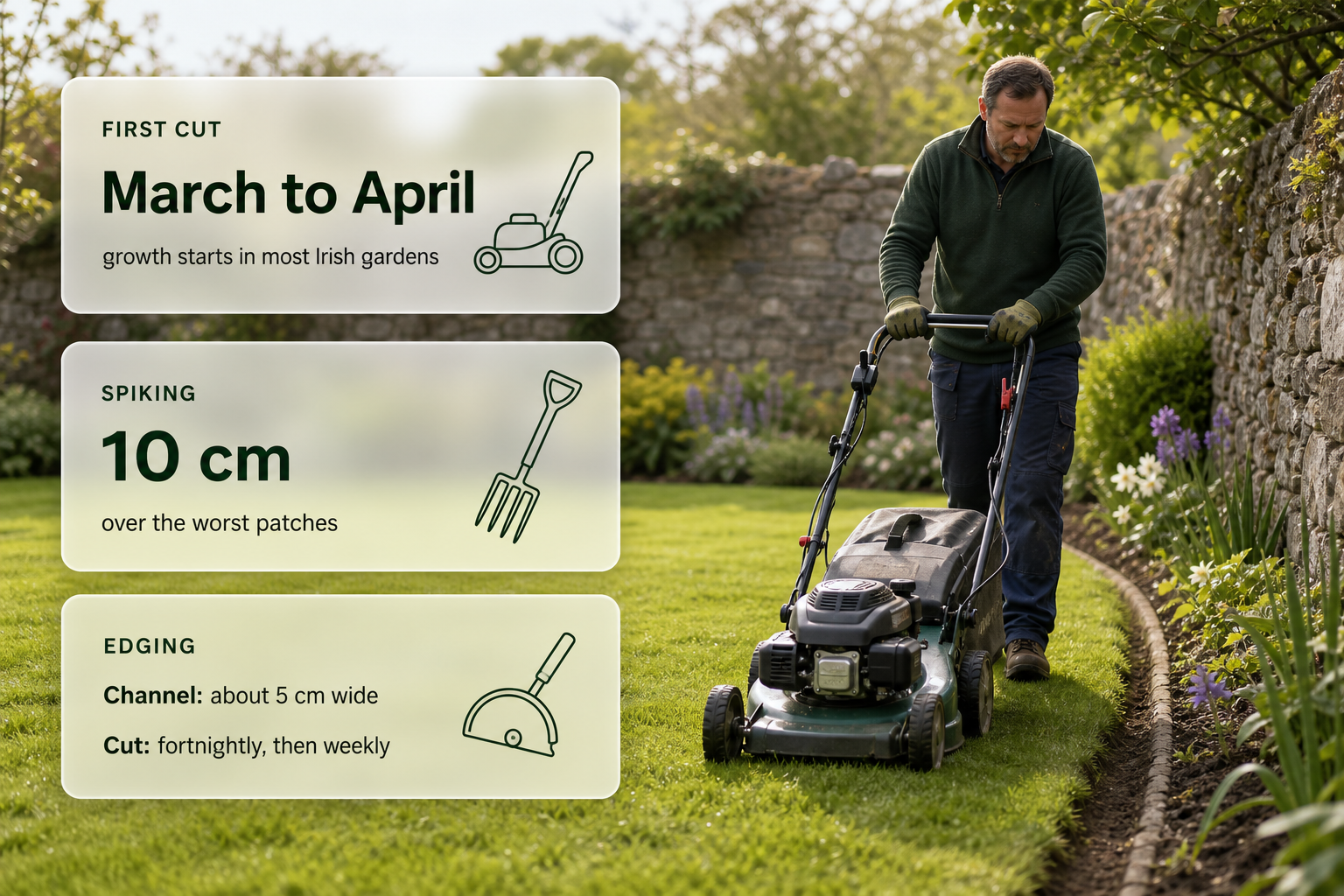
Infographic image showing first spring lawn care steps in an Irish garden, including first cut, moss control and edging.

Lawns: the first cut, moss control and edging

Grass starts into growth in most Irish gardens between March and April, and the first cut is set a notch higher than the summer height. Cut only when the ground is firm and no frost is forecast, because frosted grass tears and the crown is slow to recover. For the first two or three passes, collect the clippings.

Moss is a symptom rather than a separate job, pointing to shade, compaction, poor drainage or thin grass. On a small lawn a spring-tine rake or scarifier lifts it out once it is dry; on heavier ground, spiking the lawn with a garden fork to roughly 10 cm over the worst patches opens the surface. Overseed thin and bare areas afterwards, keep the seed damp, and feed lightly at the rate and timing printed on the packet rather than a heavy summer dose. Unless the shade or the drainage changes, moss returns.

Edging finishes the job. A half-moon edger, or the back of a spade held vertically, cuts a clean line and a channel about 5 cm wide, and shears or a line trimmer tidy the rest with eye protection on. Cut fortnightly until growth speeds up, then weekly, and never remove more than a third of the leaf in one pass.

Beds and borders: weeds, mulch and compost

Weed early and weed small. A hoe on a dry morning kills seedling weeds as the sun dries the cut roots, which is much quicker than pulling them later. Deep-rooted perennials such as dandelion and dock are loosened with a hand fork and pulled with a steady tug so the root comes with the top. The aim is to get them before they set seed.

Once the beds are clear and the soil has warmed and dried a little, a 5–7 cm layer of garden compost, well-rotted manure or bark holds moisture and keeps the next wave of seedlings down. Keep it clear of stems and crowns so nothing rots at the base.

A spring tidy produces most of what a home compost heap needs, so the material is worth keeping on site. Layer soft green material such as grass clippings and spent plants with tougher brown material such as cardboard, dry leaves and woody prunings, keep the heap as damp as a wrung-out sponge, turn it every few weeks, and take finished compost from the base. Cooked food, meat, dairy, diseased plants, perennial weed roots and treated timber stay out of a domestic heap.

Pruning: cut what needs it, when it needs it

Sharp bypass secateurs and a pruning saw cover most spring pruning. Cuts go back to a bud or to the branch collar without leaving a stub, and the work starts with the three Ds: dead, damaged and diseased wood. Shrubs that flower on last year's growth, such as forsythia and lilac, are pruned straight after flowering, since cutting them earlier removes the buds for the season ahead. Evergreens take only a light trim, and not until hard frost has passed. Where there is any sign of disease, clean the blades between plants.
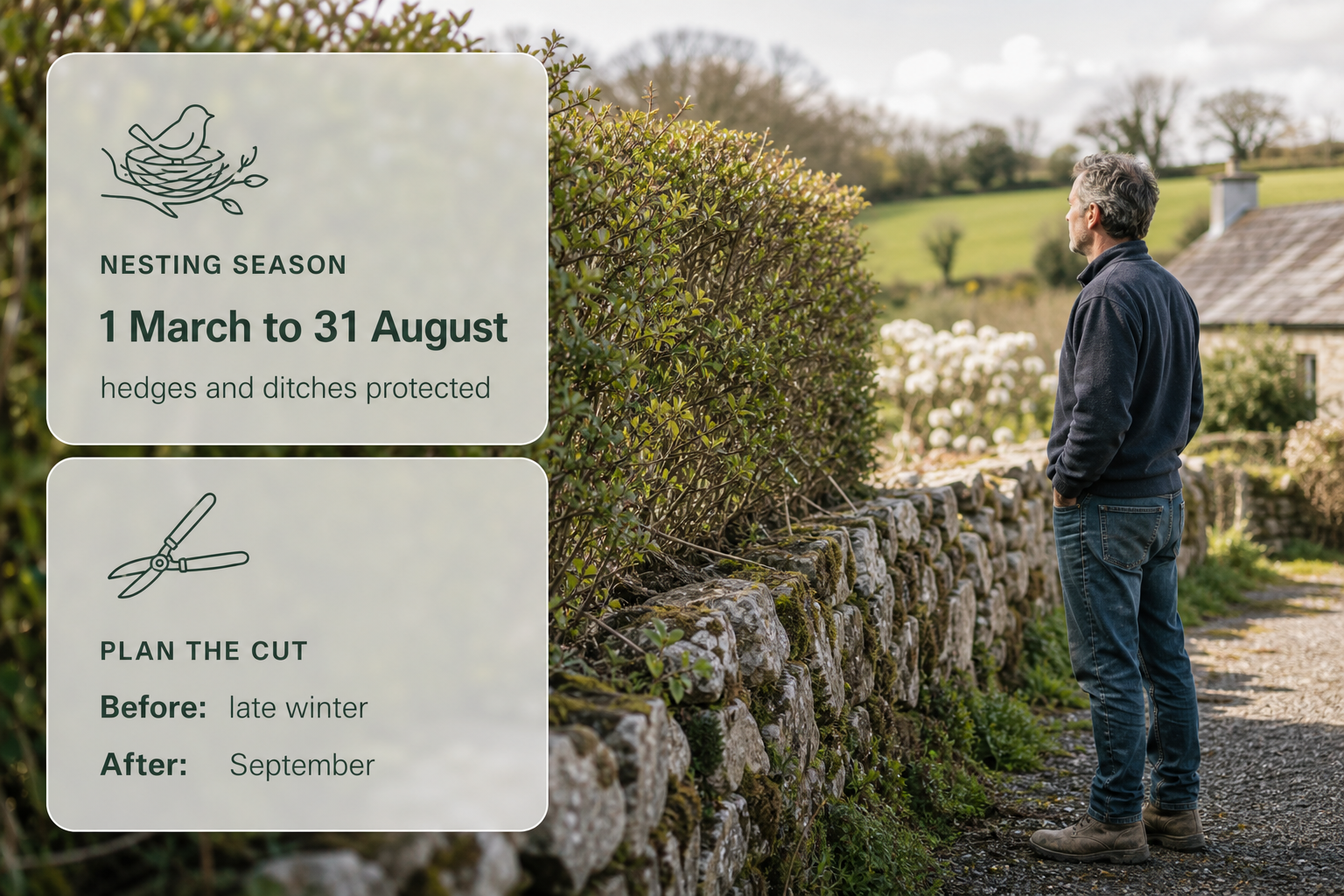
Infographic image explaining Irish hedge-cutting restrictions during nesting season in a rural garden setting.

Hedges, ditches and the nesting season rule

Hedge work is the one spring job with a legal deadline attached. Ireland's nesting season runs from 1 March to 31 August, and during that period Section 40 of the Wildlife Act 1976 prohibits the cutting, grubbing, burning or other destruction of vegetation growing in any hedge or ditch, with limited exemptions, as the Department of Housing, Local Government and Heritage has set out. The protection covers hedges and ditches generally, not only the nests of uncommon birds.

In practice, the main hedge cut is planned for late winter, before 1 March, or held until September. Where a trim genuinely cannot wait, the current position and any exemption should be confirmed with the relevant Irish authority before work starts. A garden fire is not a way around it: the prohibition covers burning vegetation in a hedge or ditch, and anyone considering burning garden waste should check the position with the local authority first.


Garden waste: compost, brown bin or recycling centre

Grass clippings and soft prunings are the easiest material to compost at home, and where a brown bin is provided they can go there instead. The general waste bin is the wrong home for garden material, which is heavy, wet and bulky and adds little but weight.

Bulky hedge prunings are the awkward part of a spring tidy. Small quantities can be cut down and composted, or shredded for use as a rough mulch; larger volumes usually go to the civic amenity site or recycling centre run by the local authority, where a charge often applies, so it is worth checking the local authority's own list of accepted material and fees. Where the pile is bigger than a few bags, a one-off tidy-up can be arranged through local home services on ShamFix, which is often the quickest way to get clippings and prunings off the site in a single visit.

Weedkillers and garden chemicals for home use

Chemical weed control in a home garden is regulated. Plant protection products for amateur home and garden users must be authorised before they can be marketed or used in Ireland, according to the Pesticides Registration and Control Division. That has two practical consequences: only products clearly labelled for amateur home and garden use should be bought or used, and the label needs checking each season because approvals change.

Where a product is used, the label sets the dose, the timing and any weather limits, and spraying on a windy day or ahead of rain wastes the product and moves it off target. Products are stored in their original container, out of reach of children and pets, and empty containers are disposed of as the label and the local authority direct. Chemical weedkillers are usually reserved for paving, paths and driveways, where hoeing and mulching are not an option.

Timing: what to do in March, April and May

March: finish the clear-up, cut back old growth, and take the first high lawn cut in the second half of the month once the ground is firm. Hedge work is already closed off for the season, so any hedge plan either waits or was completed earlier.

April: mowing settles into a weekly rhythm, lawn edges are cut, beds are mulched once the soil warms, and spring-flowering shrubs are pruned as the flowers fade.

May: keep cutting, start a light lawn feed at label rates, thin and water new plantings, stop weeds setting seed, and watch young growth for pests and disease. Gardens in the west and on higher ground run two or three weeks behind the south-east, so the month on the calendar matters less than what the plants and the soil are doing.

Booking spring help

A small, mostly tidy garden can be worked through over a few weekends. Where a hedge is tall, a chainsaw is needed or the waste runs to more than a few bags, help is the practical answer, because hedge work and waste removal soak up most of the hours. Cost varies with the size of the garden, how overgrown it has become and how much waste has to be taken away, so an itemised quote that separates labour, waste removal and machinery is more useful than a single figure. It is worth asking about insurance and about the training relevant to the tools being used, and agreeing in advance where the green waste is going.

Getting help through ShamFix

ShamFix is a free Irish marketplace where homeowners post jobs and local tradespeople respond. Posting a job and listing on ShamFix is free and there is no commission, and a subscription is planned for the future. ShamFix does not check or certify tradespeople, and profiles are filled in by tradespeople themselves, so homeowners should check registrations themselves and read reviews. A spring garden job can be posted on ShamFix for local tradespeople to respond to.

FAQ

What should be tackled first if only one weekend is free?

Sort anything affecting safety or access first, such as a branch over a path or a loose post, then clear the ground, then take a high first cut off the lawn. Beds, mulching and feeding can wait a fortnight without harm, and hedges usually have to wait until the closed season ends.

When should the lawn get its first cut?

Judge it by growth and ground rather than by the calendar: cut when the grass has clearly lengthened and the surface no longer squelches underfoot, and set the mower high for the first two passes. If frost is forecast, wait, because frozen blades tear rather than cut. Early cuts are about tidiness, not about forcing growth.

Can a hedge be trimmed in April?

Expect to wait. Hedge and ditch vegetation is protected from 1 March to 31 August and the exemptions are limited, so any trim inside that window should be confirmed with the relevant Irish authority first. Planning the main cut for late winter or for September avoids the question altogether.

What is the difference between mulching and composting?

Mulching is a layer of material spread on the surface of the soil to hold moisture and suppress weeds, while composting is the breakdown of garden and kitchen material into a soil improver. Finished compost is often used as a mulch. A home heap needs a mix of soft green and tough brown material plus an occasional turn, whereas a mulch only needs to be spread and left.

Keep reading