A garage clear-out, end-of-tenancy move or garden renovation can leave a Kildare household with far more waste than the ordinary bins can handle. The important decision isn't just finding the cheapest collection. It is choosing a legal disposal route, checking who will carry the load, and comparing the full cost once weight, access and restricted materials are included.
Kildare has a formal waste network rather than an informal dumping system. According to Kildare County Council waste materials information, the county provides civic amenity facilities that accept common materials including bulky waste, aerosols, aluminium and metal cans, cardboard, household glass and clothes. Households and businesses must use authorised collectors, civic amenity sites or recycling facilities. Check kildarecoco.ie for current site details and accepted materials.
Three Ways to Book Rubbish Removal in Kildare
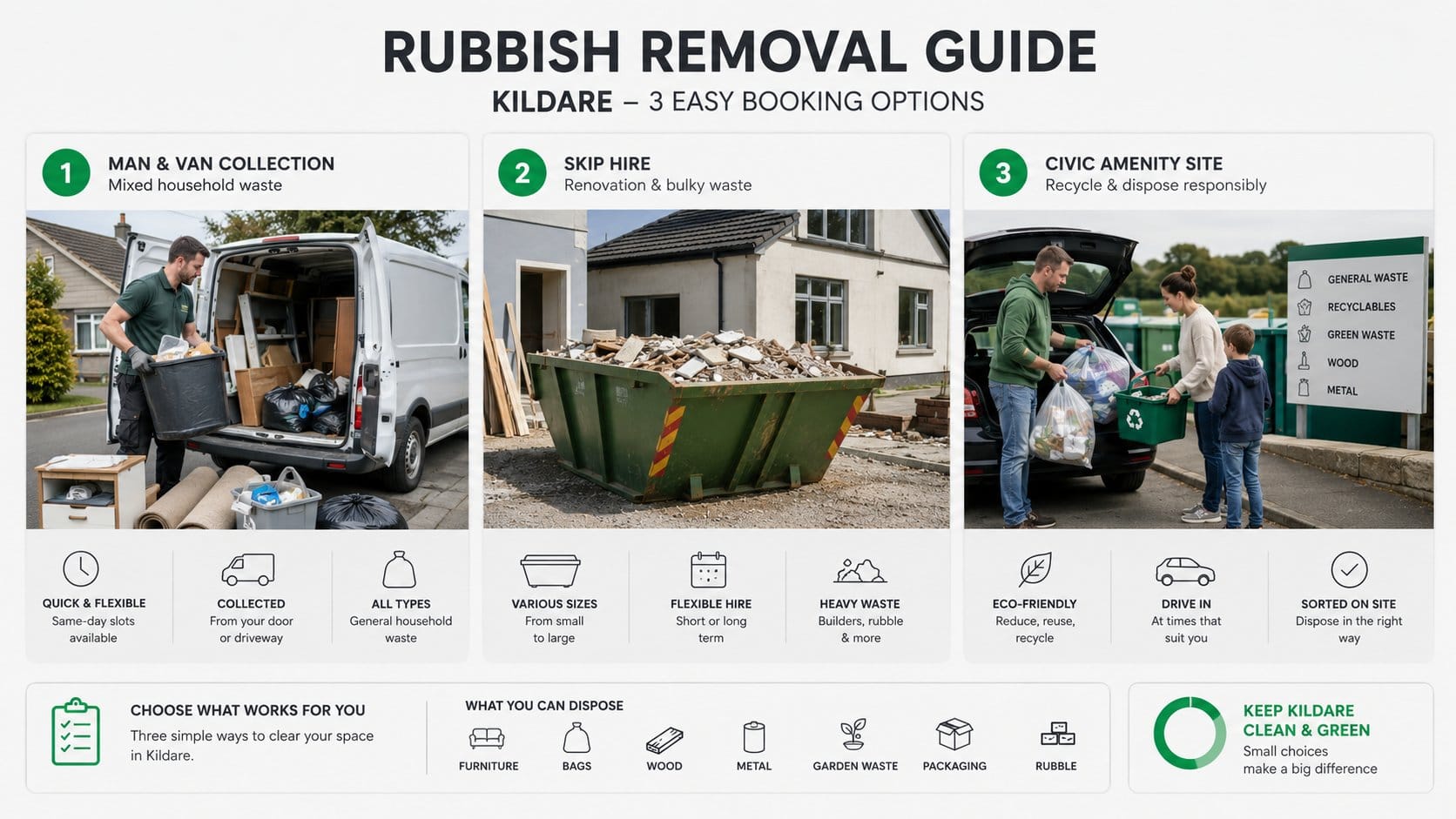
A packed garage, one unwanted sofa and a renovation load each call for a different collection method. The right choice depends on volume, lifting, access and how quickly the waste must leave. In Kildare, three routes cover most household jobs: a man-with-a-van collection, skip hire, or a self-drive trip to a civic amenity site.
Choose the route that matches the load
A man-with-a-van service suits a small or mixed load. The operator loads furniture, bags, appliances and garden waste, so the homeowner avoids doing the heavy lifting. Same-day collection may be available if a local provider has an open slot and receives an accurate description. For a planned job, book for the next day rather than relying on a last-minute opening.
Skip hire makes more sense when waste will build up over several days, such as during a kitchen strip-out, attic clearance or building project. Check the placement before booking. An apartment block, narrow estate road or restricted kerbside may prevent delivery, and a skip still requires prohibited or specialist materials to be separated.
A civic amenity drop-off can suit a household with a suitable vehicle, manageable quantities and time to sort the load. Kildare County Council lists authorised disposal routes, sites, accepted materials, opening arrangements and charges on kildarecoco.ie. Check those details before loading the car, then confirm the site can take the specific materials.
| Route | Best suited to | Timing and practical issue |
|---|---|---|
| Man-with-a-van | Mixed household items, furniture and smaller clearances | Same-day may be available, but next-day booking is more dependable. Confirm loading and access. |
| Skip hire | Ongoing clear-outs, renovation waste and larger volumes | Delivery depends on a suitable location and any required permission. |
| Civic amenity drop-off | Sorted household loads and recyclable materials | The householder handles transport, unloading and site rules. |
Check the rules before leaving bags or containers at the kerb. The Kildare waste management bye-laws set presentation and removal rules for waste placed in public areas, including stated evening and next-morning time limits for collection day. Check kildarecoco.ie for the current wording before leaving items out. A sofa or fridge is not ordinary bin waste. Citizens Information advises using a skip, civic amenity centre, landfill site or advertised local-authority bulk service for carpets, furniture and fridges, as explained in its domestic refuse guidance.
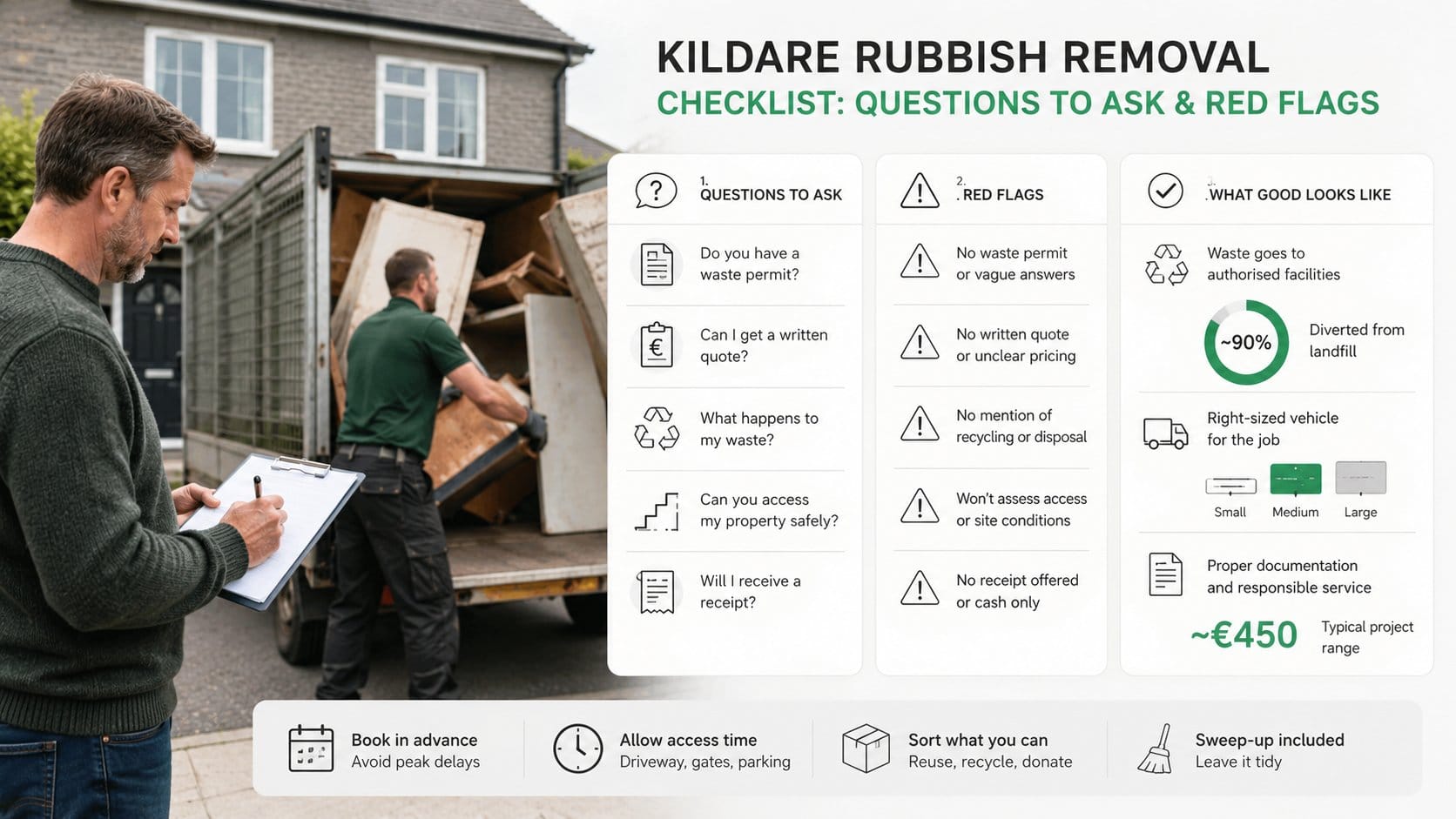
Protect yourself before comparing prices. Use finding local tradespeople in Ireland to identify relevant providers, then ask who will collect the load and where it will go. ShamFix lets Kildare residents compare rubbish-removal providers by rating and response time and message them about availability. It does not carry out collections.
Check the Provider Holds a Waste Collection Permit
The permit check comes before the price comparison. A company or individual collecting waste for payment in Ireland must hold the appropriate waste collection permit, administered through the National Waste Collection Permit Office, commonly known as the NWCPO.
A provider's website, social-media page or branded van isn't proof of permission. The homeowner should ask for the permit details and then search the public NWCPO register independently. The name on the register should match the trading entity accepting the booking, and the permit should be current and cover the type of waste being collected.
How to make the check
Use this sequence before confirming a collection:
Ask for the permit information. Request the legal or trading name connected with the collection, the permit number and the waste categories covered.
Search the NWCPO register. Check that the operator appears and that the permit status is active.
Match the details. A company name that differs from the name on the quote deserves an explanation. So does a permit that doesn't cover the proposed load.
Keep the evidence. Save the quote, receipt, messages and permit details, particularly for a large clearance or commercial-looking load.
Walk away if the answer is vague. A legitimate operator should be able to explain its authorisation without pressuring the customer.
Practical rule: A low quote isn't a bargain if the person taking the rubbish has no lawful route for disposing of it.
The risk isn't limited to the collector. If waste is fly-tipped after leaving the property, the householder may be expected to show that reasonable care was taken when choosing a waste operator and can face enforcement consequences. Kildare County Council states that households and businesses must use an authorised waste collection service, civic amenity site or recycling facility, reinforcing the homeowner's responsibility to use a lawful route.
This is why a permit check protects more than the wallet. It helps establish who took the waste, whether the operator was authorised to carry it, and whether the quoted service is connected to a proper disposal pathway. A homeowner researching how to find a tradesman in Ireland should apply the same permission-first habit to rubbish removal, while remembering that ShamFix doesn't verify provider documents. The provider remains responsible for holding the correct permit.
What a Good Provider Segregates and Where It Goes
A responsible collection starts with sorting, not with lifting everything into one heap. The provider should inspect the load, identify materials that need separate handling, and explain the disposal route before work begins. This protects the homeowner from contamination charges and from waste entering an unlawful disposal route.
Separate the obvious streams
WEEE and electrical items need particular care. Fridges, washing machines, televisions, small appliances and other electrical goods should not disappear into a general mixed load. Ask which authorised route will receive them, and treat an unclear answer as a warning sign.
Furniture deserves a second check before disposal. A sound table, chair, wardrobe or shelving unit may suit a charity shop or a local reuse listing such as FreeTrade Ireland. Remove personal documents first, then confirm that the recipient accepts the item. Do not assume every unwanted piece can be donated.
Keep green waste, clean timber, scrap metal and rubble apart where practical. Grass and hedge clippings belong in a garden-waste stream. Clean rubble and hardcore may follow a different route from plasterboard, soil or mixed household rubbish. A provider planning to put everything into one vehicle without discussing separation is offering basic disposal, not careful rubbish removal.
The residual fraction is whatever has no viable reuse or recycling route under the operator's arrangements. Only that material should go to landfill or another residual-waste facility. Ask how restricted items will be handled. “It will all be recycled” is not a disposal plan.
Use the council sites when self-hauling
Kildare County Council's waste and recycling information sets out the civic amenity options available for bulky waste and common recyclable household materials, including cardboard, glass, clothes, aerosols, aluminium and metal cans. Check kildarecoco.ie before loading a vehicle. Accepted materials, opening hours and fees are specific to each site and may change.
The EPA household waste statistics include Kildare household-waste collection data for 2022, covering bin-service availability and per-household collection amounts. Those figures show that household sorting already forms part of waste management in Kildare, but check the EPA for the current figures. A removal provider should therefore be ready to discuss separated loads, not present sorting as an optional extra.