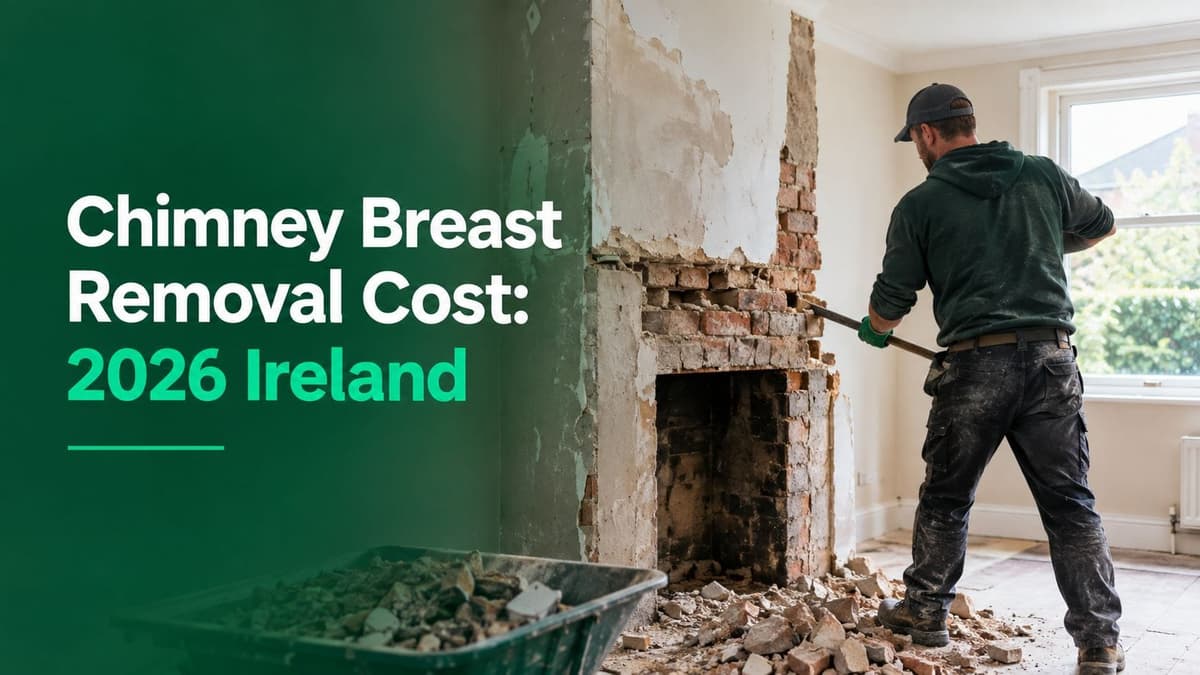
A home radon test with a passive detector kit from an EPA-registered company, left in place for about three months and then lab-analysed, typically costs about €40 to €60 in Ireland. Mitigation is a separate, higher cost if the result is high.
That distinction is the key to understanding the radon testing cost in Ireland. The initial payment is for measuring the air in the home. It isn't the price of fitting a radon sump, installing ventilation, or carrying out other remedial work. A homeowner who treats those as one charge may budget incorrectly, especially after receiving a result at or above Ireland's national reference level.
How Much Radon Testing Costs in Ireland Right Now
A domestic radon testing kit in Ireland costs about €40 to €60, with the EPA also describing the price as about €50. That fee covers a passive test using detectors from an EPA-registered radon measurement service. The detectors stay in the home for about three months, then go to a laboratory for analysis.
The written result normally gives the measured radon concentration in Bq/m³, identifies the testing period and detector locations, and records the laboratory's finding. It is more useful than an instant reading because it represents conditions over a longer period. EPA guidance should be checked before ordering, particularly for placement and return arrangements.
Testing and mitigation are different budgets
A passive test is the first stage. It measures the air in the home and shows whether further action should be considered. If the result is high, mitigation becomes a separate project involving installation work, such as a radon sump or positive-input ventilation, along with possible fan electricity costs.
Irish radon guidance uses 200 Bq/m³ as the reference level. A result at or above that level can justify getting remedial advice, but it does not turn the original test fee into a mitigation quote. Testing answers the question, “How much radon is present?” Mitigation addresses, “How can the level be reduced?”
Check what the quote includes
Prices vary when a property needs more detectors, a repeat test, professional continuous monitoring or extra reporting. Ask whether the quoted amount includes VAT, delivery, return postage, laboratory analysis and the written report. Providers may present these items differently, so a clear quote avoids surprises.
Compare like with like: the same testing period, detector arrangement, laboratory service and report format. The cheapest headline price may cover less.
Homeowners seeking comparable local enquiries can post a radon testing job on ShamFix, including the property type, location and test required. If the result is high, request a separate mitigation price rather than assuming it forms part of the testing charge.
What a Standard Home Radon Test Includes
A standard domestic test uses a passive detector kit, not an instant reading taken during a quick walk-through. The EPA explains that homeowners normally use two detectors, left in place for about three months, before the detectors are returned for analysis through an EPA-registered service.
From delivery to placement
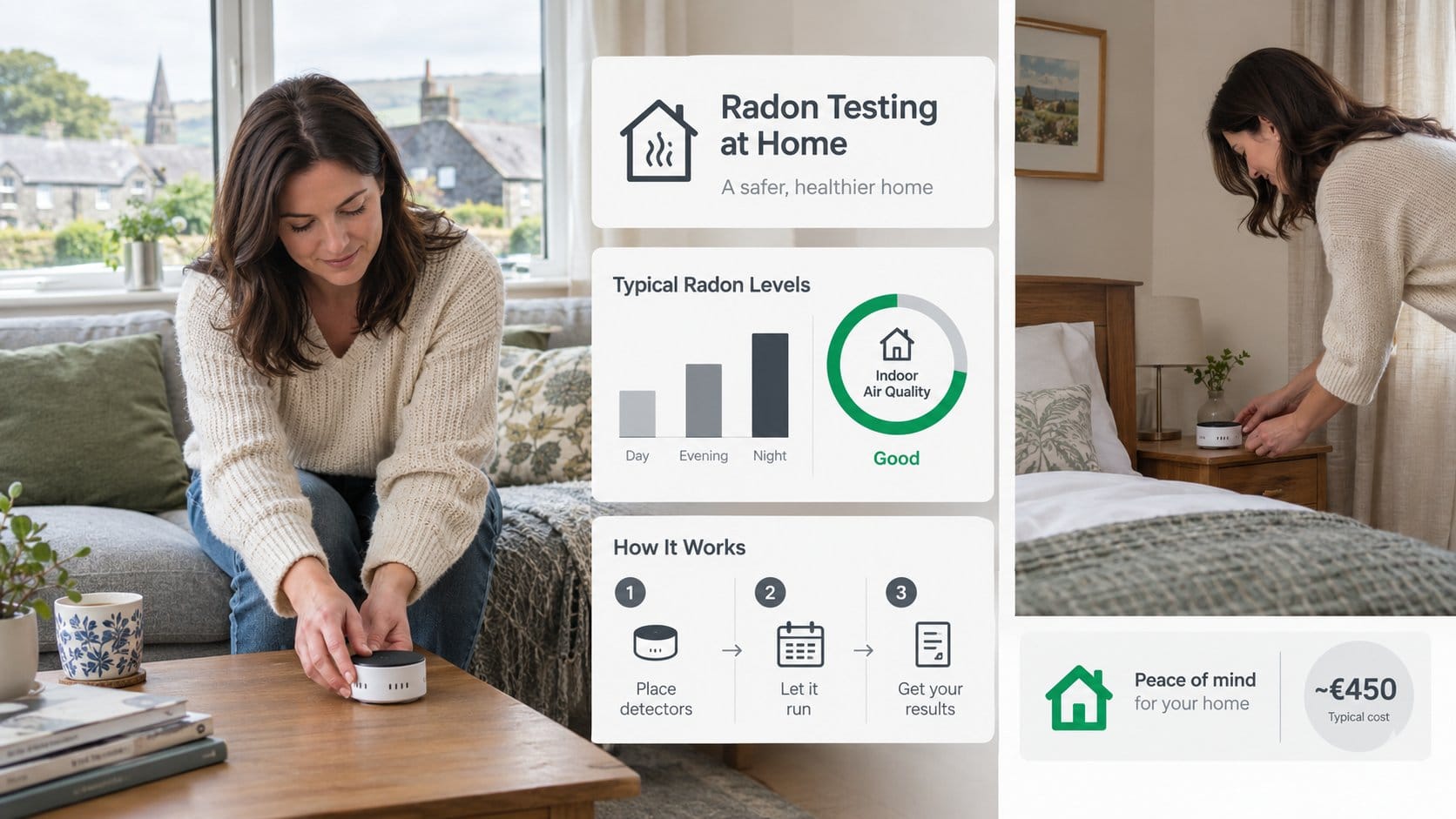
The process usually follows a simple sequence:
- Order the kit. The homeowner buys the detectors from an EPA-registered radon testing service. The kit arrives with placement and return instructions.
- Place both detectors. The EPA's domestic approach uses two detectors in suitable occupied parts of the home. Placement should follow the provider's instructions rather than being improvised beside a window, heater or extractor.
- Leave them in position. The detectors remain exposed for about three months. This longer period helps produce a more representative average than a brief visit or a short reading.
- Return the detectors. The homeowner posts the detectors back using the supplied return process.
- Receive the report. A laboratory analyses the detectors and issues a formal result.
The price therefore pays for more than two small pieces of equipment. It includes the handling and analysis needed to turn the exposure into a documented measurement.
Why the test takes about three months
Radon levels can change over time. A test lasting about three months gives the measurement service a longer exposure period from which to calculate an average, rather than relying on one moment in the house. That makes the result more useful for deciding whether the property needs further attention.
A quick meter reading can still be useful in some professional investigations, but it isn't the standard domestic method described by the EPA. Short-term tests may appear cheaper or faster, yet a shorter exposure can give a less reliable picture of the home's typical level.
Practical rule: A lower price isn't a saving if the test doesn't provide the exposure period and formal laboratory report needed for a meaningful decision.
The returned report should identify the property or test location, the detector results, the exposure details and the measured concentration in Bq/m³. Homeowners should keep the report with other property documents, particularly when arranging remedial work or buying a home.
Why Quotes Vary Between Homes
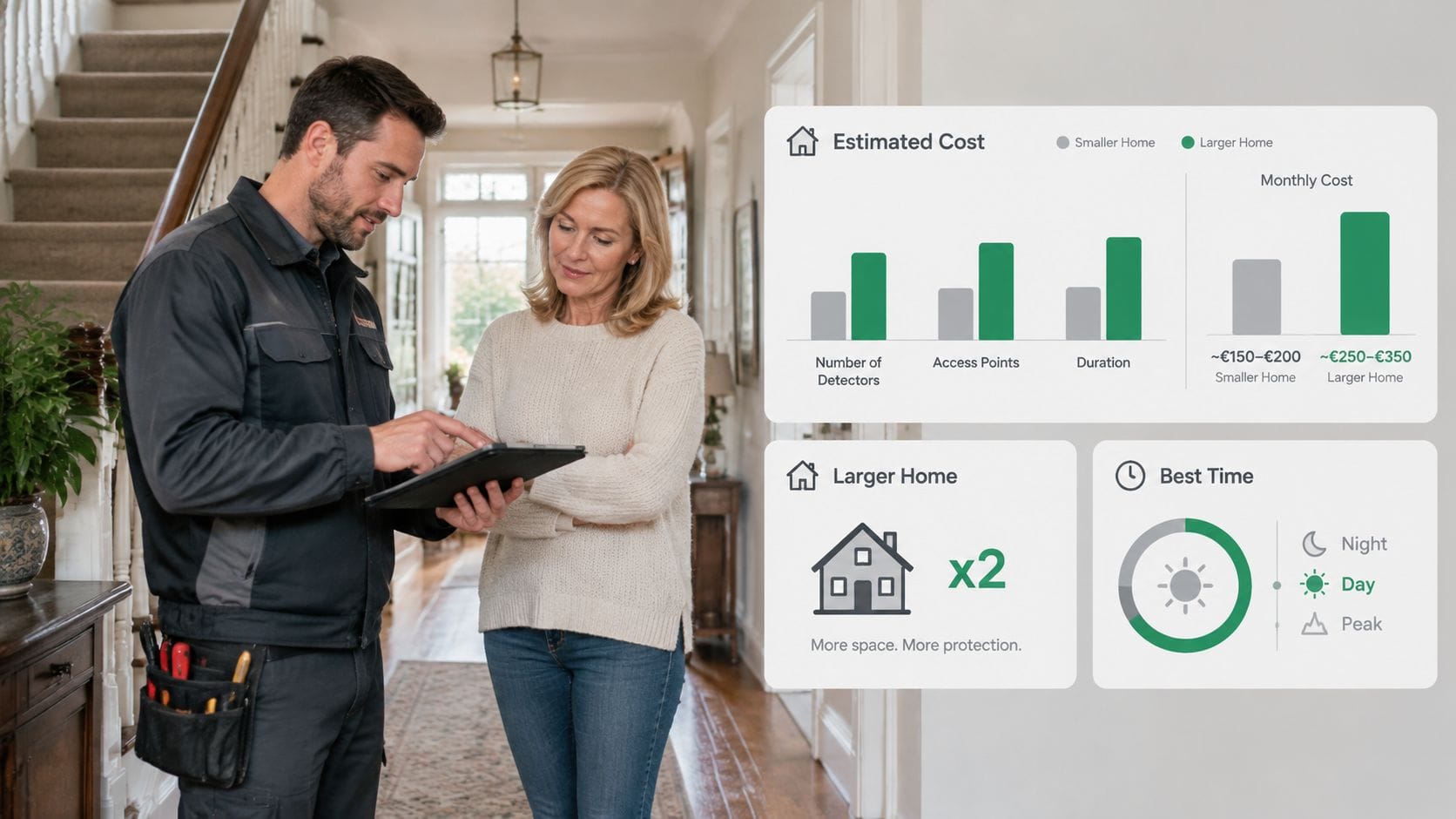
The typical passive-kit price is a useful starting point, but the final testing quote can change with the property and the service selected. The clearest cost driver is the number of detectors required. A smaller home may follow the standard two-detector arrangement, while a larger or more complex property may need advice about additional rooms or separate testing areas.
The important question is whether a provider is quoting for the whole property or only for one part of it. A low figure can be incomplete if it covers one area when the homeowner needs a broader assessment.
The main testing cost drivers
- Property size and layout: More rooms or separate occupied areas can affect the detector plan.
- Laboratory analysis: Lab analysis is part of the testing service, not mitigation. The quote should say whether it is included.
- Postal handling: Delivery and return arrangements can be built into the price or shown separately.
- Retesting: A homeowner may need another test after mitigation to check the result, creating a new testing charge.
- Property transaction timing: A buyer or seller may choose a professional continuous-monitor survey where a quicker diagnostic view is needed.
- Higher-risk location: The EPA's radon map can encourage testing in areas with higher mapped potential, although the map doesn't predict the result in an individual house.
Compare the scope, not just the number
Two quotes can look different while covering different services. One may include two passive detectors, postage, analysis and a report. Another may refer to a professional visit, continuous monitoring or extra detectors.
A useful written quote should identify the number and type of detectors, the exposure period, collection or postage arrangements, laboratory analysis, report format and VAT treatment. If the quote is for mitigation, it should instead identify the proposed system, installation work, electrical requirements, making good and any post-installation test.
Installation belongs in the mitigation budget. It shouldn't be hidden inside a supposedly cheap testing quote.
Passive Kit Versus Professional Continuous Monitor
A passive detector kit and a professional continuous monitor answer related but different questions. The passive kit is designed for a longer domestic exposure and a laboratory result. A continuous monitor records readings over a shorter period and can show how levels move during the survey.
The standard Irish homeowner process remains the passive approach described by the EPA, with two detectors left in place for about three months. A professional continuous monitor may be chosen for a diagnostic investigation, a time-sensitive property decision or a situation where a specialist needs more detailed information about changes during the day.
Passive Kit vs Continuous Monitor at a Glance
| Feature | Passive Detector Kit | Professional Continuous Monitor |
|---|---|---|
| Main purpose | Establishes a longer-term domestic measurement | Shows changes in radon readings during a shorter professional survey |
| Equipment | Two passive detectors in the standard EPA domestic approach | Electronic monitoring equipment supplied and managed by a specialist |
| Exposure | About three months | Shorter, service-dependent monitoring period |
| Analysis | Detectors are returned for laboratory analysis | Data is downloaded or reviewed by the monitoring provider |
| Typical use | Homeowner screening and documented results | Diagnostic work or time-sensitive investigation |
| Cost position | About €40 to €60 for the standard Irish kit benchmark | Typically more expensive than a passive kit, with the quote depending on the professional service |
| Limitation | It doesn't provide instant readings | It isn't automatically a substitute for the standard longer domestic average |
The cheaper option isn't always the correct option, and the more expensive option isn't automatically necessary. A passive test is usually the sensible starting point for a homeowner who wants to understand the property's ordinary radon level.
Continuous monitoring can be useful when a specialist needs to investigate patterns, compare rooms or examine the effect of a building change. It may also suit a property transaction where waiting for a three-month exposure isn't practical, although the shorter survey should be understood on its own terms.
Before booking: The provider should explain whether the service is a passive laboratory test or a continuous-monitor survey, what the final report contains and whether VAT is included.
Understanding Your Result and the EPA Radon Map
Your report gives the indoor concentration in Bq/m³, or becquerels per cubic metre. Ireland's national reference level is 200 Bq/m³. Reaching or exceeding that level is a prompt to discuss reducing radon with a suitably experienced provider. It is a decision point, not a diagnosis or a mitigation quotation.
The EPA publishes a radon map showing areas with higher radon potential. Use the map to decide whether testing deserves priority, not to predict the result for one address. It provides a broad view of the ground conditions, while the test measures what is accumulating inside your home.
Use the map as a prompt, not a verdict
A property in a mapped higher-risk area may still record a lower concentration. A home outside one may record a higher concentration. Radon enters and collects according to the relationship between the ground, the building and its ventilation, so only measurement can establish the property's level.
The three-month passive test gives a more useful average than a single instant reading. Conditions change with weather, heating and ventilation, much like a phone photograph can capture one moment while a longer recording shows the usual pattern. The longer exposure reduces the chance that an unusual day will dominate the report.
What to do after the report arrives
- Below the reference level: Keep the report and follow any advice from the registered measurement service.
- At or above 200 Bq/m³: Ask an experienced provider to assess suitable mitigation and the work involved. This is separate from the original testing cost.
- After remedial work: Arrange another test when advised. It checks whether the intervention reduced the indoor concentration.
- When buying: Give the report to the relevant property professionals and confirm that it covers the rooms and areas being assessed.
The map helps set testing priorities, while the result guides the next conversation. The reference level does not identify whether the property needs a sump, ventilation system or another remedy. That choice requires an assessment of the building and its measured concentration.
What Mitigation Costs If Your Result Is High
Mitigation is the work carried out after testing indicates that radon reduction is needed. It costs more than the initial test because it involves equipment, installation, electrical work where applicable, sealing or preparation, and sometimes work beneath or around the building.
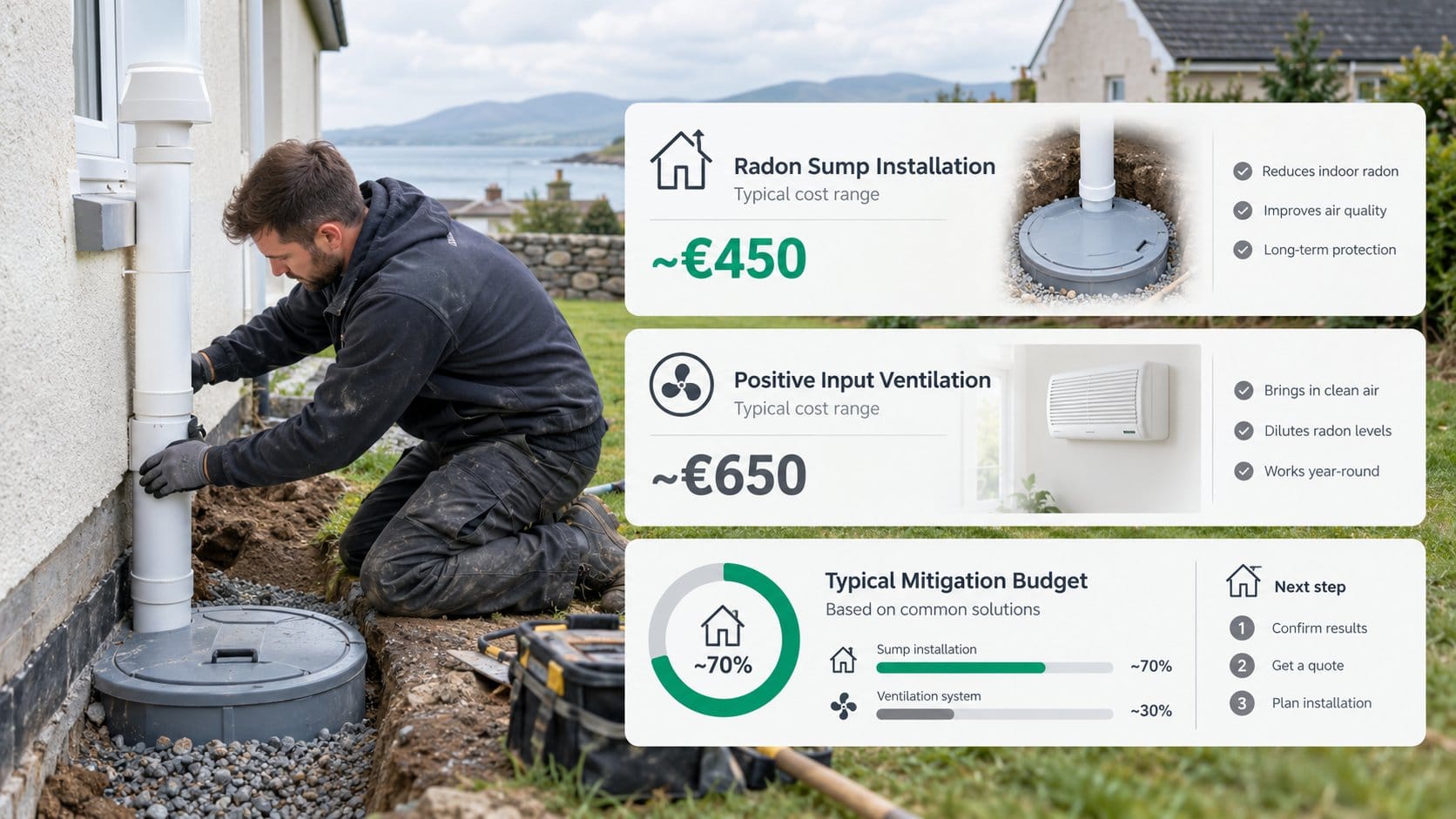
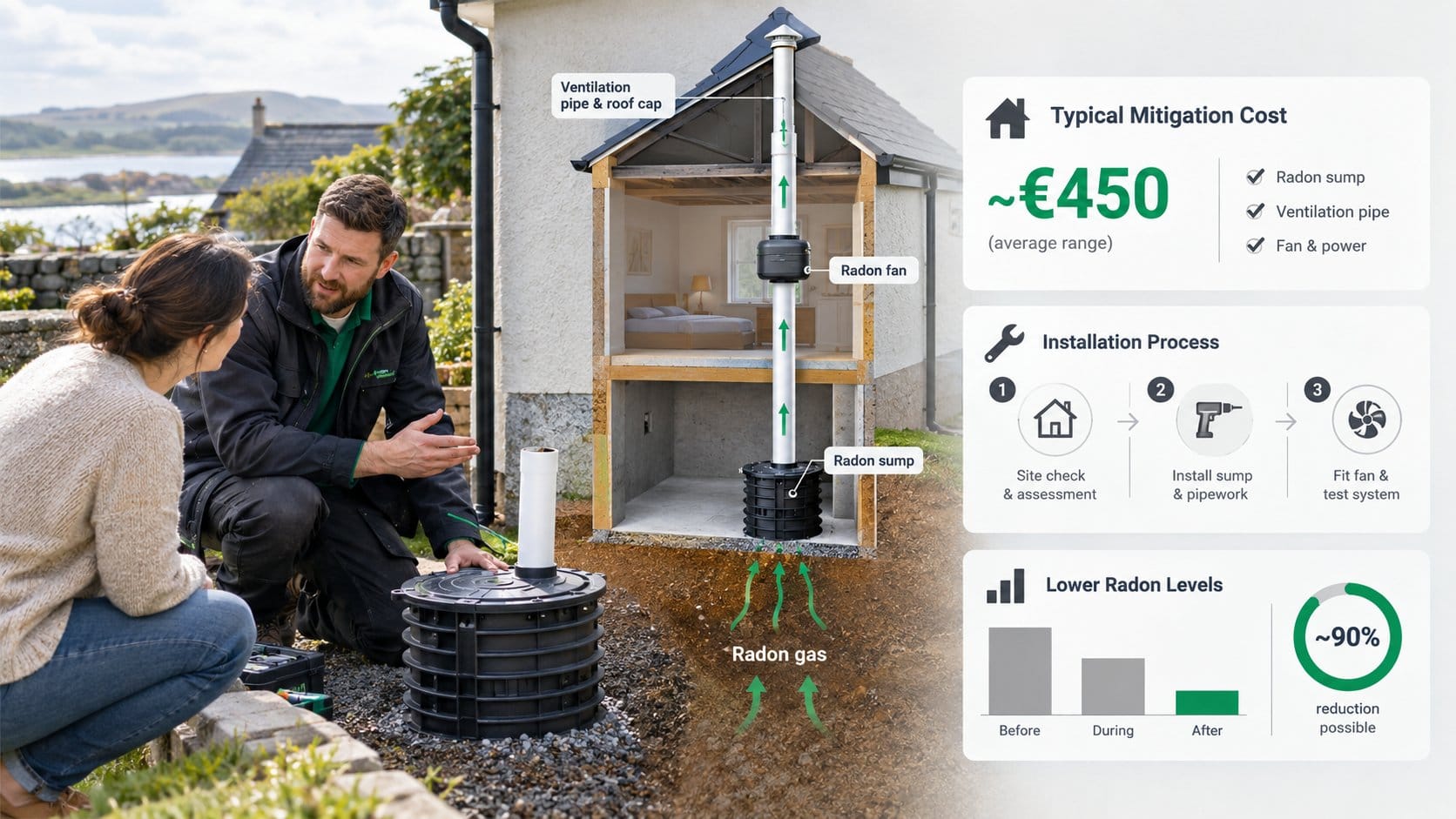
Irish local-authority guidance cites a typical remedial-system installation cost of about €850, with a broader range of roughly €450 to €1,150. The same guidance gives annual running costs of about €50 to €110, depending on fan power consumption of 30 to 70 watts. These figures are separate from the passive testing fee and should be treated as an installation and ownership budget. See the Kilkenny County Council radon information suite for that Irish guidance.
A proposed system may use a radon sump, which draws soil gas from beneath the building, or positive-input ventilation, which changes the air pressure and airflow within the home. The appropriate solution depends on the construction, sub-floor arrangement, access and the measured result.
Retrofit and new-build context
Homes built since 1998 require radon-preventive measures under the building regulations. Those measures can make a difference to how a new build is approached, but they don't remove the need to test the finished home. Existing houses may need a retrofit system if the measurement is high.
A retrofit quote should identify the route for pipework, the fan location, power supply, external termination, sealing, internal finishes and any making good. A system that appears cheaper may exclude access work or reinstatement.
The difference between the two budgets is straightforward:
| Budget | What it pays for |
|---|---|
| Testing | Detectors, exposure period, postage, laboratory analysis and report |
| Mitigation | Investigation, system design, installation, equipment and possible making good |
| Ongoing ownership | Fan electricity and any future maintenance or retesting |
Insulation or other energy work shouldn't be assumed to resolve a radon result unless a qualified assessment specifically connects that work to radon control.
Getting a Reliable Quote and Next Steps in Ireland
A good quote makes the testing method visible. It should say whether the service is a passive kit or a continuous monitor, how many detectors are supplied, how long they remain in the home, and whether laboratory analysis and the report are included.
For mitigation, the scope should be more detailed. The homeowner should receive a description of the proposed system, the installation route, fan and electrical requirements, external work, access arrangements, making good, VAT and any follow-up test.
Questions to ask before agreeing
- Is the company EPA-registered for measurement? Homeowners should check the provider against the EPA's own registered-service information.
- What is included in the price? Confirm detectors, postage, analysis, reporting and VAT for testing.
- What is excluded? Ask about access, electrical work, sealing, finishes, scaffolding or other preparation for mitigation.
- Which result triggers further action? The quote should explain how the 200 Bq/m³ reference level will be interpreted.
- What happens after installation? Confirm whether a post-mitigation test is recommended and priced separately.
A homeowner comparing providers should still check radon-specific credentials directly. ShamFix does not vet or verify providers, and a marketplace enquiry is only a route to contact, not a quality guarantee.
The practical decision is to buy the correct test first, then price mitigation only if the result and professional advice call for it. Keeping those stages separate prevents a €40 to €60 screening expense from being confused with the larger installation and running costs that may follow.
Are you a radon specialist in Ireland?
Radon testing and mitigation companies can list their services on ShamFix so homeowners can find local specialists. ShamFix does not vet or verify providers, so homeowners should use EPA-registered measurement companies and check credentials themselves. Listing on ShamFix is free and there's no commission; a subscription is planned for the future.