Pressure washing cost per square metre: an Irish guide
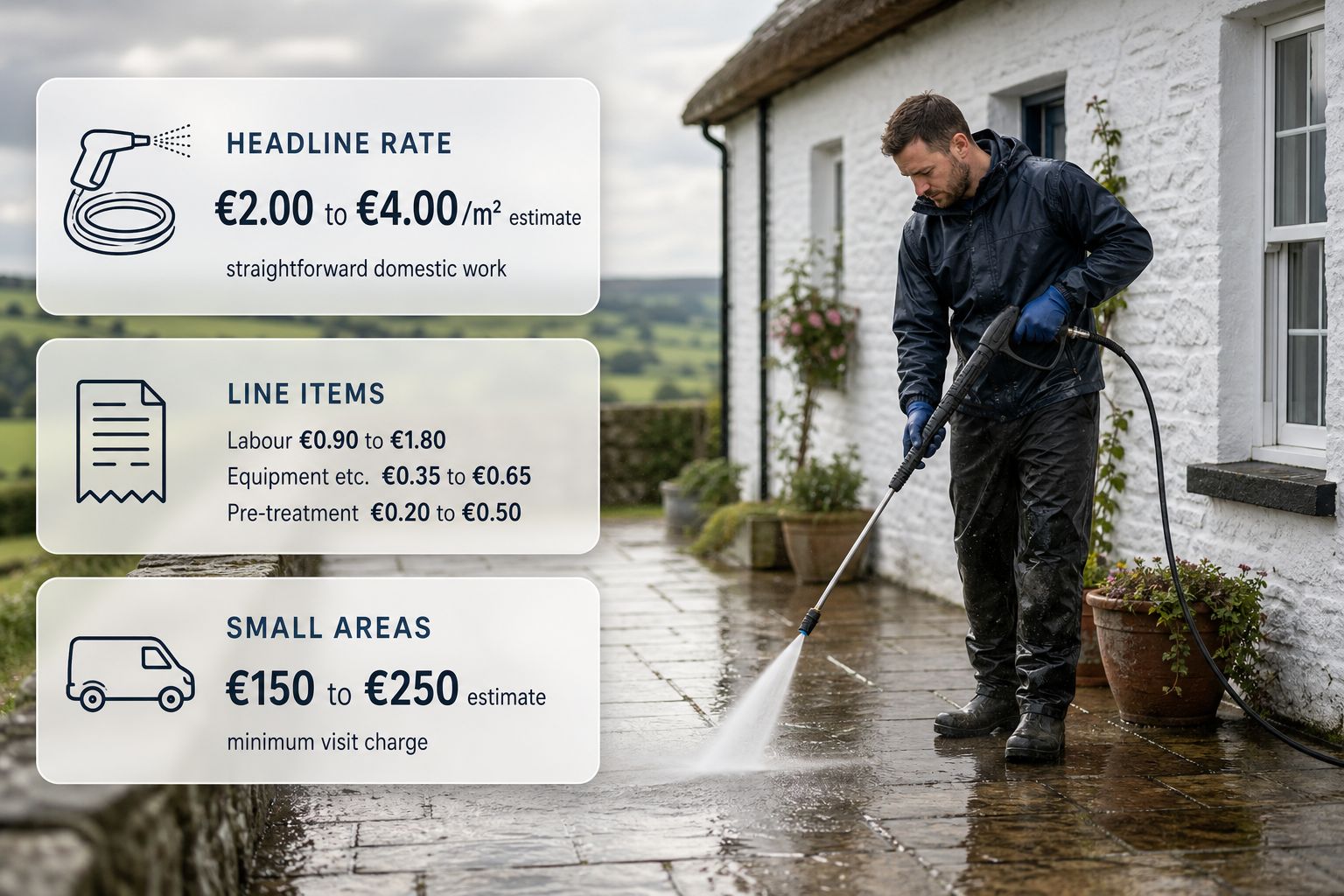
Pressure washing costs about €2 to €4 per square metre in Ireland, with small jobs priced at a minimum visit charge of €150 to €250.
/8 min read
Most Irish homeowners pay roughly €2.00 to €4.00 per square metre for domestic pressure washing, an aggregate Irish market estimate that covers a standard driveway, path or patio wash with ordinary soiling. Small areas rarely reach that rate at all, because many contractors apply a minimum visit charge of €150 to €250, so the job is priced by the visit rather than by true square metre measurement. Commercial and multi-unit work is quoted on a different basis again, often per visit, per hour or on a contract rate.
What pressure washing costs per square metre (aggregate Irish market estimate)
A domestic price is really the sum of a few lines, and the per-square-metre rate a homeowner is quoted simply rolls them together. The block below sets out an aggregate Irish market estimate for straightforward domestic work: the five per-square-metre lines together make up the €2.00 to €4.00 headline rate, while the minimum visit charge replaces the measured rate when the area is small. Quotes for power washing and pressure cleaning move within these bands depending on the surface and on how the contractor is set up.
Line on the quote
Basis
Typical range
Labour (operator time and machine running)
per m²
€0.90 to €1.80
Equipment, water, fuel and setup
per m²
€0.35 to €0.65
Detergent, biocide or surface pre-treatment
per m²
€0.20 to €0.50
Waste-water containment and disposal
per m²
€0.25 to €0.55
Access and preparation (moving items, tap connection, masking)
per m²
€0.30 to €0.50
Minimum visit charge for small areas
per visit
€150 to €250
Read across the surface types and the picture fills in. A concrete or tarmac driveway and a slab patio washed in a single pass usually sit between €2.00 and €3.00 per square metre; narrow paths and small paved areas come in around €2.00 to €2.50; render, external walls and delicate stone cleaned at low pressure with a soft wash sit at €2.50 to €4.00; and a surface carrying heavy moss or algae coverage climbs to €3.00 to €4.00.
What pushes the price up: surface, dirt and access
Surface type is the first driver. Open-jointed paving takes longer than a smooth sealed slab because water and dirt work into the joints. Tarmac is softer and needs lower pressure and more passes, while natural stone such as sandstone can be marked or stripped by a narrow high-pressure jet and generally needs a low-pressure wash with a suitable detergent. Render and painted finishes rule out aggressive pressure altogether.
Dirt level comes next. A light algae film lifts quickly. Black spot lichen, oil staining and moss rooted in joints take a pre-treatment, a dwell period and often a second visit, and that extra time is what moves a quote towards the top of the range.
Access is the quiet cost. A long hose run from a single outdoor tap, steps, a sloping driveway, cars that have to be moved, planters and garden furniture to shift, or a narrow side entrance all add labour. Where a contractor has to bring water in a tank rather than use the household supply, the job is usually priced at the upper end of the range because of the extra handling.
Domestic rates, commercial rates and the Dublin premium
Domestic work is priced for one machine, one operator and usually a single hard surface, which is why the minimum visit charge matters so much on a small driveway. Commercial work is quoted differently: multi-site contracts, car parks, forecourts and retail frontages are often priced per visit, per hour or on a scheduled contract. Scale can bring the per-square-metre figure down, but out-of-hours working, heavier grease and oil contamination, larger equipment and traffic arrangements can push it above domestic rates.
Location matters within the domestic market too. Quotes taken in Dublin and the surrounding commuter belt tend to sit at the upper end of the ranges in the table, since demand is higher and travel time, parking and access into older estates all take longer. The same driveway in a rural setting where the van can park beside the surface usually comes in closer to the lower end.
Hot wash, soft wash and protecting delicate surfaces
Hot water units break down grease, oil, algae and organic film faster than cold water, so fewer passes are needed on a greasy or heavily soiled surface. A hot wash is normally priced at the upper end of the range because the machine costs more to run.
Soft washing is different in method, not just in pressure. It uses a low-pressure application of a detergent or biocide followed by a dwell period and a gentle rinse, and it is the usual choice for render, painted walls, older mortar, roof tiles and delicate stone. Chemical use and the waiting time can make it dearer than a straight pressure wash, but it protects finishes that a jet would ruin.
Protection is a large part of the job on any delicate surface. Plants, grass and shrubs are pre-wetted before work starts and covered where they sit close to the wall, windows and doors are kept closed, external sockets and vents are masked, and a small test patch is washed on a hidden area to confirm the finish reacts as expected. Joint lines, loose pointing, failing render and older roof coverings are worked at low pressure or by brush rather than by jet.
Re-sanding, sealing and the extras that sit outside the per-square-metre rate
Several items are commonly quoted as separate lines rather than included in the square metre rate. Re-sanding means brushing kiln-dried sand back into the joints after the wash; sealing means applying a breathable impregnating sealer once the surface is genuinely dry, which may be days later in settled weather; stain treatment covers oil, rust, paint and tyre marks; moss removal may involve a biocide, a dwell period and a return visit; and waste-water handling beyond basic containment, such as capture, pumping out or disposal away from the property, is often its own line. Homeowners bundling this work with other exterior jobs can look through home services to see how the categories sit together.
Why small jobs look expensive per square metre
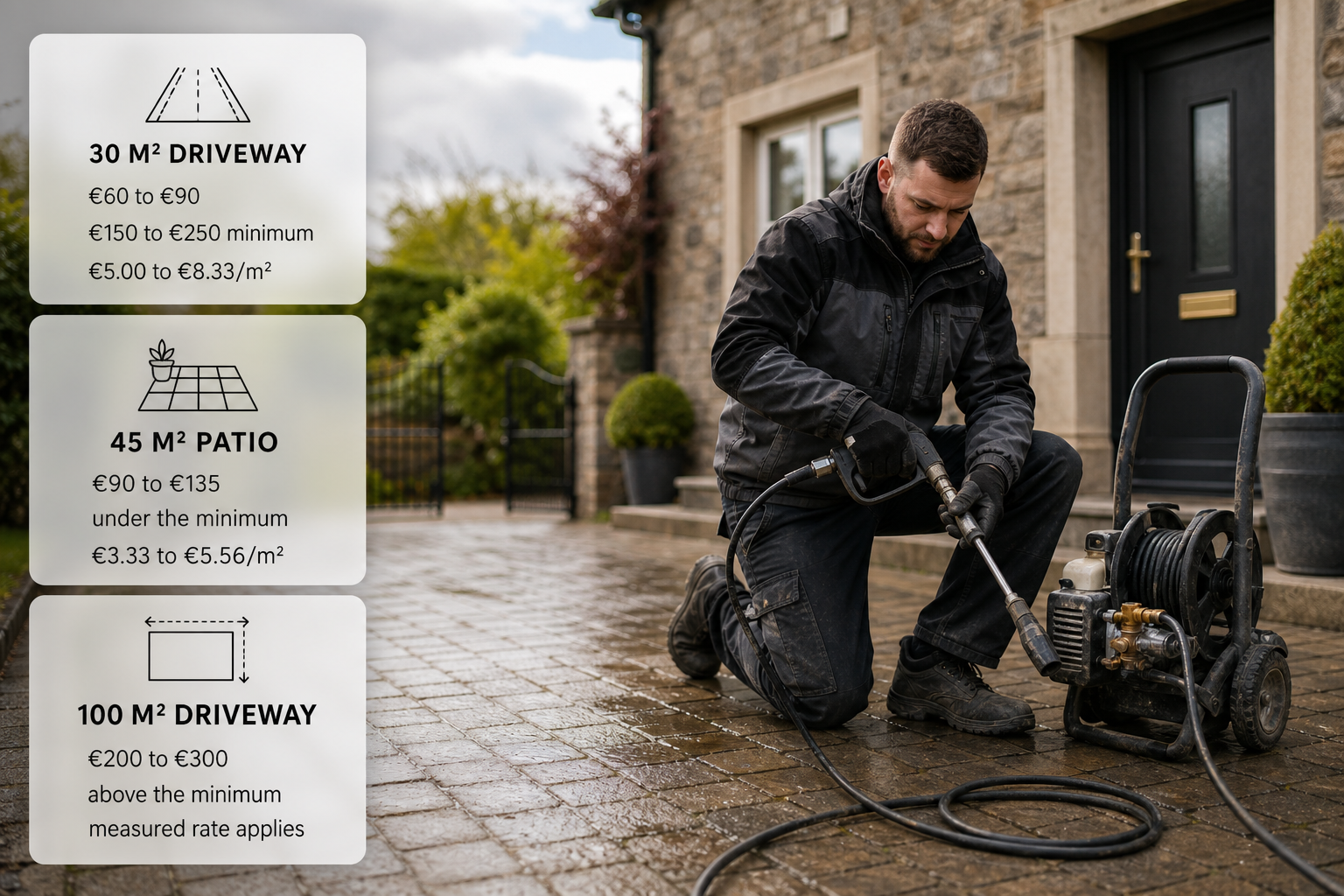
The minimum visit charge is the reason a modest job can look costly on a per-square-metre basis. Take a 30 m² driveway washed at €2.00 to €3.00 per square metre: the measured work comes to €60 to €90, which is below the €150 to €250 minimum, so the minimum applies and the effective rate becomes roughly €5.00 to €8.33 per square metre. A 45 m² patio at the same rate works out at €90 to €135, again under the minimum, giving an effective €3.33 to €5.56 per square metre.
Scale changes the arithmetic. A 100 m² driveway at €2.00 to €3.00 per square metre comes to €200 to €300, which clears most minimum charges, so the measured rate is what the homeowner actually pays. Adding a path, a side return or a second patio to the same visit spreads the fixed costs over more square metres, and sharing a boundary wall or a communal driveway with a neighbour does the same.
What a written quote should spell out
A written quote should state the measured area and whether it is a gross or net measurement, the basis of the price (per square metre, per visit or per hour) and whether a minimum charge applies. It should say whether VAT is included and at what rate; the rate and how it is applied is a matter for Revenue, and a homeowner should confirm the VAT position with Revenue when the quote is unclear.
The quote should also list what is included, such as pre-treatment, detergent, containment, clean-up and the disposal of debris, and what is charged separately, such as re-sanding, sealing, stain treatment, moss removal and waste-water handling. It should name the water source, note access and parking arrangements, set out how plants, lawns, external sockets and vents will be protected, and say who moves cars, planters and furniture. Where a wash involves detergent or run-off reaching a drain, the local authority is the body that decides what may be discharged, and the homeowner should confirm the position with it. Insurance details, the working date and payment terms belong on the page as well, and the whole thing should be in writing before work begins.
How often exterior hard surfaces need cleaning
Shaded, damp driveways under trees grow algae and moss fastest and tend to need attention more often, while paving that sits in full sun holds its appearance for longer. Leaving black spot and moss in the joints too long lets roots open them up, which turns a wash into a re-sanding job and sometimes into re-laying. A light rinse through the year and a proper wash once the surface starts to look dull keeps the work at the lower end of the range rather than the upper.
FAQ
Is the per-square-metre rate the only way a driveway job is priced?
No. Some contractors quote a flat price for the job, some quote per day or per hour, and some quote per square metre with a minimum attached. Per square metre is simply the easiest basis for comparing two quotes on the same driveway, so it is worth asking each contractor for the measured area alongside whatever pricing method is used.
Why can the same patio cost more per square metre in Dublin?
Higher demand and tighter access do most of the work. Vans may have to park away from the property, terraced side entrances slow the hose run, and busy schedules mean a contractor has less room to fill a day around a small job. Those factors push Dublin and commuter-belt quotes towards the top of the ranges.
Does the quote include clearing moss out of the joints?
Usually not. Moss removal often involves a biocide, a dwell period and sometimes a return visit once the growth has died back, and the joints then need re-sanding. Any of those three items can appear as a separate line, so it is worth asking which of them the figure covers.
Can too much pressure damage paving or render?
It can. High pressure strips joint sand, removes sealer, erodes soft mortar and can permanently mark natural stone, while render and painted finishes can be blown off the wall. A contractor should be able to explain the pressure and nozzle planned for each surface and agree a test patch before starting.
Getting pressure washing quotes
Posting a job on ShamFix is free and there is no commission, and a subscription is planned for the future. ShamFix does not check or certify tradespeople, and profiles are filled in by tradespeople themselves, so homeowners should check registrations themselves and read reviews. A post that includes the measured area, a few photographs and notes on access, parking and the water supply gives every contractor the same information to price from.