Post construction cleaning checklist: an Irish home guide
Work top to bottom and room by room: dust control, residue removal, floors, ventilation and a clear move-in standard.
/8 min read
Post-construction cleaning is the deep clean that follows the trades out of a property: it clears fine plaster dust, grit, paint speckles, adhesive smears, grout haze, silicone residue and packaging debris that an ordinary household clean leaves behind. The checklist is used at the end of a new build, extension, conversion or repair job, once snagging has been agreed and the last cutting, sanding and chasing has stopped. Homeowners, landlords and tenants work through it before handover, before move-in or between tenancies, and on a large or time-pressured job a post-construction cleaning service can take the list over.
Preparation, protection and the order of work
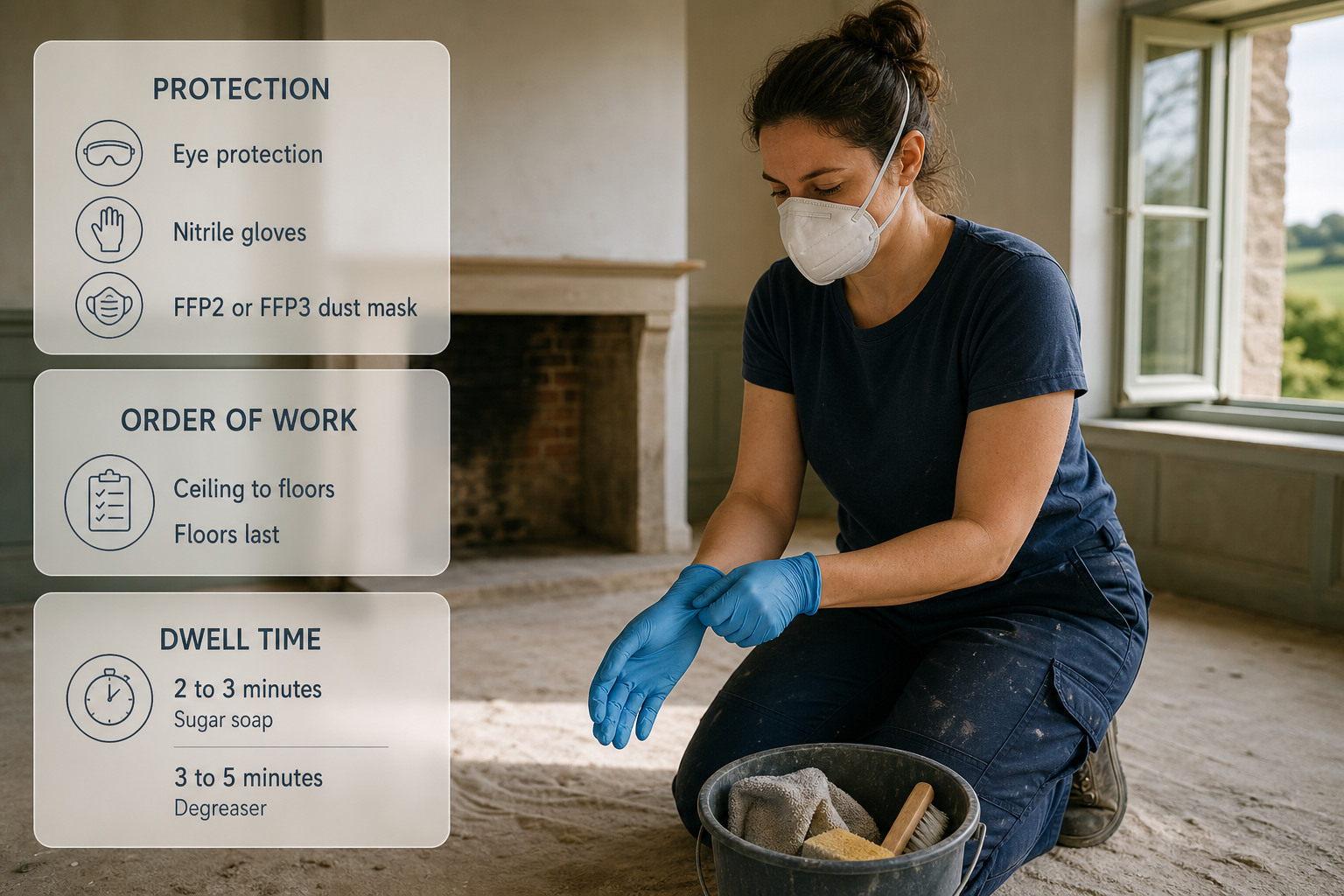
Protection comes first. Eye protection, nitrile gloves and an FFP2 or FFP3 dust mask go on before any dry dust is disturbed, and the mask stays on until fine dust has been vacuumed rather than swept. Windows and doors are opened to create a through draught, and the door of the room being worked on is kept closed so dust does not drift back into finished areas.
Two buckets work better than one: one holds warm water with a general-purpose detergent or sugar soap, the other clean water for rinsing. A cloth is dipped and wrung out until it is damp rather than wet. Painted walls, ceilings and woodwork are wiped with the sugar soap solution and left for two to three minutes before being rinsed, while a degreasing product on kitchen surfaces is left for three to five minutes, or for the dwell time printed on its label. Each surface is then buffed dry with a clean microfibre cloth, because detergent left to dry is what produces the cloudy streaks that appear a week later.
The order of work never changes: ceiling, cornices, light fittings, walls, window reveals, door frames and doors, skirting and radiators, with floors last. Dry dust is lightly misted with water before it is touched so that it clings to the cloth instead of lifting into the air.
Clearing debris, dust and packaging
Offcuts, tile boxes, empty containers and packaging are bagged first, into heavy-duty sacks or a suitable skip bag, and loose screws and fixings go into a lidded container so they never reach the vacuum or the floor. Cobwebs and loose dust are lifted from corners with a soft brush, then fine dust is taken up with a vacuum fitted with a HEPA filter, working in bands from the ceiling downwards, with bags and canisters emptied outdoors. An ordinary household vacuum blows plaster dust back out through its exhaust and can clog or overheat.
Disposal is where households most often slip up. Renovation waste such as plasterboard, timber, tiles, paint tins and packaging, is a matter for the local authority or the waste collector, whose accepted waste types and collection rules vary from area to area and should be confirmed before anything is put out.
Room-by-room checklist
Area
Tasks
Hall, stairs and landing
Wipe handrails, spindles, newel posts, skirting and door frames; lift protective film and stickers from new doors; vacuum the stair carpet and the cupboard under the stairs.
Living rooms and bedrooms
Wipe window boards, sills, reveals, sockets, switches and pendant fittings with the power off; clean inside wardrobes, drawers and cupboards, including runners; vacuum under radiators and behind door swings.
Kitchen
Wipe inside and outside units, plinths and kickboards; degrease the splashback, extractor hood, housing and filter; clean worktops; vacuum before washing the floor.
Bathroom
Descale tiles, shower screens and trays; clean the WC, cistern, basin and pedestal; dry chrome with a soft cloth; dust the extract grille; check sealant lines and report gaps.
Utility, garage and plant areas
Sweep and vacuum floors, wipe new meter boxes and casings with a dry cloth only, and clear remaining packaging.
Windows, frames and tracks
Track dust is vacuumed before anything is washed, because a wet cloth turns it into grit that scratches frames. Frames and reveals are washed with warm water and a little detergent, rinsed and dried, and glass is sprayed, wiped and buffed with a separate cloth kept for glass only, inside and out.
Paint speckles come off with water as a lubricant and a plastic scraper held at a shallow angle; a glass scraper blade belongs on plain glass only and never on coated, tinted or filmed glass. Silicone smears are lifted with a plastic blade and a solvent-based remover used as its label directs. Window vents are wiped out, and windows are left open afterwards so the tracks dry and the room airs.
Kitchens and bathrooms
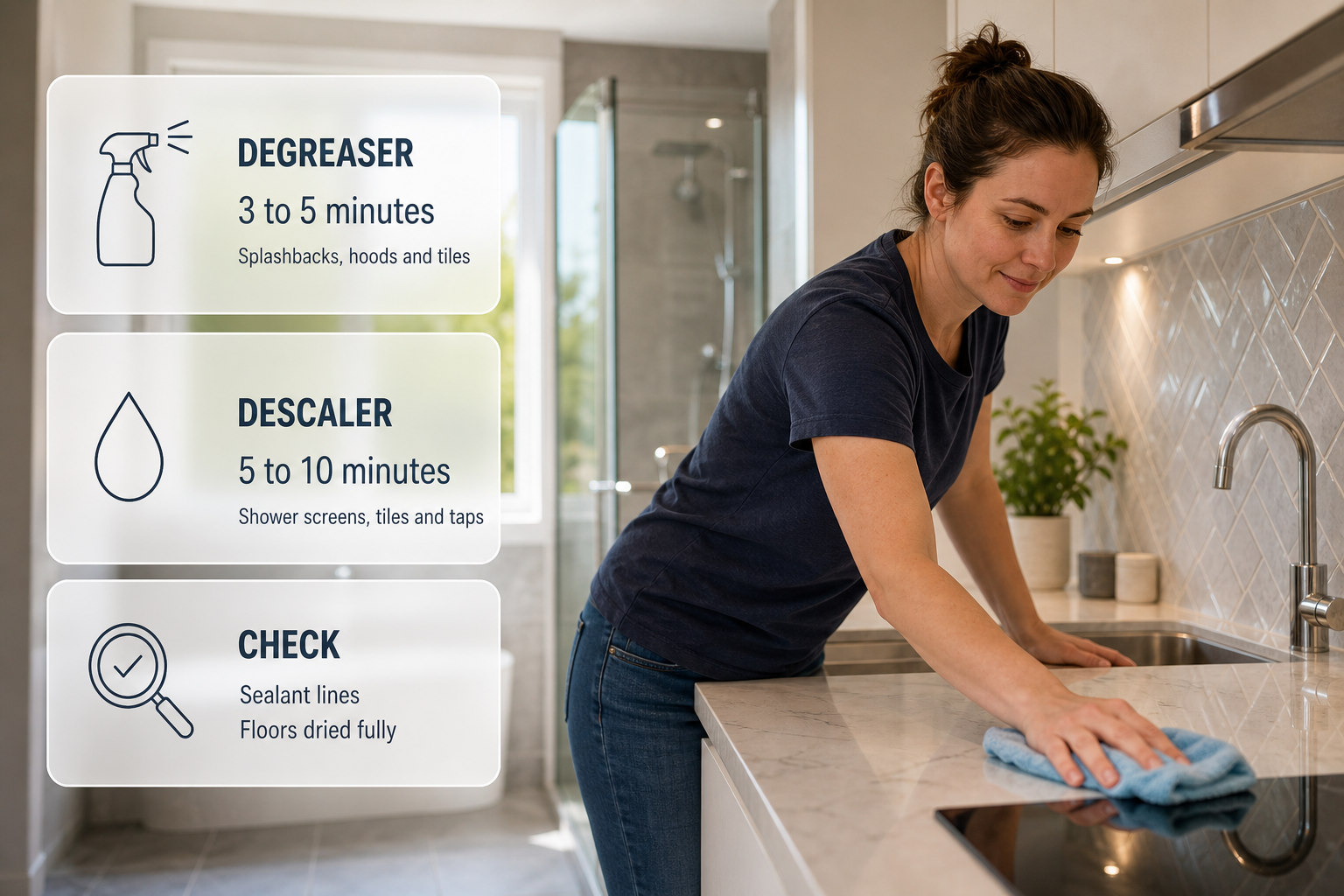
Grease and limescale need dwell time rather than force. A degreaser is sprayed on splashbacks, hoods and tiles and left for three to five minutes before being wiped away and rinsed. A descaler is left on shower screens, tiles and taps for five to ten minutes, then rinsed and squeegeed, and chrome is dried straight away to avoid water marks. Cupboard interiors, drawer runners and appliance housings are wiped out, and the extractor filter is cleaned or replaced. Every sealant line around a bath, shower or basin is checked for gaps and reported rather than covered up, and floors are dried fully before the room is used again.
Paint, adhesive, grout and silicone residue
Residue is identified before it is treated. Grout haze is removed with a dedicated haze remover left for the time on its label, agitated with a soft brush, then mopped and rinsed; acidic products are kept away from natural stone. Adhesive and sticker residue comes off with warm soapy water or a citrus-based remover, tested first on a hidden patch, and lifted with a plastic scraper. Paint on woodwork is softened with warm water and eased off with a fine abrasive pad or a scraper held flat. Metal blades, steel wool and harsh solvents damage tiles, sanitaryware, acrylic and glass.
Floors last
Floors are vacuumed first, then washed. Tiles take warm water and a mild detergent with the water changed often, and sealed grout is cleaned without acid. Timber is mopped with a barely damp microfibre head and dried immediately, never soaked. Laminate and vinyl are wiped damp, not wet, and stone is cleaned with a pH-neutral product. Carpets fitted after the works are vacuumed and, where needed, cleaned by a carpet specialist. Floors are left to dry completely before furniture arrives, and felt pads are fitted so nothing is dragged across a new surface. Where the dust load is beyond a household clean, the wider range of cleaning services includes post-build work.
Ventilation and air quality after dusty work
Dust and solvent residues hang in the air and settle on clean surfaces for several days after the last tradesperson leaves. Windows are opened daily to create cross-ventilation, and kitchen and bathroom extract fans are run for fifteen to twenty minutes after use so moisture and odours are carried away. Wall vents and grilles are checked for dust blocking the airway, and filters in a heat recovery or mechanical ventilation unit are cleaned or replaced as the unit's instructions direct. Hard surfaces are wiped over again two or three days after the first clean to catch the dust that re-settles. Where ductwork or a ventilation system was installed or altered, the installer is the right first point of contact.
Handover and move-in standard
The standard expected before keys change hands is simple to state and slow to achieve: no dust on any horizontal surface from ceiling height down, no smears or speckles on glass, no grit underfoot, no residue on tiles, woodwork or fittings, sealant lines intact, and every floor dry. Snagging is agreed with the builder before the final clean, so that touching up does not undo a finished room. Surfaces are inspected under good light, with a torch held at a low angle along skirting, window boards and worktops and a hand passed along the tops of doors, frames and high-level ledges. Where a landlord is turning a property around between tenancies, the same standard applies before the next tenant moves in.
When to hire a professional
Some jobs are better handed over. Full-house builds and plaster-heavy renovations, high or hard-to-reach glazing, delicate finishes such as natural stone or specialist coatings, a firm handover or tenancy start date, and properties where nobody can be on site for several days all point the same way. A professional clean is also worth considering where a household member has a respiratory condition, since fine dust is hardest to control without proper extraction. The checklist above then becomes a way of checking the work rather than doing it.
Where ShamFix fits
ShamFix is a free Irish marketplace where homeowners post a job and local tradespeople respond; posting a job and listing it on ShamFix is free and there is no commission, and a subscription is planned for the future. ShamFix does not check or certify tradespeople, and profiles are filled in by tradespeople themselves, so homeowners should check registrations themselves and read reviews before hiring. Jobs can be posted at shamfix.ie.
FAQ
Is post-construction cleaning different from a normal deep clean?
The difference is volume and chemistry. A normal deep clean deals mostly with grease and grime, while a post-build clean deals with mineral dust that clings to every vertical surface and with residues that each need their own remover. It also has to run in a set order, because washing a floor before the ceilings are dusted simply means doing the same work twice.
How long should pass between the last trade leaving and the final clean?
Two or three days is comfortable, because dust disturbed by snagging and by carrying tools out keeps settling, so a clean done the same evening is rarely the last one. A light second pass over hard surfaces a few days after move-in catches whatever has landed since.
Can renovation waste go into the ordinary household bin?
Not automatically. Some materials are accepted at civic amenity sites or through a collector and others are not, and the rules differ between local authority areas. The household confirms what is accepted, and whether bags or a skip are needed, with the local authority or the waste collector before anything is left out.
What should be checked on the day the keys change hands?
A slow walk-through under strong light, with a torch held low along skirting, window boards and worktops and a hand run along the tops of doors and frames. Glass, sealant lines and floors are checked last, and no furniture is brought in until every floor is dry.