A skim coat in Ireland commonly costs €10–€30 per m² or €300–€600 per room, while a full re-plaster of a three-bed property typically reaches €3,000–€6,000. Dublin pricing typically runs 10%–20% higher than elsewhere in the country.
Those figures describe useful starting benchmarks, not the amount that automatically appears on the final invoice. Preparation, damaged backgrounds, ceilings, access, waste removal, insulation systems, and VAT can all change the price. The central question for any plastering cost Ireland estimate is therefore not the rate per square metre. It's what work the quoted rate includes.
What Plastering Costs in Ireland Right Now
Irish benchmarks put ordinary skimming at €10–€30 per m², according to the Dublin-focused guide from Renovation Dublin. On a 3m by 3m wall, that rate produces an example cost of approximately €90–€270. Dublin prices are often 10%–20% above prices elsewhere in Ireland, although access, travel, property condition, and preparation can change the gap.
Per-room pricing gives a different benchmark. Irish market benchmarks place a skim coat at €300–€600 per room, while a full re-plaster of a three-bed property commonly reaches €3,000–€6,000. These figures do not convert neatly into a per m² rate because room size, ceilings, corners, and minimum call-out charges affect the labour involved. A room with extensive preparation can therefore cost twice as much as a similar-sized room needing only a finish coat.
Homeowners comparing providers can also review drywall and plastering services on ShamFix when gathering local options and written quotes.
| Job Type |
Typical Rate |
Notes |
| Skim coat |
€10–€30 per m² |
Usually applies to a sound existing surface |
| Room skim |
€300–€600 per room |
Room size and preparation affect the total |
| Full three-bed re-plaster |
€3,000–€6,000 |
A whole-house benchmark, not a guaranteed fixed price |
| External render, three-bed semi-detached house |
€5,000–€12,000 |
Scaffolding and access can materially affect the bill |
The gap between headline rates and final quotes usually sits in the preparation. Wallpaper removal, hacking off loose plaster, boarding damaged areas, ceiling repairs, furniture protection, waste removal, and access equipment may be priced separately. The finish itself can be a small part of the total labour.
VAT must be checked before acceptance. Domestic plastering on a dwelling is generally charged at Ireland's reduced 13.5% VAT rate. The written quote should state whether VAT is included and identify the contractor's VAT position.
Skim, Full Replaster, Boarding, and External Render Compared
The right method depends on the background, not just the desired appearance. A skim coat is a thin finishing layer over existing plaster that remains sufficiently sound. Full re-plastering is more disruptive because the old surface may be removed before new base and finishing coats are applied.
Dry-lining and boarding belong to a broader system. Plasterboard may be fixed to studwork, masonry, or an existing surface, then jointed and skimmed. Where insulation is included, the job becomes an internal retrofit rather than a simple decorative finish.
| Method |
Typical €/m² in Ireland |
Best For |
Lifespan |
| Skim or re-skim |
€10–€30 |
Sound walls needing a smooth finish |
Depends on the existing background and moisture conditions |
| Full re-plaster |
Typically a multiple of the skim rate; €3,000–€6,000 for a whole three-bed property |
Loose, badly cracked, or stripped-back surfaces |
Depends on substrate preparation and moisture control |
| Board-and-skim |
€35–€50 for internal dry-lining or board-and-skim |
Uneven walls, stud walls, and insulation upgrades |
Depends on board system, joints, and protection from moisture |
| External render |
€40–€70 per m² for traditional render, €50–€90 per m² for silicone or one-coat systems |
Weather protection and external finish renewal |
Depends on the render system, exposure, and substrate |
The table shows why a single “plastering rate” is misleading. A skim uses the existing wall as its base. Board-and-skim introduces boards, fixings, joints, and potentially insulation. External render adds outdoor access, weather exposure, and a different material system.
External insulation needs separate consideration. Homeowners comparing render with an energy upgrade can read EWI U-values explained for Ireland, and SEAI wall-insulation grant information covers internal, cavity and external wall insulation, with amounts depending on wall and house type. Current values are on the SEAI wall-insulation pages.
What Drives a Plastering Quote Up or Down
The wall area is only the starting point. Two homes with a similar measured area can require different amounts of labour because the plasterer is pricing the condition and accessibility of the surface as well as the finish.
Preparation changes the economics
Sound existing plaster can accept a skim after suitable preparation. Blown, hollow, salt-affected, or badly cracked plaster may need sections removed, repaired, sealed, or replaced before finishing begins. Damp should be addressed at source, because applying a smooth finish over an active moisture problem can leave the new surface vulnerable to staining, debonding, or renewed damage.
Ceilings usually demand more handling than straightforward wall areas because the plasterer works overhead and must protect floors, fittings, and furniture. High stairwells, narrow terraced-house hallways, upper floors, and awkward entrances can also increase labour time and material handling.
Surface condition: Loose plaster, deep cracks, old wallpaper, and failed bonding layers add preparation.
Ceilings: Overhead work requires more protection and can slow production.
Access: Restricted parking, stairs, long carrying routes, and scaffolding affect setup and movement.
Damp repairs: Moisture or salts may require treatment before a new finish is appropriate.
Boarding: Plasterboard, fixings, insulation, jointing, and trimming create a larger system.
Waste and protection: Removing old plaster, moving furniture, and disposing of rubble require separate labour.
Practical rule: A cheap per-m² figure is only comparable with another quote when both contractors have priced the same background preparation, finish, access, and waste obligations.
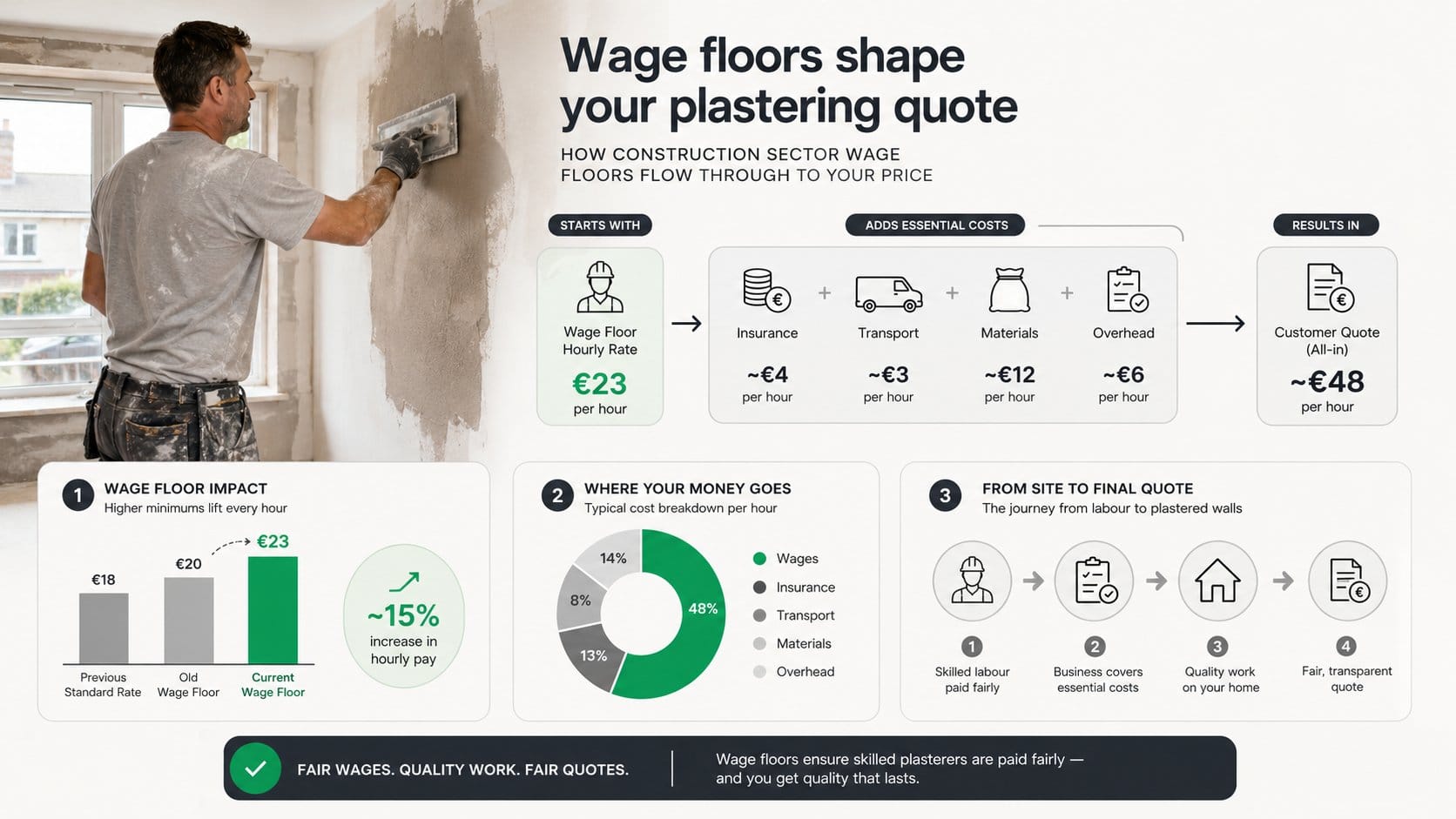
The Workplace Relations Commission's Construction Sectoral Employment Order lists a craftsperson rate of €23.00 per hour from 1 August 2025, rising to €23.74 per hour from 1 August 2026. Those are wage floors, not complete customer prices. A compliant business must still account for supervision, insurance, transport, tools, non-productive time, materials, and overhead.
How Wage Floors Shape the Price You Are Quoted
An hourly employment floor doesn't equal a plasterer's customer-facing hourly rate. The legal minimum applies to the worker's pay, while the quote must fund the wider cost of delivering the work.
Paid travel, breaks, holiday obligations, pension costs, employer contributions, insurance, vehicle running costs, tools, estimating time, and snagging all sit outside the bare hourly wage. A self-employed plasterer also has to recover the hours that can't be billed directly, including collecting materials, protecting rooms, cleaning down, and returning to address agreed defects.
The WRC figures provide a useful reference point, but they can't be converted into a universal day rate without assumptions about employment status, working time, productivity, and overhead. A small patch repair may have a high effective cost per square metre because setup and travel occupy much of the visit. A large open wall can produce a lower unit rate because preparation and equipment are spread across more area.
Dublin can sit towards the upper end of Irish pricing where labour, parking, access, and travel create extra cost. Rural work may benefit from easier access or lower local overheads, but long journeys can reverse that advantage. The quote should therefore show the actual scope rather than relying on a national average.

For homeowners assessing providers, ShamFix explained describes a marketplace and routing process, not a guarantee of workmanship or a replacement for checking the written scope, insurance, and reviews.
Sample Job Estimates an Irish Homeowner Can Sanity-Check
Worked examples can expose the difference between an area rate and a complete quote, but they must be treated as planning illustrations rather than promises. The figures below use published Irish benchmarks for the relevant work types and keep preparation, waste, and VAT separate where the available data doesn't support a precise allocation.
A kitchen with two walls and a ceiling can't be priced responsibly without measuring the areas and checking the existing finish. The skim benchmark remains €10–€30 per m², while a per-room benchmark of €300–€600 may be more useful where the room is small but setup and protection take a meaningful share of the job.
| Job |
Area |
Rate Type |
Subtotal |
Dublin Uplift |
Likely Total |
| Kitchen skim |
Measured walls and ceiling |
€10–€30 per m² |
Area multiplied by the quoted rate |
Dublin may sit 10%–20% higher |
Confirm prep, protection, waste, and VAT |
| Living-room full re-plaster |
Measured walls and ceiling |
Full re-plaster, priced after inspection |
Not safely calculated without measured area |
Dublin may sit towards the upper end |
Confirm stripping, base coat, finish, and waste |
| Three-bed semi-detached re-plaster |
Whole property |
€3,000–€6,000 |
€3,000–€6,000 headline benchmark |
Dublin can be higher |
Add only clearly itemised extras |
| External render |
Whole external area |
€40–€70 per m² traditional render, or €50–€90 per m² silicone or one-coat system |
Measured area multiplied by system rate |
Access may raise the final figure |
Confirm scaffolding, preparation, waste, and VAT |
A three-bed external render job illustrates the scale change. Irish market benchmarks place full external render for a three-bed semi-detached house at €5,000–€12,000, with per-square-metre rates distinguishing traditional render from silicone or one-coat systems. The system choice, wall condition, access, and scaffolding can matter more than a small difference in the nominal finish rate.
Homeowners assessing attic or extension work should also separate plastering from the wider build. Guidance on dormer and Velux conversion pricing is relevant because boarding, insulation, fire protection, electrical work, and roof alterations can sit alongside the plaster finish.
What a Written Plastering Quote Should Show
A written quote should make the finish measurable. “Plaster walls throughout” doesn't establish whether the contractor is skimming existing plaster, stripping back to masonry, boarding sections, repairing cracks, or treating damp.
At minimum, the document should identify the rooms, measured areas where available, surface preparation, materials, finish, access arrangements, waste responsibility, payment stages, and VAT treatment. It should also state what happens if the background differs from the condition observed during the initial visit.
Core items to request
Preparation: Wallpaper removal, scraping, hacking off, crack repairs, cleaning, sealing, and bonding.
System: Plasterboard type, insulation where applicable, base coat, finish coat, jointing, and primers.
Details: Corner beads, arch beads, reveals, ceiling edges, sockets, radiators, and other obstructions.
Protection: Floor covering, furniture protection, room clearance, cleaning, and final dust removal.
Waste: Removal and disposal of old plaster, boards, bags, rubble, and packaging.
Finish standard: The expected smoothness, drying condition, visible tolerances, and snagging process.
Price basis: Fixed price or measured rate, exclusions, variation process, and payment schedule.
VAT: Whether the price includes the reduced 13.5% rate generally applicable to plastering a dwelling.
The Revenue guidance on VAT rates should be checked for the specific work. Domestic repair and renovation work can fall under the reduced rate, but the exact treatment depends on the supply and project circumstances. A contractor should identify the VAT treatment on the quote rather than leaving the homeowner to infer it from the total.
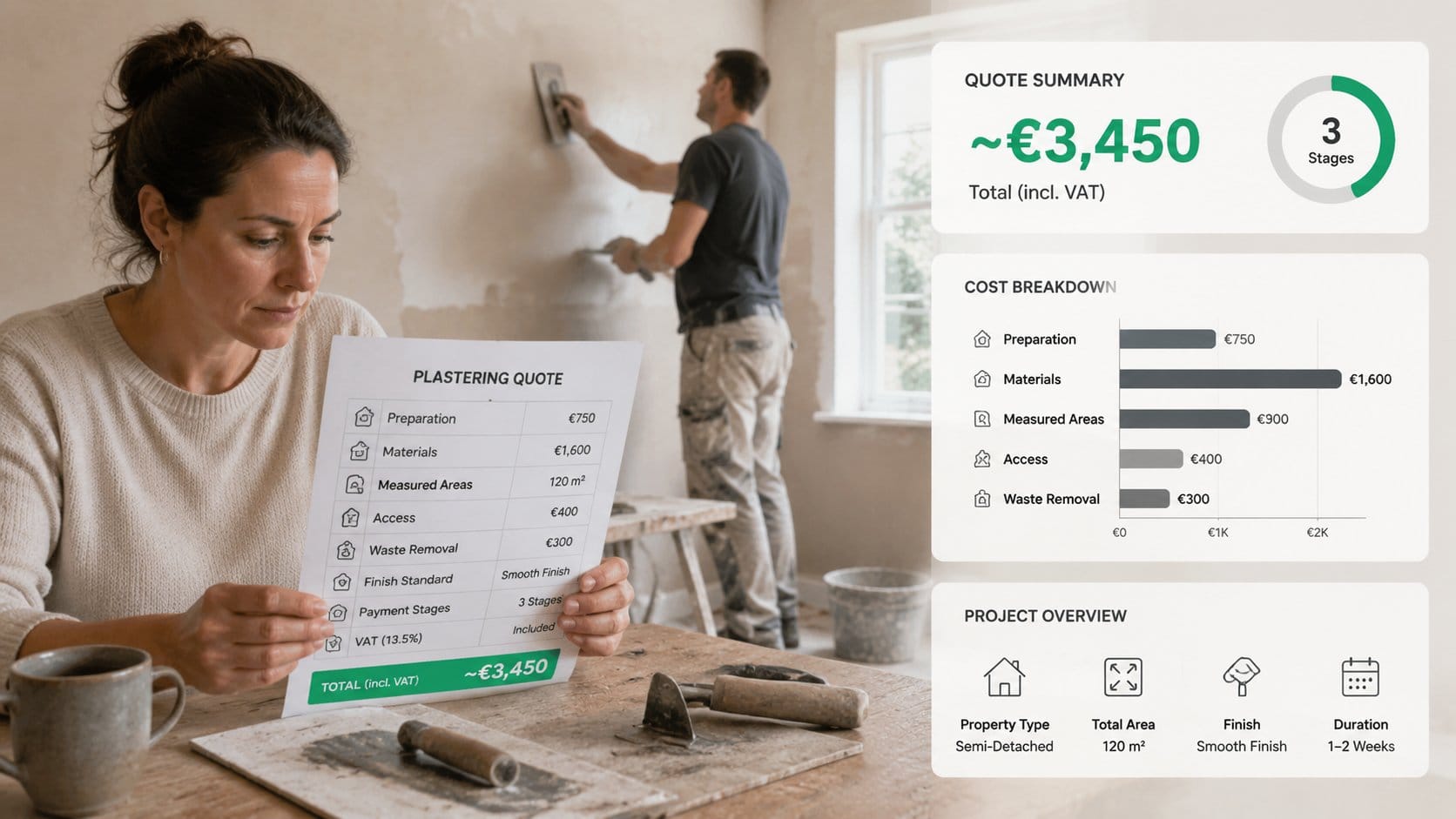
Before signing: The quote should state what triggers an extra charge, who approves variations, and whether the price includes VAT, waste, access, and making good.
How to Choose a Plasterer When the Trade Is Unregulated
Plastering isn't a state-registered trade in Ireland. That means a homeowner can't rely on a statutory plasterer register in the same way a customer checks a regulated gas or electrical contractor. Insurance, a clear written scope, and detailed local reviews become the practical substitutes.
The first check is public liability insurance. The certificate should be current, show the insured business name, and match the entity issuing the quote. The homeowner should also confirm whether the plasterer is trading as a sole operator or through a company, because the name on the insurance and invoice should be consistent.
A sensible checking process
Request a written scope. It should separate preparation, plastering, boarding, access, waste, and VAT.
Ask for local references. Recent addresses or named customers can provide more useful context than generic praise.
Inspect relevant reviews. Reviews should describe comparable work, such as ceilings, damp repairs, external render, or whole-house re-plastering.
Compare the exclusions. A lower quote may omit stripping, protection, waste, or making good.
Agree payment stages. The balance shouldn't be due before the agreed finish has been inspected.
A wet-trade mistake can be expensive even when the plaster itself looks acceptable initially. Spillages can damage flooring, joinery, sockets, or freshly painted surfaces, and an uninsured operator may leave the homeowner with the repair burden. That risk explains why the cheapest headline figure isn't automatically the cheapest completed job.
Red flags include cash-only demands, no trading address, reluctance to identify materials, refusal to separate labour from preparation, and pressure to pay the balance before inspection. Homeowners looking to find local reliable tradespeople Ireland should still carry out their own checks, because a marketplace or directory doesn't replace responsibility for choosing and contracting with the provider.
Frequently Asked Questions and Where to Find Local Plasterers
What does it cost to re-plaster a three-bed semi in Dublin?
A full three-bed re-plaster commonly sits around €3,000–€6,000 across Ireland. Dublin may fall above that broad benchmark, but the quote depends on stripping, ceilings, access, damp repairs, boarding, waste removal, and VAT. A per-room figure is only a starting point. Convert it into the area covered and separate preparation from finishing before comparing contractors.
Does a skim price include 13.5% VAT?
Not always. Domestic plastering on a dwelling is generally associated with Ireland's reduced 13.5% VAT rate, but the quote must state whether VAT is included and how it applies to the work. Request a VAT-inclusive total, with labour, materials, preparation, access, and waste shown separately.
What does a small plastering job cost?
A room skim commonly falls within €300–€600. Small repairs can have a high effective cost per m² because travel, floor protection, setup, and cleaning are spread across a limited area. The hourly cost also reflects preparation and site time, not only the minutes spent applying plaster.
How long does a full-house re-plaster take?
No reliable duration can be given without inspecting the house. The main variables are floor area, ceilings, stripping, drying conditions, access, boarding, and damp treatment. A written quote should set out the work sequence and identify when surfaces will be ready for decoration, rather than promise a fixed finish date before inspection.
Local trade directories, builders' providers' noticeboards, community groups, and personal recommendations can produce leads. Homeowners should request a written scope and comparable pricing from at least three written quotes. The comparison should focus on exclusions, particularly preparation, access, waste, protection, and VAT, because these items can explain why apparently similar jobs differ sharply.
Homeowners can also find local pros Ireland through ShamFix's Ireland-only marketplace. Reviews from both sides after completed work provide context, but they do not replace checks on insurance, credentials, scope, materials, or VAT.
Are you a plasterer in Ireland?
Plasterers can list on ShamFix. Listing is free and there's no commission; a subscription is planned for the future. Listing terms are available on the ShamFix tradesperson page.