Piano moving in Ireland typically runs from €250 to €1,000, driven by stairs, access and distance. Here's what to check before booking a mover.
/10 min read
Moving a piano in Ireland costs roughly €250 to €1,000, an aggregate Irish market estimate, and the position inside that band is decided by the access at both ends of the journey rather than by the instrument. A straightforward upright at ground level with a short drive sits at the bottom of the range, while a grand that has to be dismantled and carried down flights of stairs reaches the top. Most homeowners use a crew that handles pianos and other heavy items regularly, booking it through piano and heavy item moving rather than through a general house-move team (whole-house prices are in house moving cost).
What piano moving costs in Ireland
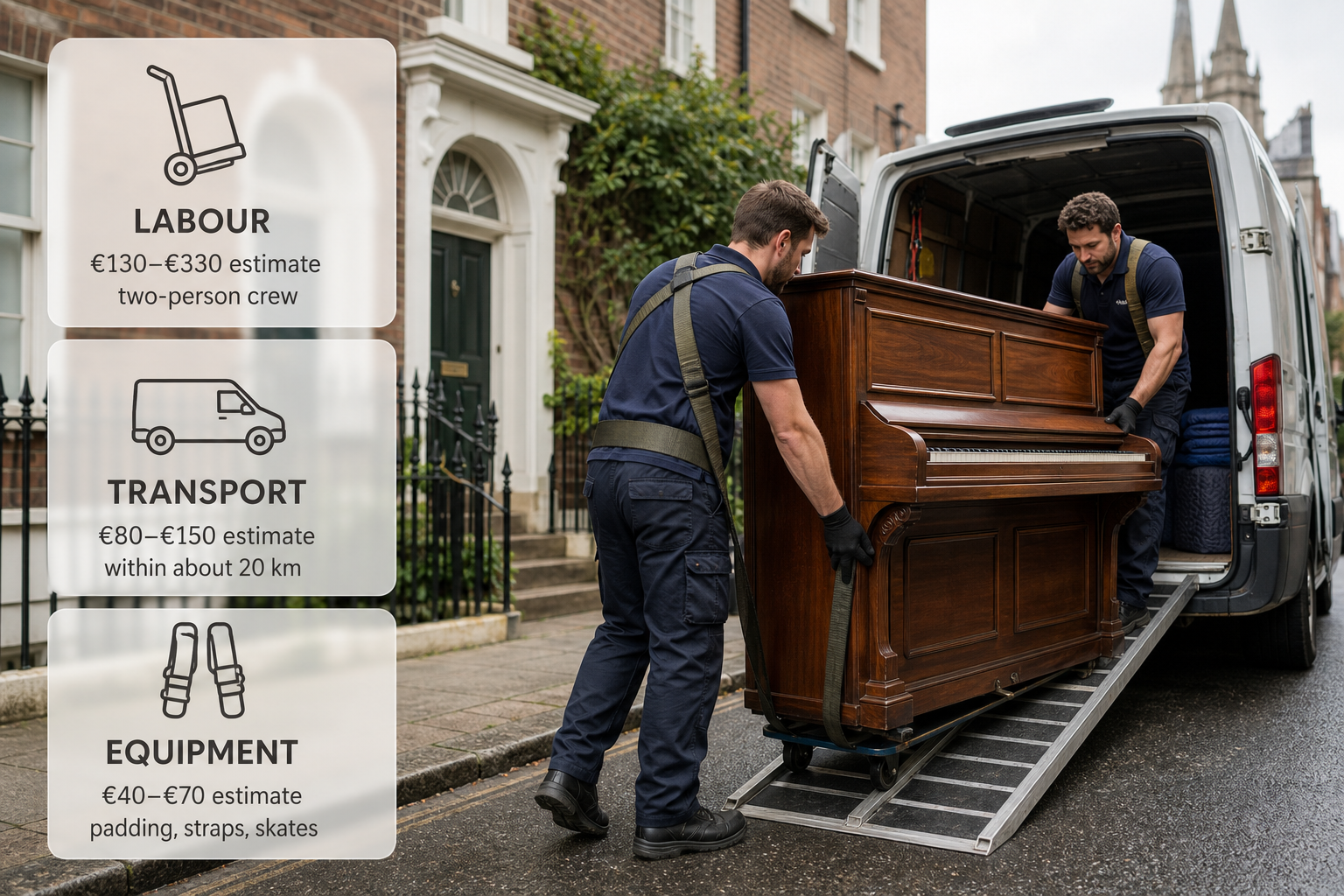
Piano moves are quoted as a package rather than at an hourly rate, but the package is built from a handful of lines that appear on Irish quotes again and again. The figures below are an aggregate Irish market estimate for each line.
Line on the quote
Typical range
Labour — two-person crew for loading, carrying and unloading
€130–€330
Transport — a run within about 20 km of the same city; longer journeys charged per kilometre
€80–€150
Padding, straps, piano skates and dollies
€40–€70
Stairs, steps or no-lift access — charged per flight or per level carried
€40–€120
Dismantling and reassembly of a grand — legs, pedal lyre and lid
€0–€280
Contingency for access, timing or a second visit
€0–€50
The first three lines apply to every move. Labour, transport and protection materials come to €250 at the low end and €550 at the high end, and that is where a simple upright at ground level with a short drive sits. A flight of stairs adds up to €120, dismantling a grand adds up to €280 and a contingency for extra time or a second visit adds up to €50, which is how the same job reaches the €1,000 top of the range. Few moves use every line at once, and the spread in the market comes from access rather than from the make of the piano.
Worked through, a two-bedroom first-floor apartment with one flight of stairs and a 15 km drive across the city might read labour €200, transport €110, protection materials €50 and stairs €80, a total of €440.
Upright or grand: what changes the price
An upright piano usually travels in one piece. Two people, padded quilts, straps and a piano skate are enough when the route is level, which is why uprights sit at the bottom of the range above. A grand has to come apart before it can be carried: the lid comes off, the legs are unscrewed and the pedal lyre is detached, and the instrument is rebuilt and levelled at the far end.
That work is the €0 to €280 dismantling line in the table, and it is the main reason grands rarely come in below the middle of the range. A smaller baby grand tends to land well below a full concert grand, and a concert grand leaving an upstairs room through a narrow hallway is the classic top-of-range job.
Stairs, floors, access and distance
Stairs are the most common extra. Crews charge per flight or per level carried, at the €40 to €120 line in the table, and a piano coming down three flights in a building with no lift will be quoted at the top of it. Floor level works the same way: a ground-floor entrance with a wide door and no steps is the easiest job, while an upper-floor apartment with a narrow stairwell and no lift is the hardest.
Poor access — a tight turn at the bottom of the stairs, a low doorframe, a hallway too narrow to take the piano on its side, a front door that has to come off its hinges — rarely has its own price line, but it eats time, and the contingency line of up to €50 is what covers it. Distance is charged on the €80 to €150 transport line for a run within roughly 20 km of the same city, with longer journeys quoted per kilometre on top.
Where a piano cannot be carried into or out of a building at all, a crane or hoist has to be hired and is quoted as a separate item, often the largest single addition to a quote for a city-centre or upper-floor job. Dismantling and reassembly, at up to €280, is normally built into the package rather than billed separately, although a second visit to rebuild a grand after delivery may be charged on its own.
Availability shapes the travel charge. In Dublin, several specialist crews often cover the same streets, so quotes come back quickly and travel charges stay modest; outside the main cities the nearest specialist may be an hour or more away, which is why mileage and travel time appear more often on quotes for rural addresses.
Why specialist handling matters, and the risks of a DIY move
A piano is heavy, top-weighted and fragile exactly where it is hardest to protect. The frame, soundboard and action sit behind a wooden case that gives little warning before it cracks, and the small castors are built for a level floor rather than a doorstep or a gravel path. A specialist crew works to a routine: the keyboard and lid are protected, the piano is quilted and strapped, it is tilted onto a skate rather than dragged, the weight is carried through the frame rather than the lid or the legs, and the instrument is supported whenever it is on its side.
A DIY move with a few helpers and a hired van tends to fail on three points. There is no equipment, so the piano is lifted instead of rolled. There is no technique, so the weight is taken in the wrong places. And there is no cover — homeowners should check with their own insurer before attempting a move themselves, because cover for a piano being carried by its owners is not something to assume. Dropping the instrument on a stairs, or through a doorframe or a glass panel, leaves the repair bill with the owner, quite apart from the risk of a back or hand injury.
Insurance to ask about before booking
Homeowners should ask the mover directly whether the firm holds goods in transit insurance and public liability cover, and ask to see the certificate rather than accept a verbal assurance. Three details matter: whether pianos are covered or excluded, whether the cover applies while the instrument is being carried as well as while it sits in the van, and what excess applies to a claim. If there is no cover, or if pianos are excluded, that is a good reason to look at another quote or to accept the risk knowingly. It is also worth checking what the household's own policy says about a piano in transit and while it is being carried out of the house.
How to compare piano moving quotes
Good quotes come from good information. The mover should be told the type of piano (upright, baby grand or grand), its approximate height and length, the floor and the number of steps or flights at both addresses, whether a lift serves either floor, the width of the narrowest door and the tightest turn, where the van can park, the distance between the two addresses, and the date and arrival window wanted. Photographs of both entrances and of the route through the house save a lot of back-and-forth, and the same details can be put to local crews through moving and transport services when comparing what is available.
Every quote should be in writing and should state the total price, what is included, the rate for stairs, mileage beyond the local area, any crane or hoist charge, whether dismantling and reassembly are included, whether transit insurance is in place, and how and when payment is due. A low hourly rate is not a useful comparison if the crew then quotes extra for stairs; the total for the described job is what counts.
Your rights if a mover is late, cancels or does only part of the job
Most disagreements about a piano move come back to something that was never agreed in writing. Before booking, the homeowner and the mover should settle the date and arrival window; the total price and what it includes; who removes and refits the legs, lid and pedal lyre; who takes a door off its hinges and puts it back; whether the piano is covered in transit and for how much; and when payment is due. A short email confirming all of it is enough.
Once agreed, the work has to match that description and be carried out with reasonable care and skill, including meeting the timing that was agreed. If only part of the job is done — the piano is delivered but the legs are never refitted, for example — a proportional refund may be due. If the service is not provided at all, the homeowner can cancel and seek a full refund, as CCPC sets out. Where a piano arrives damaged, careless handling is a failure of that care and skill standard, and the repair is normally claimed through the mover's transit cover or, if there is none, through the owner's own insurer — a question worth settling before booking rather than after.
Retuning is a separate cost after the move
A piano that has been tilted, carried and driven will almost always drift out of tune, and it needs a few weeks to settle before a technician touches it. A tuning is a separate cost from the move — an aggregate Irish market estimate of €100 to €180 — and it belongs in the budget alongside the moving quote. Booking it for roughly a month after delivery is the usual approach, and a piano that has not been tuned for several years may need more than one visit.
Before you book
Piano moving is a small, specialist market, and the gap between two quotes for the same instrument is usually explained by access, crew size and insurance rather than by the piano itself. The practical order of work is to describe the job fully, collect three written quotes, confirm the insurance position in writing, agree how the day itself will run, and set aside the tuning cost for a few weeks later. ShamFix is where Irish homeowners can post a job for a piano or any other heavy item. Posting a job and listing on ShamFix is free and there is no commission, and a subscription is planned for the future. ShamFix does not check or certify tradespeople and profiles are filled in by tradespeople themselves, so homeowners should check registrations themselves and read reviews.
FAQ
Can a mover add charges on the day?
If the real access differs from what was described — an extra flight of stairs, a hoist, a much longer carry than the quote assumed — an extra charge is likely, and the lines in the table above show what those items normally cost. The sensible approach is to ask for any extra to be confirmed in writing before the crew continues, and to keep the original quote email to hand.
What if no time was agreed and the mover keeps postponing?
Where no specific time is agreed for a service, it must still be provided within a reasonable time. If the business has been given further time and still does not provide the service, the consumer can terminate the contract and must be refunded without undue delay and at most within 14 days. Chasing the matter in writing, with dates, makes any later claim far easier to evidence.
Does the piano need tuning afterwards?
Almost always. The instrument needs a few weeks to settle in its new room, so a tuning is booked for roughly a month after delivery, at an aggregate Irish market estimate of €100 to €180, which sits outside the moving quote. A technician will say on the day whether a piano that has been out of tune for years needs a second visit.
What should be cleared and photographed before the crew arrives?
Sheet music, a metronome, ornaments, photographs and anything resting on top of the instrument should come off the day before, and the keyboard lid should be closed. Clearing the route inside the house — rugs, plants, shoes — and moving cars so the van can park close to the door saves loading time, which is charged. Photographing the piano, both entrances and the tightest turns gives a dated record of the condition and the route if anything is questioned later.