A typical Irish house move in 2026 costs about €350 to €1,600, with a two or three-bedroom home often falling between €600 and €950. The two biggest price drivers are the amount of furniture being moved and the distance between the two addresses.
That headline removal price rarely covers every door-to-door cost. Packing, materials, storage, difficult access, parking, waiting time, specialist handling and VAT can all change the final bill. Irish moving costs also sit beside the much larger transaction costs of buying or selling a home, so the removal van should be treated as one part of the household budget, not the whole budget.
What a House Move in Ireland Costs in 2026
A house move in Ireland costs roughly €250 to €2,500, depending on home size, distance and service level. A one-bedroom local move can start near €250, while a long-distance three-bedroom move can reach €2,500. The headline van price is only the transport portion. Packing, access, insurance, waiting time and extra crew can turn a cheap quote into a much larger door-to-door bill.
Irish price guides put a three-bedroom local move around €800 to €1,500, and a one-bedroom local move around €250 to €500. A 2026 Ireland-specific guide lists €900 to €1,500 for a local three-bed, €300 to €600 for a one-bedroom flat and €1,500 to €2,500 for a long-distance three-bedroom move. These figures are reported in Northwest Removals' Ireland moving-cost guide.

A low online figure often covers only a van and driver. Check whether the written quote includes a second mover, packing labour, wrapping, dismantling, stairs, long carries from the parking space, waiting for keys and insurance. Dublin, Cork and Galway jobs may cost more where parking restrictions, traffic or stair-only apartment access slow loading and unloading.
Put the truck price beside the actual door-to-door cost. Materials and packing time belong in the same budget line as transport, while storage and specialist handling should be listed separately. Ask the mover to confirm every inclusion before booking.
Buying or selling the property creates a separate cost category. Conveyancing can include solicitor fees of €1,500 to €3,000 plus VAT, Land Registry fees of €400 to €800, search fees of €150 to €300, and stamp duty of 1% on the purchase price up to €1,000,000, according to SortMyHouse's 2026 conveyancing guide. On a €340,000 property, stamp duty alone is €3,400.
Practical rule: Get at least two written quotes using the same inventory, addresses, floor details, parking information and access requirements.
A separate estimate puts total move-related costs, including transaction items, at roughly 2% to 4% of the property price. A €350,000 home could therefore involve €7,000 to €14,000 in such costs, before optional packing, storage or specialist handling, as outlined by FinanceTool.ie. Keep removal costs separate from purchase or sale overheads.
Post a house move task with the inventory, addresses and access details to request several local quotes.
Typical Prices by Home Size and Distance
A realistic Irish move in 2026 starts at about €250 for a small local job and can reach €2,500 for a larger long-distance move. A cheap van quote often covers only the truck and basic labour. Packing, difficult access, waiting time, protection and insurance can push the final door-to-door cost well above that first figure.
Irish movers price the work from furniture volume, vehicle size, crew numbers and loading time. Distance adds fuel, travel hours and the risk of an unpaid return journey. Each extra bedroom can also mean another loading cycle, more protective material and longer unloading.
The local ranges below are supported by Get A Mover's Irish house-removal guide, which lists €250 to €500 for one bedroom, €450 to €800 for two bedrooms, €800 to €1,500 for three bedrooms and €900 to €1,500 for four bedrooms.
| Home size | Local move, under 50km | Long-distance move, 150km+ |
|---|---|---|
| Studio or one-bed | €250 to €500 | Request a written quote based on volume and route |
| Two-bed | €450 to €800 | Request a written quote based on volume and route |
| Three-bed | €800 to €1,500 | €1,500 to €2,500 |
| Four-bed | €900 to €1,500 | Request a written quote based on inventory and access |
Another Irish guide gives local examples of €250 to €400 for a one-bedroom move, €500 to €800 for two bedrooms and €1,000 to €1,500 for three or four bedrooms. It lists packing at €250 to €500 and storage at €100 to €200 per month, as shown by Moving Company Dublin.
Why bedroom count is not enough
A two-bed house with a full attic, shed, garage and large appliances can cost more than a lightly furnished three-bed flat. Terraced houses, upper-floor apartments and limited parking increase the price because movers carry items farther or shuttle them between the property and vehicle.
List wardrobes, beds, sofas, white goods, garden furniture, bicycles, garage contents and attic boxes. Include stairs, lifts, parking restrictions and narrow entrances. A survey, video walk-through or detailed inventory gives the mover enough information to price the actual job.
Put the agreed inventory, access conditions, packing scope, waiting-time charge and insurance cover in writing. Request three quotes using the same details, then compare the door-to-door total rather than the cheapest van figure.
Man-and-Van vs Full Removal Crew
A man-and-van service suits a small, straightforward move where you pack boxes, dismantle furniture and help load. Irish examples place one-bedroom moves around €250 to €400 and two-bedroom moves around €500 to €800, as outlined in Get A Mover's domestic removals guide.
A full removal crew is the better choice for a larger home, fragile contents or a tight handover. The same guide gives removal-company services for a typical three-bedroom move at around €250 to €700, while packing, materials and disassembly can bring a complete example to about €1,700.
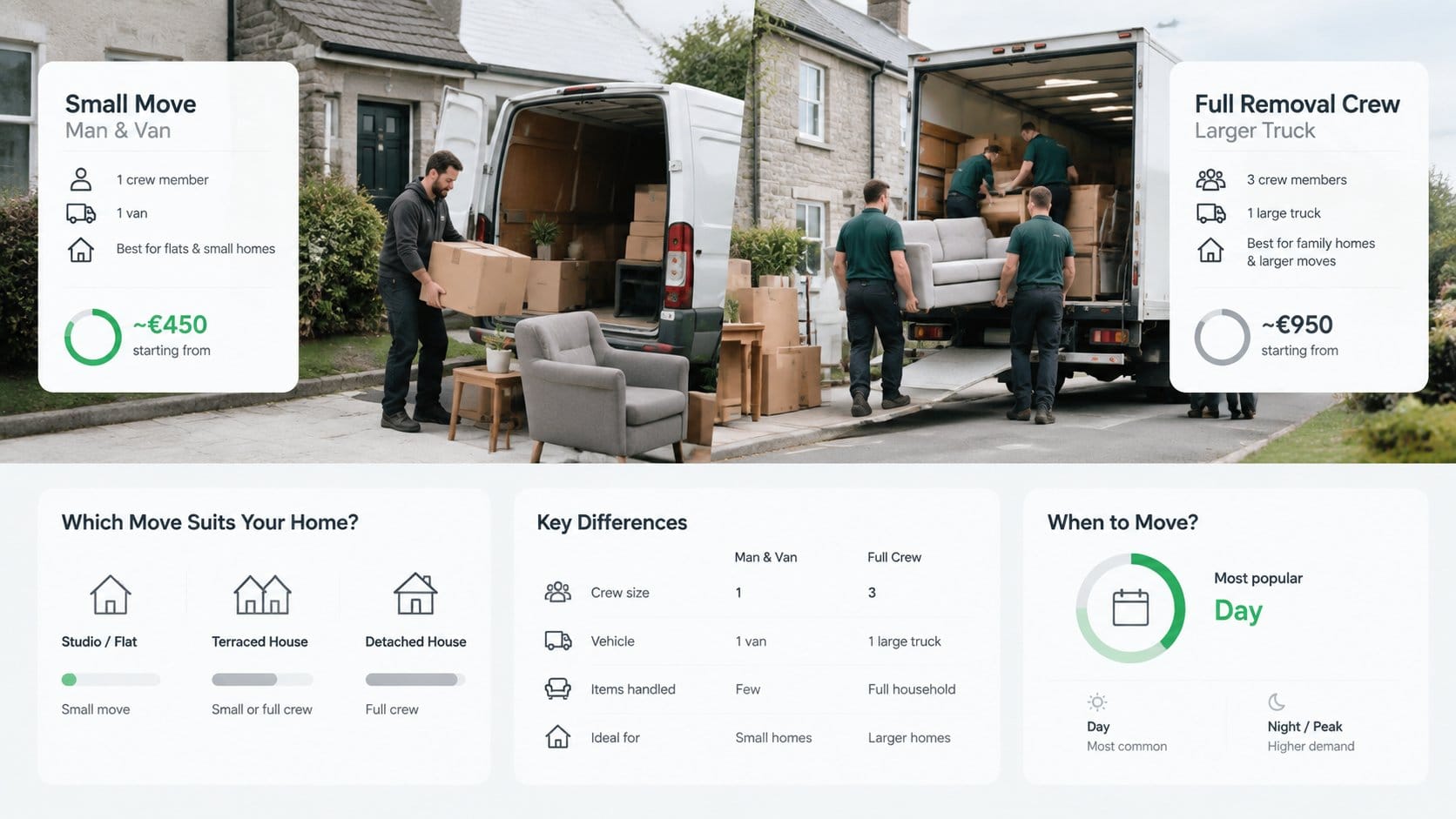
| Service | Best suited to | What the household should expect |
|---|---|---|
| Man-and-van | Studio or one-bed, small inventory | Customer-packed boxes, limited handling and possible hourly charging |
| Full removal crew | Two-bed to four-bed homes | More movers, larger vehicle, protective equipment and broader handling |
| Specialist handling | Pianos, safes, antiques and bulky furniture | Separate assessment, equipment and a written surcharge |
The cheap van figure is often only the truck and basic labour. It may exclude packing, furniture protection, stairs, waiting time, extra mileage and higher insurance cover. Compare the advertised vehicle price with the realistic door-to-door total.
Put the number of movers, vehicle size, estimated hours, equipment, insurance, access conditions and every extra charge in writing. For white goods, pianos, antiques or large wardrobes, choose the full crew unless the smaller provider confirms suitable handling and cover.
Unwanted furniture and household waste should be priced separately, and any disposal or waste-removal step should be quoted on its own rather than folded into the moving job.
Add-Ons That Change the Quote
Packing is normally an optional service, not part of the basic transport price. It may be charged by crew time, by the amount of material supplied or as a fixed packing allowance. Full packing costs more than packing only glassware, artwork and other fragile items.
Irish published examples put packing at €250 to €500 for a local move and storage at €100 to €200 per month, while another Irish guide lists packing materials and disassembly as separate components of a three-bedroom move. Get A Mover's house-removal pricing guide lists additional packing costs of €150 to €200 for a one-bedroom move, €200 to €250 for two bedrooms, €250 to €300 for three bedrooms and €300 to €400 for four bedrooms.
| Add-on | Typical range | Worth it? |
|---|---|---|
| Packing service | €150 to €500, depending on scope | Yes for limited time or a fragile-only pack |
| Packing materials | Ask for an itemised allowance | Often worthwhile for glass, electronics and furniture |
| Storage | €100 to €200 per month in one Irish published guide | Useful where sale and purchase dates don't align |
| Disassembly and reassembly | Ask for an itemised quote | Worth paying for large wardrobes and beds |
| Specialist handling | Written quote required | Essential for pianos, safes and unusually bulky items |
| Cleaning after departure | Separate cleaning quote | Useful where the property must be handed over ready |
The most sensible compromise for many households is self-packing ordinary books, clothes and kitchenware, then paying for professional wrapping of fragile items. Materials should be listed separately from labour so the household can compare a mover-supplied package with boxes sourced elsewhere.
Cleaning is another cost that often sits outside the removal quote. A household arranging end-of-tenancy cleaning should get a separate quote for the actual property condition rather than assume it is part of the move.
What Moves the Price the Most
Distance matters, but time on site often decides the final figure. A longer route increases driving time and fuel use, while stairs, narrow entrances, long carries and poor parking increase the paid labour window.
Access and carrying distance
An apartment without a usable lift can require repeated trips between the vehicle and the property. A narrow road, restricted loading area or parking space far from the entrance can create the same problem. The survey should record floor level, lift dimensions, doorway width, parking distance and whether a permit or suspension is needed.
Waiting and difficult handovers
Delayed keys, an occupied loading bay, a lift that hasn't been booked or a blocked driveway can leave a crew idle. Irish removals pricing can also use short time increments, with Dublin examples showing extra time billed at €7.50 to €10 per 15 minutes for one service band. Furniture disassembly and reassembly can run from €7.50 to €12.50 per 15 minutes on a lower band and up to €20 to €30 per 15 minutes on higher service bands, according to Man With A Van Dublin.

The written quote should state whether waiting is charged by the hour, part-hour or another increment. It should also identify parking permits, tolls and failed-access charges. The household shouldn't assume that a fixed quote covers delays caused by missing keys or unavailable access.
Fragile and bulky contents
A piano, safe, glass cabinet, large wardrobe or American-style fridge may require additional equipment, protective wrapping or more than the standard crew. The provider needs those items listed before quoting, not discovered beside the van on moving day.
Access detail saves money: A photograph of each entrance, staircase, lift and parking area can be more useful than a room count alone.
How to Compare Two Removal Quotes
Two quotes are comparable only when they price the same scope. A low total may exclude packing, stairs, extra mileage, furniture protection or waiting time.
Place the quotes side by side and check these fields first:
- Price basis: Is the charge hourly, fixed or an estimate?
- Crew and vehicle: How many movers are attending, and what vehicle size is included?
- Time and mileage: What hours, route distance, tolls and return travel are covered?
- Handling: Are packing, wrapping, furniture dismantling, reassembly and fragile items included?
- Access: Are stairs, long carries, lifts, parking restrictions and permits allowed for?
- Insurance: Does the quote include public liability and goods-in-transit cover, and what exclusions apply?
- VAT: Is the stated price inclusive of VAT?
House removals are generally subject to 23% VAT, so the customer should confirm whether the quote is VAT-inclusive before comparing totals. The invoice should also name the legal business, payment schedule and cancellation terms.
Insurance deserves its own check
Goods-in-transit cover protects contents while they're being transported, but the customer needs to understand limits, exclusions and the claims process. Public liability cover addresses a different risk, such as accidental damage to a property or another person's property during the work.
The provider should state the level of cover, whether fragile items require special packing, whether self-packed boxes are covered and how damage must be reported. The customer shouldn't rely on a verbal assurance.
Four questions to send by email
- Is the quoted price fixed or estimated?
- What happens if the job takes longer than the allowance?
- What cancellation notice is required?
- How are damage claims submitted and handled?
Written answers create a clear record. They also expose a quote that appears cheap only because important services haven't been included.
Sample Budgets for Common Irish Moves
A realistic Irish moving budget starts with the headline transport range, then adds the work a cheap van quote often leaves out. Packing, storage, cleaning, access problems and utility arrangements can all sit outside the vehicle price.
The figures below are planning examples, not fixed prices for a particular property. Use them to compare the truck cost with the likely door-to-door total, and request separate prices for cleaning and utility work.
| Line item | Local two-bed Dublin | Long-distance three-bed Cork to Galway |
|---|---|---|
| Removal transport and crew | €500 to €800 | €1,500 to €2,500 |
| Packing or materials | €150 to €500 | €150 to €500 |
| Storage during handover | €100 to €200 per month | €100 to €200 per month |
| Utility transfers | Request provider quotes | Request provider quotes |
| Cleaning | Request a separate quote | Request a separate quote |
| Specialist handling | Only if required | Only if required |
| VAT treatment | Confirm whether included | Confirm whether included |
For a local Dublin two-bedroom move, allow €500 to €800 for removal transport and crew before packing or storage. Treat that as the starting figure, not the finished budget. Add only the services you need, but make the provider list each one in writing.
For the Cork to Galway three-bedroom move, allow €1,500 to €2,500 for the long-distance removal range. Storage may be needed if the property handover dates do not match. Full packing, stairs, restricted parking or a long carry from the vehicle can raise the final bill beyond the transport allowance.
Citizens Information's moving-home guidance advises households to close or transfer electricity, gas, water and waste services when moving. Keep those arrangements outside the removal quote unless the mover is handling them directly. Utility connection fees and other move-related charges need provider confirmation, so ask for separate written estimates.
Before booking, request one total for the removal itself and a second total for every add-on. That format shows whether a low van price is cheaper or excludes the work needed to complete the move.
Money-Saving Tips and a Moving Day Checklist
The best saving usually comes from reducing volume and avoiding wasted crew time. Decluttering before the survey means fewer boxes, fewer loading cycles and less space in the vehicle.
Book for a flexible date where possible. Mid-week and mid-month availability may give the household more choice, while Friday and month-end dates can be harder to coordinate. No provider should promise a saving without putting the actual price in writing.
Supply suitable boxes for ordinary belongings, but don't cut corners with fragile goods. Strong cartons, proper wrapping and clear room labels reduce confusion at the delivery address. The provider should confirm whether customer-packed boxes remain covered under its goods-in-transit terms.
Reserve access early. Apartment lift bookings, parking permissions and loading arrangements should be confirmed before the van arrives. A vehicle waiting outside while keys or access are unavailable can turn a tidy quote into a larger bill.
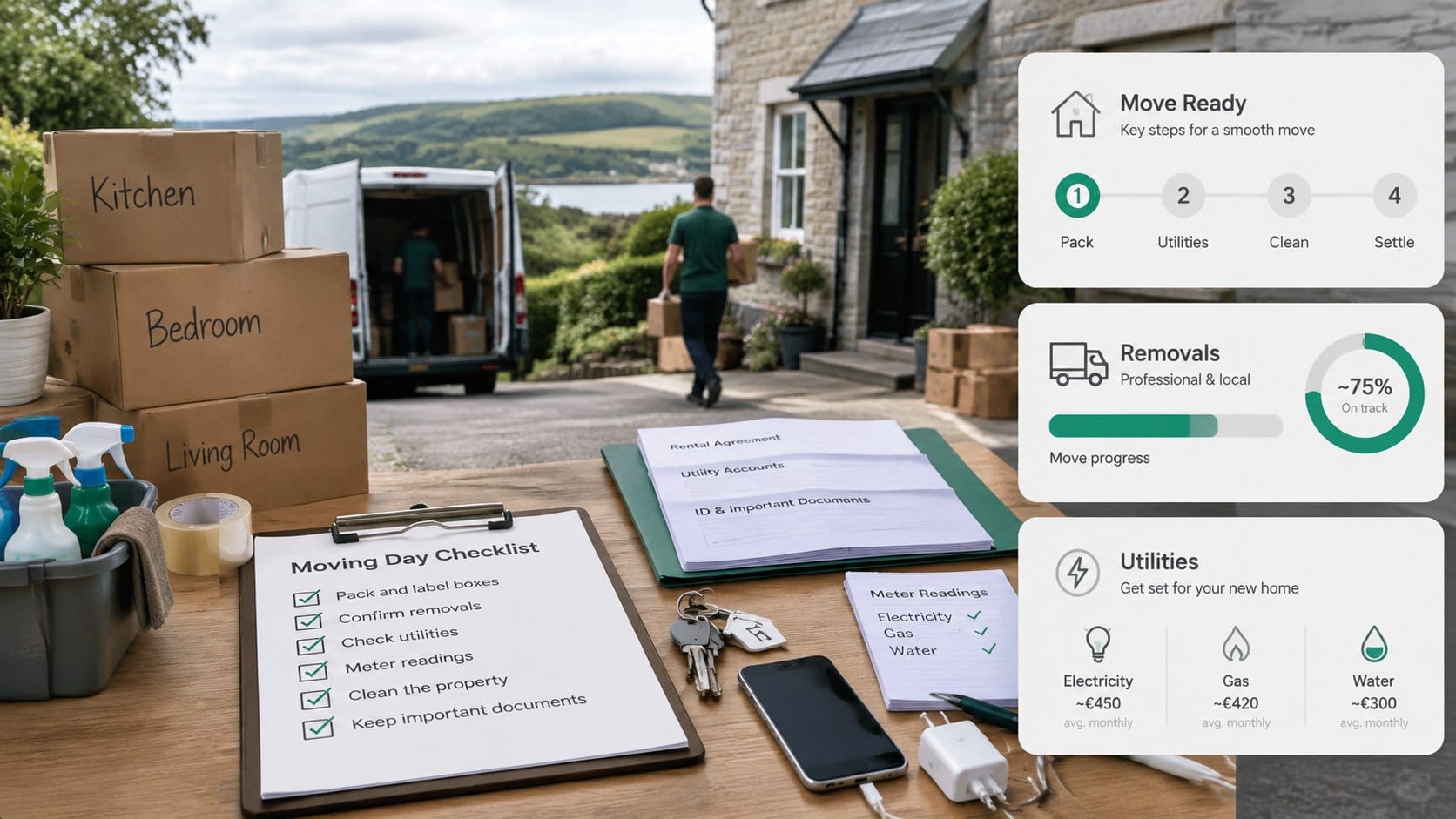
Moving-day checklist
- Essentials box: Keep medication, chargers, documents, toiletries, tea and a change of clothes separate.
- Meter readings: Photograph electricity, gas and water meters at both addresses.
- Condition evidence: Photograph walls, floors, furniture and appliances before loading and after delivery.
- Access confirmation: Keep keys, lift bookings, parking permissions and contact numbers available.
- Payment check: Confirm the accepted payment method and when the balance is due.
- Damage procedure: Report damage promptly, photograph it and follow the written claims process.
- Final sweep: Check the attic, shed, garage, cupboards and behind doors before leaving.
Before requesting quotes, the household should declutter, photograph access points, list every bulky item, separate optional packing from transport, and ask for goods-in-transit cover in writing. Those steps produce a more accurate comparison than chasing the lowest headline van price.
Are You a Removals Business in Ireland
Households increasingly compare the full door-to-door cost, not just the van price. A removals business that gives a clear, itemised quote — crew, vehicle, access, packing, waiting time, insurance and VAT — wins more of these jobs than one quoting a single low figure.
ShamFix connects removals companies and man-and-van services with households across the Republic of Ireland. Listing on ShamFix is free and there's no commission; a subscription is planned for the future. ShamFix does not vet or verify providers, so households confirm insurance, cover and reviews themselves.
Providers can list a removals service on ShamFix, ideally showing goods-in-transit and public liability cover and a sample itemised quote.