You're probably looking at one of three jobs. A sofa won't fit in the car. A student flat has to be cleared by the weekend. Or there's a pile of old furniture in the shed and someone has offered to “take it away cheap”. In Cork, that's where a Man with a Van service can be useful, but it's also where people get caught on price, paperwork, and vague promises.
The term sounds simple. It isn't. In Ireland, “Cork man with a van” isn't a formal trade class or regulated service label, so the burden is on the customer to define the job properly, ask the right questions, and check the right documents. That matters even more when the job crosses from moving items into waste removal.
What a Cork Man with a Van Service Actually Does
Clients booking a Cork Man with a Van typically don't need a full removals company. They need a smaller, more flexible job done without hiring a lorry and a full crew. That usually means one van, one operator, and a job that can be finished in a short window if access is organised properly.
A typical provider might handle small house or apartment moves, student moves, single-item furniture runs, appliance collection, flat-pack pickups, and short delivery jobs from places such as IKEA or private sellers. Some also offer dismantling or reassembly, but that should never be assumed. Transport and assembly are two separate pieces of work, and they need to be priced and agreed separately.
For readers comparing options, Man with a Van providers on ShamFix are listed as local service providers rather than as one in-house van company. The platform itself doesn't run vans.
The jobs that usually fit this service
The best use cases are straightforward and practical:
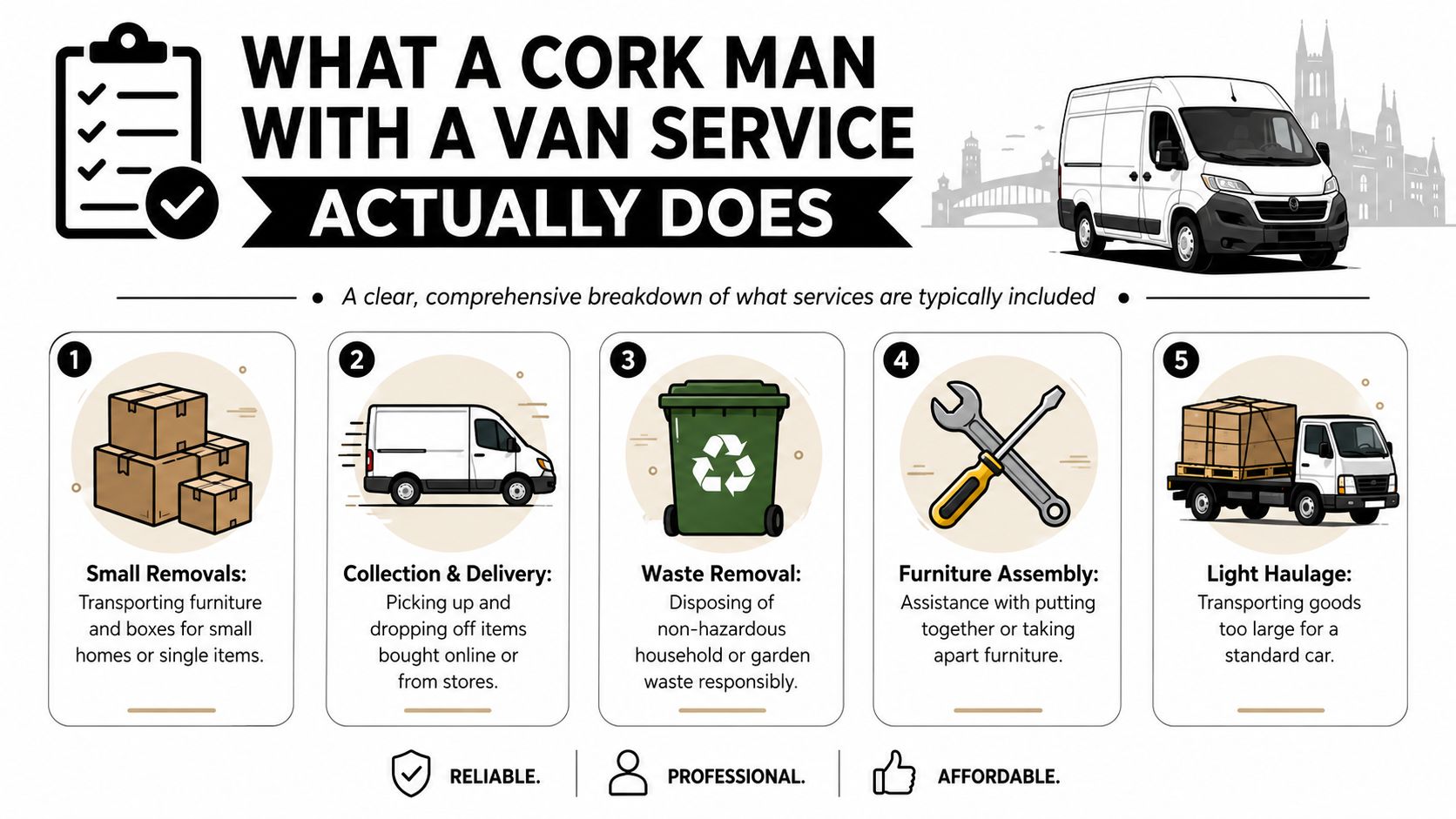
- Small removals. Beds, boxes, chairs, desks, and the contents of a studio or room.
- Collection and delivery. Store pickups, Facebook Marketplace purchases, DoneDeal buys, or appliance transport.
- Student moves. End-of-term clear-outs, short-notice moves, and parent-assisted drop-offs.
- Light haulage. Items too awkward for a hatchback but too small for a full removals contract.
- Basic furniture handling. Carrying, loading, strapping, and unloading. Assembly only if clearly included.
Practical rule: if the job needs specialist lifting gear, multiple floors without a lift, or careful handling of expensive items, say that upfront. A vague description nearly always turns into a bad quote or an argument on the day.
Where the line changes from transport to waste
Moving an item and disposing of it are two different jobs, and the difference is where the legal risk starts. Moving a wardrobe from one house to another is one thing. Removing that same wardrobe for disposal is different.
If the operator is taking away rubbish, old furniture for disposal, garden waste, or mixed junk, that's not just “a van job”. It enters waste collection. In Ireland, the operator must hold a valid waste collection permit for that work. If a householder hands waste to someone without the proper permit and that waste is dumped illegally, the problem doesn't disappear because cash changed hands on a driveway.
If the operator is taking material away for disposal, they must hold a valid waste collection permit. Permits are issued nationally by the National Waste Collection Permit Office (NWCPO), based in Offaly County Council, not by the local authority in Cork, and the NWCPO runs a public permit search, so a customer can check a provider's permit rather than take their word for it.
That's why the phrase Cork Man with a Van can be too broad to trust on its own. It may mean moving, delivery, clearance, or a bit of everything. Before booking, get the provider to state plainly what they're doing, what's included, and whether the job involves lawful disposal.
Understanding Man with a Van Costs in Cork
Price confusion usually starts when the customer and the operator are pricing two different jobs. One is thinking “quick sofa collection”. The other is pricing stairs, waiting time, parking trouble, and a second pair of hands. Clear scope saves money.
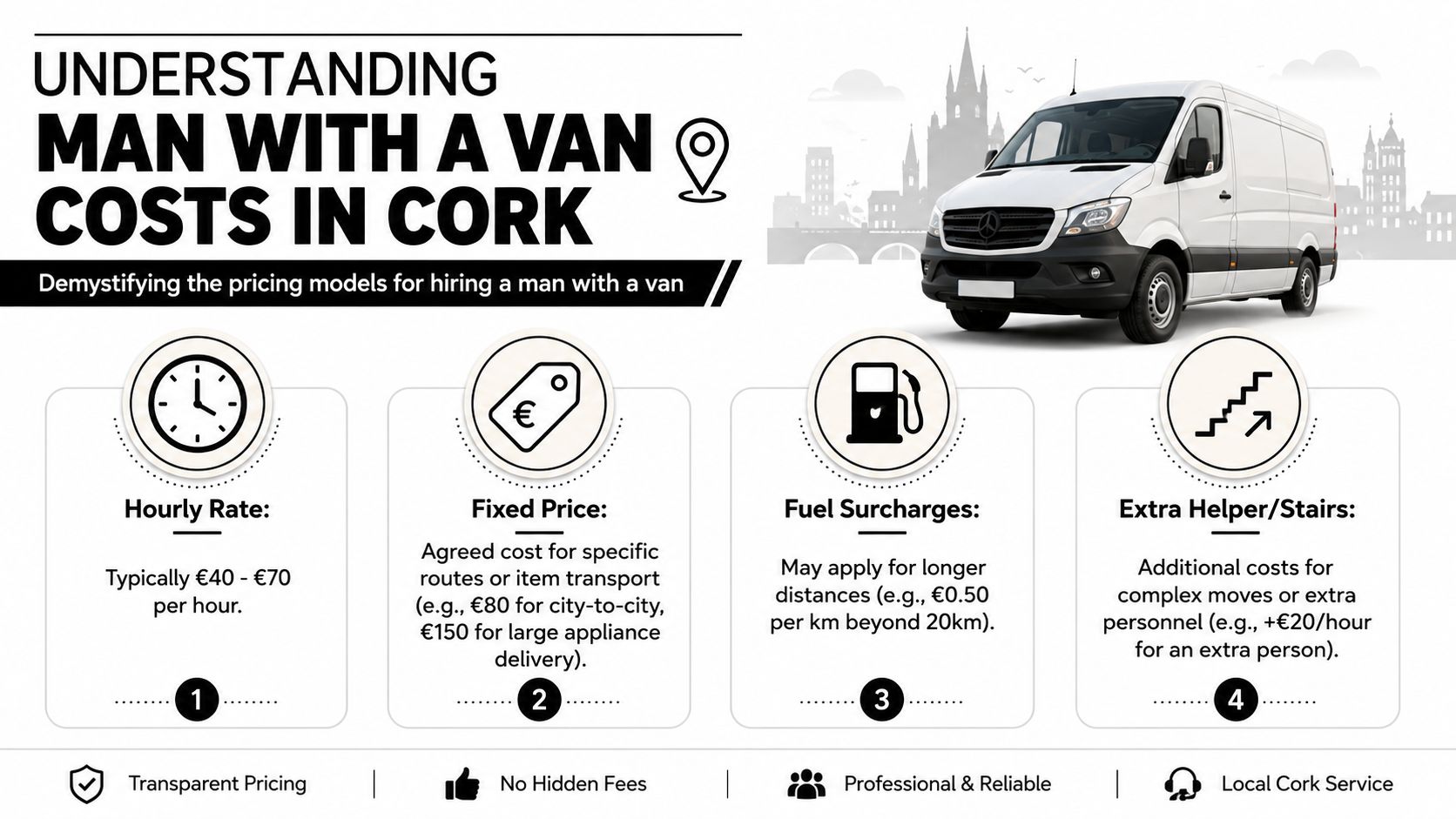
The main pricing models in Cork are hourly charging and fixed quotes. Hourly rates suit local jobs where time on site is the main variable. Fixed rates suit single-item runs or clearly defined point-to-point work.
What Cork rates look like
QuickVan's Ireland pricing guide
Irish market rates give a workable baseline. A single operator with a small van commonly charges around €50 to €90 an hour, with some quoting from about €40 for basic transport where the customer helps load. Two movers with a larger van run roughly €110 to €130 an hour in Dublin, the most expensive market in the country, so Cork quotes typically sit at or below that. Most local moves land between €250 and €700 all in, and a two-hour minimum is common.
That gives a customer a real baseline. It doesn't mean every quote outside those bands is wrong. It means any quote should have a reason behind it.
A simple way to look at it:
| Job type | Typical market structure |
|---|---|
| Single chair, table, or appliance pickup | Usually fixed quote |
| Short local move with unknown loading time | Usually hourly |
| Flat or house move with stairs and multiple items | Hourly or site-based quote |
| Disposal job with legal waste handling | Quote should state disposal clearly |
What pushes the quote up
The final number usually moves for practical reasons, not magic. The biggest price drivers are these:
- Van size. More volume means a bigger vehicle, and often a higher operating cost.
- Crew size. One operator is cheaper. Two people save time on heavier jobs.
- Access. Upper floors, no lift, long carries, poor parking, and tight hallways all slow the job.
- Distance. Longer routes can be quoted as fixed work or may include a fuel or mileage element.
- Waiting time. Delayed keys, late sellers, blocked loading bays, and slow handovers all matter.
- Waste disposal. If disposal is included, the quote should make that explicit.
A cheap headline rate can become an expensive job if the quote doesn't say whether stairs, waiting time, heavy items, or disposal are included.
The sensible move is to ask one blunt question before booking: what exactly is included in this price?
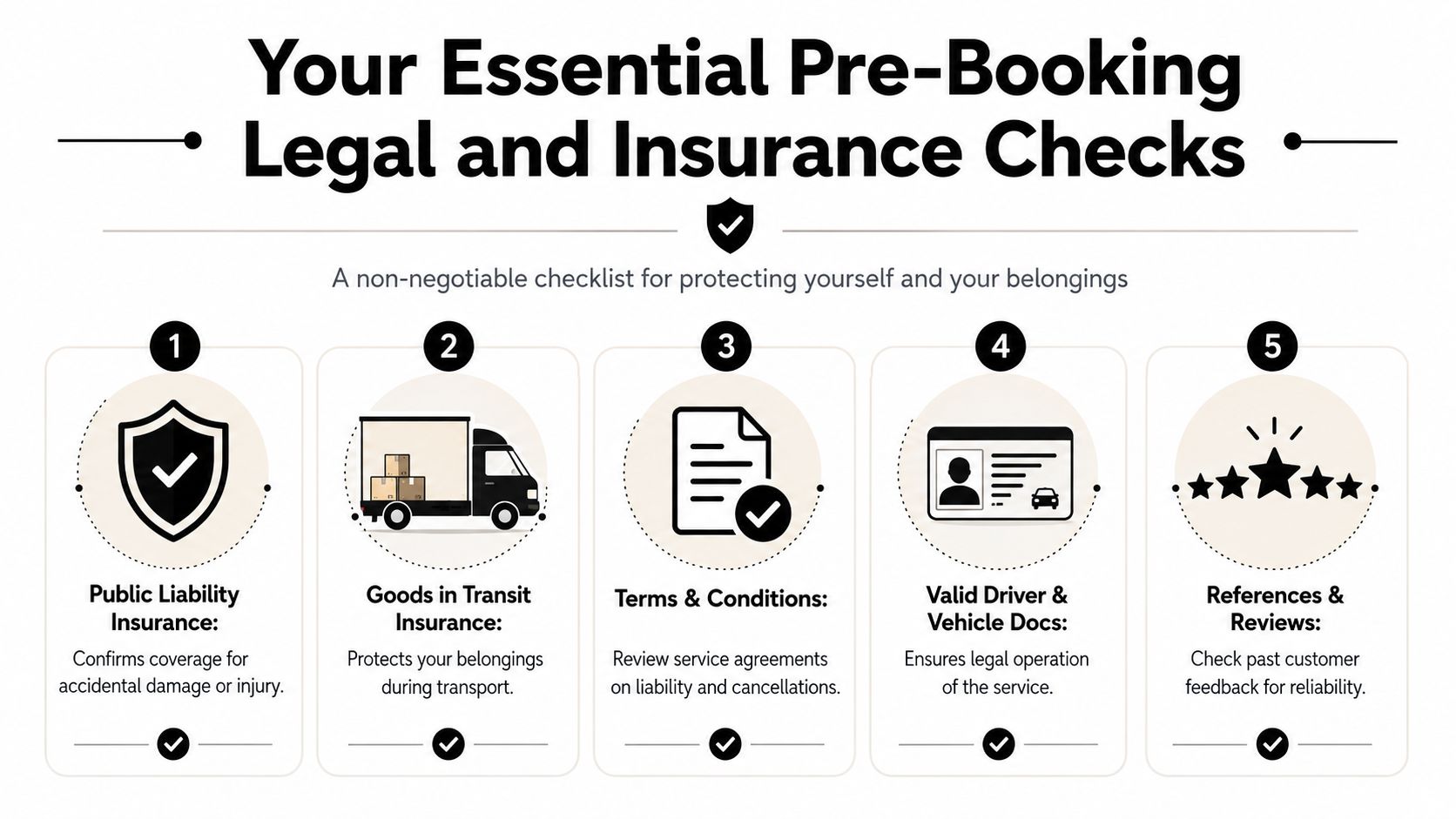
Your Essential Pre-Booking Legal and Insurance Checks
A polished ad means very little. A clean van means even less. The important part is whether the operator can legally do the job they're offering and whether there's cover in place if something goes wrong.
"Man with a van" is not a regulated trade category in Ireland. There is no licence, register or qualification attached to the phrase itself, which means the ad tells the customer nothing about whether the operator is insured or permitted to do the work being offered. The checks below are what actually matter.
Why the checks matter more than the ad
If a wardrobe is scratched in transit, insurance matters. If a hallway wall is gouged while carrying a fridge, insurance matters. If someone takes rubbish away without the right permit and dumps it, paperwork matters even more.
Customers sometimes rely on screenshots, profile badges, or a casual “don't worry, it's covered”. That's not enough. A proper booking should include direct questions and direct answers.
Ask before the job is confirmed. Not after the van arrives.
The documents worth asking for
A sensible customer checks four things.
- Goods in transit insurance. This covers belongings while they're in the vehicle and being moved as part of the transport job. If the provider says they have cover, ask what kind of items it applies to and whether there are exclusions.
- Public liability insurance. This is about third-party damage or injury. If a stair rail, doorway, communal area, or parked vehicle is damaged during the job, this is the policy that matters.
- Driving licence and vehicle documents. The driver should hold the correct licence category for the van being used. For a commercial vehicle, the customer should also ask whether the van has a valid CVRT.
- Written terms. Even a short message is better than a handshake. Cancellation terms, waiting time, and liability should be clear enough to read back later.
For rubbish, junk, or any disposal work, there is one essential item beyond the usual insurance questions:
If the job includes waste removal, the operator must hold a valid waste collection permit. Without it, the customer shouldn't proceed.
That includes house clear-outs, garden waste, broken furniture for disposal, and mixed rubbish from renovations or landlord turnovers. Customers should ask to see the permit details and confirm that the provider is authorised for the type of waste being collected.
A short pre-booking checklist keeps things simple:
- Define the job. Transport only, or transport plus disposal.
- Ask for cover. Goods in transit and public liability.
- Confirm the vehicle is legal. Correct licence and current CVRT.
- Check waste authority where relevant. No permit, no clearance job.
- Get the quote in writing. Even if it's by message.
That isn't overkill. It's the difference between a straightforward job and a very avoidable mess.
How to Find and Evaluate Providers in Cork
The old way still works to a point. Ask a neighbour, a letting agent, a caretaker, or the local family WhatsApp group and a name usually appears. That's useful for a quick lead, but it often comes with thin detail. “He was grand” doesn't tell a customer whether the provider showed up on time, charged what was agreed, handled stairs well, or had the right paperwork for disposal work.
Online search solves part of that problem by showing more options. It also creates a new one. Plenty of profiles look fine at first glance because almost every provider can write a tidy description.
Word of mouth versus online platforms
The practical difference isn't online versus offline. It's whether the customer can see enough real behaviour to judge the provider properly.
A decent evaluation process is simple:
- Read for specificity. Reviews that mention timing, item type, communication, and access issues are more useful than vague praise.
- Look at job fit. Someone who mainly does collections may not be right for a multi-stop flat move.
- Check how the provider presents limits. A clearer profile is often a better sign than a flashy one.
- Watch for disposal language. If waste removal is offered, the customer should still confirm permit details directly.
The strongest signal is consistency. One glowing comment means little. A pattern of sensible, detailed feedback means more.
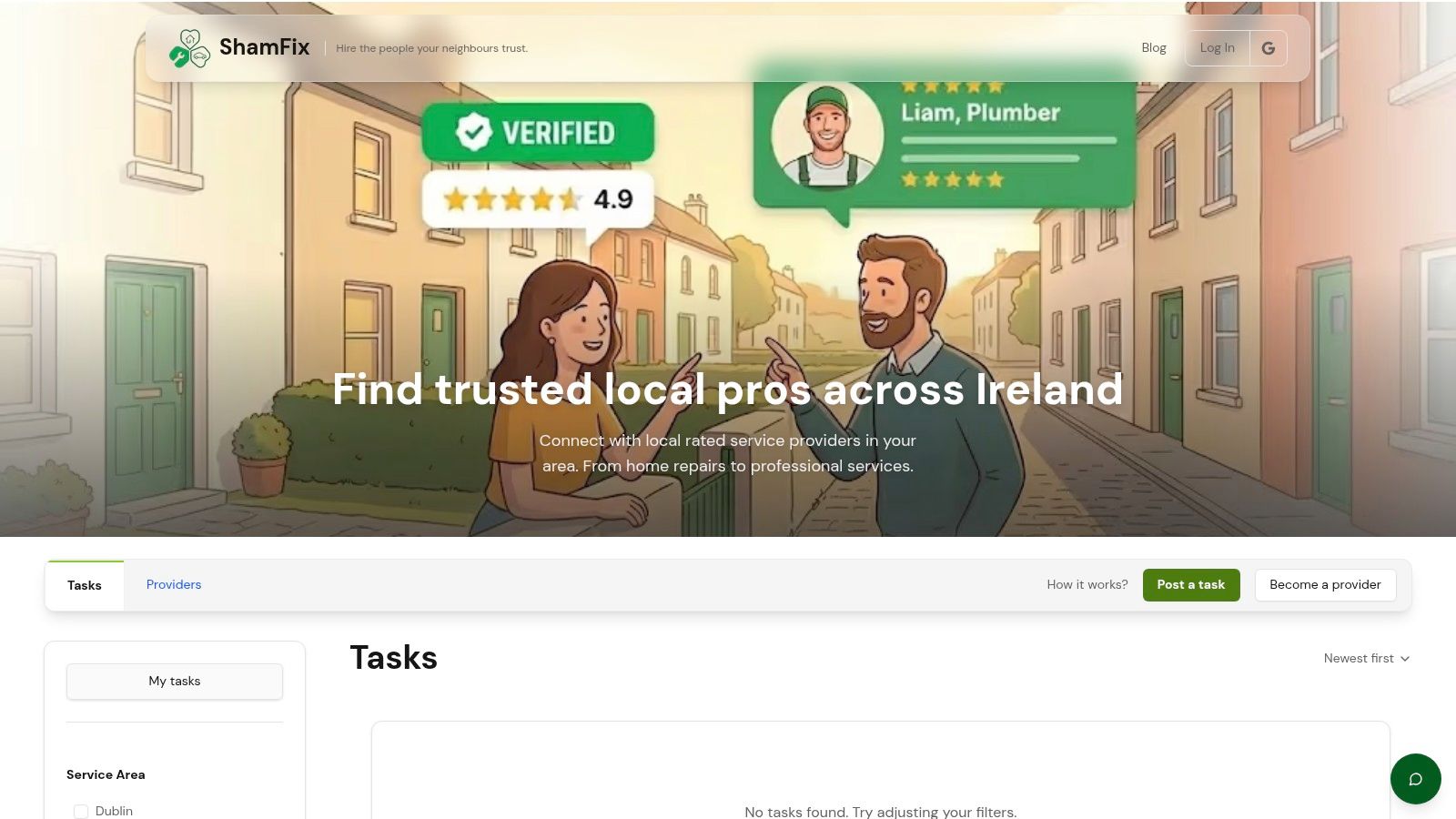
Here's what a modern marketplace view looks like in practice.
What real trust looks like
Some platforms lean heavily on badges and broad language that can make customers think someone has been checked more thoroughly than they have. A better approach is to make reputation visible and mutual.
On ShamFix's task posting system, trust is built through a real two-sided review system where both providers and customers rate each other after every completed job, with no vetting or verification performed by the platform, as explained in ShamFix's review model overview. Providers list their own credentials, and customers need to verify regulated registrations directly with the relevant authority where applicable.
That matters because it keeps the trust signal honest. The customer can see how a provider behaves, and the provider can also show whether a customer is organised, clear, and fair to deal with.
Good reviews answer practical questions. Did the provider arrive when promised, communicate clearly, handle the items properly, and stick to the agreed scope?
ShamFix itself is an Irish marketplace operating only in the Republic of Ireland. It was founded in 2025. Listing on ShamFix is free and there's no commission; a subscription is planned for the future. What it offers is a clearer structure for finding local providers as the marketplace grows.
Cork-Specific Logistics Parking Loading and Planning
Cork jobs are often won or lost before the van even arrives. Parking, one-way systems, and building access can turn a short move into a slow one. A customer who ignores that usually pays for the delay in time, stress, or both.
City centre access changes the whole job
The city centre needs planning. Grand Parade, Oliver Plunkett Street, Washington Street, and the lanes feeding off them can be awkward for a van if the pickup depends on stopping “just for five minutes”. Loading space disappears quickly, and one blocked lane can force a long hand carry.
Apartment moves bring their own headaches. The key details are whether there's a lift, whether the lift can take the item, where the van can stop, and whether there's a booking system for move-in or move-out access. A sofa that fits inside the flat still may not fit around the stairwell turn.
Patrick's Hill and other steep approaches aren't impossible, but they change handling. Heavy white goods, awkward wardrobes, and narrow landings need more thought there than they do at a ground-floor suburban address.
Simple planning that saves time
The customer should send clear details before the day:
- Photos of the item or load. One wide shot and one close shot usually help more than a long text explanation.
- Exact access notes. Stairs, lifts, coded gates, parking restrictions, and loading distances.
- Timing windows. Especially important for apartment blocks, city-centre collections, and seller pickups.
- A parking plan. If a permit, loading bay, or reserved space is needed, sort it early.
For local options, Cork service listings on ShamFix give customers a place to compare providers, but the planning work still sits with the person booking the job.
The fastest jobs in Cork are usually the ones where the customer has already measured the item, checked the route, and warned the provider about stairs and parking.
A good plan isn't bureaucracy. It's what keeps an hour-long job from turning into half a day.
Your Final Checklist for a Smooth Move
A good Cork Man with a Van booking comes down to three things. Define the job properly. Check the paperwork properly. Choose the provider on real reputation, not a glossy profile.
That sounds basic, but most trouble starts where one of those steps is skipped.
Before the van arrives
Run through this once and the booking is usually on solid ground:
- State the actual job. Move, delivery, assembly, or disposal. Don't bundle them together loosely.
- Get a clear quote. Make sure the provider states what's included.
- List access problems upfront. Stairs, lifts, parking, waiting time, and item size all matter.
- Check the legal side. Insurance, licence, vehicle compliance, and waste permit where relevant.
- Read the reviews properly. Look for detail, not just star ratings.
On the day and after the job
A smooth handover still needs a bit of discipline.
- Have the load ready. Boxes sealed, drawers emptied, fragile items identified.
- Keep routes clear. Doors open, parking organised, building access arranged.
- Confirm changes immediately. Extra items and extra stops should be agreed before loading continues.
- Inspect before closing out. Check the item, the hallway, and the final price against what was agreed.
The broader lesson is simple. A Cork Man with a Van can be excellent value for the right kind of work, but only when the customer treats it like a proper service contract and not a casual favour with a van attached.
For anyone ready to compare local providers in the Republic of Ireland, ShamFix is an Irish marketplace founded in 2025. It operates with a real two-sided review system, where customers and providers rate each other after completed jobs. Providers list for free; there's no commission and a subscription is planned for the future, so customers can start with local profiles and genuine reviews rather than platform badges.