
A chip often starts with a sharp tap on the M50, the kind of noise that makes a driver glance up and hope for the best. Then the light catches it at the next set of traffic lights. What looked minor at first can turn into a proper distraction by the time the car reaches Dundrum, Blanchardstown or the quays.
That's why windscreen repair in Dublin is rarely just about glass. It becomes a judgement call about safety, cost, time off the road, and whether insurance will pay without a row. The practical answer depends on where the damage sits, how large it is, and whether the repairer can handle the claim process cleanly.
That Sudden Crack A Dublin Driver's Introduction
A familiar Dublin scenario goes like this. A car joins the M1 or M50 in ordinary traffic, a van or lorry throws up road grit, and a small white star appears near the passenger side. By that evening, the same mark looks larger in the low sun, and the driver is left wondering whether it needs urgent replacement, whether insurance covers it, and whether a mobile repair is enough.
That uncertainty reflects a wider shift in the trade toward a "repair before replacing" approach, fixing a chip early where it is safe to do so, rather than defaulting to a full replacement. Irish specialists follow the same standard.
Practical rule: A small chip isn't automatically a replacement job. In many cases, the safest and most economical first question is whether it qualifies for repair.
That matters in Dublin because the right choice isn't always the most obvious one. A mobile technician may be ideal for a straightforward chip in a work car parked outside an office. A workshop may be the better call when the damage is awkwardly placed, the screen may need full replacement, or the insurance process is likely to require extra paperwork and photos.
The sensible approach is to slow the process down for ten minutes and check the basics first. Size, location and edge distance decide most of the outcome. After that, the next real issue is administration. Plenty of drivers can handle the damage itself. It's the claim process that catches them.
Assessing the Damage Can Your Windscreen Be Repaired
Before booking anything, a driver can do a quick check at the kerbside. Irish repair standards are specific enough that a rough self-assessment is usually possible before any call is made.
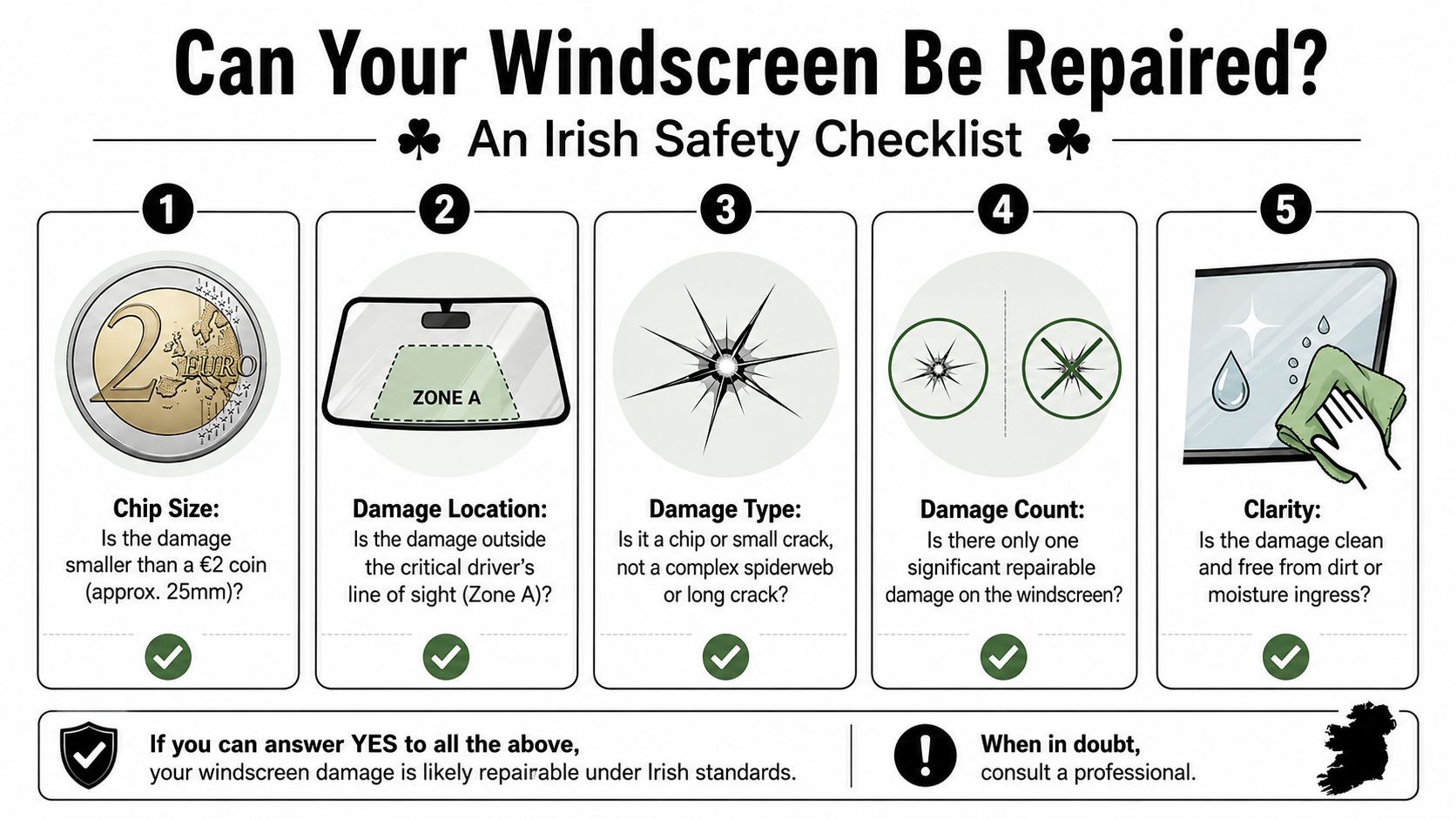
The three checks that matter first
A useful first filter is size, position, and distance from the edge, but providers can apply slightly different operational thresholds. Autoglass Ireland's repair guidance indicates that smaller chips are often repairable, while damage in the driver's critical viewing area, close to the windscreen edge, or in sensitive camera zones is much more likely to require replacement. For a driver doing a quick self-check, a €2 coin is still a practical rough guide for a small chip, but the technician's assessment and the screen's location rules matter more than coin-only comparisons.
That gives a simple first test:
- Use a €2 coin as a rough guide: If the damage clearly spreads wider than the coin, replacement becomes more likely.
- Check the driver's view: Damage in the driver's critical viewing area is treated far more strictly because even a neat repair can still leave distortion.
- Measure from the edge: Damage near the border is more likely to affect structural integrity and spread.
A visual check also helps with the damage type. A compact stone chip is one thing. A long running crack or a messy spider pattern is another. Even before a technician arrives, the shape often tells the story.
A qualified specialist can confirm whether a chip qualifies for repair or needs replacement before you book.
What usually rules a repair out
Some faults fail the test immediately. If a crack is travelling outwards, if the damage sits too close to the edge, or if the mark falls directly across the most critical viewing area, repair may no longer be the responsible recommendation.
If a technician says a chip is too close to the edge or too large for a proper resin fill, that isn't upselling by itself. It may simply be the point where the glass can no longer be restored safely.
There's also a practical issue that drivers miss. Dirt and moisture change the quality of the finish. A fresh chip is usually easier to repair neatly than one that has sat through rain, road film and repeated heating and cooling cycles in Dublin traffic.
Repair or Replace Weighing the Costs and Consequences
Once the damage has been assessed, the next choice is blunt. Either the glass can be stabilised with a proper repair, or the whole screen has to come out.
The financial gap is real. In Ireland, there is no single fixed price for windscreen replacement because cost depends on the car's make, model, year, glass specification, and whether ADAS calibration is required afterwards. Autoglass Ireland notes that replacement pricing varies by vehicle, and also highlights that ADAS windscreen calibration can be required after replacement. In practical terms, replacement is usually far more expensive than a simple chip repair, which is why repair is often the stronger option for minor damage that still meets safety criteria.
Where repair wins
Repair usually makes sense when the chip is small, outside the critical sightline limits, and caught early. It keeps the original screen in place, avoids a larger job, and is generally the cleaner answer where the damage is contained.
Replacement becomes unavoidable when the screen no longer meets the repair criteria or when the defect would leave optical distortion in an area the driver uses constantly. On many modern cars, replacement can also mean extra workshop time if related systems need attention afterwards. A driver shouldn't assume the glass swap is the end of the matter.
Windscreen Repair vs. Replacement Decision Matrix
| Factor | Repair | Replacement |
|---|---|---|
| Best for | Small chip or limited crack that meets Irish repair rules | Large damage, poor location, or failed repair criteria |
| Cost position | Usually the cheaper route for minor damage | Usually much more expensive than repair, with the final price varying by vehicle and whether ADAS calibration is needed |
| Time off the road | Often shorter and simpler | Usually a bigger booking with more moving parts |
| Original factory screen | Kept in place | Removed and substituted |
| Insurance admin | Can be straightforward, but depends on insurer workflow | Often more formal because the job is larger |
| When it shouldn't be forced | If visibility, edge integrity or size rules are breached | When a safe repair is still possible and proportionate |
A common mistake is treating replacement as the more thorough option in every case. It isn't. If a chip qualifies for repair, replacing the full windscreen can mean extra cost and more disruption without a better practical outcome.
Two Dublin-specific points. First, a mobile fitter can usually come to a home or workplace across the city, which suits a straightforward chip, while a workshop is easier when the insurer wants staged photos or a replacement looks likely. Second, if your NCT is due, a crack in the driver's line of sight can fail the test — so it is worth repairing or replacing before the appointment rather than after.
Finding a Reputable Windscreen Specialist in Dublin
Dublin drivers have no shortage of choice. The harder part is sorting convenience from competence. Windscreen work looks simple from the outside, but the difference between a tidy resin fill and a poor one is obvious the moment the sun hits the glass.
Mobile van or workshop
A mobile service suits many Dublin jobs. It works well for a chip repair at home, in a work car park, or anywhere the car can stay still long enough for the technician to do the job properly. For a straightforward repair, convenience is the obvious advantage.
A workshop can be the stronger option when the job looks borderline, when replacement is likely, or when the driver wants a fixed location for paperwork, follow-up and inspection. Workshop-based operators also tend to have fewer environmental variables to contend with than a technician working kerbside in Irish weather.
How to compare providers properly
The best questions are practical ones:
- Ask what they think the job is before arrival: A serious operator should be willing to discuss whether the damage sounds repairable or likely to need replacement.
- Ask where the work will be done: Mobile isn't automatically better. A workshop isn't automatically slower.
- Ask how reviews work: Real trade trust comes from actual customer feedback, not decorative badges.
- Ask what standards or procedures they follow: For windscreen work, the useful questions are whether the provider assesses repairs against current safety criteria, whether they handle ADAS-equipped vehicles properly, and what happens if a booked repair turns out to need replacement.
For drivers searching by area, you can post your windscreen job on ShamFix to get quotes from local Dublin auto glass technicians, or browse the windscreen repair category. Trust is built through two-sided reviews where customers and providers rate each other after completed work.
A polished website doesn't repair glass. Clear answers, consistent reviews and sensible job triage matter far more.
Navigating Irish Insurance Claims for Glass Repair
A small chip on the M50 in the morning can turn into an insurance problem by lunch. The glass is one job. Getting the claim approved is another.

Irish drivers often get caught on the same question. Ring the insurer first, or book the repairer first?
In practice, insurer first is usually the safer order. It helps avoid a row over authorisation, excess, or approved suppliers after the work is done. Allianz Ireland's windscreen guidance also frames repair as the lower-cost option where suitable, which fits that insurer-first approach before any work is authorised.
The first call should clear up four points
Before any glass work is booked, confirm:
- Does the policy cover repair, replacement, or both
- Does the insurer require an approved glass company
- Is pre-authorisation needed before the technician starts
- Does the claim need photos, app uploads, or a reference number first
That last point catches people out more often now. Some insurers want damage photos uploaded through an app or portal before they approve the job, and some want the registration, policy number, and damage images matched on the claim before a technician attends.
Mobile service is convenient. Workshop service can be easier for the claim
Drivers need to consider practicality. Mobile repair is handy if the car is at home or work and the claim has already been cleared. But if the insurer wants staged photo evidence, digital forms, or approval before glass is ordered, a workshop booking can be simpler because the paperwork and images are usually handled in one place.
That does not mean mobile service is a poor choice. It means the claim process needs to suit the service model.
Ask the repairer one plain question before you agree to anything: If my insurer wants photos or digital approval before work starts, who handles that and when?
A good operator will answer directly. They will tell you whether they bill the insurer, whether you pay first and reclaim, and whether a failed repair that turns into a replacement changes the claim.
Watch for the policy details that affect cost
Drivers tend to focus on whether glass is covered at all. The more useful question is how it is covered.
Check for:
- A separate windscreen excess
- Limits on using non-approved repairers
- Whether calibration or related glass sensors are included if replacement is needed
- Whether the claim affects no-claims bonus, if your policy wording treats glass separately
If any part of that answer is vague, ask for it by email or in the insurer's app. A written record helps if the invoice and the claim do not match later.
For drivers comparing providers beyond standard windscreen-only work, it can also help to look at local glass and mirror works services when a job involves side glass or related vehicle glass issues.
One final point. Do not assume the technician and insurer will sort everything between themselves. Sometimes they do. Sometimes the driver still has to upload photos, confirm policy details, or approve the excess before the job can go ahead. A two-minute check at the start usually saves a long afternoon on the phone later.
After the Repair What a Quality Job Looks Like
A finished repair should not leave the driver guessing. The glass won't usually return to untouched factory condition, but a competent job has clear signs.
Most small chips that meet the repair criteria can be fixed successfully, and a good repair should be smooth, clear and free of bubbles.
What to check before the technician leaves
Use a simple inspection:
- Run a fingertip across the repair: It should feel completely smooth, not raised or rough.
- Look for bubbles or cloudiness: Trapped air or debris is a bad sign, not a cosmetic quirk.
- Stand back, then step close: A faint mark up close can be acceptable. A milky or messy patch isn't.
- Ask the direct question: Has the damage been stabilised with no risk of further spreading?
If the repair looks patchy in ordinary daylight, it won't improve later.
Simple aftercare that protects the result
A repaired screen deserves a bit of care for the next day or two. Avoid harsh treatment straight away, especially high-pressure washing, and keep an eye on the area if the car is exposed to big temperature changes.
A sensible finish to any windscreen repair in Dublin is to keep the invoice, keep any claim reference, and inspect the repair again in clean daylight. If the chip turns cloudy or shows movement, raise it promptly while the job is still fresh in everyone's mind.
A final practical note: whether you choose a mobile fitter or a workshop in Dublin, confirm the insurance steps before booking and keep the invoice and any claim reference.
Are you a windscreen technician in Dublin?
Windscreen and auto glass specialists covering Dublin can create a provider profile and be among the first found as local demand grows. Listing on ShamFix is free and there's no commission; a subscription is planned for the future.