
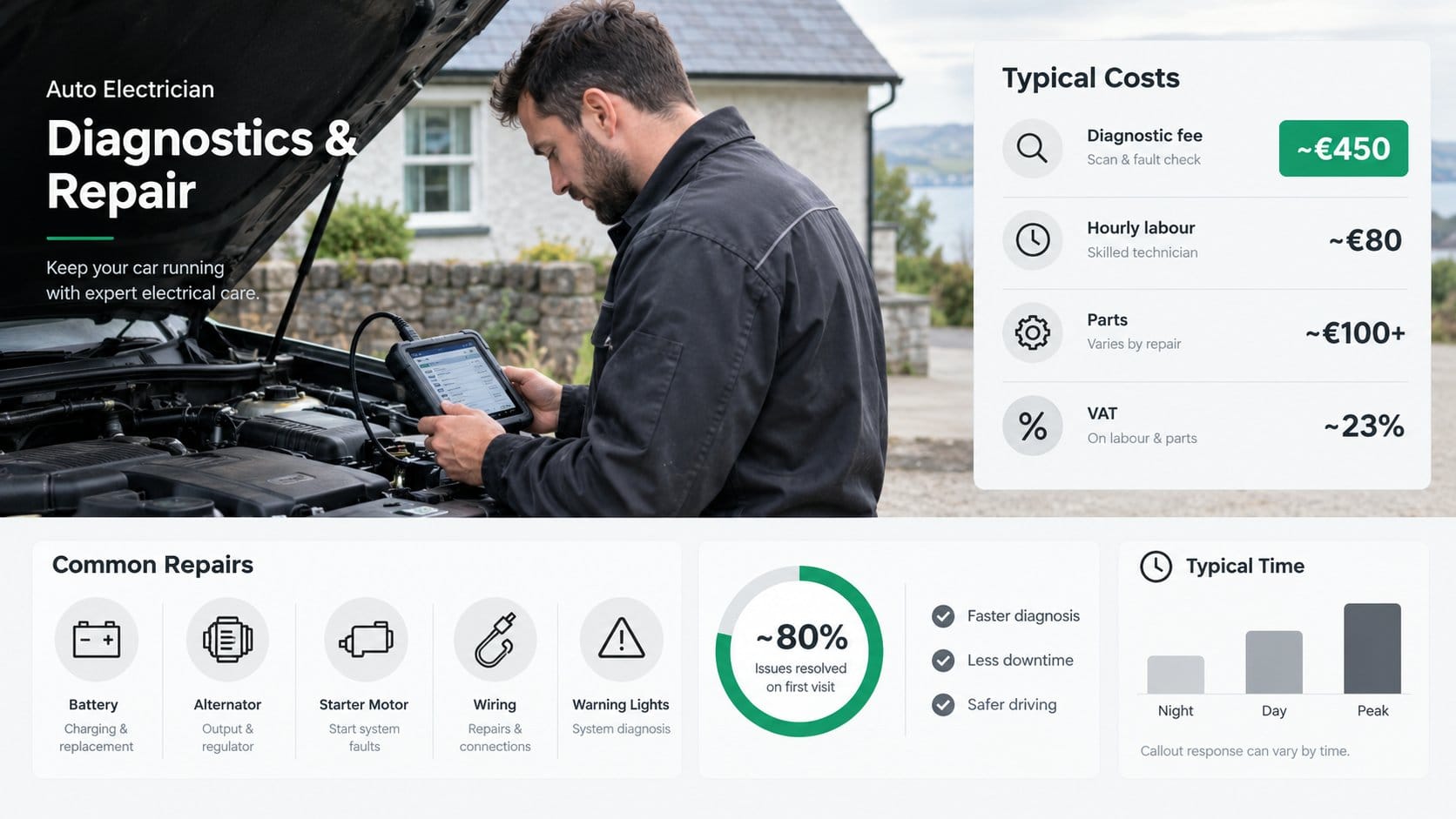
A typical auto electrician cost in Ireland starts around a €40 to €90 diagnostic or fault-find fee, with labour often priced against a professional hourly base rather than a casual repair rate. Customer labour is charged well above a technician's own wage, so the figure that matters is the charge-out hourly rate written on your quote, not published pay data - and it varies by workshop and by how hard the fault is to trace.
The moment a dashboard light stays on, many drivers face the same question, whether the fault is a battery, alternator, starter, wiring, sensor, immobiliser or central locking issue, and whether the bill is for vehicle electrics, not a domestic electrician and not a full car service.
A simple rule helps. The first cost is usually the diagnostic scan or fault trace, and that fee is often credited against the repair if the owner goes ahead. The next cost is the actual labour and parts needed to fix the fault, which is where the bill can change quickly when the problem turns out to be intermittent or buried in a loom or module.
The spending question for an Irish driver is simpler: how much the fault will cost to diagnose, repair and test properly.
Introduction What an Auto Electrician Costs in Ireland Right Now
A warning light, dead battery, stubborn central locking or a no-start fault usually sends Irish drivers looking for an auto electrician cost Ireland answer fast. The short answer is that a diagnostic or fault-find visit commonly starts around €40 to €90, and the labour side is generally priced on a specialist hourly charge-out rate rather than a flat handyman-style rate. Published wage figures are not the same as the charge-out rate a customer pays, so the number that counts is the labour rate quoted for the actual job.
That matters because vehicle electrics are not the same as domestic electrics, and they are not the same as a routine oil-and-filter service. The work can involve batteries, alternators, starter motors, sensors, wiring looms, immobilisers, lights and central locking, with the cost shaped by fault tracing and testing before any part is replaced.
Practical rule: if the car needs a quick code read, the bill should look very different from a deep trace of an intermittent wiring or module fault.
Irish drivers also get confused by quotes that mix the diagnosis, labour and parts into one number. A clear quote should show what is being charged for the scan, what is being charged for labour, and what parts are included, because a simple warning-light fault can be inexpensive while a control-module or loom issue can move the price sharply higher.
For local quoting, the fastest next step is usually to post the job and compare replies from nearby auto electricians. That keeps the decision focused on the fault, not on guesswork.
How Auto Electricians Charge Diagnostic Fees and Hourly Rates
A proper auto-electrical quote usually starts with a diagnostic fee, then moves to labour if the fault needs repair. That fee covers the first stage of finding the problem, which may be a quick code read, but it can also stretch into live-data checks, circuit testing and component tracing when the fault is intermittent or the warning light does not tell the full story. The diagnostic-first approach is why a bill can begin modestly and still rise if the technician has to spend time isolating the actual failure path.
For Irish consumers, the useful way to read the quote is simple. If the fault is obvious, the job may be priced as a fixed repair. If the fault is unclear, the garage or mobile auto electrician usually prices a diagnostic visit plus hourly labour, and the diagnostic is often credited against the repair when the owner proceeds.
What the fee usually covers
The first charge is often the scanner or fault-find time. That can be a quick OBD-II code read, or a deeper search using live data and electrical testing equipment, because the code itself does not always name the failed part. Irish retail diagnostic equipment ranges from inexpensive code readers to professional scanners that cost far more, which helps explain why advanced fault tracing is priced as specialist labour rather than a cheap add-on.
The labour side is where the hourly rate matters. In Ireland, the motor-repair labour benchmark from the CSO sits at €26.28 per hour, while industry pay snapshots for automotive electricians show different hourly figures depending on source and definition. Customers should treat those numbers as background, not as a retail invoice, because the customer rate also has to cover insurance, tools, van costs, travel, overhead and VAT where applicable. CSO labour costs in motor repair
Check the quote line by line: diagnostic, labour, parts and VAT should each be visible. If they are bundled together, the cheaper figure may be missing the real cost of the job.
VAT matters too. Revenue states that bona fide motor-vehicle repairs and related services are liable at the standard VAT rate in Ireland, so a quote should be checked to see whether VAT is already included or still to be added. Revenue motor-vehicles repairs VAT guidance
Common Auto Electrical Jobs and What They Typically Cost
Irish drivers usually ask about a narrow set of faults, and the price depends less on the part name than on how hard the fault is to find. A battery swap can be straightforward, while a warning light that keeps returning can send the technician into live data, relays, connectors, hidden corrosion and control-module checks.
Typical job ranges
| Job | Typical Total Range | What Drives Cost |
|---|---|---|
| Battery testing and fitting | €50 to €260 | Test time, battery type, access, and whether coding or reset work is needed |
| Alternator replacement | €100 to €500+ | Part price, belt access, labour time, and charging-system testing |
| Starter motor replacement | €100 to €500+ | Part cost, cramped engine-bay access, and whether the fault is truly the starter |
| Wiring or loom fault tracing | €50 to €500+ | Intermittent faults, hidden corrosion, connector repair, and tracing hours |
| Sensors and warning-light diagnostics | €50 to €90 for diagnostics, higher if parts follow | Live-data checks, scan interpretation, and whether the fault is a simple sensor or module issue |
| Immobiliser and central-locking faults | €20 to €100+ | Key-fob repair, coding, module checks, and fault location |
These ranges line up with published Irish repair examples that show how widely the bill can move, from airbag light repair from €50, immobiliser repair from €100, ECU swap from €100, and key-fob repair from €20, alongside diagnostics with live data at €50 to €90 and battery fitting at €130 to €260.
Battery jobs often look cheap until the technician finds that the battery itself isn't the issue. If the alternator isn't charging correctly, or if a parasitic drain is flattening the battery overnight, the first part of the bill may only buy the diagnosis.
Alternator and starter motor jobs are similar in one respect, parts can sometimes cost more than the time to fit them. That's why a quote should make it obvious whether the figure covers the component, the labour, or both.
Wiring and loom faults are the most unpredictable. A loose connector or corroded splice may be quick to fix, but an intermittent fault can take time because the fault has to be reproduced before it can be isolated.
How Quotes Separate Parts and Labour and Why Tracing Takes Time
A clean auto-electrical quote should separate diagnostic cost, labour, and parts. That structure matters because two jobs with the same warning light can have very different labour profiles, and because the expensive item is not always the component, sometimes it is the time spent proving which component failed.
Why tracing can overrun
Electrical faults overrun when the problem is intermittent, hidden in a loom, or caused by corrosion that only shows under load. A technician may need to test the circuit, check live data, inspect connectors and repeat the fault before any repair is safe to price.
That is where the better equipment comes in. Irish diagnostic tools range from simple OBD readers to professional scanners, so a basic code read may be quick, but a proper trace of a module or loom fault usually needs specialist kit, time and experience.
Good quoting means no surprises: if a starter or alternator is the answer, the quote should show whether the part is included. If the technician is still tracing the fault, the owner should know whether the clock is running on diagnosis or repair.
The other reason time varies is that parts can sit above labour on some jobs. A modern alternator, control module or branded sensor can carry a meaningful parts cost, so the bill is not just a labour story.
A vague total is harder to challenge and harder to compare. A proper total lets the owner see where the money is going, whether the job is a scan, a repair, a replacement or a mixture of all three.
Mobile Auto Electrician Versus Garage or Main Dealer
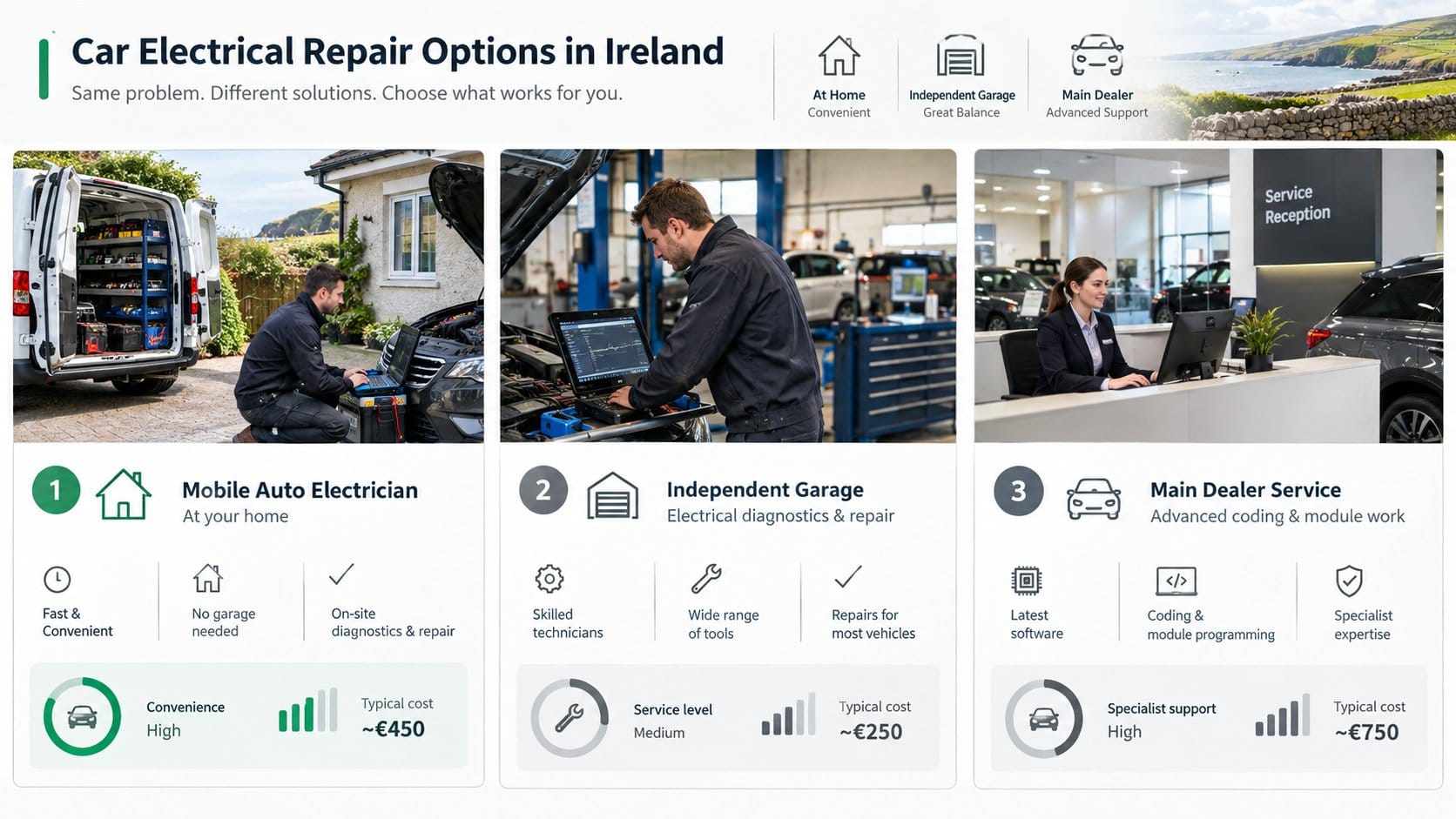
A mobile auto electrician suits jobs where call-out convenience matters. That can work well for roadside non-starts, home diagnostics and simple battery or central-locking faults, because the driver avoids towing or driving a faulty car to a workshop.
An independent garage is often better for longer tracing jobs. Workshop access helps when the technician needs ramps, better lighting, battery support equipment or a controlled place to strip trim and chase a loom.
A main dealer can make sense for complex brand-specific modules and coding. The trade-off is usually cost, because dealer diagnostics and software access tend to sit at the higher end of the market.
Matching the fault to the setting
- Mobile call-out: useful when the car won't start, the battery is dead, or the owner needs a roadside test.
- Independent workshop: useful for loom work, repeat faults, trim removal and repairs that need time on the bench.
- Main dealer: useful when the fault is brand-specific and likely to involve coding, software or dealer-only procedures.
The biggest cost trap is paying for convenience when the fault really needs workshop equipment. A mobile visit can cover the first hour and travel, but if the issue turns out to be a buried wiring fault, the car may still need to move into a workshop afterwards.
For car owners, one Irish consumer-facing comparison is to think in terms of fault type, not business type. The more complex the electronics, the more likely it is that the cheaper first visit only solves the opening stage.
If the fault is electrical rather than mechanical, the right specialist can save time by starting with the right tools and the right tests.
What to Check Before You Hire an Auto Electrician
The first question is whether the person does auto electrical work, not just general servicing. A mechanic can be excellent at brakes, tyres and routine maintenance, but an electrical fault needs fault-code interpretation, circuit testing and careful tracing.
The practical checklist
- Specialist focus: Ask whether they handle batteries, alternators, starters, wiring, sensors, immobilisers and central locking every day.
- Diagnostic equipment: Confirm they have a scanner that can read live data, not just a cheap code reader.
- Written quote: Make sure the quote lists the diagnostic fee, labour, parts and VAT separately.
- Warranty on work: Ask what is covered on the part and on the repair itself, and whether parts are new or refurbished.
- Diagnostic credit: Confirm whether the diagnostic fee is deducted if the owner approves the repair.
Auto electrical work is not a single regulated trade in Ireland in the same way some other trades are. That makes a written scope and clear customer reviews especially useful, because the paperwork is doing part of the trust work that regulation does elsewhere.
A short quote with no detail often costs more in the end. The owner should know whether the first payment buys diagnosis only, or diagnosis plus repair time.
This is also where a clear service description matters: ask what's included, check the paperwork, and don't accept a vague total when an itemised one is possible.
A final check is VAT. Revenue's motor-repair guidance confirms the standard-rated treatment, so the number on the phone is not always the number on the invoice unless VAT is clearly included. Revenue motor-vehicles repairs VAT guidance
Get Local Quotes and Next Steps for Car Owners
The simplest way to judge an Irish auto electrician quote is to test it against three things, the diagnostic fee, the hourly labour rate, and whether VAT is included. If the job is a straightforward replacement, ask what sits outside the headline price, because prep, access, scan time and parts can all move the final figure.
The same quote-reading habit helps on other electrics-related jobs too: check the labour unit, the parts, and the extras before agreeing.
For local help, find a local auto electrician and post your job for free on ShamFix — you compare replies on the same fault description rather than ringing around blind. For wider vehicle work, browse other automotive services.
Listing on ShamFix is free and there is no commission; a subscription is planned for the future. ShamFix is Ireland's free marketplace where you post a job and local specialists come to you — for auto electrics, home trades and more. ShamFix does not vet or verify providers, so customers check credentials and reviews themselves.