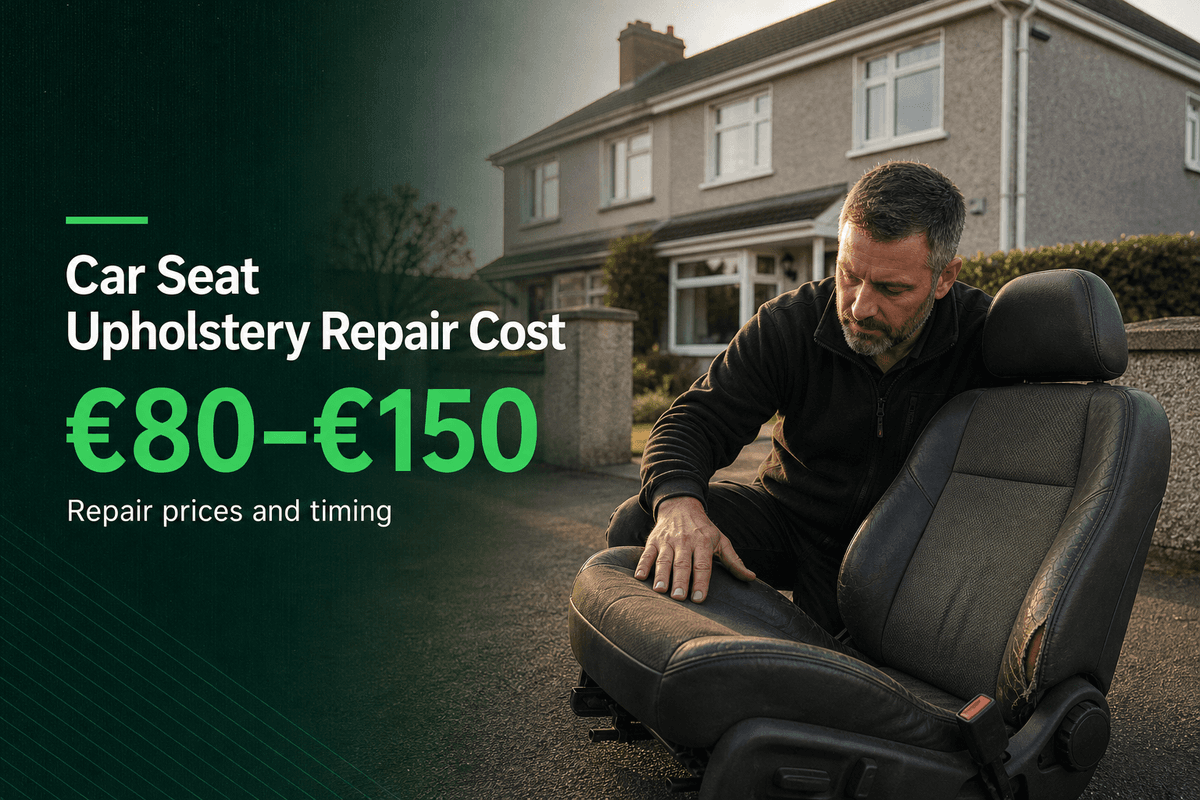
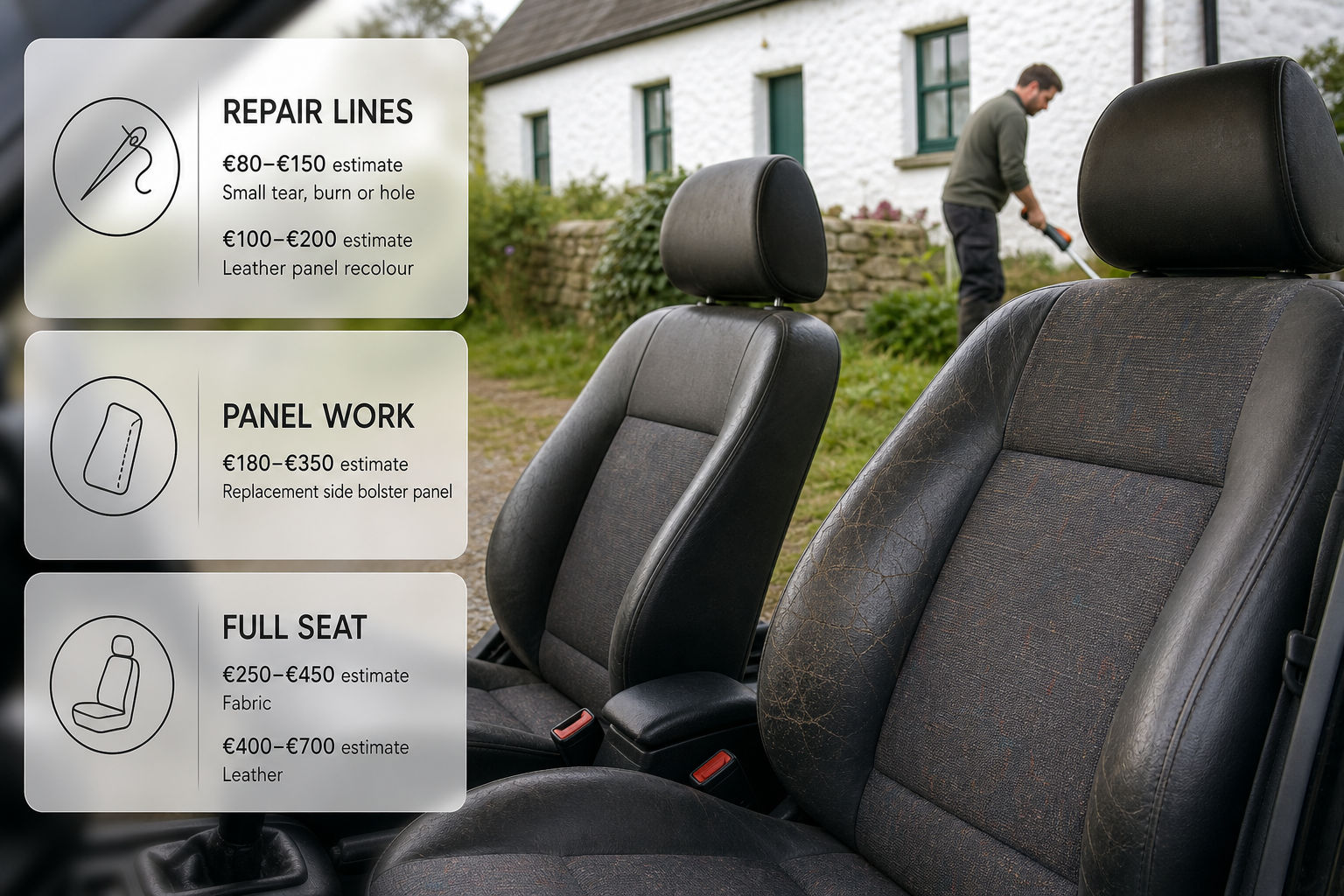
As an aggregate Irish market estimate, car seat upholstery repair in Ireland costs €80–€150 to mend a small tear, burn or hole in fabric and €400–€700 to reupholster one front seat fully in leather, VAT included. A leather panel recolour is €100–€200, a replacement leather side bolster €180–€350 and a full fabric reupholstery of one front seat €250–€450, while a mobile call-out to the driveway adds €30–€60. A driver who would rather have the seat assessed at home can post the job as car interior upholstery repair and ask for the price per seat.
Car seat upholstery repair prices
The ranges below are an aggregate Irish market estimate, VAT included, priced per seat or per panel, with the call-out the only charge added on top.
| Work | Typical price |
|---|---|
| Small tear, burn or hole repair in fabric, one seat | €80–€150 |
| Leather scuff, crack or colour-loss repair and recolour of one panel | €100–€200 |
| Replacement of a worn leather side bolster panel | €180–€350 |
| Full reupholstery of one front seat in fabric | €250–€450 |
| Full reupholstery of one front seat in leather | €400–€700 |
| Mobile call-out to the driveway | €30–€60 extra |
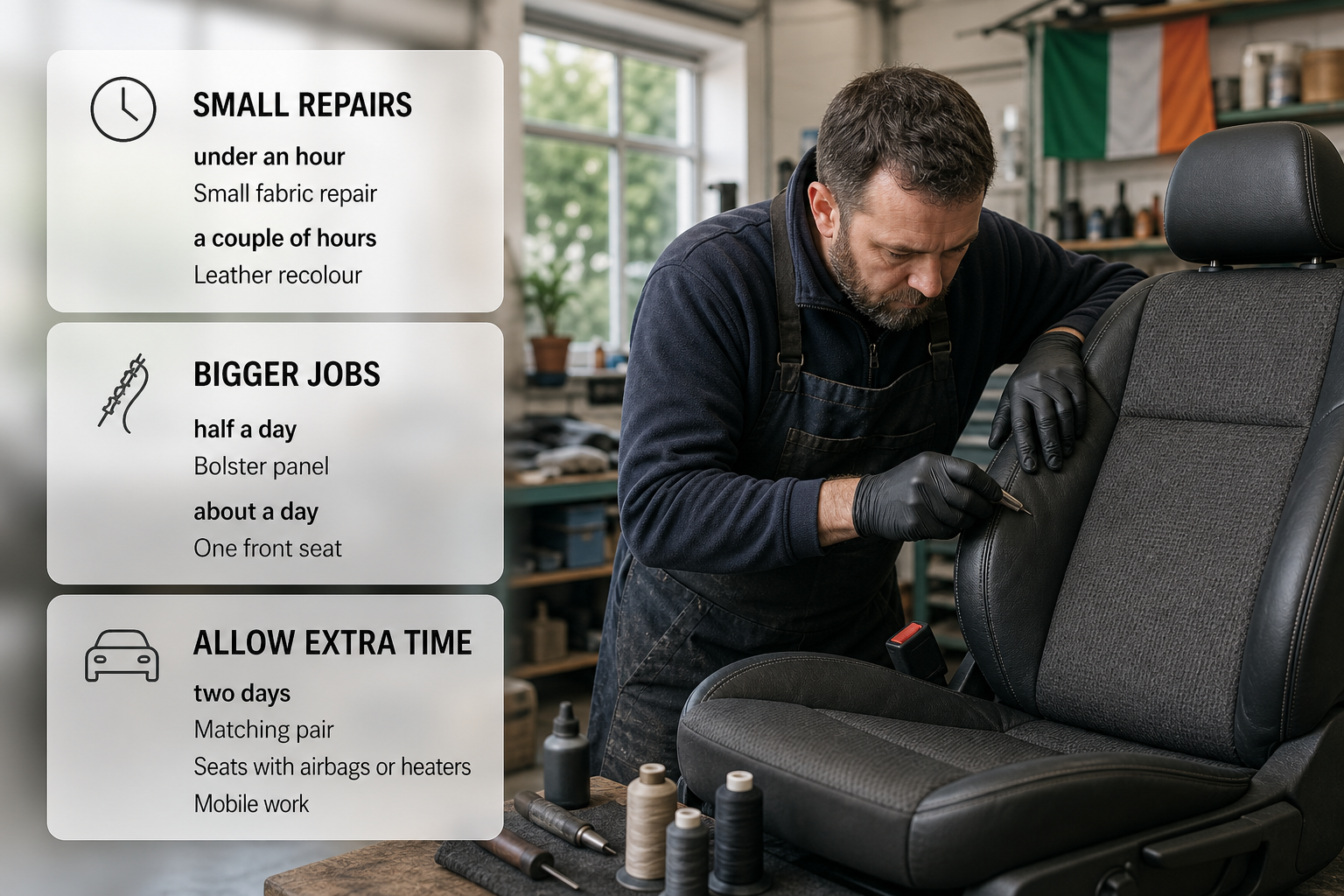
Most drivers pay for one or two lines, not the whole table. A repair line fixes the seat that is already in the car, while a reupholstery line strips the seat, fits new covers and rebuilds it, which is why the two ends of the table differ by several hundred euro. Where the damage is limited to a single panel, the bolster and recolour lines sit in between and are often the sensible middle choice.
A worked example makes this clearer. Take a driver's seat with a worn leather side bolster and a passenger seat with a cracked, faded panel: replacing the bolster costs €180–€350 and recolouring the cracked panel costs €100–€200, so the pair comes to about €280–€550, plus €30–€60 if the upholsterer travels to the house.
What moves the price
Fabric, leather or vinyl. Fabric is the quickest and least costly material to mend, because a patch can be cut from a concealed area and blended into the pattern. Leather needs cleaning, filling, dyeing and sealing, and the grain texture has to be re-stamped around the repair. Vinyl sits between the two: it takes a patch well but the finish can age differently from the surrounding material.
Size and position of the damage. A burn the size of a coin on a cushion is straightforward. A split along a seam, damage on the side bolster where the driver slides in and out, or a hole in a perforated centre panel all take longer, because the panel has to be opened up or partly remade rather than spotted in place.
Colour and texture matching. Sun-faded leather and bleached fabric are the usual reason a small repair turns into a panel job. A patch of new material will read darker than the seat around it, so the trimmer blends across the whole panel or recolours it, and the recolour line is priced per panel for that reason.
Stitching pattern. Contrast stitching, fluted panels, piping and perforation all have to be copied. Rebuilding a bolster means matching the original pattern and thread so the seat does not look half-repaired from the far side of the car.
Seats with heaters, sensors or side airbags. These take longer to strip, because the cover has to come off around wiring, heating pads and airbag modules and go back on without disturbing them. That extra labour is the main reason two apparently similar seats can quote differently.
Is the damage repairable, or does the panel need replacing?
Damage that is generally repairable: small burns and holes, scuffs, surface cracking, colour loss, seam splits on sound material and shine or wear on a bolster that has not gone through. Stains, grime and smells are a cleaning job rather than a repair, and how to clean car seats covers those.
Damage that usually means a new panel: material worn through to the foam, a bolster with a hole that keeps reopening, leather that has hardened and cracked right through, or a seam that splits again because the material on either side has thinned.
Foam or wadding that has collapsed or crumbled is replaced as part of either route and should be priced into the quote. Frame or spring damage is a different job again, and worth flagging when asking for prices.
The practical test is simple: if the material around the damage is still supple and holds a stitch, a repair will last. If it tears when pulled gently, a patch will not hold and the panel needs replacing.
Repair the panel, reupholster the seat or fit a used seat
- Repair. A fabric mend at €80–€150, a leather recolour at €100–€200 or a bolster panel at €180–€350 keeps the original trim and is the cheapest route when the rest of the seat is sound.
- Full reupholstery. At €250–€450 in fabric or €400–€700 in leather, this makes sense when two or three panels on the same seat are gone, or when the covers are finished but the frame and foam are good.
- Used replacement seat. The price varies widely by model and is not covered by the ranges above. Matching the trim level and colour is the hard part, the condition of a second-hand seat is unknown, and an older seat may simply wear in the same places.
Compare like with like. A bolster at €180–€350 against a full leather seat at €400–€700 is an easy call if the cushion and backrest are still good. If the cushion, backrest and bolster are all worn, the full reupholstery line is the better spend, because three separate panel jobs quickly approach it.
Work that runs beyond the seat itself, such as a headliner, door card or steering wheel needing the same colour treatment, can be posted together under automotive services so one trimmer can quote the whole interior in a single visit.