A standard pest control call-out for a three-bedroom home in Ireland usually falls between €80 and €250, depending on the pest and the work involved. A single wasp treatment may be one visit, while mice, rats, bed bugs and cockroaches commonly need a short treatment plan with follow-up visits.
The familiar situation is a homeowner finding droppings under the sink, hearing scratching above the ceiling, or spotting insects around a bedroom or kitchen. The first quote can look straightforward, but cost depends on whether it covers a single knockdown treatment or a programme that includes monitoring, repeat applications and proofing.
The Irish market is substantial enough to support specialist treatments, but most household work is still sold as individual call-outs or smaller programmes rather than large project contracts. IBISWorld's Ireland pest control industry data values the market at €38.0 million in 2026. That context matters because a homeowner is usually comparing the cost of a particular job, not a major facilities contract.
Homeowners can post a pest control job and get quotes from local technicians, but the written scope matters more than the first number on the page.
What Pest Control Costs in Ireland in 2026
For a standard three-bedroom home, the practical starting point is €80 to €250 for a typical call-out or treatment, with the pest, access and number of visits deciding where the quote lands. A single accessible wasp nest is near the lower end. Rodent programmes sit higher because they involve inspection, bait placement and monitoring. Specialist work for bed bugs or cockroaches can move well above the ordinary call-out range.
Irish price guides put wasp nest removal at about €80 to €120, mice or rat treatment programmes at €150 to €250, cockroach treatment at €200 to €350, and bed bug treatment at €300 to €600. These ranges come from Central Pest Control's Irish cost guide and Wicklow Pest Control's domestic pricing information.
| Service type | Typical price range | What's usually included |
|---|---|---|
| Single wasp nest treatment | €80 to €120 | Inspection and treatment of one accessible nest |
| Mice or rat programme | €150 to €250 | Initial survey, bait stations, follow-up monitoring and proofing recommendations |
| Cockroach treatment | €200 to €350 | Inspection and treatment, often with repeat visits |
| Bed bug treatment | €300 to €600 | Room-level inspection and repeated heat or chemical treatment |
| Standard domestic call-out | €80 to €250 | A one-off visit, depending on the pest and access |
A rodent programme is not the same product as a wasp call-out. Irish pricing guidance describes rodent work as commonly including an initial survey, bait station placement, two follow-up monitoring visits, written completion reporting and proofing recommendations. A wasp job often needs one technician deployment, so comparing both on a “per visit” basis can mislead.
VAT also needs checking before booking. Pest control is generally standard-rated at 23% VAT, so the customer should ask whether the advertised quote includes VAT or whether it will be added. A quote that doesn't state this clearly isn't complete.
Prices by Pest Type
The pest determines the treatment method, but the number of visits determines much of the final bill. A technician dealing with one exposed wasp nest has a very different job from one breaking a rodent or bed bug cycle across several rooms.
| Pest | Per visit or treatment | Typical total |
|---|---|---|
| Mice | Included within broader domestic ranges, commonly part of a €150 to €250 programme | €150 to €250 for a domestic programme |
| Rats | Included within broader domestic ranges, commonly part of a €150 to €250 programme | €150 to €250 for a domestic programme |
| Wasp nest or hornet nest | €80 to €120 | €80 to €120 where one accessible nest is treated |
| Ants | No reliable standalone Irish range available | Ask for a written quote stating visits and treatment scope |
| Fleas | No reliable standalone Irish range available | Ask whether repeat treatment and preparation are included |
| Bed bugs | €300 to €600 | €300 to €600, depending on rooms, method and follow-up |
| Cockroaches | €200 to €350 | €200 to €350, often involving repeat treatment |
The mice and rat figures are programme prices rather than a promise of a single visit. Central Pest Control's Ireland pricing guide highlights the overlooked issue: the quote needs to say whether it includes repeat visits, proofing and follow-up. A cheap first attendance can become poor value if the technician leaves after baiting and charges separately for every return.
Wasp and hornet work is usually more limited when the nest is visible and accessible. Height, roof access, wall cavities and awkward positioning can change the price, even though the pest itself hasn't changed. The headline range therefore applies to a straightforward nest, not every nest found in an Irish home.
Bed bug work is at the expensive end because the technician must inspect rooms carefully and address hiding places, eggs and surviving insects. Irish guides place bed bug treatment at €300 to €600, several times the cost of a basic wasp nest removal, as recorded by Central Pest Control. Cockroach treatment is also labour-heavy, with Irish guidance placing it at €200 to €350 because repeat treatment and detailed inspection are common.
There isn't a reliable standalone Irish figure for ants or fleas, so ask for a written quote rather than relying on a generic table entry. For fleas, the homeowner should ask whether treatment includes the rooms, soft furnishings and any required repeat visit. For ants, the important question is whether the technician is treating a visible trail or locating the colony and entry route.
What Changes the Price on the Day
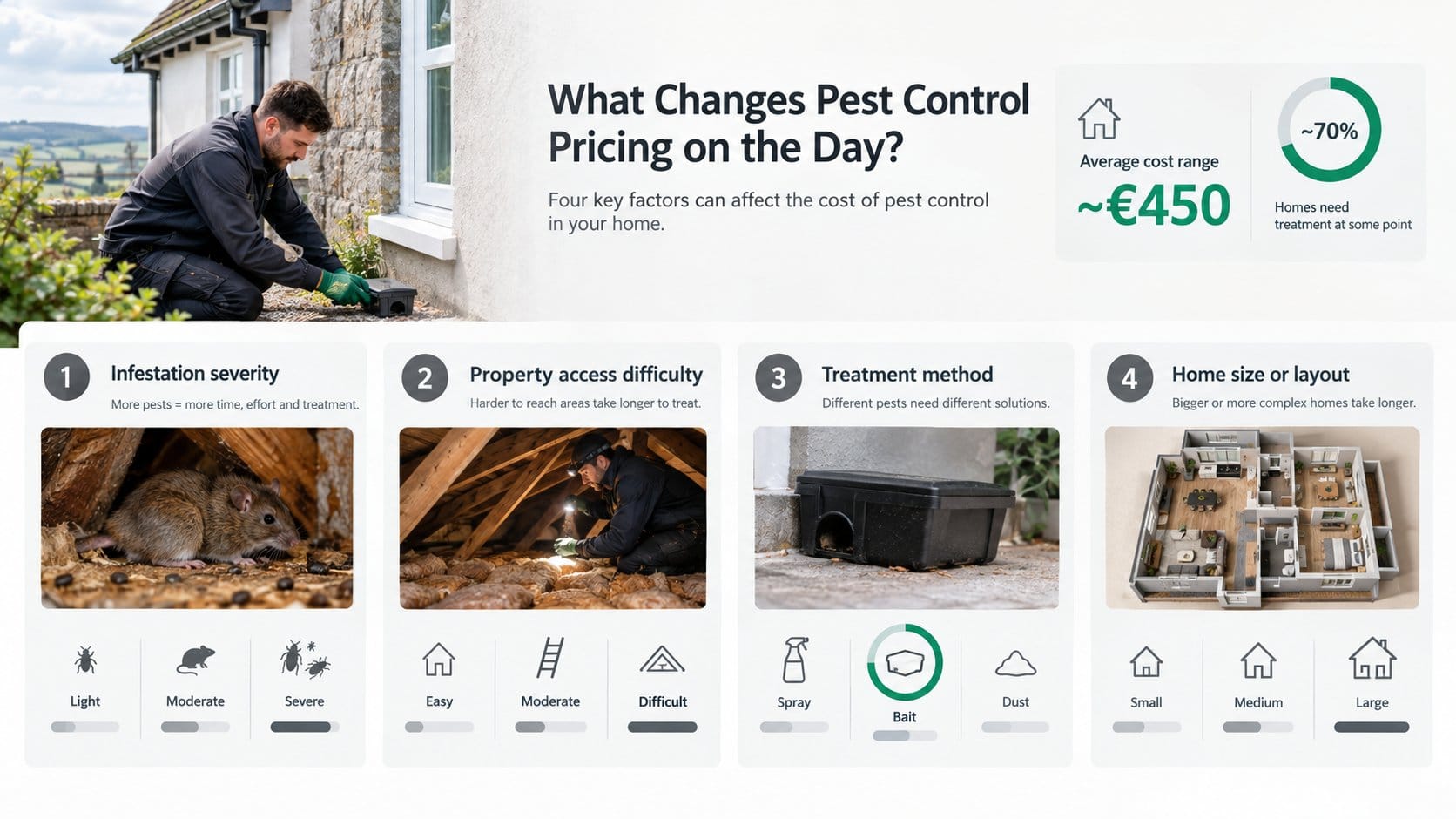
Two homes can report the same pest and still receive very different quotes. The difference usually comes from severity, access, treatment method, property layout and what the headline price excludes, not from arbitrary pricing.
The main cost levers
Severity comes first. One mouse sighting in a kitchen is a smaller investigation than droppings in the attic, sub-floor and garage. A larger infestation needs more bait points, more monitoring and more time before the technician can close the job.
Access can change the labour. A nest beside a ground-floor door is easier to reach than one inside a roof space or wall cavity. Rats entering through drains or gaps beneath floors can require inspection and proofing that isn't part of a basic treatment.
Treatment method matters. A technician may use targeted spray, gel bait, tamper-resistant bait stations or another professional product, depending on the pest and location. Bed bug work can involve heat or chemical protocols, while rodent work commonly depends on controlled baiting, monitoring and entry-point recommendations. The method affects preparation, labour and return visits.
Property size and layout affect coverage. An apartment, terrace, semi-detached house and detached property present different inspection routes. Attics, wall cavities, sheds, garages and multiple food-preparation areas add places that need checking.
A useful way to understand other home-service pricing is to compare how providers separate labour, preparation and follow-up costs before booking.
What may sit outside the quote
The written estimate should identify whether it includes:
- The call-out: Travel, inspection and the first treatment may be separate charges.
- Return visits: Monitoring, repeat baiting or another application may cost extra.
- Proofing: Mesh, sealing and exclusion work can be additional.
- Access work: Difficult roof or cavity access may need extra labour or equipment.
- Urgency: Evening, weekend and same-day attendance can attract a premium.
Irish commercial pricing demonstrates the same principle at a larger scale. Wicklow Pest Control's commercial guide shows that premises risk, visit frequency and documentation can matter more than pest species alone. A domestic customer should apply the same logic, and compare the full programme rather than a low opening fee.
How to Compare Two Pest Control Quotes
The better quote is the one that makes the end point clear. Before booking, the homeowner should be able to see the pest identified, the treatment proposed, the number of visits and the conditions attached to any guarantee.
Four questions for every quotation
Is the call-out the first treatment or inspection only? A call-out fee may cover attendance and assessment, with treatment charged separately. The quote should state the total for the first visit.
How many treatments are included? A single visit and a two or three-visit programme aren't comparable services. Rodent and bed bug work especially needs clarity on follow-up attendance.
What does the guarantee cover? A guarantee may cover a return visit, a particular pest or a defined treatment area. It may not cover a new infestation, untreated adjoining areas or conditions the homeowner hasn't corrected.
Is proofing included? Sealing gaps, fitting mesh and dealing with entry routes can be the work that prevents recurrence. If proofing is excluded, the quote should say so and give a separate price where possible.
A simple example shows why the lower headline can lose. Quote A might be €40 cheaper but exclude proofing and the second visit, while Quote B includes both and offers a six-month guarantee. The figures in that example are for comparison only, not a market rate, and the sensible choice depends on the actual written scope.
The homeowner should also request the product or treatment type, the required re-entry period and safety instructions around children, pets and food. A written summary by email protects both sides from a verbal promise being remembered differently later.
The same discipline applies when arranging other home work. A homeowner arranging any home work should also ask for a written scope, exclusions and payment terms. Pest control deserves the same care, particularly where chemicals or rodenticides are involved.
Practical rule: Compare the price of achieving control, not the price of getting someone through the front door.
Keeping the Total Spend Under Control
The cheapest first visit isn't automatically the cheapest job. Early action, a defined treatment plan and sensible proofing usually give the homeowner better control over the final spend than repeated one-off call-outs.
A homeowner should ask for a fixed-price plan where the pest and property make that realistic. The plan should name the included visits, what happens if activity continues, and whether a return visit is covered by a guarantee. That removes the uncertainty of open-ended attendance charges.
Proofing also deserves serious consideration. Sealing entry points, improving door or pipe penetrations and addressing gaps around roof or wall access can cost more at the start, but treatment alone can't stop pests using the same route again. The right proofing depends on the inspection, so it should be itemised rather than bundled into a vague “prevention” line.
Practical budgeting choices
- Act when signs first appear: A small problem is generally easier to inspect and contain than an established infestation.
- Buy the programme when repeat visits are likely: Rodents and bed bugs are poor candidates for a spray-and-go approach.
- Request the guarantee in writing: The customer should know whether a return visit is included and what conditions apply.
- Combine related work where appropriate: If one property has more than one pest issue, the quote can state whether inspection or access overlaps.
- Keep the receipt and report: Landlords and tenants may need a record of the treatment, products and completion status.
A local contractor marketplace can be one route to comparing written scopes. Homeowners comparing tradespeople should still check each quote directly, because marketplace matching routes an enquiry and isn't a quality guarantee.
The useful figure isn't the cheapest visit. It's the total cost of getting the property pest-free and keeping it that way.
Key Takeaways Before You Book
A good pest control booking starts with identification, not panic. The technician should know whether the issue is mice, rats, wasps, hornets, ants, fleas, bed bugs or cockroaches, because each pest calls for a different treatment and follow-up approach.
The booking checklist is short:
- Confirm the pest: Share photographs and signs, but ask the technician to confirm the identification on inspection.
- Get the scope in writing: The quote should state the treatment, number of visits and total price.
- Ask about the guarantee: Find out what a return visit covers and what would end that cover.
- Itemise proofing: Entry-point sealing and exclusion work shouldn't hide inside an unclear allowance.
- Check safe product use: Ask whether the technician is trained to use professional products safely and what precautions apply around children, pets and food.
- Keep the paperwork: Retain the receipt, treatment summary and any completion report for a landlord or rental record.
The homeowner should also check that the operator carries appropriate insurance and understands safe handling of professional biocides and rodenticides. The technician remains responsible for explaining preparation, ventilation, re-entry and food-storage requirements before treatment begins.
The cheapest number is rarely the best number when it excludes the visit that finishes the job or the proofing that prevents its return.
Are You a Pest Control Technician in Ireland
Pest control technicians compete on price, but homeowners increasingly need something more useful than a low headline figure. A clear quote that separates inspection, treatment, follow-up visits, proofing and guarantee terms gives customers a fair basis for comparison.
ShamFix connects pest control businesses with homeowners looking for treatment in the Republic of Ireland. Listing on ShamFix is free and there's no commission; a subscription is planned for the future. ShamFix doesn't vet or verify providers, so homeowners check credentials, insurance and reviews themselves.
Businesses can list their pest control service on ShamFix. Applications should include relevant Republic of Ireland registration details where applicable, public liability cover and a sample multi-visit treatment plan that shows exactly what customers receive.
Homeowners can use ShamFix to post a pest control task and invite local businesses to quote against the same written requirements. Ask each technician to separate the first visit, follow-ups, proofing, VAT and guarantee before choosing the quote.