Packing for a House Move in Ireland: A Complete Guide
Start packing weeks ahead: sort room by room, pack rarely used items first and keep medicines, documents and valuables out of the moving van.
/10 min read
Packing for a house move in Ireland goes best when it starts weeks before moving day, begins with the rooms and belongings that are rarely used, and ends with a clearly marked essentials box that travels with the household rather than in the van. The basic kit is a set of sturdy boxes in small, medium and large sizes, packing paper, bubble wrap, tape, marker pens and labels, mattress bags, stretch wrap, zip bags for screws and fittings, and a notebook or phone note that doubles as an inventory. The safest order is rarely used rooms first, heavy items in small boxes, fragile items wrapped and boxed as the household works through each room, and everyday kitchen and bathroom items left until the final days.
When Packing Should Start and What Supplies Are Needed
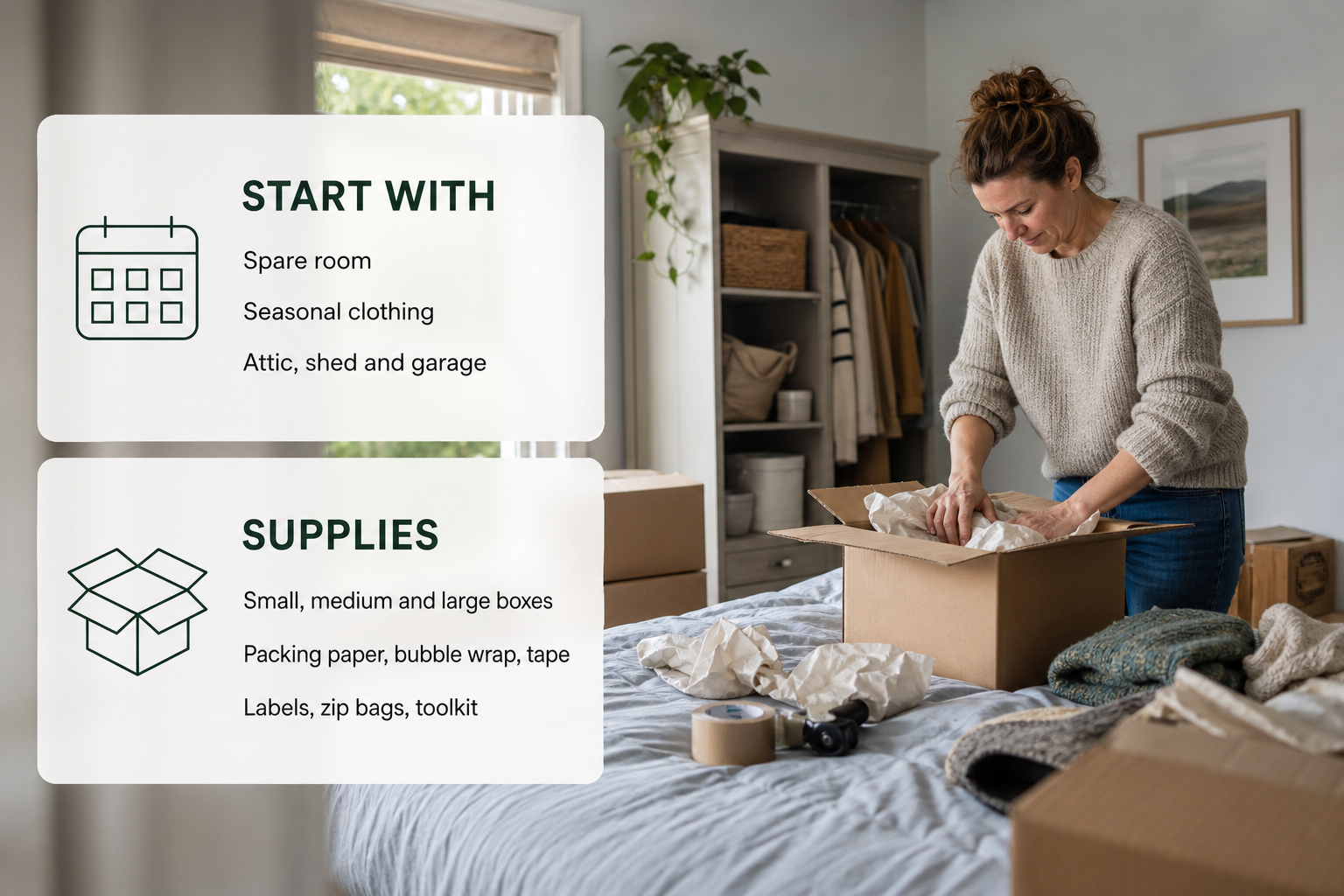
Timing is worked backwards from the move date and from whatever deadline sits behind it — the end of a tenancy, the closing of a sale or the handover of keys. The first boxes are filled well in advance: spare room contents, seasonal clothing, books, decorative items, out-of-season sports gear, and the contents of the attic, shed and garage. Kitchens, bathrooms and everyday clothing follow, and the last day is kept for bedding, toiletries and the essentials box.
Small, double-walled boxes for books, tins, tools and anything heavy
Medium boxes for general room contents
Large, light boxes for bedding and cushions
Packing paper, tissue and bubble wrap
Tape, a tape dispenser, marker pens and labels
Stretch wrap, mattress bags and furniture covers
Zip bags and elastic bands for screws, bolts and small parts
A small toolkit for dismantling flat-pack furniture
A notebook or phone note for the inventory and for photographs of cable connections
Two boxes of the same size do not weigh the same once filled, so books, tins and tools belong in the small ones. Where heavy furniture, appliances or a full load also need to travel, local house moving services can be arranged through ShamFix.
Decluttering Before Packing
Decluttering is done room by room, and each room is finished before the next is started. Everything is sorted into keep, donate, sell, recycle and dispose, and only the keep pile is packed. Charity shops take clean clothing, books and small household items, while neighbours and family often take furniture that is still usable. Items that cannot be rehomed — broken furniture, worn mattresses, old electrical goods, leftover paint and garden chemicals — go to a civic amenity site or through an authorised waste collector, and the local authority or the waste provider confirms what is accepted locally.
The attic, shed and garage are cleared first because they are the most forgotten and the dustiest, and food cupboards, the fridge and the freezer are worked down in the weeks before the move. Decluttering early cuts both the number of boxes and the weight carried.
Room-by-Room Packing Order and Tips
Packing moves from the least used room to the most used, and each room is packed completely — cupboards, drawers and shelves first, then furniture.
Kitchen: packed last, opened first. Plates are wrapped and stood on edge rather than laid flat, glasses stand upright with paper inside and around them, and bowls are nested with paper between. Cutlery is bundled and taped, tins go into small boxes, and liquids travel upright inside zip bags. The fridge and freezer are emptied, defrosted and cleaned, and a working set of plates, mugs, one pot and a knife is kept out until the last morning.
Bedrooms: clothing goes into suitcases and holdalls rather than boxes. Bed frames are dismantled and the bolts taped to the frame they belong to.
Bathroom: half-empty bottles leak, so they are sealed in zip bags and packed on the final morning with towels and toiletries.
Living room: screens, routers and consoles are photographed from behind before any cable is unplugged, and each cable is coiled, labelled and bagged with its device.
Attic, shed and garage: tools are packed blade-down in small boxes, and fuel, paint and garden chemicals are not boxed at all. Where furniture, appliances or the whole load also need to travel, moving and transport services can be sourced through ShamFix.
Labelling Boxes
Every box is labelled on the top and on one long side, so the label can be read whether the box is stacked or carried. Each label carries the destination room, a short contents note and any handling instruction — fragile, this way up, heavy, do not stack. Boxes are numbered, and a matching list is kept in the essentials box or on a phone, noting what is inside each number and which room it came from.
General labels such as misc defeat the purpose, whereas kitchen — baking tins or spare room — winter bedding means the right box can be found without opening five others. Flat-pack furniture is labelled by item with the fittings bagged and taped to it, and the essentials box is marked load last, unload first.
Packing Fragile Items Safely
Fragile items are wrapped one at a time in two or three sheets of packing paper, taped so the paper cannot slip, and packed so that nothing touches anything bare. A layer of crumpled paper goes into the bottom of a double-walled box, plates are stood on edge like records with crumpled paper between them, glasses stand upright with paper inside and outside, and the gaps are filled with crumpled paper, bubble wrap or soft towels. The box is filled to the top so nothing can shift, topped with a thicker layer of paper, and sealed with tape along the centre seam and down the sides.
The lid should close flat, because an overfilled box bulges and the contents move. Very fragile pieces go box within box with padding between the two, and heavy fragile items go in small boxes. Mirrors and pictures are wrapped in cardboard or a mirror box and carried upright, never laid flat, and the most breakable items are best carried by the household rather than loaded into the van.
What Should Never Go in a Moving Box
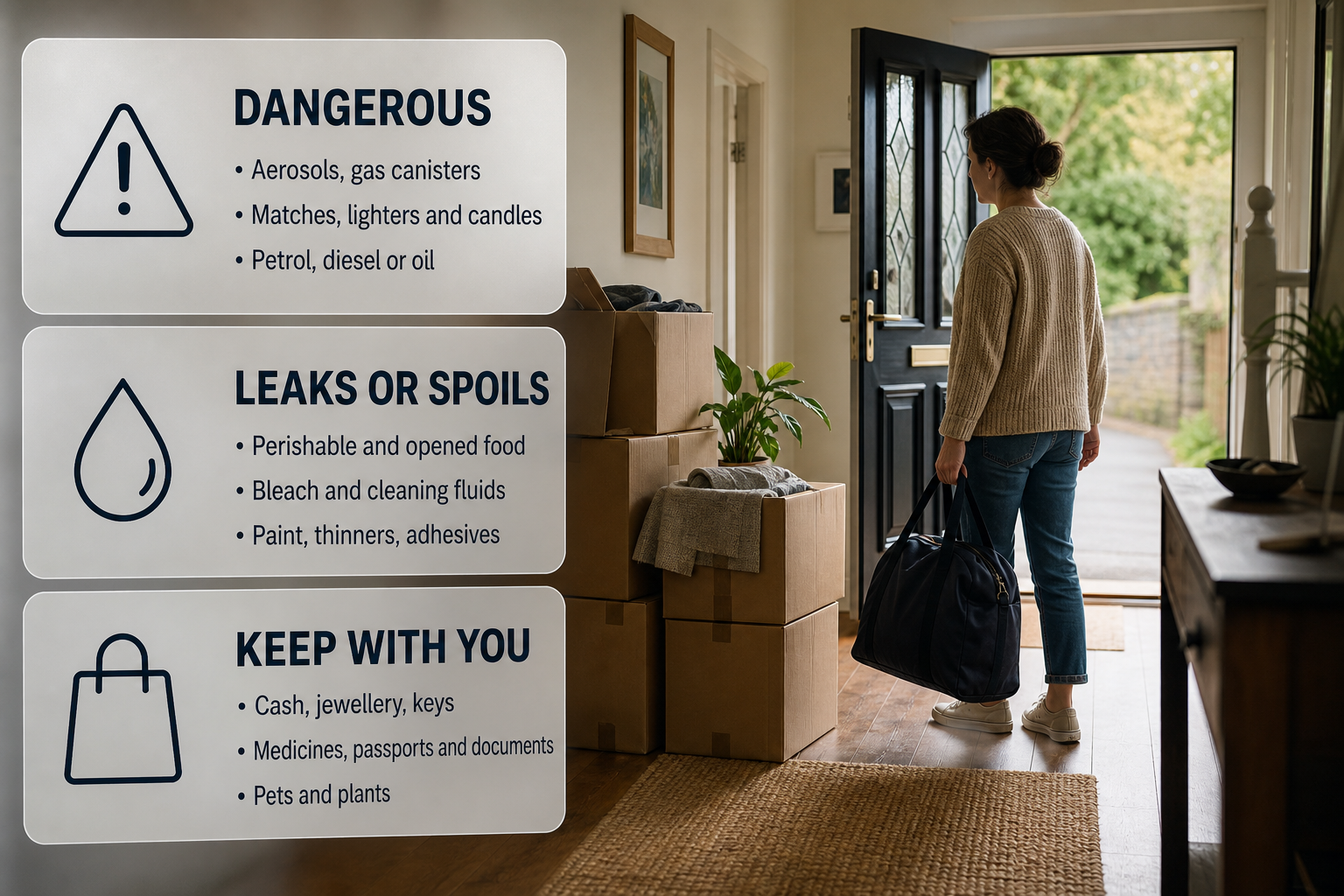
Some items should never be boxed at all, because they are dangerous in a closed van, because they leak, or because they are irreplaceable.
Perishable and opened food, and anything from the fridge or freezer that will not survive the journey
Liquids that spill: bleach and cleaning fluids, paint, thinners, adhesives, weedkiller and motor oil
Aerosols, gas canisters, camping gas, matches, lighters and candles
Loose batteries, power banks and car batteries, which are a fire risk in a warm van
Petrol, diesel or oil, since equipment such as a lawnmower is drained before it travels
Plants, which do poorly in a dark van, and pets, which travel with the household
Damp laundry, which turns musty in a sealed box
The household's own cash, jewellery, keys, medicines, passports and documents
Anything the household would not want to lose goes with the people rather than with the boxes. Removal crews can refuse to load fuel, gas or leaking containers, so these are dealt with before moving day rather than on it.
Medicines, Documents and Valuables
Medicines travel in their original packaging with the pharmacy label intact, and a written list of medicines and doses goes with them. Regular medicines are kept in a cool bag on hot days and stay in the household's own bag rather than being packed in the van, where a box can sit overnight in a very cold or very warm space. A pharmacist can advise on safe disposal of medicines that are not travelling.
Documents are gathered into one folder before the boxes come out: passports, birth and marriage certificates, PPS and social welfare papers, insurance policies, mortgage or tenancy agreements, wills, deeds, and medical, school and vaccination records. The folder travels in the car or in a bag that stays with the household.
Valuables follow the same rule: jewellery, watches, small electronics, bank cards, spare keys and hard drives in one bag that never goes in the van and is never left unattended while a load is being carried out.
The Essentials Box
One clearly marked box covers the first night and the following morning. It holds a change of clothes for each person, toiletries and towels, bed linen for the first night, phone chargers, the kettle with mugs, tea, coffee and long-life milk, snacks, toilet roll, bin bags, cleaning cloths, a small toolkit with a screwdriver, hammer, scissors and tape, a torch, first-aid items, any regular medicine, baby or child supplies, pet food and a lead, and the printed inventory.
The box is loaded last so that it comes off first, or carried in the car. It is worth packing as though the first night will be spent in the new house with nothing else unpacked, because that is usually how the evening goes.
Renters, Homeowners and Insurance Before the Move
Renters pack around a landlord's fixtures. Everything supplied by the landlord stays where it is and is not boxed, the tenancy agreement and inventory are checked before packing begins, and the property is photographed room by room before the last items leave. Cleaning materials and a few tools are kept out until the end, since the property usually has to be left clean.
Homeowners tend to face heavier, longer-term loads: attic, shed and garage contents, garden tools, DIY materials and long-kept furniture. Items that stay with the house — built-in appliances, curtains, spare keys and alarm codes — are marked and kept in one place so that they are not loaded by mistake.
Before moving day, the household checks with its home or contents insurance provider whether cover follows the contents during the move and at the new address, and how long any overlap between the two addresses lasts. Where a removal company is used, it is worth asking what goods-in-transit cover it holds and what its liability limits are, and getting the answers in writing. Renters check whether their contents policy is tied to the old tenancy, since cover at the new address is not automatic.
Post redirection, utilities, broadband and the other admin around the move are covered step by step in the moving day checklist.
ShamFix is a free Irish marketplace where homeowners post a job and local tradespeople respond; posting a job and listing on ShamFix is free and there is no commission, and a subscription is planned for the future. ShamFix does not check or certify tradespeople and profiles are filled in by tradespeople themselves, so homeowners should check registrations themselves and read reviews before agreeing to work. Packing help, loading, van transport or a full house move can be posted on ShamFix.
FAQ
Should the kitchen be packed first or last?
The kitchen is packed last, but not all at once. Baking tins, serving dishes and the contents of the top cupboards can be boxed weeks in advance, while a small working set of plates, mugs, cutlery, one pot and the kettle stays out until the final morning. Packing the whole kitchen early makes the last few days at the old address unnecessarily difficult, and unpacking the kitchen first settles a household into the new one faster.
How are mattresses, mirrors and artwork moved safely?
A mattress is slipped into a mattress bag or wrapped in heavy polythene and carried flat, never folded or bent, since bending damages both springs and cover. Mirrors and framed artwork are wrapped in cardboard or a mirror box, taped across the glass for support and carried upright, because laying a mirror flat puts the entire weight of the frame on the glass. Neither should sit under other boxes in the van.
Can plants and pets travel in the moving van?
No. Pets travel with the household in the car, with water, a lead and a familiar blanket, and are never left in a parked vehicle. House plants are moved in the car footwell or on the back seat, watered the day before rather than on the morning, and the pot wrapped for protection, since a dark and unventilated van overnight will damage most of them.
What happens to leftover paint, fuel and garden chemicals?
These are not packed, and they are never poured down a drain, into a gutter or into the general bin. They are kept upright in their original labelled containers and brought to a civic amenity site or handed to an authorised waste collector, with the local authority or the waste provider confirming what is accepted locally.