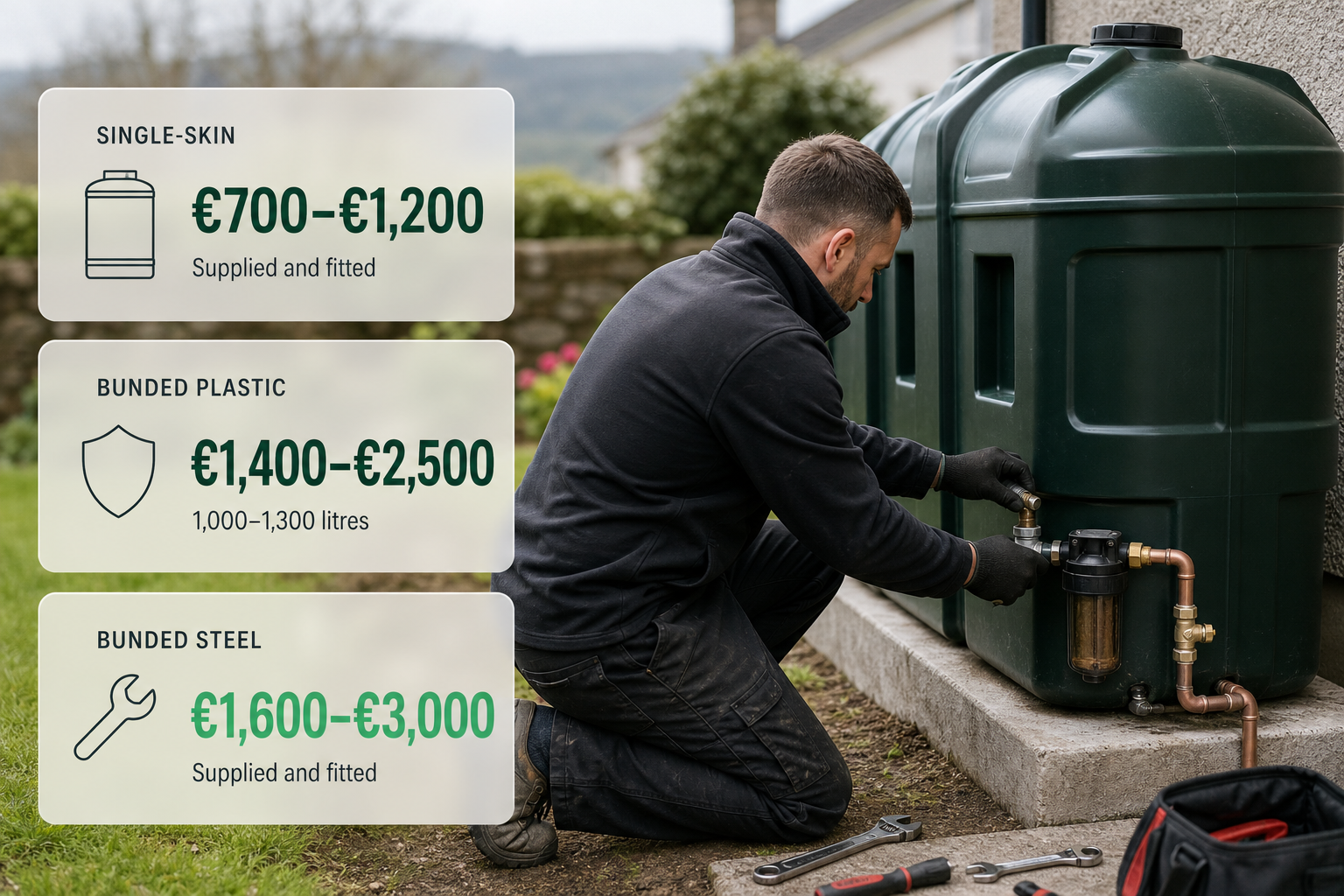
Replacing a home heating oil tank in Ireland usually costs €1,400 to €2,500 for a new bunded plastic tank of around 1,000 to 1,300 litres, supplied and fitted, as an aggregate Irish market estimate including VAT. A bunded steel tank usually costs €1,600 to €3,000 fitted, while a basic single-skin plastic tank can cost €700 to €1,200. Removing and disposing of the old tank usually adds €150 to €400, and a new concrete base €200 to €500 where needed. A leaking or damaged tank should be dealt with quickly, because oil spills are expensive to clean up and homeowners are responsible for storing oil safely. Homeowners who need a tank replaced can post the job under oil boiler servicing and compare quotes from local heating engineers.
Oil tank replacement prices at a glance
The figures below are an aggregate Irish market estimate, VAT included, for a typical domestic tank.
| Job | Typical price |
|---|---|
| Single-skin plastic tank, 1,000–1,300 litres, supplied and fitted | €700–€1,200 |
| Bunded plastic tank, 1,000–1,300 litres, supplied and fitted | €1,400–€2,500 |
| Bunded steel tank, supplied and fitted | €1,600–€3,000 |
| Larger bunded tank, 2,000–2,500 litres, supplied and fitted | €2,200–€3,500 |
| Removing and disposing of the old tank | €150–€400 |
| Pumping out old oil or sludge | €150–€300 |
| New concrete base or plinth | €200–€500 |
| New pipework, filter and fire valve | €100–€300 |
| Moving oil from the old tank to the new one | Often included, or €100–€200 |
| Oil level monitor or leak alarm, fitted | €100–€250 |
Prices are higher where the tank is hard to reach, sits in a different position from the old one, or needs new underground pipework to the boiler. A tank replacement is often done together with a boiler service or a new filter, which can save a second call-out.
A worked example: the 20-year-old single-skin plastic tank behind a bungalow in Roscommon has faded, brittle patches and a small damp patch underneath. A heating engineer pumps out the remaining oil, removes and disposes of the old tank, lays a new concrete base and fits a 1,200-litre bunded plastic tank with a new filter and fire valve, then transfers the usable oil. The total comes to roughly €1,900 to €3,700. If the tank had leaked badly into the ground, the clean-up could have cost far more than the new tank.
Signs an oil tank needs replacing
According to Clare County Council, homeowners have a legal responsibility under environmental legislation to make sure oil is stored safely and securely. Its checklist includes looking for:
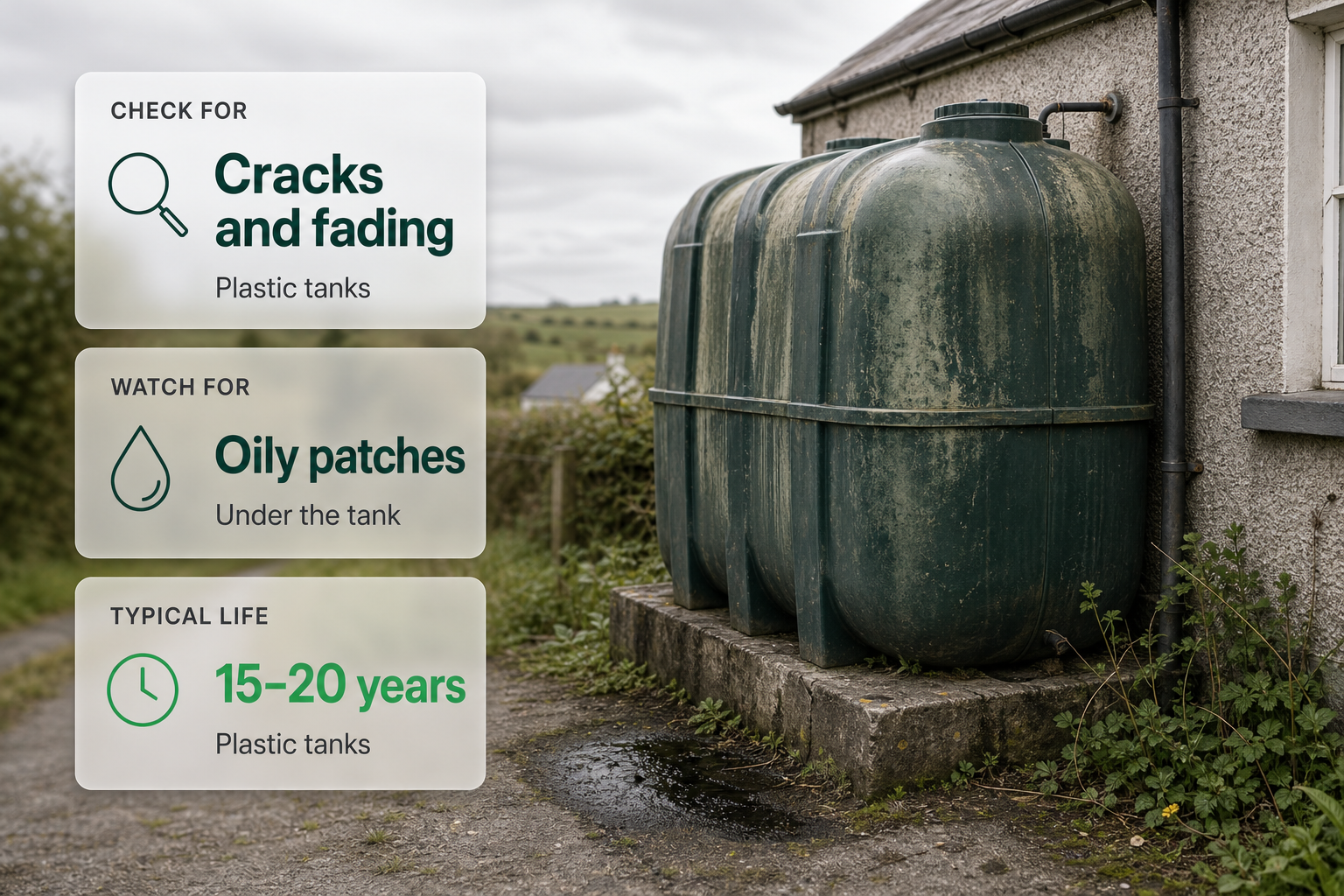
- splits, cracks or sun-bleached patches on plastic tanks;
- rust patches on metal tanks;
- damp or oily patches underneath the tank;
- a strong smell of oil;
- small, irregular drips from the tank or pipework.
Other common reasons to replace a tank include bulges or warping, a tank that is unstable or sitting on a cracked base, and a single-skin tank near a drain, ditch or stream, where a leak would be hard to contain. Plastic tanks often last around 15 to 20 years, but sunlight, frost and poor bases can shorten that.
Bunded or single-skin tank?
- Single-skin tank. One wall only. Cheaper, but if it splits, the oil goes straight onto the ground.
- Bunded tank. A tank inside a second tank, which catches oil if the inner tank leaks. Clare County Council suggests considering a bunded tank and a leak detection alarm. Most installers now recommend bunded tanks for homes, and some insurers prefer them.
- Plastic or steel. Plastic tanks are lighter, cheaper and do not rust. Steel tanks are stronger and can be repaired, but need painting and checks for rust.
Where the tank can go
The siting of oil storage tanks is covered by the Building Regulations guidance Technical Guidance Document J, which deals with heat producing appliances and their fuel. An installer should follow it on distances from the house, boundaries and openings, and on fire protection. In practice, a good installation also:
- sits on a level, solid base that supports the whole tank, as Clare County Council recommends;
- is easy for the oil delivery driver to reach;
- keeps the tank away from drains, ditches and streams;
- protects underground pipework and records where it runs.
Moving a tank to a new position costs more than a like-for-like swap, because of the new base and longer pipe runs.