
Finding a hidden water leak in Ireland usually costs €100 to €200 for a plumber's call-out and basic investigation, and €250 to €500 for a specialist leak detection survey using thermal imaging, acoustic equipment or pressure testing, as an aggregate Irish market estimate including VAT. Tracing a leak in underfloor heating or under a concrete floor with tracer gas usually costs €350 to €700. The repair and making good are extra, from about €150 for a simple pipe joint to €1,500 or more where a floor has to be opened. A leak on the external supply pipe between the property boundary and the house may be investigated and repaired for free under Uisce Éireann's First Fix Free scheme. Homeowners who suspect a leak can post the job under plumbing and compare quotes from local plumbers.
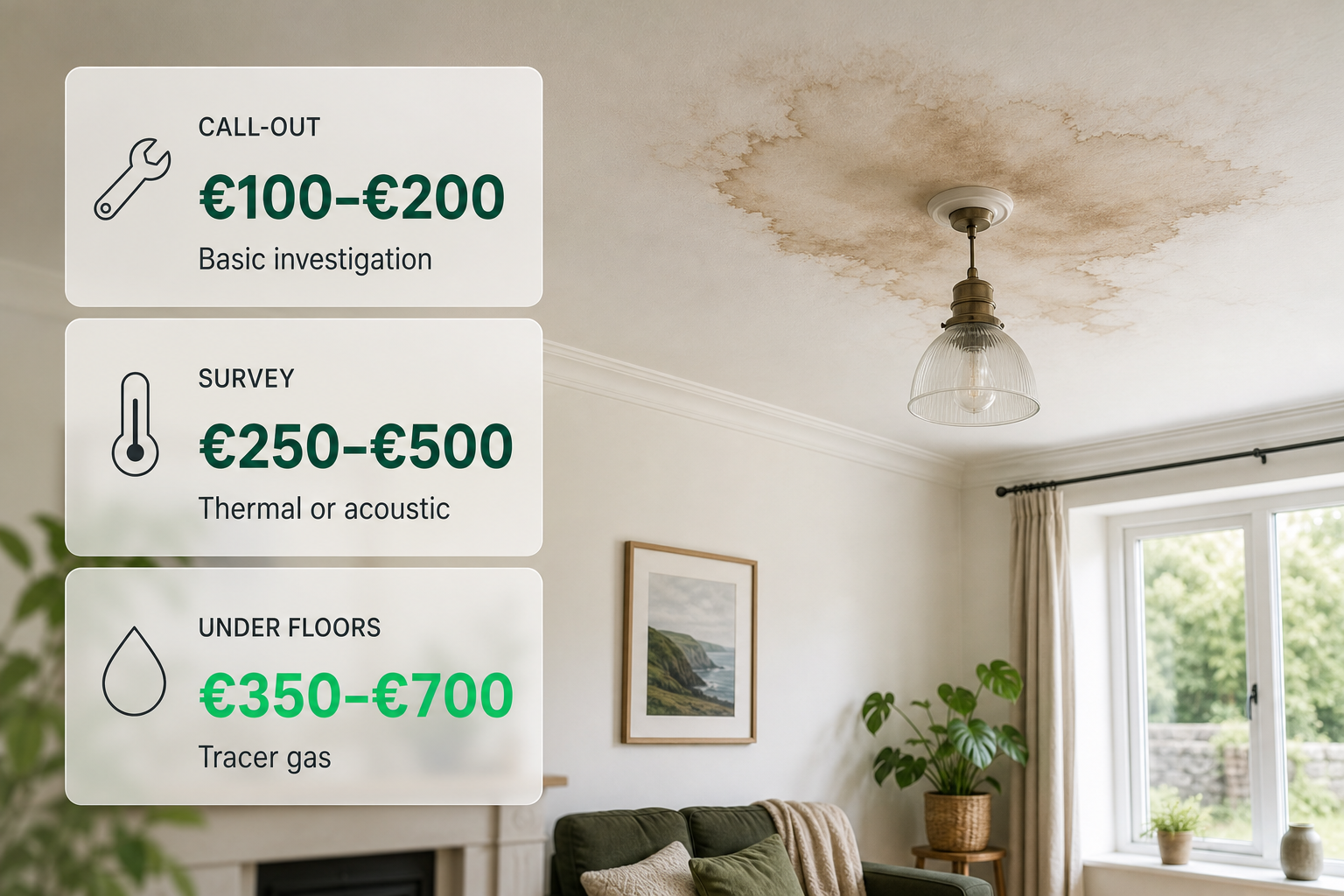
Leak detection prices at a glance
The figures below are an aggregate Irish market estimate, VAT included, for a typical home.
| Job | Typical price |
|---|---|
| Plumber call-out and basic leak investigation | €100–€200 |
| Specialist leak detection survey (thermal imaging, acoustic, moisture mapping) | €250–€500 |
| Pressure test of the heating or water system | €150–€350 |
| Tracer gas detection, underfloor heating or under a slab | €350–€700 |
| Repairing a leaking joint or short pipe section | €150–€350 |
| Opening and reinstating a section of floor or wall | €250–€800 |
| Repairing a leaking pipe under a concrete floor | €600–€1,500+ |
| Replacing an external supply pipe, if not covered by First Fix Free | €800–€2,500 |
| Written leak detection report for an insurance claim | Often included, or €50–€150 extra |
Prices are higher for emergency or out-of-hours call-outs, large or older homes, and leaks in underfloor heating, where the pipes are buried in the screed. The cost of drying out, replastering, redecorating or replacing flooring after a leak is separate.
A worked example: a family in Cork notices a damp patch spreading across the kitchen floor and a heating system that keeps losing pressure. A specialist uses thermal imaging and a pressure test to trace the leak to an underfloor heating pipe, at a cost of €350 to €600 including a written report. The plumber then opens a small section of floor, repairs the pipe and reinstates the screed for €500 to €900. The total comes to roughly €850 to €1,500, before any new flooring. Many home insurance policies have a "trace and access" section that may cover part of the detection cost, so it is worth checking the policy before work starts.
Signs of a hidden leak
- Damp patches or staining on ceilings, walls or floors that keep growing.
- A heating system that keeps losing pressure and needs topping up.
- The sound of running water when no taps or appliances are in use.
- Warm spots on the floor, a common sign of a leaking heating or hot water pipe.
- Mould, a musty smell or lifting floorboards in one area of the house.
- A letter from Uisce Éireann saying the water meter shows a possible leak.
Pipes that froze in a cold spell can crack and start leaking later, so leaks often show up after a hard frost; the risk of frozen pipes is covered separately.
How leak detection works
- Thermal imaging. A camera shows temperature differences, which makes leaks from hot water and heating pipes easy to spot through floors and walls.
- Acoustic detection. Sensitive microphones pick up the sound of water escaping from a pressurised pipe.
- Moisture mapping. Meters measure how wet walls and floors are, showing where the water is spreading from.
- Pressure testing. The system is isolated and pressurised to confirm whether it is losing water and which section is at fault.
- Tracer gas. A harmless gas mix is pushed through the pipe and detected where it escapes, useful for pipes buried in concrete.
The aim of a non-invasive survey is to find the leak precisely, so only a small section of floor or wall needs to be opened instead of digging up a whole room.
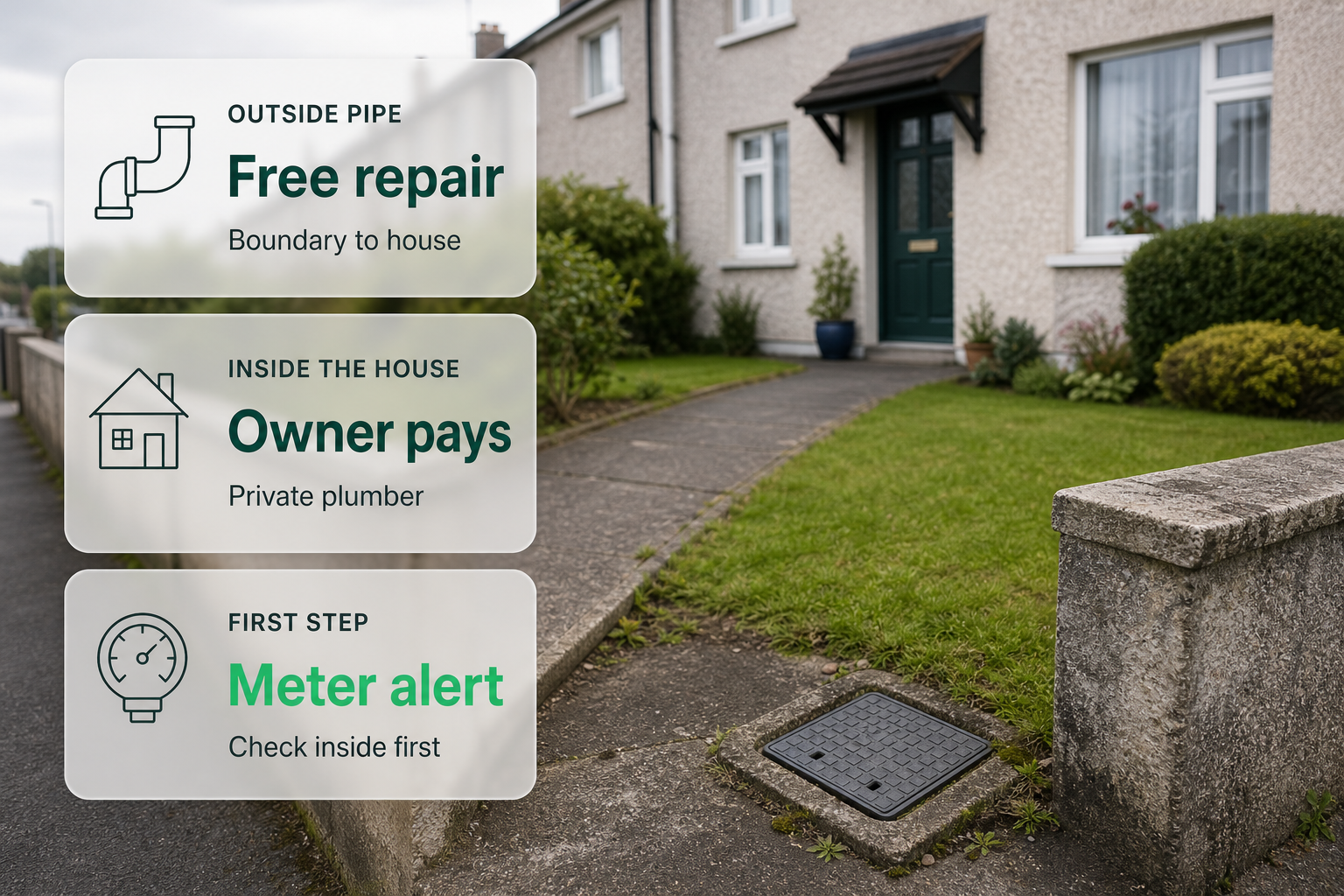
First Fix Free: leaks on the external supply pipe
According to Uisce Éireann, the First Fix Free scheme offers a free investigation if the water meter has indicated a possible leak on the external supply pipe, and a free repair if a leak is found on that pipe, subject to terms and conditions. Domestic customers, and mixed-use customers who use water mainly for domestic purposes, are eligible.
The Commission for Regulation of Utilities explains that the scheme applies to a leak between the property boundary and the entry to the house, and that any leaks inside the house are outside the scheme. Uisce Éireann says homeowners are responsible for the pipes on their property and inside their home, while it is responsible for the pipes on the public side.
In practice:
- Uisce Éireann writes to the household if the meter suggests a possible leak.
- The household carries out simple checks to rule out problems inside the house, such as a running toilet cistern, a tank in the attic that keeps refilling or a dripping tap.
- If no internal problem is found, the household registers for First Fix Free by phone or online.
- A contractor investigates and, if the leak is on the external supply pipe, the property owner signs an acceptance form before the repair is scheduled.
Leaks inside the house, including heating pipes, underfloor heating and pipes under floors, need a private plumber or leak detection specialist.