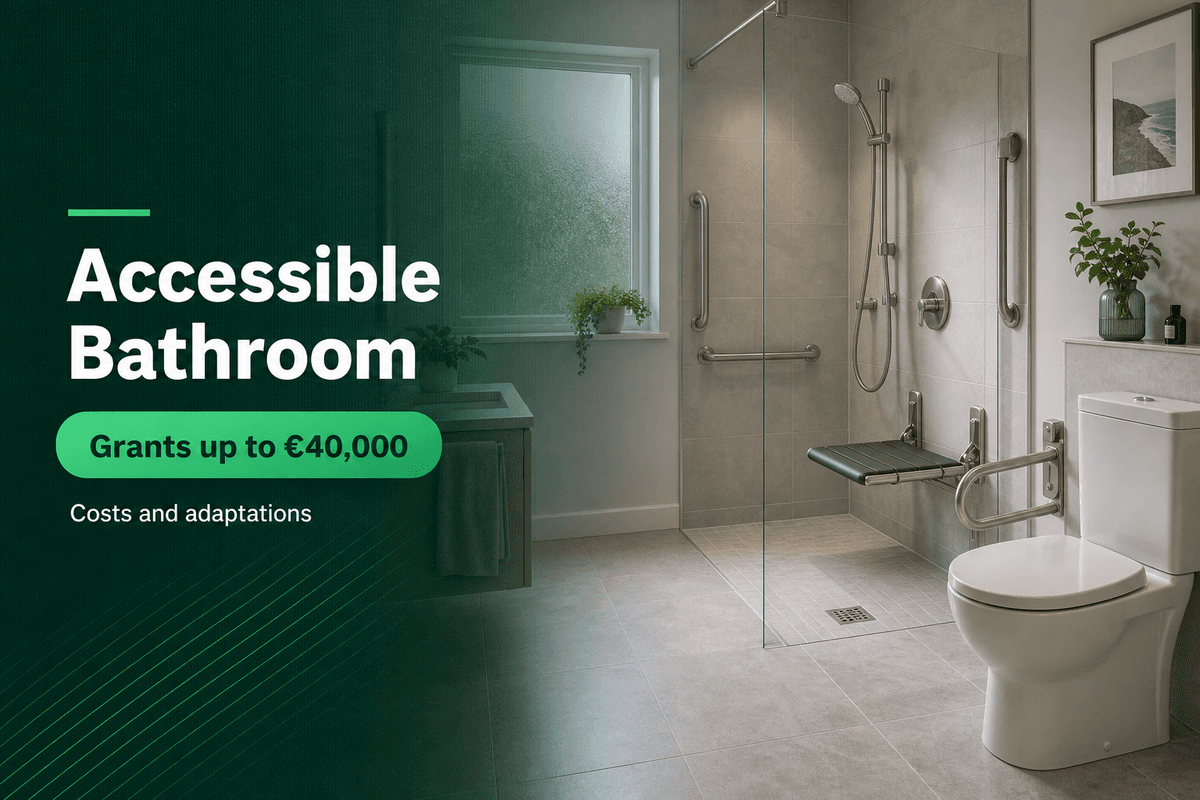
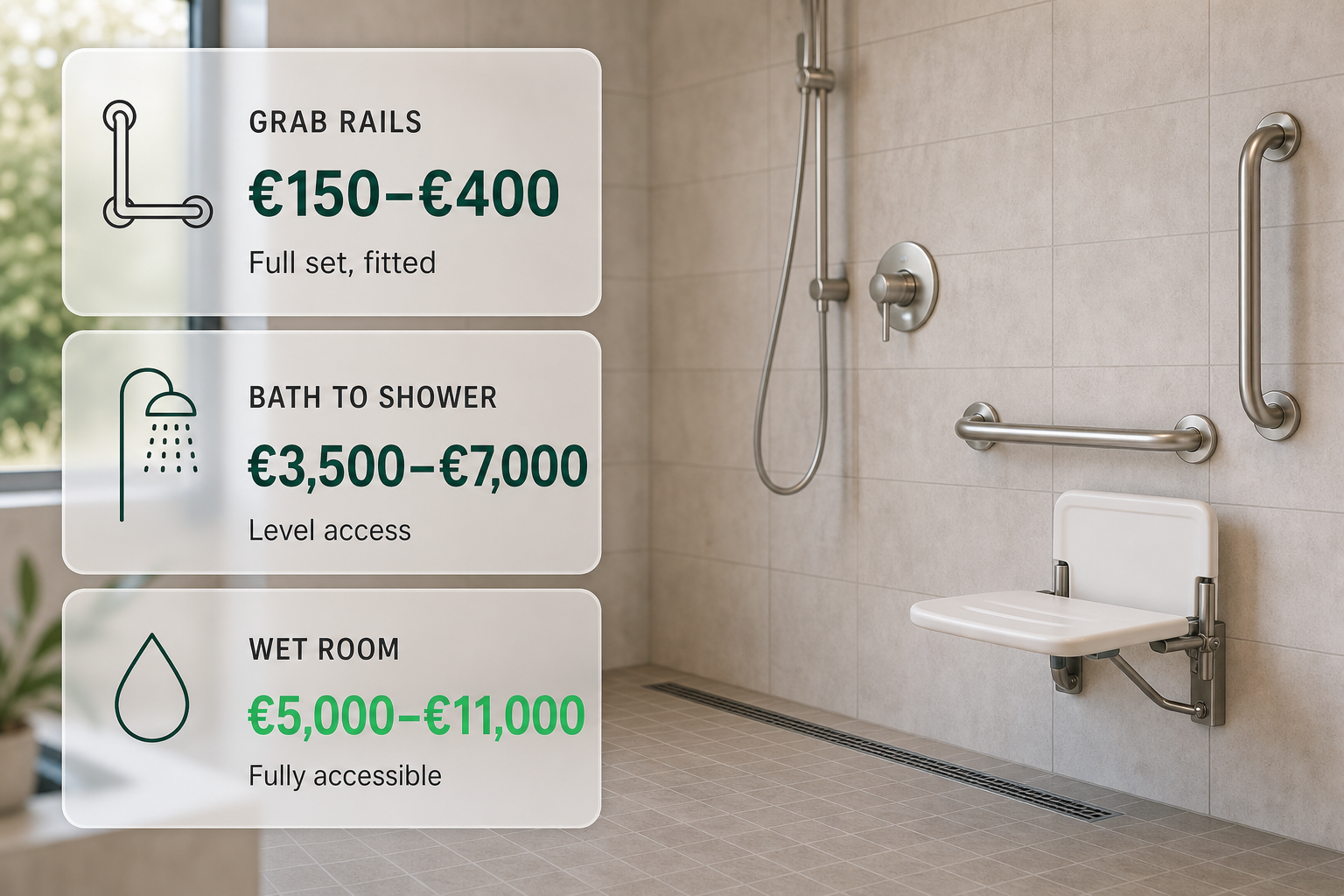
Making a bathroom accessible in Ireland usually costs €150 to €400 for a set of grab rails, €3,500 to €7,000 to replace a bath with a level-access shower and €5,000 to €11,000 for a full accessible wet room, as an aggregate Irish market estimate including VAT. Creating a new accessible shower room downstairs usually costs €8,000 to €18,000, and building an extension with an accessible bathroom €35,000 to €60,000 or more. Local authority grants can cover a large share of these costs: the Housing Adaptation Grant for People with a Disability goes up to €40,000 and the Mobility Aids Grant up to €8,000, both covering up to 100% of approved costs for lower-income households. Families planning bathroom adaptations can post the job under bathroom renovation and compare quotes from local fitters.
Accessible bathroom prices at a glance
The figures below are an aggregate Irish market estimate, VAT included, for a typical home.
| Adaptation | Typical price |
|---|---|
| Grab rails, per rail fitted | €40–€100 |
| Set of grab rails for toilet, basin and shower | €150–€400 |
| Comfort-height toilet, supplied and fitted | €300–€700 |
| Fold-down shower seat, fitted | €150–€350 |
| Thermostatic shower valve to prevent scalding | €250–€500 |
| Replacing a bath with a level-access shower | €3,500–€7,000 |
| Full accessible wet room | €5,000–€11,000 |
| Widening a bathroom door | €500–€1,500 |
| New accessible shower room downstairs, in existing space | €8,000–€18,000 |
| Ground-floor extension with accessible bathroom | €35,000–€60,000+ |
| Private occupational therapist assessment | €150–€300 |
Prices are higher where drainage has to be moved, floors need to be lowered for a level-access shower, or walls have to be strengthened to hold grab rails safely. Specialist anti-slip floors, wider doors and wall-hung fittings also add to the cost.
A worked example: a retired couple in Mayo, one of whom uses a walking frame, need the upstairs bath replaced with a level-access shower, grab rails, a fold-down seat and a comfort-height toilet. The bath-to-shower conversion costs about €4,500 to €6,500, grab rails and the seat €300 to €700, and the toilet €400 to €600, for a total of roughly €5,200 to €7,800. If their gross household income is under €37,500, the Mobility Aids Grant can cover up to €8,000 and up to 100% of approved costs, provided the work is approved by the local authority before it starts.
Grants for accessible bathrooms
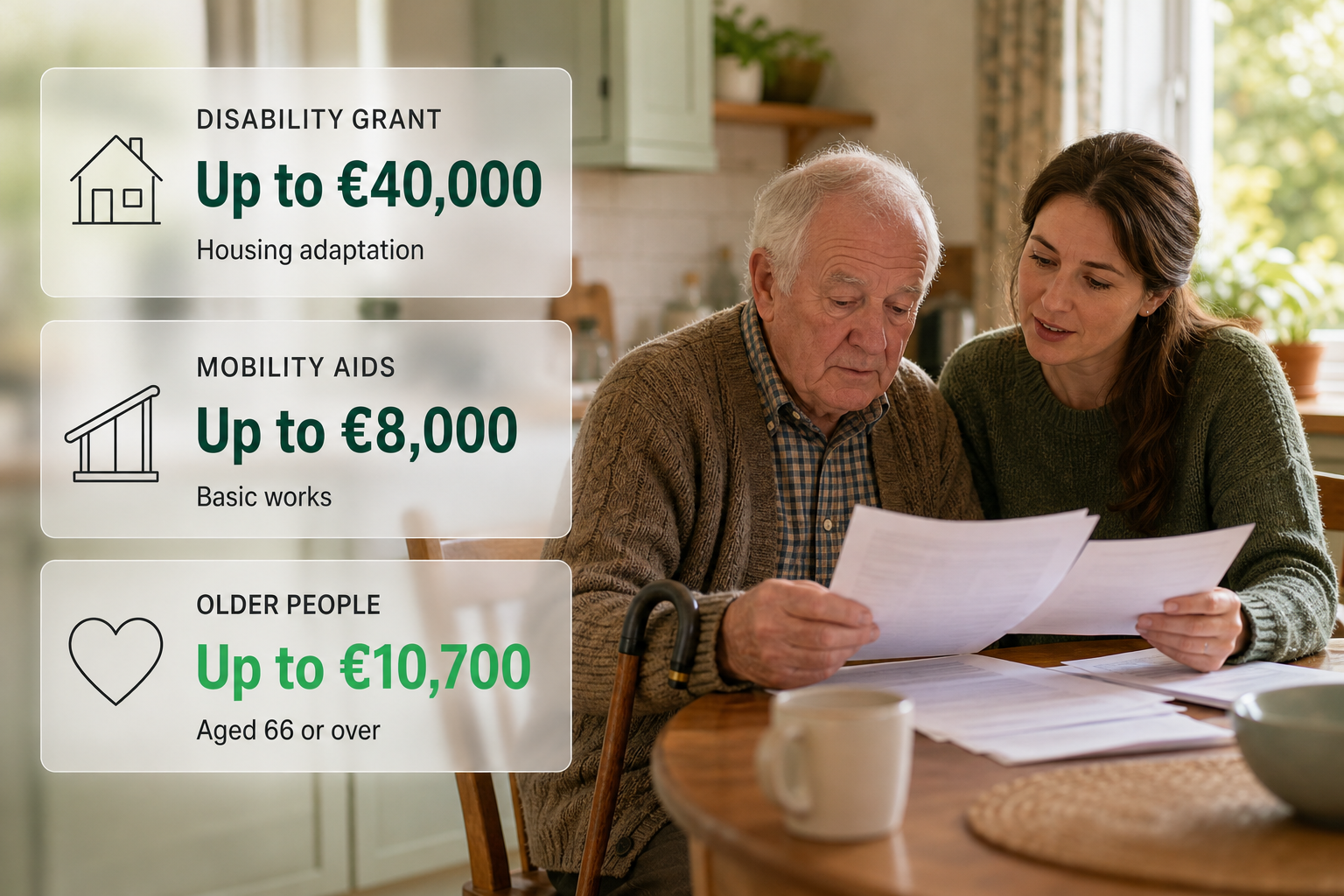
Three local authority grants help with home adaptations. They are applied for through the local council's housing grants section, and the works must be approved before they start.
| Grant | Maximum | Who it is for |
|---|---|---|
| Housing Adaptation Grant for People with a Disability | €40,000 | Homes where a member of the household has a disability and needs adaptation works |
| Mobility Aids Grant | €8,000 | Basic mobility works for households with gross income up to €37,500 |
| Housing Aid for Older People | €10,700 | People aged 66 or over, mainly for repairs, rewiring and heating |
Housing Adaptation Grant for People with a Disability. According to gov.ie, the grant can be up to €40,000 or up to 100% of the approved cost, whichever is less. Households with a gross income up to €37,500 can get up to 100% of the cost, and the share tapers to 30% for incomes between €62,501 and €75,000. Qualifying works can include accessible showers and downstairs toilets, ramps, stairlifts or through-floor lifts, hoists, wheelchair space and extensions for a bedroom or bathroom.
Mobility Aids Grant. According to gov.ie, this grant covers basic works such as grab rails, ramps, an accessible shower and stairlifts, up to €8,000, and may cover 100% of the cost for households with a gross income up to €37,500.
Housing Aid for Older People. According to gov.ie, this grant is for people aged 66 or over, up to €10,700, and is mainly for structural repairs, rewiring and heating improvements rather than bathroom adaptations. Written approval and a grant offer must be in place before any work starts.
These maximums took effect when the revised schemes commenced on 1 December 2024, according to the government announcement. Grant budgets are set by each local authority, so waiting times vary around the country.
How to apply
- Get an assessment. An occupational therapist, often through the HSE, can recommend which adaptations are needed. Some councils require an OT report for larger works.
- Get quotes. Some councils ask for quotes for the proposed works with the application.
- Apply to the local authority with the application form, proof of income and the supporting documents.
- Wait for written approval. Work started before approval is not covered.
- Complete the works as approved and submit the invoices for payment.