Office Cleaning Checklist: An Irish Workplace Guide
Use this office cleaning checklist to set daily, weekly and monthly tasks, then build a specification an Irish office can actually supervise.
/8 min read
An office cleaning checklist is a working document that names what is cleaned, how often and to what standard in a real workplace. It is written for Irish employers, office managers and tenants rather than for domestic cleaning, and it should be short enough to be ticked off during a normal working day. A checklist is also what turns a request for office cleaning into work that can be supervised, checked and handed over.
Daily office cleaning tasks
Empty and reline bins at desks, in kitchens, washrooms and communal areas, and move food waste to the agreed store.
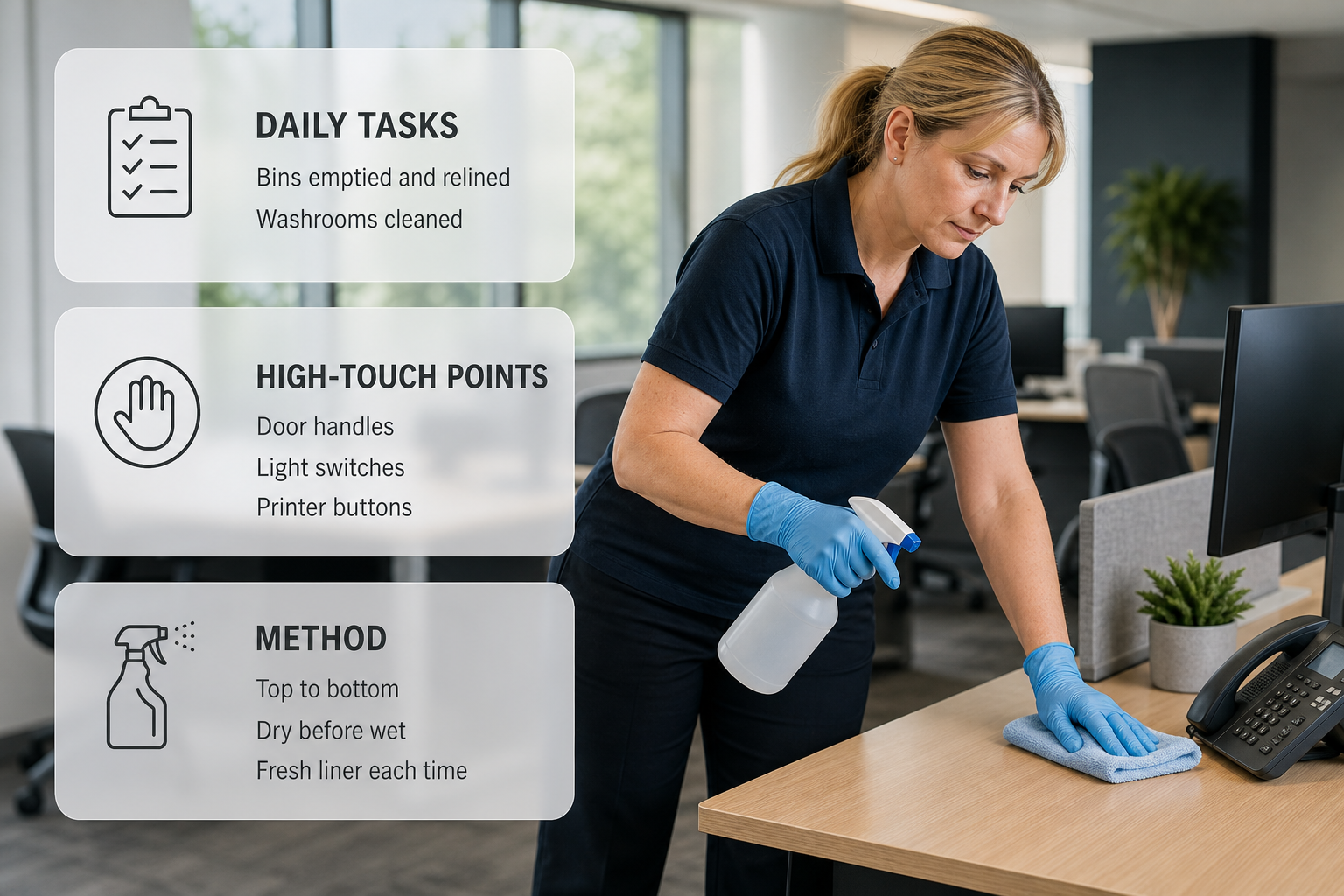
Wipe and disinfect high-touch points: door handles, push plates, lift buttons, light switches, handrails, kettle handles, water-cooler taps and printer buttons.
Clean and disinfect washroom fittings: toilet seats, flush handles, taps, soap dispensers, hand dryers and washroom door handles.
Wipe kitchen and break-room worktops, sinks, taps, table tops and appliance handles.
Sweep or mop hard floors and vacuum entrance matting and main routes.
Spot-clean internal glass, vision panels and door glass.
Restock soap, hand towels, toilet tissue, sanitiser and bin liners.
Do a closing walk-through with the checklist so nothing is left half done.
Method matters as much as the list. Work top to bottom and dry before wet so dust does not settle on cleaned surfaces. Use a neutral multi-surface cleaner first, then a disinfectant on the clean surface, left for the contact time on the label. Let hard surfaces air-dry or buff with a clean dry cloth. Use colour-coded cloths, change mop water before it turns grey, and fit a fresh liner each time a bin is emptied. Wear gloves, eye protection when diluting concentrates, and a mask when dusting overhead or using disinfectant in a poorly ventilated washroom.
Weekly office cleaning tasks
Vacuum carpets and rugs, including under desks, behind doors and along skirtings.
Mop hard floors with a cleaner suited to the surface, then dry to avoid streaks and slip marks.
Dust skirtings, sills, ledges, partition tops, vents and the tops of wall units.
Wipe desks, chair arms, drawer fronts and shared meeting tables where in scope.
Clean internal glass, mirrors and partition panels.
Wash washroom walls, tiles and splashbacks; wipe the outside of sanitary ware.
Wipe outside kitchen appliances, clean the sink and drain area, and wash bins where food waste was present.
Remove marks and scuffs from walls, doors and corridor corners.
Monthly and periodic office cleaning tasks
Deep clean or shampoo carpets; machine scrub hard floors and reseal or polish where worn.
Clean inside windows, blinds, louvres and light diffusers.
Dust high-level surfaces: extract grilles, ceiling vents, light fittings, cable trays and tops of tall cabinets.
Clean inside fridges, microwaves and dishwashers.
Descale washroom fittings; clean behind toilets and under sinks.
Move and clean behind and under furniture and equipment.
Wash or replace entrance matting; deep clean high-touch points beyond the daily wipe.
Check consumable stock and review the checklist against the specification.
Area-by-area office cleaning checklist
Desks and workstations. Wipe the work surface, desk edges, chair arms, under-desk bin and cable tidy. Screens, keyboards and phones are usually left to the user, but the checklist should say so. Meeting rooms need table, chairs, whiteboard ledge, power points, screens and bins daily.
Bins. Check each bin against its label where waste streams are separated, and match the liner to the stream. Empty and reline pedestal, kitchen, washroom and sanitary bins daily; wash the container weekly where food waste was present. Leave bin stores tidy with lids closed.
Floors. Sweep or mop hard floors and vacuum carpets on the same visit. Edges, corners, under desks, behind doors and the strip beside the entrance matting need attention. Clean spills when they happen, and dry mop where a wet mop would leave too much water on timber or laminate.
Washrooms. Daily: toilets, seats, flush handles, sinks, taps, soap dispensers, hand dryers, mirrors, door handles, floors and bins. Weekly: walls, tiles, grout, cubicle doors and partitions. Periodic: descale taps and fittings, clean extract grilles, and deep clean floor corners and behind the door.
Kitchens. Daily: worktops, sink, taps, kettle and appliance handles, microwave door, fridge handle, table tops and floor around the bin. Weekly: outside appliances, sink drain area and cupboard fronts. Periodic: inside fridges, microwaves and dishwashers, and the extract grille above a hob.
High-touch surfaces. Door handles, push plates, lift buttons, light switches, handrails, printer buttons, appliance handles, water-cooler taps, fridge handles, shared desk edges, washroom taps and flush handles. Name them individually rather than folding them into a general wipe-down.
How often should high-touch areas be cleaned?
The HSA's cleaning and disinfection checklist helps employers put additional cleaning and disinfection measures in place at the workplace. That makes frequency a decision for the employer rather than one figure that suits every building. An office with more people, hot-desking, shared equipment or a steady flow of visitors may need a different routine from a small closed office. The chosen frequency should be written into both the checklist and the specification, so the person cleaning and the person checking the work are following the same line. The HSA checklist is the prompt to review whether additional measures are needed; the employer records what those measures are and who carries them out.
Irish duties for office cleaning
The HSA's guidance on safety statements and risk assessment notes that small office, retail, commercial, service and light industrial firms usually have hazards that are few and simple, and that outside contractors may include cleaning work. In an Irish workplace the employer remains responsible for health and safety, and cleaning arrangements can sit within the safety statement, the risk assessment and the use of outside contractors. A checklist is a management tool that supports those documents rather than a substitute for them.
Cleaning specification versus a simple checklist
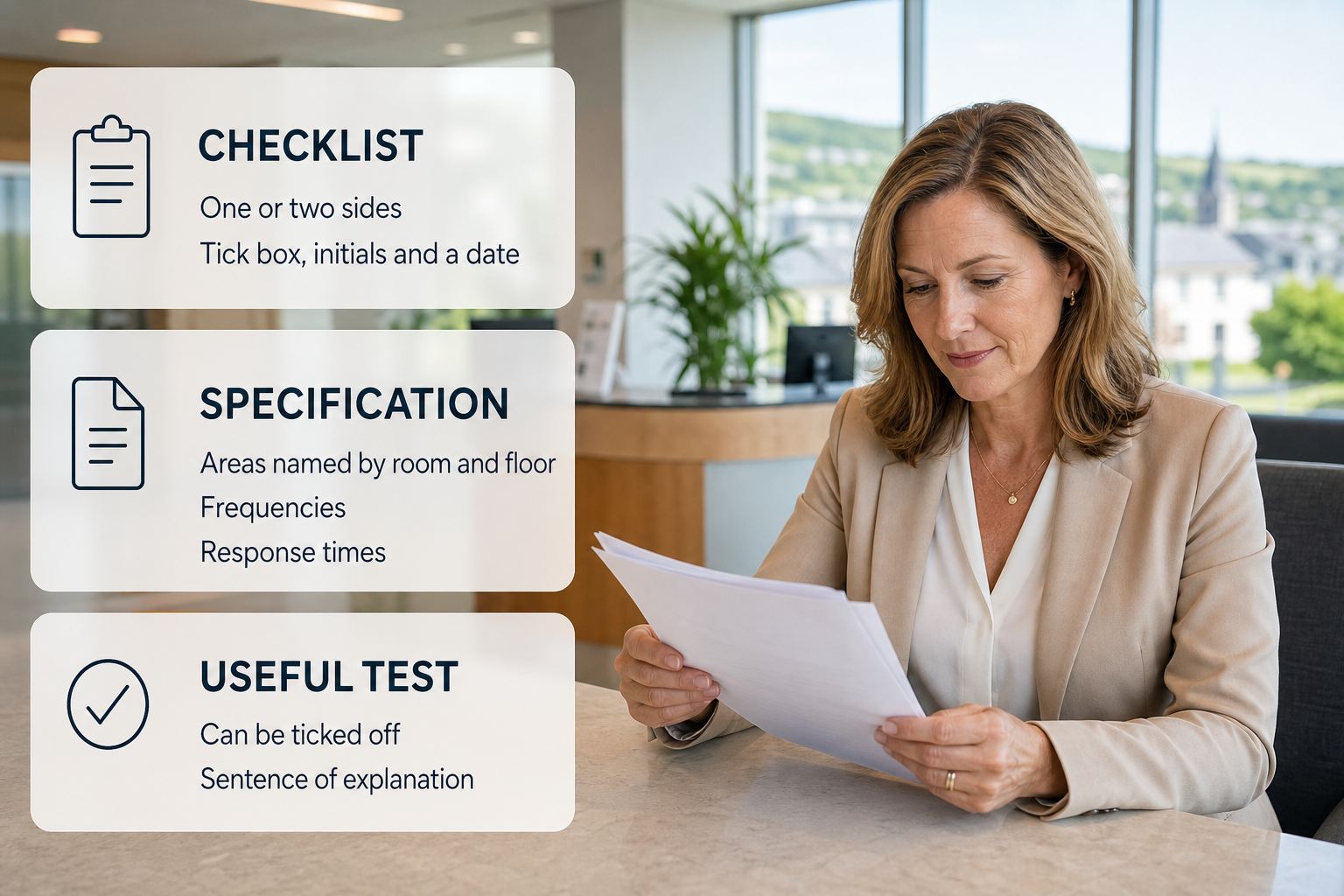
These two documents are often confused, and the difference matters when something goes wrong. A checklist is short: one or two sides, tasks grouped by frequency, a tick box, initials and a date, kept in the cleaning cupboard or at reception and used to supervise the daily and weekly work.
A specification is the annex to a contract and describes the job in full — areas named by room and floor, frequencies, the standard expected and how it will be measured, response times for spills and washroom issues, working hours and access, keys and alarm codes, cover for absence, missed-task reporting, and how changes are agreed. It is the document a firm supplying cleaning services prices from, and the one to reach for when a standard slips.
A useful test: if a line needs a sentence of explanation, it belongs in the specification. If it can be ticked off by the person holding the cloth, it belongs on the checklist.
Who supplies cleaning products and equipment?
Whether the cleaner or the employer supplies products and equipment is a contract and specification point to agree, not something to assume. If the cleaner brings the products and equipment, the contract should say which products are used on which surface, where they are stored on site and who keeps them topped up. If the employer supplies them, the contract should say where the cupboard is, how equipment is maintained and what happens when something breaks. Consumables such as soap, hand towels and liners are a separate item from chemicals and equipment, and they are a common source of argument when nobody wrote them down. Specialist items — carpet shampoo, a floor machine, tall dusting equipment and personal protective equipment — should be listed by name so there is no gap on the first visit.
A short office cleaning contract template
A workable template keeps the clauses short and attaches the detail as schedules:
Parties, sites and the areas covered.
Term, review date and notice.
Scope — the specification as Schedule 1 and the checklist as Schedule 2.
Frequencies, working hours, access, keys and alarm codes.
Standard, inspection, and how snags are reported and closed.
Products, equipment and consumables — who supplies what, and where it is stored.
Waste handling and bin stores.
Reporting of accidents, damage, maintenance issues and missed tasks.
Variations, and how a change to the checklist is approved.
Signatures and date.
Employers who want a firm to work to a template like this can post the job on ShamFix, where listing a job is free and no commission is charged, and a subscription is planned for the future. Profiles are filled in by tradespeople themselves, so ShamFix does not check or certify them, and employers should check registrations themselves and read reviews.
FAQ
Should the checklist cover areas shared with other businesses?
The checklist should follow control and access. Where an entrance, stairwell or shared washroom sits outside the space a tenant actually occupies, it belongs in whichever document covers that space; where the tenant runs it, it belongs on the tenant's own sheet. Naming the split in writing stops an area falling between two documents that each assume the other is dealing with it.
What is the difference between a checklist and a cleaning schedule?
A schedule sets out dates, times and who attends; a checklist sets out tasks and standards. The schedule answers when, the checklist answers what and how well. Both can sit in the specification, but the person cleaning needs the checklist at the point of work.
Should a checklist include product names?
Generic product types are enough on the checklist — neutral cleaner, disinfectant, glass cleaner, floor cleaner suited to the surface. The specification can hold the detail on dilution, contact time and which product goes on which surface. That keeps the checklist short while making sure the cleaner can still see what to do.
How should a checklist be reviewed?
Review it when the workplace changes, such as a new floor finish, more desks, a hot-desking policy or a different washroom layout. Walk the building with the checklist, tick what works and strike out lines that no longer apply. Changes to frequency or scope should then be agreed in the contract rather than pencilled onto the sheet.
Who should sign off the checklist?
A named person should own it, such as an office manager, facilities lead or the person supervising the contract. That person signs it off, queries gaps and raises repeated misses. When nobody owns it, the sheet fills with ticks that nobody has checked.