In Ireland, kitchen worktops typically range from about €50–€250 per m² for laminate, while quartz is commonly around €425–€650 per m² and granite about €450–€600 per m², before fitting extras. Templating, sink and hob cut-outs, upstands, installation and VAT can sit outside that headline material rate, so the installed total is often higher than the slab price suggests.
That difference explains why a small kitchen can receive one quote for a relatively modest sum and another that is several times higher. The surface itself is only one part of the job. Run length, joints, edge finishing, access and the condition of the existing units all affect what a homeowner will pay.
For a practical starting point, aggregate Irish market estimates give €800–€2,000 for laminate in a typical 8–10 m² kitchen, €2,500–€3,500 for entry-level quartz or granite, €3,500–€5,500 for better-grade stone, and €6,000 or more for marble or Dekton, with fitting-related extras listed separately. Homeowners comparing local options can find kitchen fitters and post your job once the required material and specification are clear.
How Much Kitchen Worktops Cost in Ireland Right Now
A worktop can cost €50–€250 per m² for laminate, while quartz is often €300–€700 per m² and granite €300–€600 per m² on aggregate Irish market estimates. Those are material rates, not the amount you will necessarily pay once the surface is measured, cut and fitted.
Suppliers may quote by linear metre, also called a running metre. This measures the length of the worktop run, like measuring a shelf from one end to the other. Square metres describe the material used across the surface. A three-metre straight run is simpler than an L-shaped layout with joints, returns or a deeper section, so the two measurements cannot be converted directly without the worktop design.
Other Irish estimates put laminate at approximately €50–€250 per m², quartz at €425–€650 per m², and granite at €450–€600 per m², before fitting extras. The spread between estimates reflects product range and specification, so your quotation should state the exact material, thickness and finish.
What an installed quote includes
Templating may add roughly €100–€200, installation around €300–€600, sink or hob cut-outs €50–€100 each, and upstands €75–€150 per linear metre, on aggregate Irish market estimates. These items work like the labour and alterations on a fitted floor. They are easy to miss when comparing only the board or slab price.
Ask whether the quote includes VAT. Irish residential fit-out guidance states that qualifying supply-and-fit worktops can fall under the 13.5% reduced VAT rate. The written price should show whether VAT is included and explain any conditions.
Practical rule: compare the complete supply-and-fit figure, not the material rate alone.
The wider kitchen budget provides useful context. One Ireland-focused guide places a budget kitchen with laminate and worktops at roughly €4,500–€7,500, a mid-range kitchen with quartz at €8,500–€16,000, and a bespoke kitchen with granite at €18,000–€35,000 or more. Worktops typically represent about 10–15% of total kitchen costs, depending on the project. The final figure still depends on run length, joints, cut-outs, edge finishing, access and the condition of the units.
Material choice sets the broad budget, but it also affects how the surface handles heat, spills, knives and daily cleaning. Laminate is usually the entry point. Quartz, granite and other solid surfaces need more specialist fabrication and handling.
The table uses indicative Irish guidance. Some figures are quoted per square metre, others per running metre or as a typical kitchen allowance. That is like comparing paint by tin with flooring by square metre. Ask the supplier to confirm the unit, material thickness, finish and what is included in the installed price.
Kitchen Worktop Cost by Material in Ireland
| Material |
Typical Cost per m² in Ireland |
Best For |
Watch For |
| Laminate |
€50–€250 per m² |
Tight budgets, rental refreshes and straightforward runs |
More vulnerable to heat, moisture at exposed edges and swelling if water reaches the core |
| Solid wood |
About €800 for an average kitchen on aggregate Irish estimates |
Warm, natural interiors and homes where the surface can be maintained |
Needs appropriate care and can mark or change appearance with moisture and heat |
| Quartz or engineered stone |
€300–€700 per m² |
A consistent stone appearance with strong everyday performance |
Higher fabrication, templating, handling and installation costs |
| Granite |
€300–€600 per m² |
Natural variation, a substantial appearance and durable everyday cooking |
Slabs are heavy, while joints, access and cut-outs need careful planning |
| Solid surface, porcelain or Dekton |
€400 per linear metre starting point for porcelain in some Irish coverage, while Dekton can reach €6,000 or more in a typical 8–10 m² kitchen |
Continuous-surface designs, premium finishes and specialist projects |
Premium pricing, specialist fabrication and careful installation requirements |
Laminate works like a printed, sealed skin over a board. Stone is a dense slab that must be measured, transported, cut and positioned accurately. The material rate therefore gives only the starting point. Templating, sink and hob cut-outs, edge work, upstands and fitting can change what you pay.
Quartz often suits homeowners seeking a durable stone-style surface without choosing the highest-priced natural or specialist option. Granite offers natural pattern and a durable feel, but the finished appearance depends on the chosen slab, joint placement and fabrication quality.
When comparing appearance, maintenance and everyday use, work from Irish pricing and local fitting conditions for your installed budget.
What Moves Your Worktop Quote Up or Down
The length of the worktop sets the starting point, but the installed total depends on what must happen to the surface. Two kitchens with similar runs can receive different quotes if one needs a sink, hob, return, thick edge and several joints, while the other has a simple straight layout.
The main cost variables
- Material class: Laminate usually sits at the budget end. Quartz, granite, marble and Dekton generally occupy higher price bands.
- Shape and joints: L-shaped and U-shaped layouts require more precise joining and may produce more waste. A straight run is usually simpler to measure and fit.
- Cut-outs: Sink and hob openings each require measuring and cutting. Aggregate Irish estimates place each cut-out at €50–€100.
- Edges and thickness: A square edge needs less fabrication than a detailed or built-up profile. A thicker-looking finish may also require extra material and workshop time.
- Upstands and splashbacks: Upstands can cost approximately €75–€150 per linear metre. Splashbacks are separate pieces, so check whether they appear in the quote.
- Templating: Stone surfaces often need an accurate template before final cutting. The same Irish guidance lists templating at about €100–€200.
- Installation and handling: Fitting is commonly listed at around €300–€600. Heavy stone also needs suitable access and careful handling.
- Removal and disposal: Taking away old worktops, protecting floors and disposing of waste may appear as separate charges.
- Site condition: Uneven walls, out-of-level units, awkward corners and plumbing changes can all add preparation time.
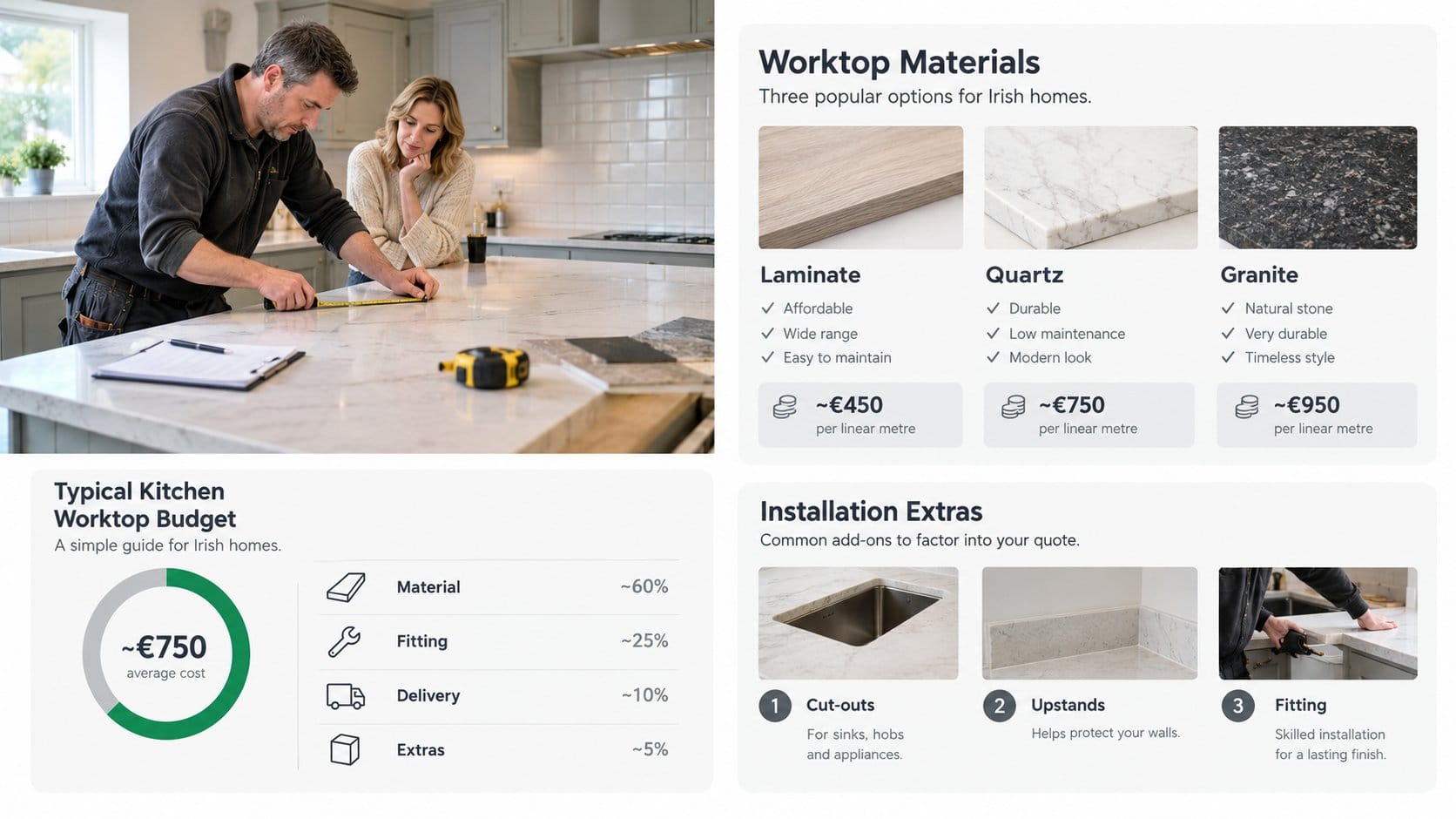
Treat the material rate like the price of ingredients, and the fitted quote like the finished meal. Dublin and commuter counties can often have higher fitting fees than rural areas because labour, travel, access and operating costs differ. There should not be an assumed county surcharge without a written quote.
A low headline price may cover only boards or slabs. A higher figure may already include templating, cut-outs, edging, upstands and fitting. Compare itemised offers using the same material, dimensions and finishing schedule, then check exactly which services are included before choosing a fitter.
Example Budgets for Common Irish Kitchen Sizes
A useful budget separates the worktop itself from the work needed to turn it into a finished surface. The examples below are hypothetical planning examples, not completed jobs. They use Irish benchmarks for an 8–10 m² kitchen and show why a shorter run does not always mean a proportionally smaller fitted bill.
Compact galley
A compact galley with a straight run of around three to four metres may suit laminate when keeping the refresh affordable matters. Irish guidance gives a typical total of about €150–€500 including VAT for a standard three-metre laminate run, with a simple thickness and edge profile.
That is a planning benchmark, not a universal installed price. A sink or hob cut-out, old worktop removal, upstands, awkward access and fitting can all increase the final amount. Fixed costs for measuring and installation take up a larger share of a short run, much like paying a delivery charge for a small order.
Typical 8–10 m² kitchen
For a typical Irish kitchen of 8–10 m², a practical benchmark is €800–€2,000 for laminate, €2,500–€3,500 for entry-level quartz or granite, and €3,500–€5,500 for better-grade stone, on aggregate Irish market estimates.
A laminate example might have a straightforward run, standard edging and limited cut-outs. A quartz example with the same room size may need templating, specialist cutting, heavier handling and more precise joints. The floor area is unchanged, but the fabrication and fitting workload is different.
When planning the wider renovation budget, keep the kitchen installation figure separate from the worktop allowance, because installation may cover services beyond the surface itself.
L-shaped or U-shaped kitchen
An L-shaped or U-shaped layout usually needs more sections, corners and carefully planned joints. The material cost rises with the run length. Complex fabrication, trimming and difficult site access can also increase labour and waste.
For higher-end materials, the Irish benchmark reaches €6,000 or more for marble or Dekton in a typical 8–10 m² kitchen. A larger or more complicated layout needs a bespoke quotation rather than a simple room-size allowance.
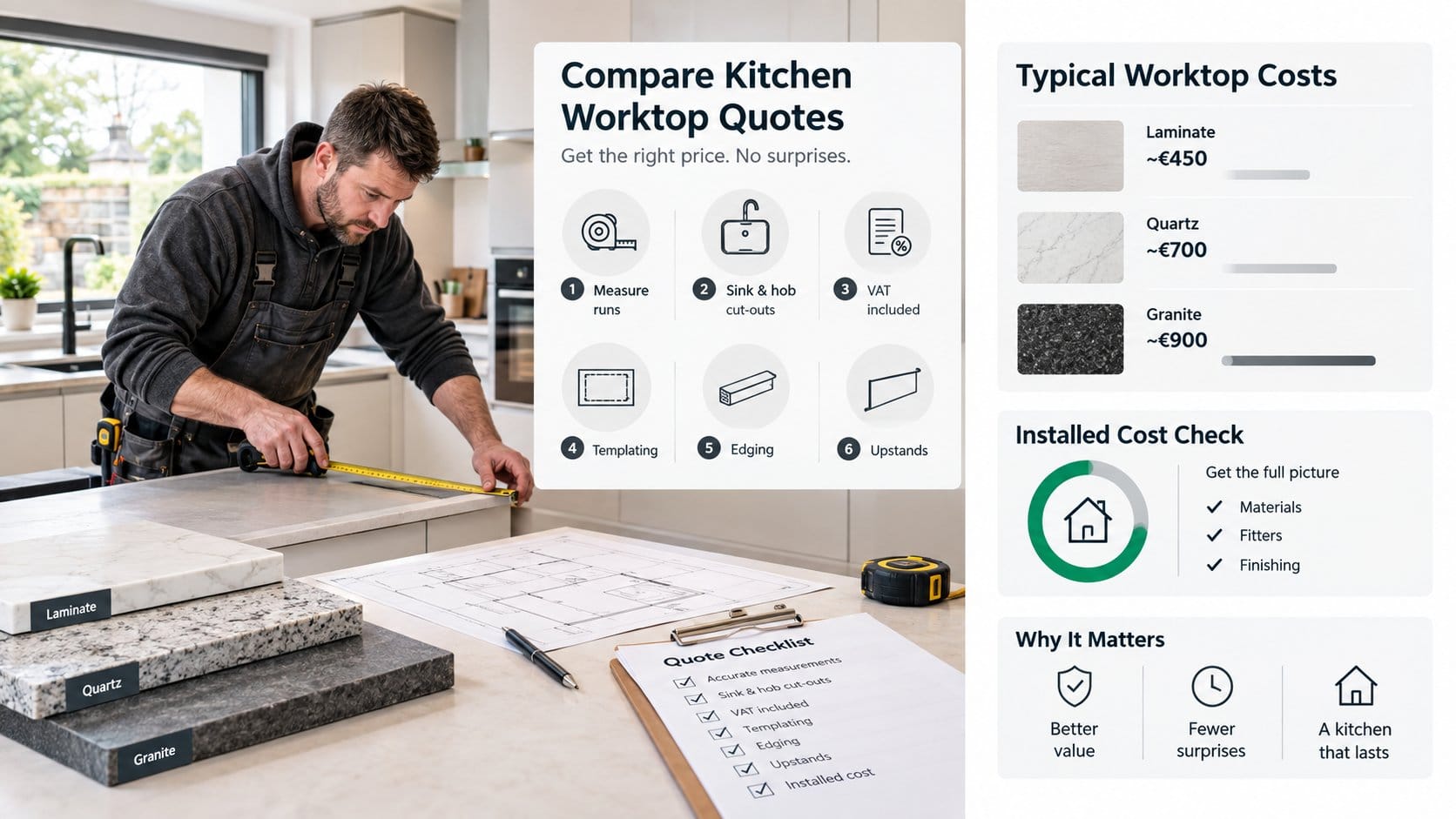
The practical lesson is clear. A short run can still carry a meaningful minimum cost, while a larger kitchen may offer a fairer per-metre comparison because measuring, delivery and fitting are spread across more material. Compare the installed total, not only the headline material rate.
How to Compare Quotes and Get an Accurate Price
A useful quotation lets two suppliers price the same job. Supply-only and supply-and-fit totals cannot be compared fairly, even when both quotes name the same material. The installed figure works like a recipe total: the worktop is one ingredient, while templating, cut-outs, joints, upstands and fitting add their own costs.
Start with the specification
Describe the approximate run length, layout, material, thickness, edge style, sink type, hob position, and whether upstands or splashbacks are required. Include a plan, photographs and clear measurements where possible. A specialist fitter should still check the dimensions before fabrication, because a small measurement error can affect joints and cut-outs.
Ask the supplier to show these items clearly:
- Supply-only or supply-and-fit: List each service separately.
- VAT treatment: Confirm whether the total includes the applicable 13.5% reduced VAT rate for residential fit-out work.
- Templating: State whether a site template is included and when it will be taken.
- Cut-outs: Price sink and hob openings individually, including special shapes or drainer details.
- Edges and joints: Describe the edge profile and show where joints will be positioned.
- Upstands and splashbacks: Give their dimensions and prices separately.
- Removal and disposal: Confirm whether old worktops, packaging and waste are included.
- Preparation and making good: Allow for uneven units, irregular walls or plumbing changes where required.
These details turn a headline material rate into a usable installed-cost comparison. A low per-metre figure can rise once fabrication and site work are added.
Ask practical questions before booking
Ask who measures the worktop, who carries out the cutting, how joints will be positioned and what happens if the units are not level. Confirm whether the homeowner supplies the sink and hob, whether appliances need disconnecting, and whether a plumber or electrician must attend separately.
Quote test: If the offer does not show the material, dimensions, cut-outs, edging, VAT and fitting scope, it is not yet a reliable installed-cost comparison.
Worktops can represent a meaningful share of the wider kitchen budget, typically around 10–15% of total kitchen costs on aggregate Irish estimates. Use that context when setting an allowance, while keeping the worktop total separate from cabinets, appliances and other renovation work.
For trades beyond the worktop itself, homeowners can find tradespeople and post a task. A kitchen refit may involve carpentry, plumbing, electrical and decorating work, so the quotation should state exactly where the worktop fitter's responsibility ends.
When to Replace Just the Worktop and How to Save
Replacing only the worktop makes sense when the cabinet boxes are sound, the doors still suit the room and the layout works. It can give a landlord, first-time buyer or homeowner a noticeable refresh without the cost and disruption of replacing the whole kitchen.
Start by checking what sits underneath. Swollen or unstable units, and cabinets that are badly out of level, can make a new worktop look like a solution while leaving the underlying problem in place. Sound cabinets give you more choice. Laminate can keep the material cost controlled, while mid-range quartz may provide a harder-wearing finish without specifying premium stone throughout.
Where savings usually come from
- Choose a standard material: Laminate generally costs less than quartz, granite or specialist surfaces.
- Keep the layout: Reusing the existing run can limit changes to joints, plumbing and appliance positions.
- Limit cut-outs: Each extra sink, hob or tap opening adds fabrication work and measurement risk.
- Use a simple edge: A straightforward finish usually requires less work than elaborate edging or a built-up profile.
- Specify upstands carefully: Add them where they protect the wall or complete the design, rather than assuming every wall needs the same treatment.
- Compare life-cycle needs: A lower-cost surface may suit a short-term refresh, while a more durable option can make sense if the kitchen will remain in use for years.
Replacement pricing has changed across named products. Entry-level laminate worktops have roughly doubled in price since 2019, and mid-range veneer surfaces have risen by a similar order. That shows why an old headline rate may no longer match a current quote, though the shift varies by product rather than applying uniformly to every laminate or timber surface.
Porcelain slab worktops are also being presented as a newer Irish option, with guidance placing them from around €400 per linear metre. The material figure is only the starting point. Ask whether the quotation includes templating, fabrication, cut-outs, transport and fitting before comparing its value with other surfaces.
A painted-kitchen refresh can sometimes work alongside worktop replacement. Painting the cabinet doors can help when they need updating but the units themselves remain usable. This approach can refresh the room while keeping the existing layout and reducing the amount of kitchen removed.
Getting Your Worktop Fitted and Next Steps
The safest route is a written supply-and-fit quotation that states the material, dimensions, VAT, templating, cut-outs, edging, upstands, installation, removal and disposal. The offer should also explain how uneven walls, out-of-level units or plumbing changes will be handled if they appear during preparation.
Homeowners should compare quotes using the same specification. The lowest material rate isn't necessarily the lowest installed cost, particularly on a short run where fixed measuring and fitting charges take up more of the total.
Before booking, gather photographs, the kitchen plan, appliance details and the preferred sink and hob positions. Then request an itemised price from local kitchen fitters and ask for any exclusions in writing.
ShamFix provides a way to explore how ShamFix connects Irish homeowners with local providers when arranging home improvement work. Homeowners can use the marketplace to describe a kitchen worktop task and consider local provider information before requesting contact.
Are you a kitchen fitter in Ireland?
Listing on ShamFix is free and there's no commission; a subscription is planned for the future. Local kitchen fitters can read the current provider terms and create a listing through the tradesperson information page.