An Irish kitchen can look worn long before it stops working. The doors may be dated, the colour may feel heavy, and the handles may belong to another decade, yet the carcasses, hinges and layout can still be perfectly serviceable. That's where kitchen cabinet painting earns its place. It can refresh a structurally sound kitchen without the disruption of removing every unit, worktop and appliance.
The decision isn't merely about choosing a fashionable colour. It's about deciding whether repainting gives sound cabinets a useful second life or merely disguises problems that replacement will eventually expose. In the current Irish market, professional kitchen cabinet painting or respraying more often lands around €1,200 to €3,500 or more, depending on kitchen size, preparation, repairs, application method and finish specification. Broader trade estimates can still run higher where damaged doors, complex colour changes or off-site spraying are involved. Alex Trend Painters' cabinet-painting advice illustrates why product choice and preparation affect the final result.
Respray or Replace: Deciding Between Painting and Renewing Kitchen Cabinets
A tired 1990s Irish kitchen with solid beech carcasses, decent hinges and dated melamine doors may not need demolition. It needs an honest inspection first. If the doors are flat, the cabinets close squarely and the sink area is dry and sound, painting can deliver better value. Warped doors, failing board or swollen units need replacement, because new paint cannot repair weak cabinetry.
The central choice is respray versus replacement. Replacement makes sense when the layout works poorly, storage is inadequate, worktops and appliances also need changing, or water damage has spread through the units. Repainting is the stronger option when the arrangement already suits the household and the main problems are colour, surface wear or dated hardware.
The condition tests that matter
Inspect the kitchen with the doors open and closed before requesting quotes.
Check the sink cabinet: swelling, soft MDF edges or crumbling laminate indicate water damage, not a straightforward decorating job.
Check the doors: warping, delamination and loose joints can leave a sprayed finish looking worse than the original surface.
Check the carcasses: doors should close squarely, hinges should hold firmly and shelves should sit securely.
Check the layout: paint changes appearance, but it cannot correct awkward appliance positions, poor storage or an unsuitable work triangle.
Practical rule: Paint sound cabinetry. Replace cabinetry that has failed structurally.
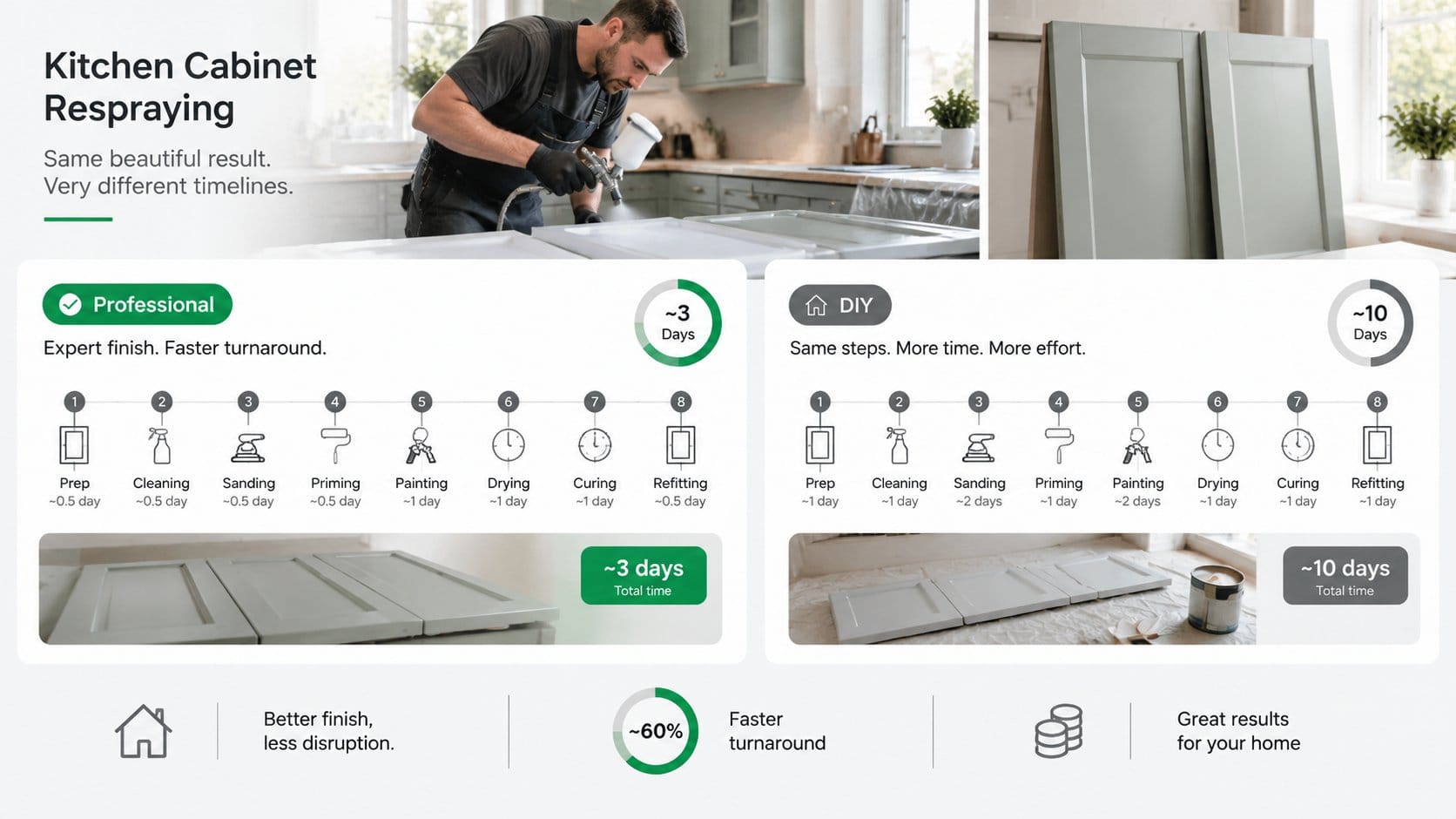
Irish providers generally position cabinet repainting as a mid-value refurbishment service, rather than a luxury reserved for a full renovation. Professional work is commonly presented as a short-disruption alternative to replacement, with many projects completed within one to four days, depending on door numbers and preparation. Some Dublin services describe many jobs as taking one to two days, while Ireland-focused guidance gives a broader two to four-day window. Those schedules suit occupied homes only when the doors and frames are suitable for coating.
The method also affects the schedule. On-site spraying can reduce transport and handling, while off-site spraying may provide a more controlled finishing environment but requires doors and drawers to be removed and returned. Ask which approach the quote includes, and confirm whether the frames are painted in the kitchen.
For homeowners comparing regional options, professional cabinet painting Dublin shows how a specialist service presents cabinet repainting as an alternative to a full kitchen refit. Base the decision on unit condition, the quoted paint system, preparation and the finish required, rather than colour trends alone.
How to Prepare Kitchen Cabinets for Paint
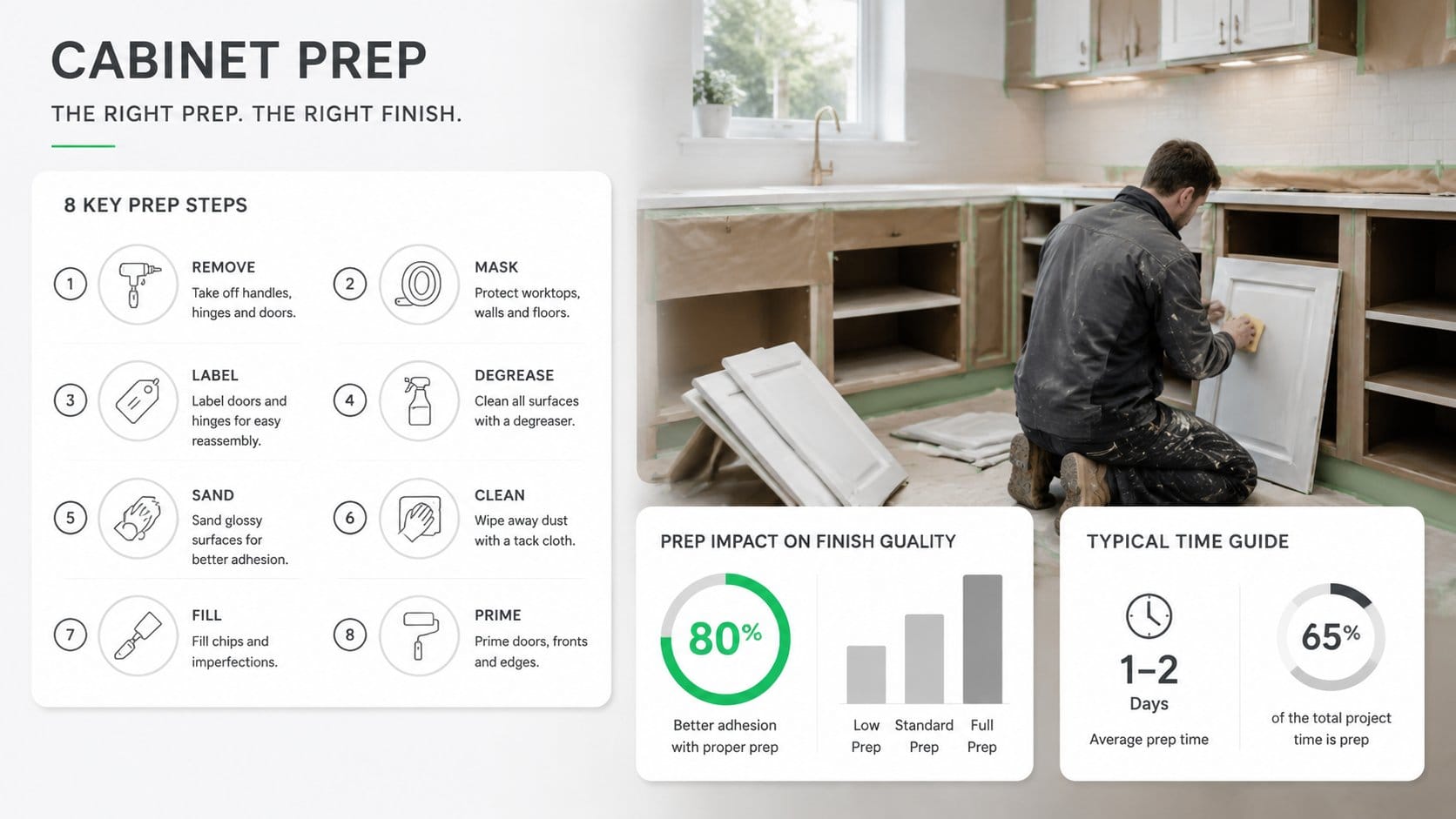
Preparation determines whether painted cabinets look intentional or improvised. Irish guidance from Woodie's on painting kitchen cabinets follows a clear sequence: remove doors and hardware, degrease, sand, remove dust and prime before applying the finish. The same principle appears in McDonnell Paints' cabinet-painting guide, which recommends fine-grade sanding followed by a thorough wipe-down before painting.
Remove, label and protect
Take off doors, drawers, handles and hinges where possible. Number each door and its matching cabinet, place screws and hinges in labelled bags, and photograph the layout before removal. This prevents a surprisingly common reassembly problem, especially where doors look identical but hinge positions differ slightly.
Protect the room before sanding or spraying. Mask worktops, appliances, walls and floors carefully. The Paint Shack's Irish cabinet guide specifically discusses masking tape, rosin paper, plastic sheeting and primer as part of protecting the kitchen during the work.
Degrease before sanding
Kitchen grease collects around handles, drawer edges, hobs and extractor areas. Ordinary soapy water may leave a film behind, so use sugar soap or a suitable cabinet degreaser and work methodically across every paintable surface. Rinse where the product requires it, then allow the substrate to dry fully.
Silicone residue near handles and splashbacks creates another adhesion problem. Paint won't bond reliably to a contaminated surface, so residue needs to be removed rather than painted over.
Key the surface and remove dust
Glossy varnish and melamine need a mechanical key. McDonnell Paints Ireland recommends 80 to 100 grit sandpaper for improving adhesion, followed by wiping down with methylated spirits and allowing the surface to dry. The aim is to remove sheen and create a uniform surface, not necessarily to strip every coating back to bare timber.
After sanding, remove dust with a tack cloth or an appropriate clean, lint-free cloth. Dust left on a door becomes visible texture under the finish and can interfere with primer adhesion.
Prime defects and exposed edges
Apply a primer designed for the substrate. MDF edges may need stain-blocking treatment, while slick laminate and melamine need a bonding primer. Fill chips, dents and old handle holes before priming, then sand repaired areas smooth once dry.
For local service options, painting services Ireland local pros can help homeowners compare painting and decorating providers across Ireland. The key question remains the same for every quote, whether the work is sprayed off-site or painted in place: does the preparation address grease, sheen, dust, repairs and exposed board edges?
Choosing the Right Paint System and Finish
Standard wall emulsion is the wrong product for kitchen cabinets. It's designed for walls, not surfaces exposed to repeated hand contact, grease, cleaning and steam. B&Q Ireland's cabinet-painting advice recommends an interior furniture paint for cupboard projects because durability matters more than covering the old colour.
A cabinet system should normally include a suitable primer and durable finish coats. Irish guidance commonly recommends two finish coats, with some products requiring a six to eight-hour recoat window depending on drying conditions. The product data sheet should control the schedule, not a desire to finish quickly.
Paint systems for kitchen cabinets compared
| Paint System | Adhesion to Melamine | Grease and Steam Resistance | Cure Time | Best For |
|---|---|---|---|---|
| Water-based cabinet enamel | Good when paired with thorough cleaning, sanding and bonding primer | Good when fully cured and maintained correctly | Follow the product specification | Homeowners wanting lower odour and easier cleaning |
| Alkyd or oil-based enamel | Can level well on prepared surfaces | Strong surface performance, but drying and odour require planning | Usually slower than water-based systems | A smooth, hard-wearing finish where ventilation is available |
| Dedicated furniture paint | Product-dependent, with substrate preparation still important | Suitable only when the product is designed for cabinetry and used correctly | Varies by system | Decorative refreshes with a clearly specified furniture coating |
| Standard wall emulsion | Poor choice for high-touch cabinet surfaces | Not intended for repeated cabinet handling and cleaning | Not the relevant selection criterion | Walls, not kitchen doors and drawers |
A satin finish is the practical default for most Irish kitchens. Matte finishes hide minor surface irregularities but can mark more readily, while gloss highlights every sanding defect and repair. Homeowners comparing sheen levels can use this guide to semi gloss or satin for kitchen, but the final choice should match the paint system and the quality of the preparation.
Primer isn't optional on melamine, laminate or glossy varnish. A bonding primer creates the adhesion base, while a stain-blocking primer helps control bleed-through from repaired areas and MDF edges. Moisture-resistant products are sensible in kitchens, but the coating still needs airflow and proper curing. Steam, washing and frequent touching can soften or mark an under-cured film regardless of its colour.