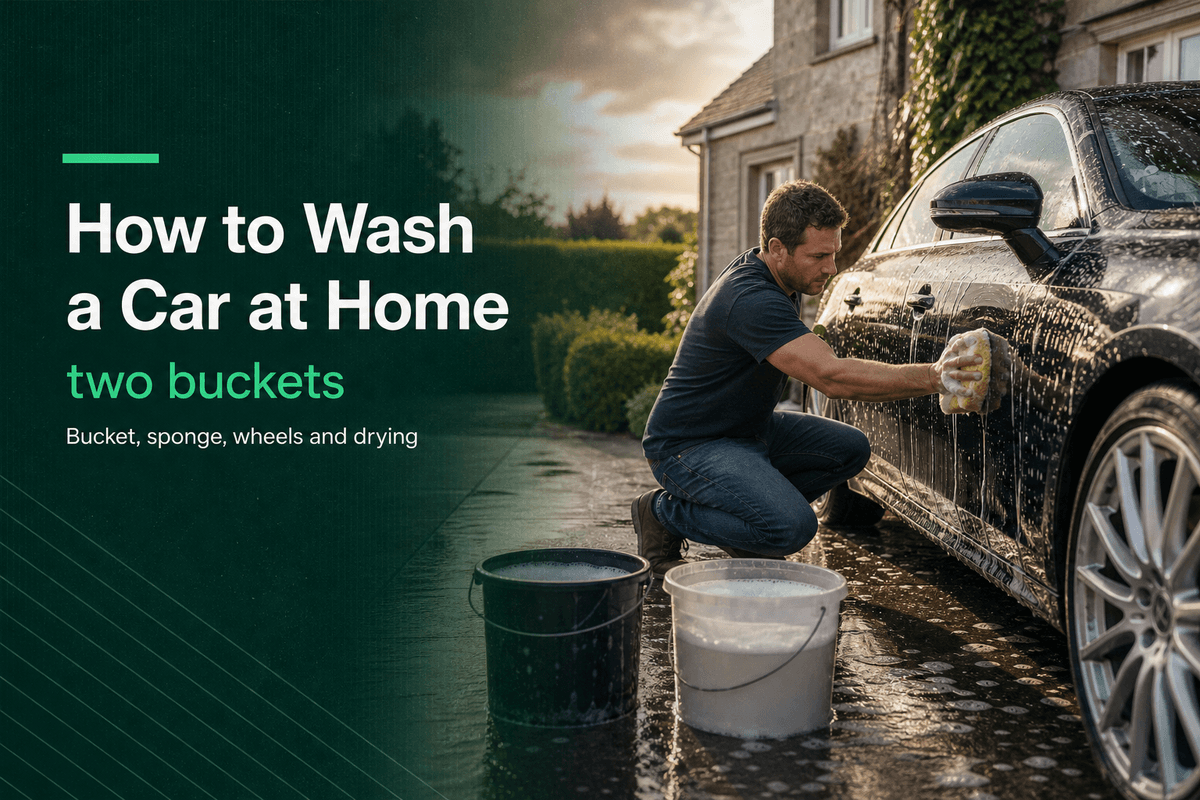
Wash a car with a bucket and sponge rather than a hose, work top to bottom with car shampoo, and keep wheel water off the paint.
/8 min read
Washing a car at home comes down to three habits: use a bucket and sponge rather than a hose, work from the roof downwards with a proper car shampoo, and keep wheel water away from paintwork. Done in that order, the job needs one bucket of soapy water, one bucket of rinse water and a soft sponge, and it leaves the paint far less marked than a quick pass with a hose. The same routine keeps paint, wheels and the underside in better shape through an Irish winter.
Start With a Bucket and Sponge, Not a Hose
Government advice for households is to wash a car or windows with a bucket and sponge instead of a hose Government of Ireland. A bucket uses far less water than a running hose.
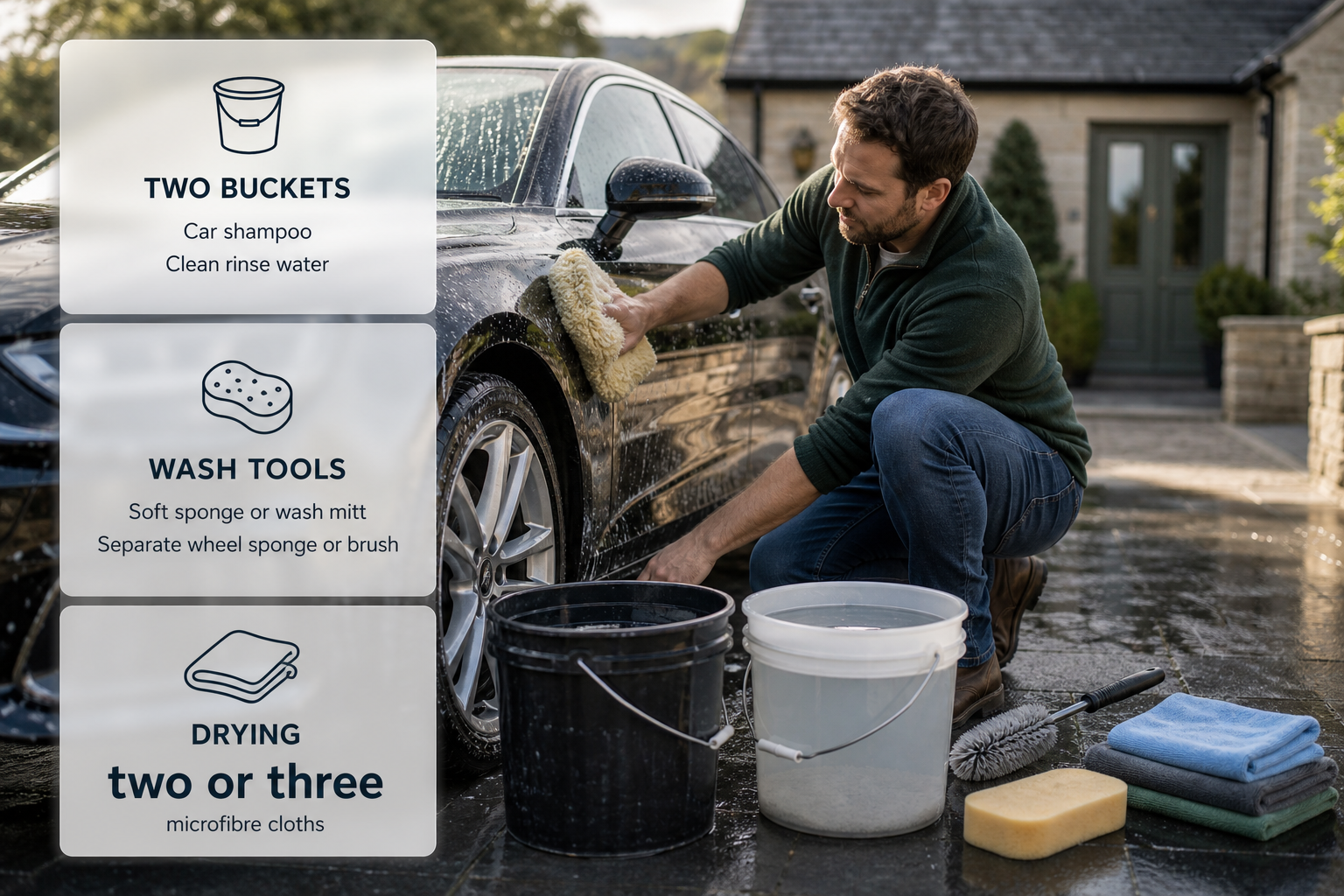
Set out two buckets — one with car shampoo mixed to the dilution printed on the label, and one with clean water for rinsing the sponge between panels. A large soft sponge or a wash mitt, a separate sponge or soft brush for the wheels, and two or three microfibre cloths for drying cover the whole job. Generic car shampoo is the correct product. Household washing-up liquid strips wax, dulls paint over time and can affect rubber seals and trim, so it belongs in the kitchen rather than the driveway. Owners who would rather hand the work over can find car wash and detailing help locally.
Work in shade where possible. Direct sun dries the shampoo before it can be rinsed, and it makes the whole job harder than it needs to be.
Wash From the Roof Down
Rinse the car first only when it is carrying loose grit, dried mud or a heavy film of road spray. A car with light dust can go straight to the soap bucket, which keeps water use down. When a pre-rinse is needed, use the bucket of clean water rather than a long hose pass, and keep it brief.
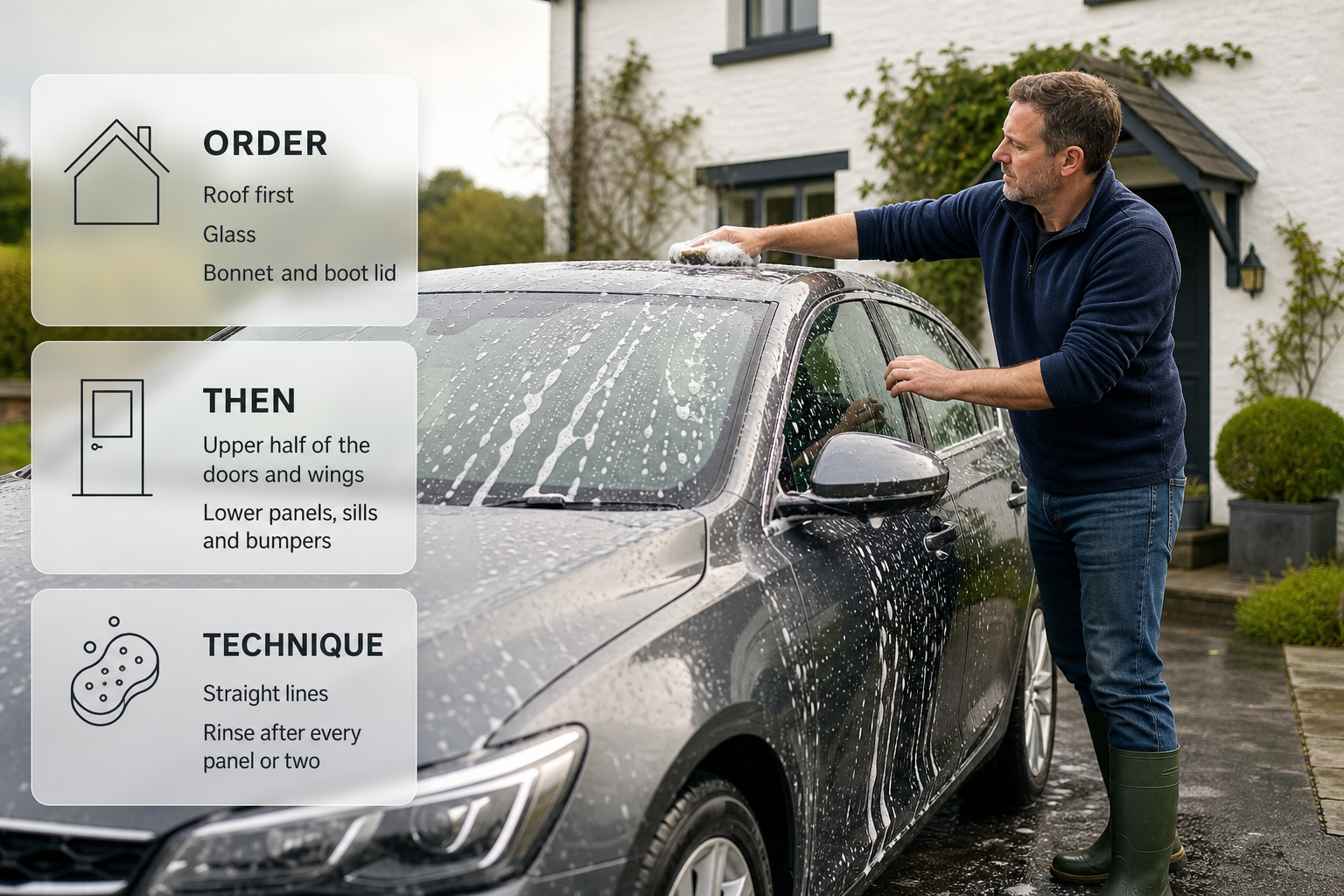
Once the soapy sponge is loaded, follow a fixed order: roof first, then the glass, then the bonnet and boot lid, then the upper half of the doors and wings, and finally the lower panels, sills and bumpers, which collect the most road grime. Working top to bottom means the dirtiest water runs over the dirtiest panels last, not over freshly cleaned paint.
Use the sponge to carry soapy water across the panel rather than scrubbing at dry dirt. Move it in straight lines instead of circles, and rinse it in the clean bucket after every panel or two. Grit trapped in a sponge is what causes swirl marks, so shake the sponge out and change the rinse water if it turns grey. Car shampoo is formulated to lift dirt and rinse away without stripping any wax or sealant underneath, which is another reason to leave detergents out of the bucket.
Do not let shampoo dry on the paint. Keep each panel wet, work steadily, and move on before the solution flashes off.
Rinse by pouring a bucket of clean water gently over each panel, keeping a hose out of the job where possible. Then dry with a microfibre cloth or a chamois, starting at the roof and working down, wringing the cloth out as it loads up. Letting a car air dry leaves water spotting, particularly where the local supply is hard, and it undoes much of the care taken during the wash.
Clean the Wheels With Their Own Water
Wheels should be cleaned with their own bucket, their own sponge or brush, and their own water. Do them before the paintwork so that any spray from the arches can be rinsed away as the body is washed, and keep the body sponge well away from wheels once it has touched brake dust.
Wheel cleaner or the same car shampoo, applied with a soft brush, is enough for most alloys. Brake dust, road grit and iron particles sit in the wheel wells and on the inner rims, so a brush that reaches behind the spokes pays off. Rinse the arches as well as the wheels, and check the tyre sidewalls, where a film of grime collects and streaks the paint after rain. Never use the wheel cloth on the body afterwards, and never use an aggressive acid-based cleaner on painted or lacquered alloys without checking the label first.
Inside the Car in Brief
Vacuum the carpets, seats and boot, and wipe hard surfaces and glass with a damp microfibre cloth. Shake the mats out outside the car rather than washing them over the interior. Stains, pet hair and fabric or leather seats are covered in how to clean car seats, and prices for a professional valet are in car interior cleaning cost.
How Often Should an Irish Car Be Washed?
Irish weather rarely leaves a car alone: rain does not clean paintwork, it leaves deposits behind and does nothing about the film of grime that builds on the lower panels. Rather than following a fixed calendar, most owners are better off washing when the car shows the signs — dull, gritty lower panels, a grey film on the glass, or a build-up of road spray along the sills. Cars parked near the coast collect salt-laden air on paint and glass and tend to need attention sooner than cars kept inland, and cars left under trees pick up sap and droppings that are worth lifting off promptly.
Bird droppings, tree sap and insect remains deserve quick attention whenever they appear, since they etch into lacquer if left. Soften them with water first and lift them off rather than scraping. Owners who want the work handled locally can browse automotive services to see what is available in their area.
Winter Salt and Underbody Rinsing
Salt and grit spread on Irish roads in cold spells are the biggest seasonal threat to a car's bodywork. Salt holds moisture against metal and speeds up corrosion, which is why the underside of a car needs attention as well as the paint.
Rinse the wheel arches, sills, behind the bumpers and the visible parts of the underbody after a spell of salt spreading, ideally once the temperature is above freezing so that water does not freeze in locks, seals, door handles or brake components. A bucket of clean water poured through the arches, or a brief low-pressure rinse, is enough. Keep high-pressure jets away from paint edges, door seals, badges, electrics and any cracked or chipped paint, where water can be forced underneath and start trouble. Cold water on cold glass is safer than hot water, which can crack a windscreen through thermal shock.
A wash after a run on salted roads also protects the wheel finish, since brake dust and salt combine into a paste that clings to alloy and is far harder to shift once it has dried on.
Keep Dirty Wash Water Out of Drains
Wash water carries shampoo, wax and road grime, and it should not be tipped into a surface-water drain, a stream, a river or a shoreline gully. Washing on gravel or grass lets the water soak away, and where that is not practical the run-off can be collected in a basin or bucket and emptied onto a garden bed. Anyone unsure whether a local restriction on outdoor water use applies where they live can confirm it with the relevant Irish local authority.
Handing the Job to a Local Car Wash or Detailer
Some jobs are better handed over: heavy tar deposits, machine polishing and paint correction, deep interior valeting, and any car with a ceramic coating, a wrap or a matte finish, all of which need products and techniques beyond a home bucket wash. A regular wash, a wheel clean and an underbody rinse are well within reach of most owners with an hour to spare.
ShamFix is an Irish marketplace where homeowners post jobs and local tradespeople respond. Posting a job and listing on ShamFix is free, with no commission, and a subscription is planned for the future. ShamFix does not check or certify tradespeople and profiles are filled in by tradespeople themselves, so homeowners should check registrations themselves and read reviews. The ShamFix home page is the place to start.
FAQ
What can be used instead of car shampoo?
Nothing in the kitchen cupboard is a good substitute, because detergents strip protection from the paint. If shampoo has run out, plain water and a very soft cloth on a small, lightly soiled area does less harm than a strong cleaning product, and the full wash can wait until proper shampoo is bought. Buy shampoo in concentrate form and mix only what is needed for one wash.
Can a car be washed in direct sunlight?
It can, but the results are usually worse. Shampoo dries on contact with hot panels and leaves streaks that have to be polished out, and water evaporates before it can be dried off properly. Early morning, late evening or a shaded side of the house avoids both problems, and working one panel at a time keeps the surface wet throughout.
How do I stop a sponge from scratching the paint?
Rinse the sponge in the clean bucket after every panel and shake out any grit before it goes back on the paint. A wash mitt with longer fibres lifts grit away from the surface more effectively than a flat sponge, and straight strokes cause less visible marking than circles. Anything dropped on the ground should be rinsed thoroughly before it touches the car again, and a sponge that feels gritty should be replaced.
Is waxing needed after every wash?
No. Washing and protecting are two separate jobs: wax or sealant goes on dry paint, in the shade, in a thin coat, and is left to cure rather than being wiped off wet. Cars with a matte finish, a wrap or a factory coating usually have their own care instructions, so those should be followed rather than a general wax. Skipping wax entirely simply means cleaning takes a little more effort next time.
Should the car be dried, or is air drying fine?
Drying is part of the wash, not an optional extra. Water left to evaporate leaves mineral spotting, which is worst where the supply is hard, and it shows most on dark paint and glass. A microfibre cloth wrung out regularly, worked from the roof downwards, removes the bulk of the water quickly and lifts the last of the shampoo residue with it.