
Trimming a hedge well comes down to three things: cutting on a dry, still day when nothing is nesting in the hedge, matching the tool to the thickness of the growth, and shaping the hedge so light reaches its base. Work the sides first and the top last, take off a little at a time, and keep both feet on the ground wherever you can. Homeowners who would rather not spend a weekend on it can post the job for local hedge cutting and boundary maintenance on ShamFix.
How to trim a hedge, step by step
The same method works on a small box hedge in a front garden and on a long boundary hedge; what changes is the tool and how far you have to reach.
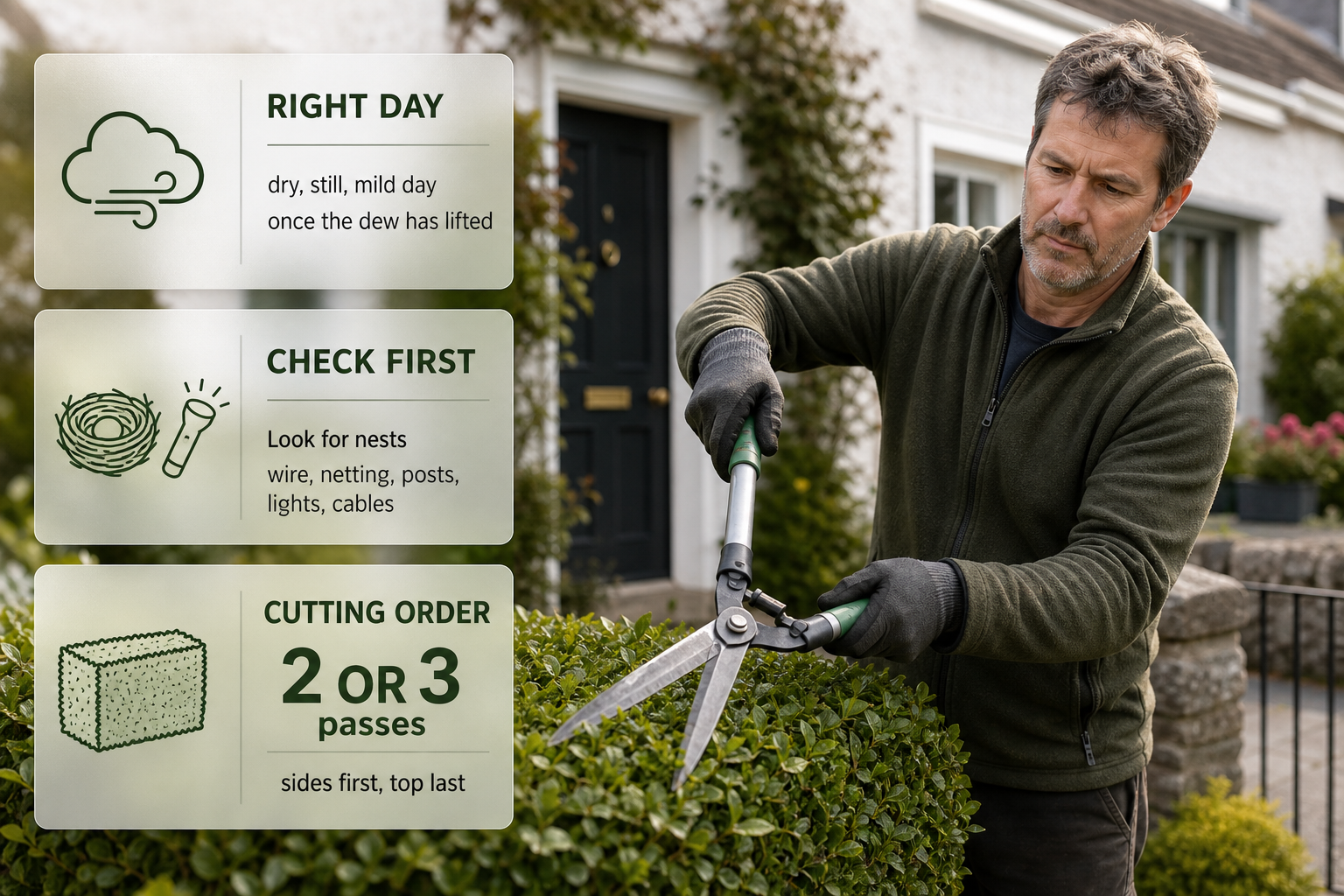
Pick the right day. Choose a dry, still, mild day and start once the dew has lifted. Wet foliage is slippery, clippings stick to the blade, and wind carries cuttings over a boundary. Leave the hedge alone during a cold snap, because fresh cuts take longer to heal on frozen wood.
Walk the hedge before you cut. Look into the top and around the base for nests, and check the line for fence wire, netting, posts, garden lights, low cables and any dead or storm-damaged sections that need a saw rather than a trimmer. If you find a nest holding eggs or chicks, stop and leave that part alone. In Ireland, hedgerows are protected for wildlife and cutting is restricted while birds are nesting, with only limited exceptions, so the local authority and the relevant public body are the ones to confirm the current position, the exceptions that may apply to your own situation and where to report suspected illegal cutting.
Protect yourself and the ground. Gloves, eye protection and sturdy boots are the minimum, plus ear defenders and a dust mask for powered work and dusty conifer hedges. A corded tool used outdoors should run through a residual current device, with the cable kept behind you. Lay a tarpaulin or an old sheet under the hedge, move cars and furniture, and tell someone that you are working outside. Never use a ladder on your own.
Match the tool to the growth. Hand shears suit small hedges, topiary and light tidying; secateurs and loppers cut individual stems; a pruning saw takes what the loppers cannot. For powered work, a corded electric trimmer suits a small hedge within reach of a socket, a battery trimmer suits a medium garden where quiet running matters, and a petrol trimmer suits large or thick rural boundaries. A long-reach or pole trimmer lets you cut a tall top with both feet on the ground. Sharp blades cut cleaner and are safer than blunt ones.
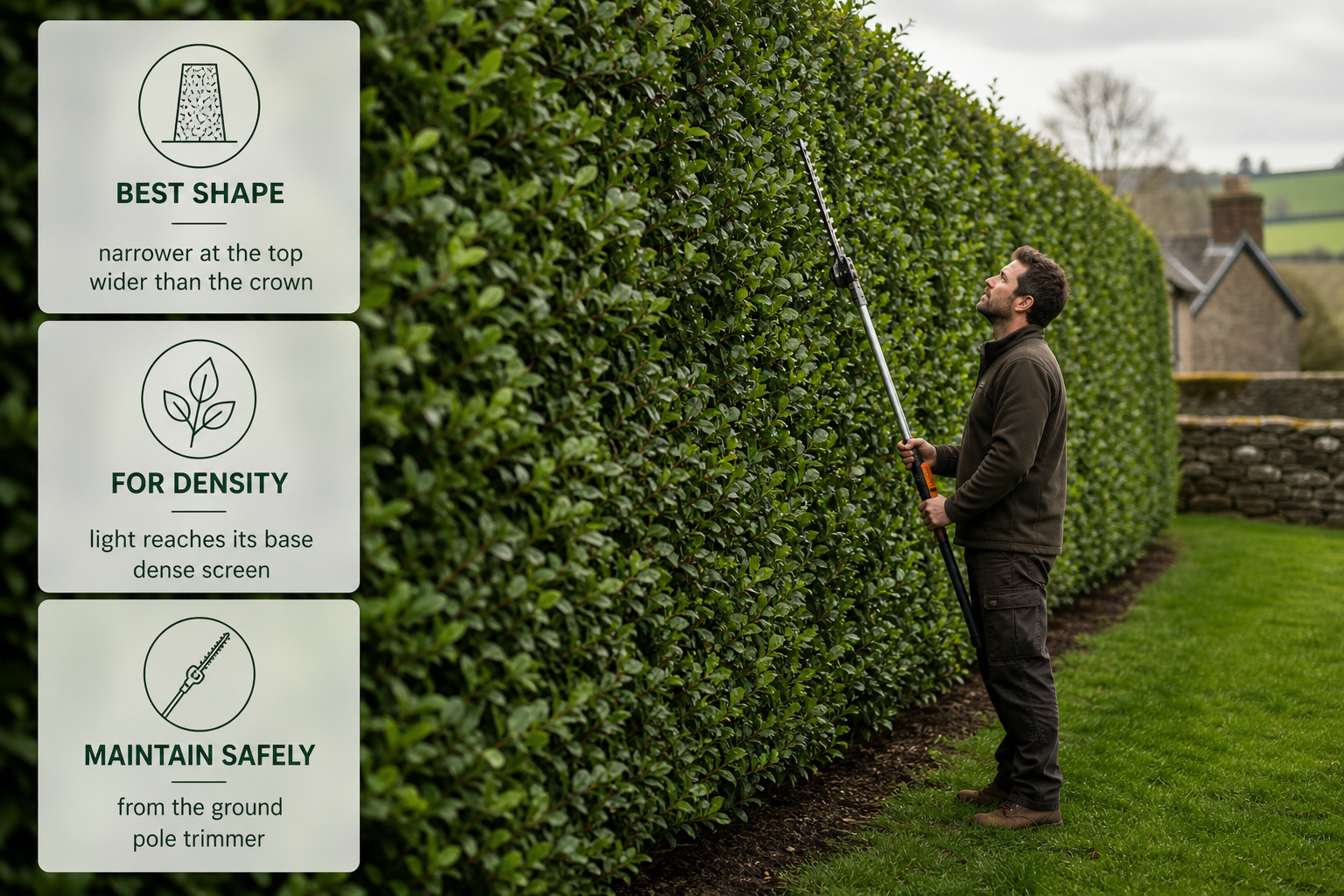
Set your lines before you cut. Push two canes into the ground at either end of the hedge, run a string line between them at the height you want the top to finish, and check it by eye from several paces back. The sides should slope very slightly inwards towards the top so the base stays wider than the crown.
Cut the sides first, from the bottom up. Hold the trimmer flat against the face of the hedge and sweep it in smooth arcs, letting the blade do the work rather than pushing it into the growth. Take the hedge back in two or three passes instead of one deep bite, and keep the blade from crossing in front of your body.
Cut the top last. Work along the string line, stepping sideways as you go and keeping both hands on the machine. A heavy trimmer should never be used above shoulder height — that is the moment to switch to a pole trimmer or to stop. Trim in short overlapping passes and step back regularly to check the line.
Take off a little and often. Regular light trimming keeps the outer shell of a hedge dense. Never cut into the brown, bare interior of leylandii, cypress or yew, because those conifers will not reshoot from old wood. Privet, beech, hornbeam, hawthorn, laurel and box will regrow from older wood if you cut back to a point where some green growth remains.
Clear up and finish properly. Rake the clippings onto the sheet and tip them into a bag or barrow; sweep the path, the road edge and any clippings that fell on the neighbour's side. Soft green clippings can be composted and the rest can go to the local recycling centre or green-waste collection. Clean the blades, let them dry and oil them before storage so they do not rust. The hedge itself needs nothing on the cut faces — leave them to harden off on their own.
Shaping a hedge for privacy, density and healthy regrowth
A hedge stays dense when light reaches its base, so shape matters more than the number of cuts. Give the sides a gentle batter — narrower at the top than at the bottom — and the whole face fills with leaves instead of thinning to bare twigs near the ground. Keep the finished height at a level you can maintain from the ground with a pole trimmer, because a hedge that needs a ladder every year slowly gets away from its owner.
Trim the sides lightly and regularly rather than saving them for one heavy cut; light, frequent cutting builds dense growth along the outside of the hedge and keeps each session short. A hedge that has been let go for years is best reduced in stages rather than cut back to size in a single session. For privacy, a dense screen works better than a merely tall one, and a very slightly domed top sheds water and looks softer than a razor-flat line. Cut the garden side first, then the outer face, so you can judge the line from both directions.
How often to trim common hedges in Irish gardens
The species sets the general rhythm, although growth rate, shelter and how formal you want the hedge to look all shift it.
| Hedge type | Typical trimming rhythm |
|---|---|
| Privet | Two or three light cuts from late spring to early autumn; fast growing and quick to look untidy. |
| Leylandii, cypress and other conifers | Regular light trims through the growing season, staying strictly within green growth. |
| Beech and hornbeam | One cut in late summer; the dead leaves hold on through winter to keep screening. |
| Hawthorn, blackthorn and whitethorn boundaries | One cut once the birds have finished nesting and before growth slows in winter. |
| Laurel and griselinia | One or two cuts a year, with loppers or a saw for thicker stems. |
| Box and small topiary | Two light trims with hand shears for a crisp finish. |
Most garden hedges grow between spring and early autumn, so that is when the work clusters, and a hedge cut once a year is quicker to keep level than one that is ignored for longer. Longer rural boundaries, roadside hedges and field hedgerows need different timing, equipment and access, and are usually handled as part of wider rural maintenance — see agriculture and rural services on ShamFix.