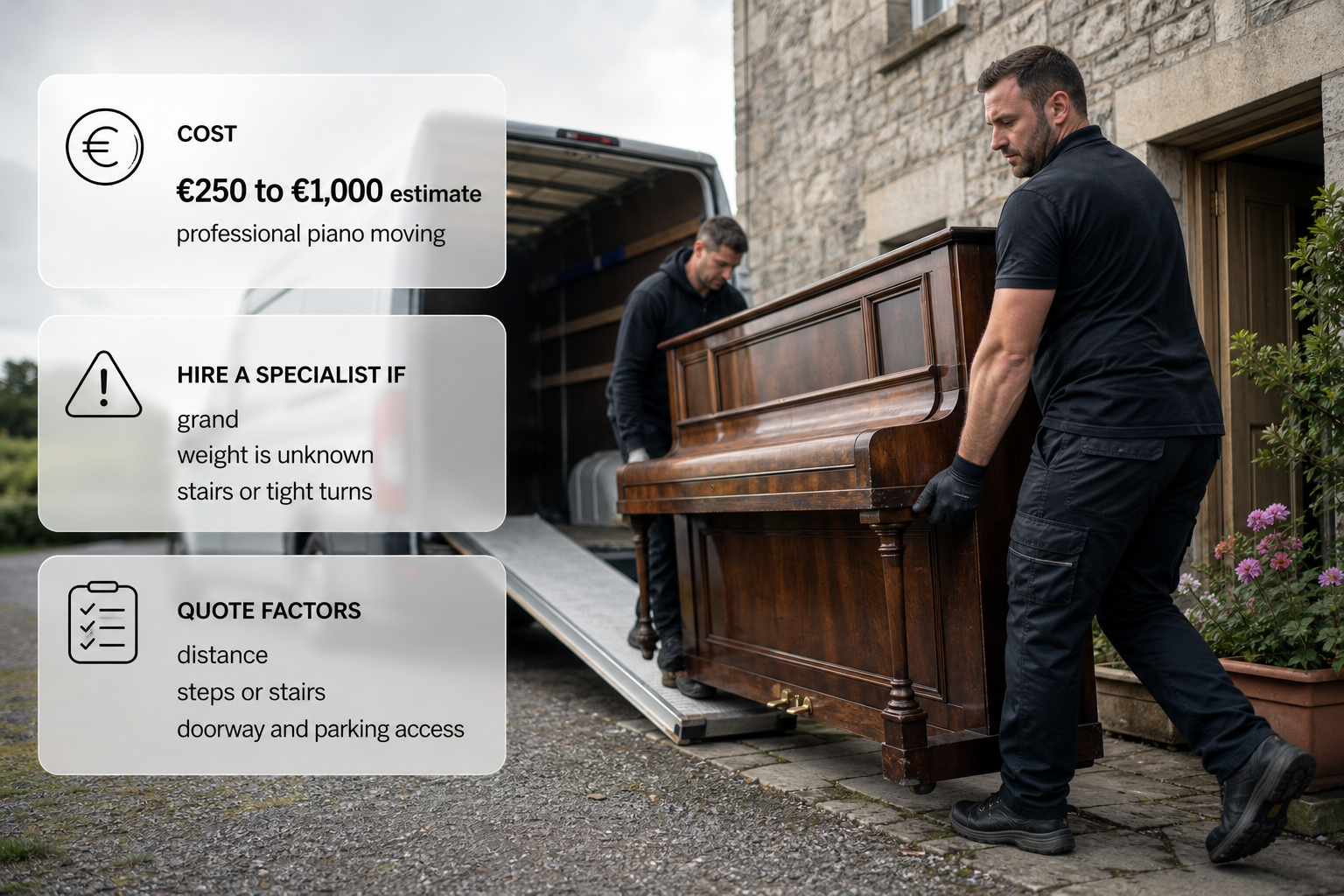
Moving a piano is a reasonable DIY job only when a small upright is going along a short, level route with enough capable helpers and the right equipment, such as a piano skate, dolly and straps. It is not reasonable if the piano is a grand, its weight is unknown, or the route involves stairs, tight turns, a long carry or lifting over obstacles. Homeowners who would rather have the lifting and transport handled can compare local heavy item moving services for the job.
Moving a piano yourself: the step-by-step method
Use this method only when the piano is a small upright on a strong, level floor, the route is short and flat, there is room for the piano and the people steering it, and a dolly or skate with straps and padding is available. If any of that fails, stop and go to the section on specialist movers.
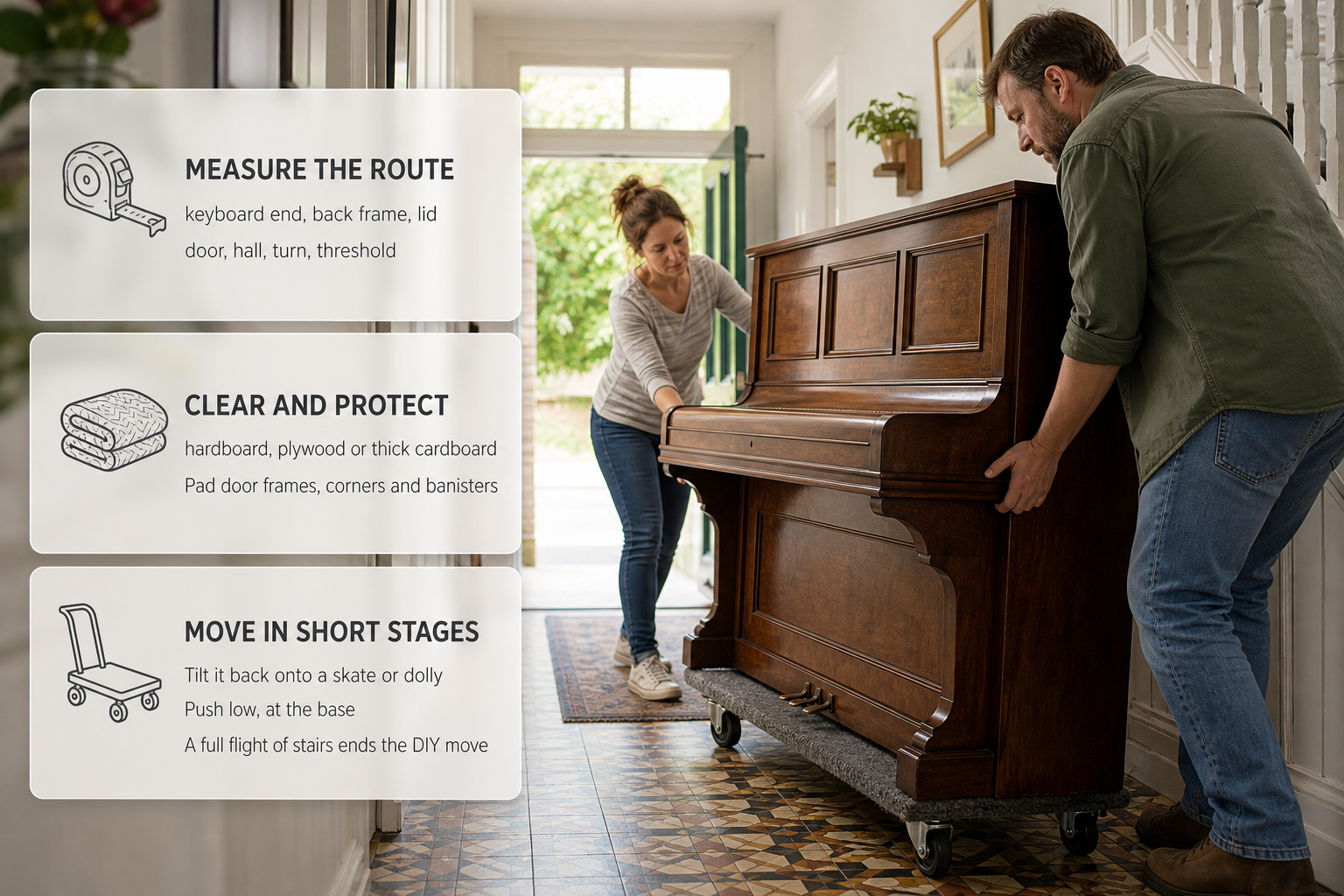
1. Measure the piano and the whole route. Measure the piano at its widest points: keyboard end, back frame, lid and the height from the floor. Then measure every door, hall, turn, threshold and van opening. The figure that matters is the diagonal of an opening, not just its width, because the piano passes at an angle. Walk the route and note anything that has to be lifted over.
2. Clear and protect. Take up rugs and mats, and move cables, toys and anything breakable. Lay hardboard, plywood or thick cardboard along the whole route and tape the edges down so the sheets cannot slide. Pad door frames, corners and banisters with blankets or cardboard and tape them in place. Work in good light and keep children and pets out of the way.
3. Wrap and secure the piano. Lift everything off the top. Close and strap the lid so it cannot swing open. Wrap the body in moving blankets and hold them with stretch wrap, keeping the wrap away from the keys and pedals so nothing is marked or bent. Never put tape directly on a polished finish.
4. Tilt it back onto a skate or dolly. This is the move that replaces lifting: the piano is not carried, it is tipped and rolled. One person controls the top of the piano while others steady the base, and the piano is tilted back only as far as it needs to be for a piano dolly or skate to slide under the base. Never lift by the lid, keyboard, legs or pedals, and never let the piano go past the point where it still balances.
5. Move in short stages. Push low, at the base, never at the top. Move a short distance, stop, check the line and the clearance, then continue. Turn slowly and never twist the piano on one corner or caster. It stays upright and balanced throughout.
6. Cross steps with a ramp or board, not by lifting. A single step or a low threshold can be crossed with a ramp or a thick board that is rated for the load and fixed so it cannot slip. Keep one person above the piano controlling a strap, and let nobody stand downhill of it. A full flight of stairs ends the DIY move.
7. Load and secure in the van. Push the piano base-first up a secured ramp with one person at the side controlling the tilt. Inside the van, strap it at the base and around the body to the van's anchor points, never across the lid or keys, and always put blankets between the straps and the piano. Keep the weight low and check every strap again before driving off.
8. Unload in reverse. Reverse the route at the far end: ramp first, then the protected floor, then the final position, and only then remove the dolly.
Key risks
Pianos are heavy, awkward and fragile in ways that are not obvious. The usual injuries are back and shoulder strains, crushed fingers and toes, and falls on steps; the usual damage is to walls, door frames, floors and banisters, as well as to the piano itself. The parts most often broken are the legs, pedals, lid, music desk and casters. A piano can run away on a slope or a step, and it can tip over if it is pushed from the top or turned too quickly.
Wear gloves with grip, safety boots and eye protection when cutting wrap, and agree before starting that anyone who cannot hold the load should say so straight away.
Pre-move checks
- Confirm the make and model if you can, and find an approximate weight. If the weight cannot be confirmed, treat the piano as too heavy for a DIY move.
- Measure the entire route, including the turn at the bottom of the stairs, the lift door, hall furniture and the vehicle opening.
- Look at the floor. A solid floor is easier than soft suspended timber boards, which a dolly wheel can mark or crush.
- Clear trip hazards and check the forecast, because a wet path or hallway is slippery underfoot.
- Ask helpers who can physically push and steady a heavy load, and name one person as the leader who gives the instructions.
- Organise access and parking. On many Irish streets and in apartment blocks the van needs to get close to the door, so check for yellow lines, disc zones and clamping, and have keys, alarm codes and lift access ready before the piano moves.
- Photograph the piano and the route beforehand, and note any existing marks.
Uprights and grands are different jobs
An upright piano has its weight low and a strong back frame, so it can be tilted onto a dolly and rolled. It should not be laid flat, and it must never be carried by its legs, lid or keyboard. Take off the music desk and any loose items on top first.
A grand piano is a different proposition. Its legs, lyre and lid usually have to come off and the body has to be supported on a piano board or skid, with reassembly and sometimes regulation afterwards. Homeowners should not dismantle a grand themselves. Even a small grand is a specialist lift, because of where its weight sits and how long the body is when it is angled through a door.
Doorways, stairs and narrow corners
At a doorway, measure the clear width with the door open, the height, and the diagonal from floor to top corner, because the piano only passes if the body can be angled through the frame. Removing the door, and sometimes the frame trim, can add the last few centimetres, but only if it can be refitted safely afterwards.
At a tight corner, walk the path with an empty dolly first. There has to be room for the dolly and for the people steering it. Pad the corner, pivot in small stages and never twist the piano's frame. Where a flight of stairs is involved, the sensible answer is a specialist with a stair-climbing dolly, or a crane where access demands it, and homeowners can compare moving and transport services for that kind of job. Sliding a piano down a bare staircase is never acceptable: a piano on stairs can run away, crush a hand or fall on the person below.