Measure width and height at three points, record the smallest figures, and choose inside or outside fit before ordering blinds.
/11 min read
Measuring for blinds is mostly about deciding where the blind will sit and then taking the smallest reliable width and height in millimetres. The first choice is inside fit, where the blind sits within the window recess, or outside fit, where it overlaps the wall or frame. Getting that decision right before measuring prevents most ordering mistakes, and for homeowners who would rather not fit the blind themselves, a local blinds and curtains installation service can check the figures before anything is made.
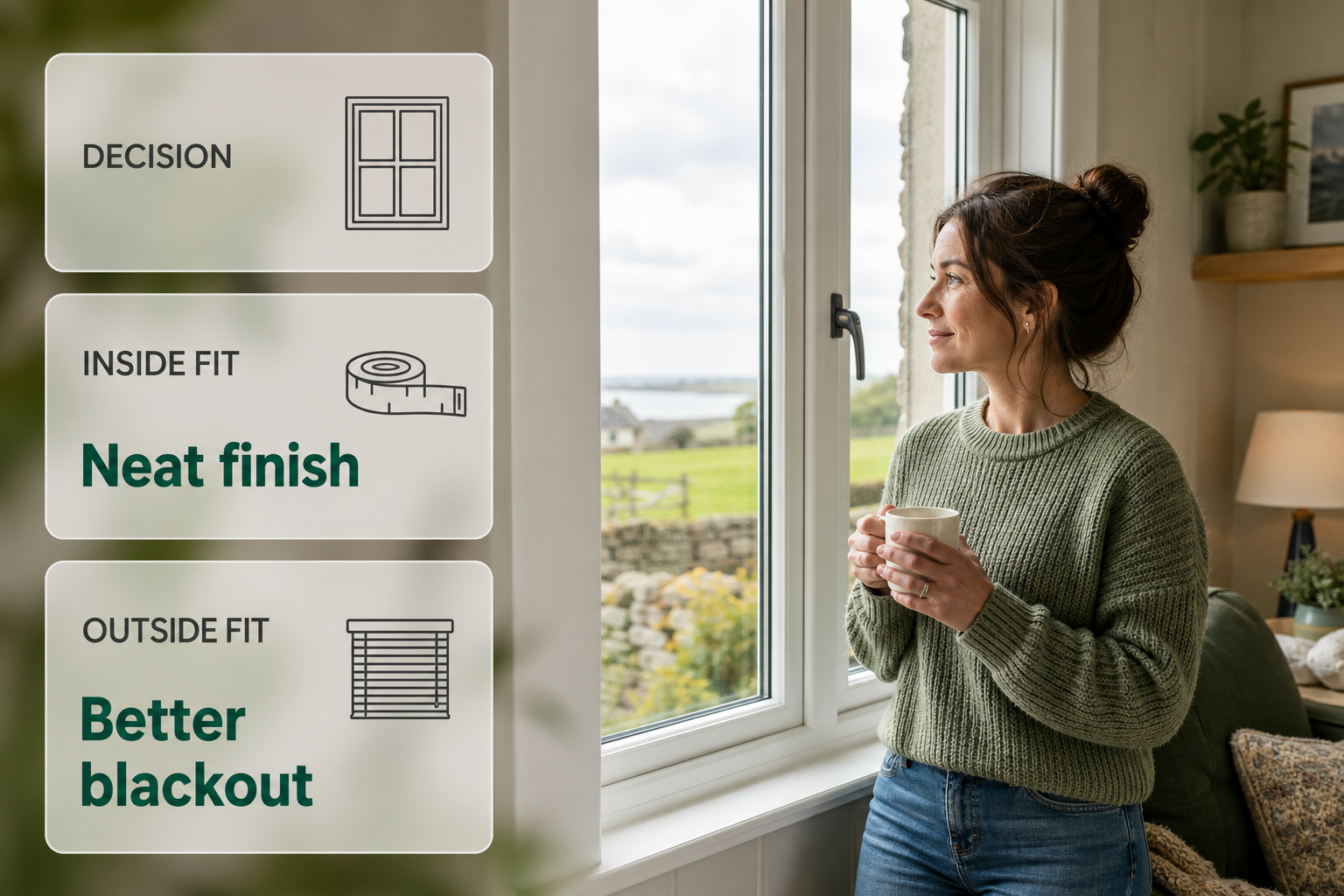
Inside fit or outside fit: the first decision
An inside fit, also called a recess fit, places the blind inside the window opening. It gives a neat finish, keeps the blind clear of curtains and wall space, and suits windows with a recess deep enough to hold the headrail and brackets. It is often the better choice for living rooms, dining rooms and bedrooms where the reveal is straight and unobstructed. Inside fit is less suitable when the recess is shallow, when a window handle protrudes, or when maximum blackout and privacy are needed because light can escape around the edges.
An outside fit, also called a face fit, places the blind in front of the window recess and overlaps the wall or frame on all sides. It suits shallow recesses, windows with handles or vents in the way, and rooms where blackout coverage matters, such as bedrooms. It also works well over tiled bathroom or kitchen walls where the blind must sit forward of the tiles. The trade-off is that the blind sits proud of the wall, so it needs enough clearance from curtains, radiators, sockets and furniture.
For each window, ask one question: is there a clear, deep recess that can take a blind without touching handles or opening sashes? If yes, inside fit is usually possible. If no, outside fit is usually safer. Measure for both options if the choice is close, then decide once the figures are in front of the homeowner.
Tools and one unit: work in millimetres
A steel tape measure is the most reliable tool because cloth tapes can stretch. A step ladder, pencil, notepad or phone, and a small torch for dark recesses are also useful. A spirit level can help check whether the window reveal is level, but it is not essential for measuring.
Use millimetres consistently. Millimetres avoid the conversion errors that happen when one figure is written in centimetres and another in millimetres. If the tape only shows centimetres, write the figure down and convert every measurement to millimetres before ordering. Record width first, then height, and note whether the figure is for an inside or outside fit. Also note the window location, such as front bedroom left window, so the numbers do not become mixed up.
How to measure a standard window for an inside fit
Start by checking the recess depth. The blind headrail, brackets and any control mechanism need to fit inside the recess without hitting the window or handle. If the recess is too shallow, an outside fit may be the only practical option.
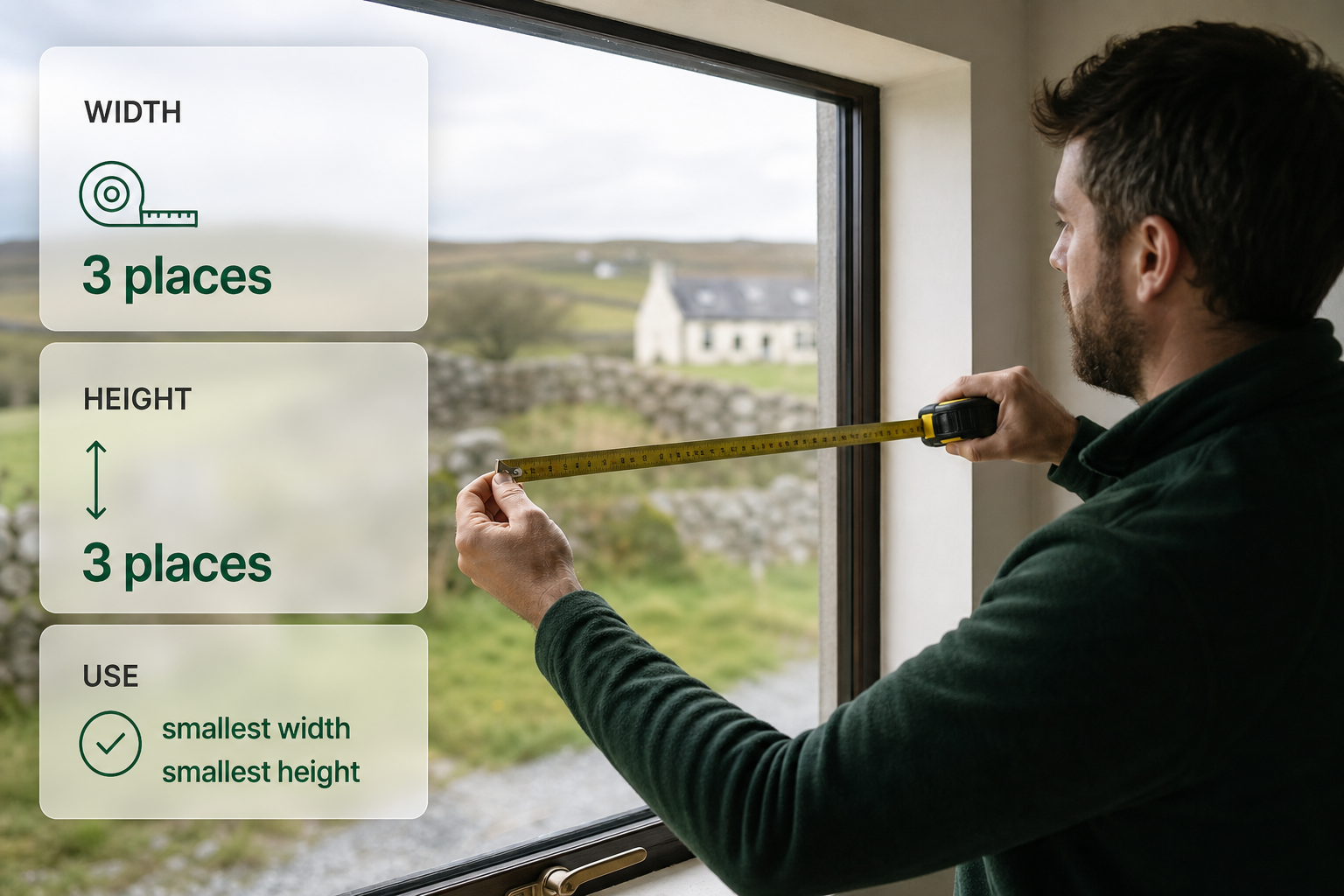
Next, measure the width of the recess in three places: near the top, in the middle and near the bottom. Write down all three figures. The smallest of these is the safe width for an inside fit because it is the narrowest point the blind must pass. Do not use an average.
Then measure the height of the recess in three places: left side, centre and right side. Again, record all three figures and use the smallest as the safe height. This matters on older Irish homes where reveals can be slightly out of square or where plaster has been repaired unevenly.
Finally, check for obstructions. Window handles, trickle vents, hinges, tilt-and-turn mechanisms and security stays can all reduce the usable space. Measure how far each obstruction projects into the recess. If a handle sits inside the recess, an inside fit blind may knock against it when the window opens. In that case, an outside fit or a different blind type may be needed.
Record the final inside-fit measurement as width x height in millimetres, using the smallest width and the smallest height. If the supplier asks for the recess size rather than the finished blind size, say so clearly, because the supplier will apply its own deductions for brackets and operating clearance.
How to measure for an outside fit
For an outside fit, the blind covers the recess and overlaps the wall or frame. Start by deciding the top and bottom of the blind. The top is usually above the recess, high enough to clear the headrail and give a neat line. The bottom is usually below the sill or level with it, depending on the room and the look required.
Measure the width of the recess at its widest point, then add the overlap on the left and right. Measure the height from the chosen top point to the chosen bottom point. For blackout or thermal blinds, more overlap gives better coverage, but too much overlap can make the blind look bulky or clash with curtains. Check the projection of the window handle and the sill. If the handle sticks out, the blind needs to sit forward of it, or the handle will catch.
Outside-fit measurements are usually the finished blind size, but this can vary. Some suppliers ask for the recess size and then add their own overlap. Others ask for the exact finished width and height. Follow the supplier’s measuring guide rather than assuming. If the guide is unclear, provide both the recess size and the desired coverage and state that the fit is outside.
Bay windows and awkward shapes
Bay windows should be measured one section at a time. Do not measure across the whole bay unless a tracked blind is being fitted around the bay. For a standard three-sided bay, measure each window section separately, using the same three-point width and three-point height method. Write the position of each section, for example left, centre and right, so the order is clear.
Angled bays need extra care. Measure the width of each pane at the top, middle and bottom, and the height at the left, centre and right. Use the smallest width and height for each section. Check the depth of each recess and the angle between sections. If the sections meet at an angle, a blind fitted inside one section may clash with the blind beside it when both are lowered. A slim headrail or an outside fit may be needed.
Awkward shapes include arches, circles, trapezoids, dormer windows and windows set into sloping ceilings. For an arched or circular window, an outside-fit rectangular blind can cover the opening, but the homeowner must measure the widest point and the full drop, then check the supplier’s template requirements. For a trapezoid, measure the top width, bottom width and both side heights, then use the smallest height for an inside fit. For dormer or sloping-ceiling windows, check that the blind will not rub against the ceiling or roof slope when it is raised or tilted. For tilt-and-turn windows, measure the handle projection and the space needed for the window to tilt inwards.
Handles, deep sills and obstructions
Window handles are one of the most common reasons a blind order fails. Measure from the window frame or recess back to the front of the handle. If the handle projects into the space where the blind would sit, an inside fit is usually unsuitable. An outside fit can clear the handle, but the blind must sit far enough forward and the brackets must be fixed to a solid surface.
Deep sills matter for outside fits. A deep sill can push the blind forward, or the blind can sit on the sill and interfere with opening. Measure the sill depth and the projection from the wall. Also check radiators, sockets, curtain poles and furniture. A blind that overlaps a radiator can affect airflow, and one that clashes with a curtain pole will not hang cleanly.
Tight-fitting blinds can also help thermal performance. SEAI notes that blinds and shutters should be tight fitting, and that thermal performance may be improved by installing blinds, heavy curtains or shutters (SEAI). That does not mean every gap must be sealed, but it does mean an inside fit that leaves large gaps is not the best choice if warmth and draught reduction are priorities. An outside fit with sensible overlap is often better for bedrooms and living rooms used in the evening.
Rented homes and non-drill fittings
In a rented home, check the lease and get the landlord’s permission before drilling or fixing anything permanent. Non-drill options include tension rods, adhesive brackets, no-drill clips and frame-mounted fittings. These can work well for light blinds, but they have weight limits. A heavy blackout blind or a wide venetian blind may pull adhesive brackets away from the wall or frame.
Measure for non-drill fittings in the same way as a standard blind, but add checks for the fixing surface. A tension rod needs an exact recess width and enough recess depth to hold the rod under pressure. Adhesive brackets need a clean, flat, dust-free surface on the frame or wall. No-drill clips need a frame profile that matches the clip. If the recess is uneven, or the frame is narrow, the fixing may not be secure. In that case, a lighter blind, an outside fit on a flat wall, or a different window treatment may be safer.
If a rented home or an unusual window makes the job risky, the home services category on ShamFix lists local tradespeople who can measure, advise and install blinds and curtains. This is useful when the window is a bay, an arch, a dormer or a tilt-and-turn unit, or when the homeowner cannot drill.
Deductions and clearances by blind type
Deductions vary by blind type and by the manufacturer’s fitting method, so there is no single formula that suits every window. For an inside fit, the supplier may deduct a small amount from the recess width to allow for brackets, end caps or operating cords. For an outside fit, the homeowner usually adds overlap rather than taking a deduction. The safest approach is to read the measuring guide for the exact blind being ordered and follow it exactly.
Roller blinds often need side clearance for brackets, and the headrail depth must fit the recess. Vertical blinds need enough width for the headrail and enough clearance for the vanes to stack and rotate. Venetian blinds need depth for the slats to tilt, and they can be difficult in shallow recesses. Roman blinds need stacking space above the window when raised. Blackout and thermal blinds usually perform better with an outside fit and a modest overlap, but the supplier’s guide should confirm the exact figure.
Frame-mounted and glass-bead blinds need the frame depth and the bead depth measured carefully. These blinds sit close to the glass and can be a good choice for tilt-and-turn windows, but they depend on the frame profile. If the homeowner is unsure, the supplier or a local installer should check the window before the blind is ordered.
Checking and recording measurements
Write every measurement in millimetres as width x height, and label it inside fit or outside fit. Keep the three width figures and three height figures until the order is confirmed, not just the final smallest figure. If a measurement is close to a limit, take it again. Measure with the window closed, and then check how the window opens. A blind that fits when closed may still catch when the window is opened.
Take a photograph of the window and the tape measure in place if possible. Photographs help an installer or supplier spot an obstruction that the numbers do not show. Check the recess depth, handle projection, sill projection and any nearby radiator or socket. If two people can measure separately, even better. The final figure should be the smallest safe measurement for an inside fit, or the exact finished coverage for an outside fit.
Cord and chain safety for children
Looped cords and chains on blinds are a hidden danger to young children, especially those under three, because a child can get caught in a loop and be strangled (CCPC window blind safety). The CCPC advises securing any loop with a chain tidy, tension device or breakaway device, keeping cords and chains out of reach so they end at least 1.6 metres above the floor, and moving beds, cots and furniture away from windows. When choosing new blinds, it recommends cordless designs, or asking whether the blind meets EN 13120:2009+A1:2014 and the safety device meets EN 16433:2014 and EN 16434:2014.
This affects measuring as well as buying. In a child's room, note where the control will hang and where the cot or bed stands, and plan the safety device and its fixing point at the same time as the width and height.
Final checks before ordering or posting a job
Before ordering, compare the measurements with the supplier’s guide one last time. Confirm whether the supplier wants recess size or finished blind size. Confirm the blind type, the fixing method and the clearance needed for handles and opening windows. If the window is in a rented home, confirm permission for the fixing method.
ShamFix is a free Irish marketplace where homeowners post a job and local tradespeople respond. Posting a job and listing on ShamFix is free and there is no commission, and a subscription is planned for the future. ShamFix does not check or certify tradespeople; profiles are filled in by tradespeople themselves, so homeowners should check registrations themselves. Homeowners can start at ShamFix to find local help with measuring, supply or fitting.
FAQ
Should I measure the window recess or the finished blind size?
It depends on the supplier. Some suppliers want the recess size and will deduct for brackets and clearance themselves. Others want the exact finished blind size. If the measuring guide is unclear, send both figures and state whether the blind is inside fit or outside fit.
What if the window is not square?
Use the smallest width and the smallest height for an inside fit. This prevents the blind from jamming at the narrowest point. If the reveal is very uneven, an outside fit can hide the problem and give a cleaner finish.
Can I measure in centimetres instead of millimetres?
It is safer to use millimetres throughout. If the tape only shows centimetres, convert each figure to millimetres before writing it down. Keeping one unit across all notes reduces the risk of an order that is ten times too small or too large.
How do I measure for a rented home with non-drill fittings?
Check the lease and get permission first. Measure the recess for a tension rod, or the flat frame and wall surface for adhesive brackets. Non-drill fittings suit lighter blinds, so a heavy blind may need a different fixing or a different window treatment.
Do I need to deduct anything for every blind type?
No. Deductions depend on the blind type and the supplier’s fitting method. For an inside fit, the supplier may deduct for brackets or operating clearance. For an outside fit, the homeowner usually adds overlap instead. Follow the guide supplied with the chosen blind.