
In Ireland a home lawn is made in one of two ways: turf, which is strips of established grass cut from a nursery and rolled out onto prepared ground, or grass seed sown onto a fine, firm seedbed and left to knit together over the following weeks. Turf gives an instant, usable lawn and copes well with small awkward shapes and gentle slopes; seed suits larger areas and gives a wider choice of grass mixtures, but it asks for more patience and more careful watering. Both depend on the ground underneath, and where the soil is heavy or the levels need real work, many homeowners hand the job to a local landscaping and garden design service instead.
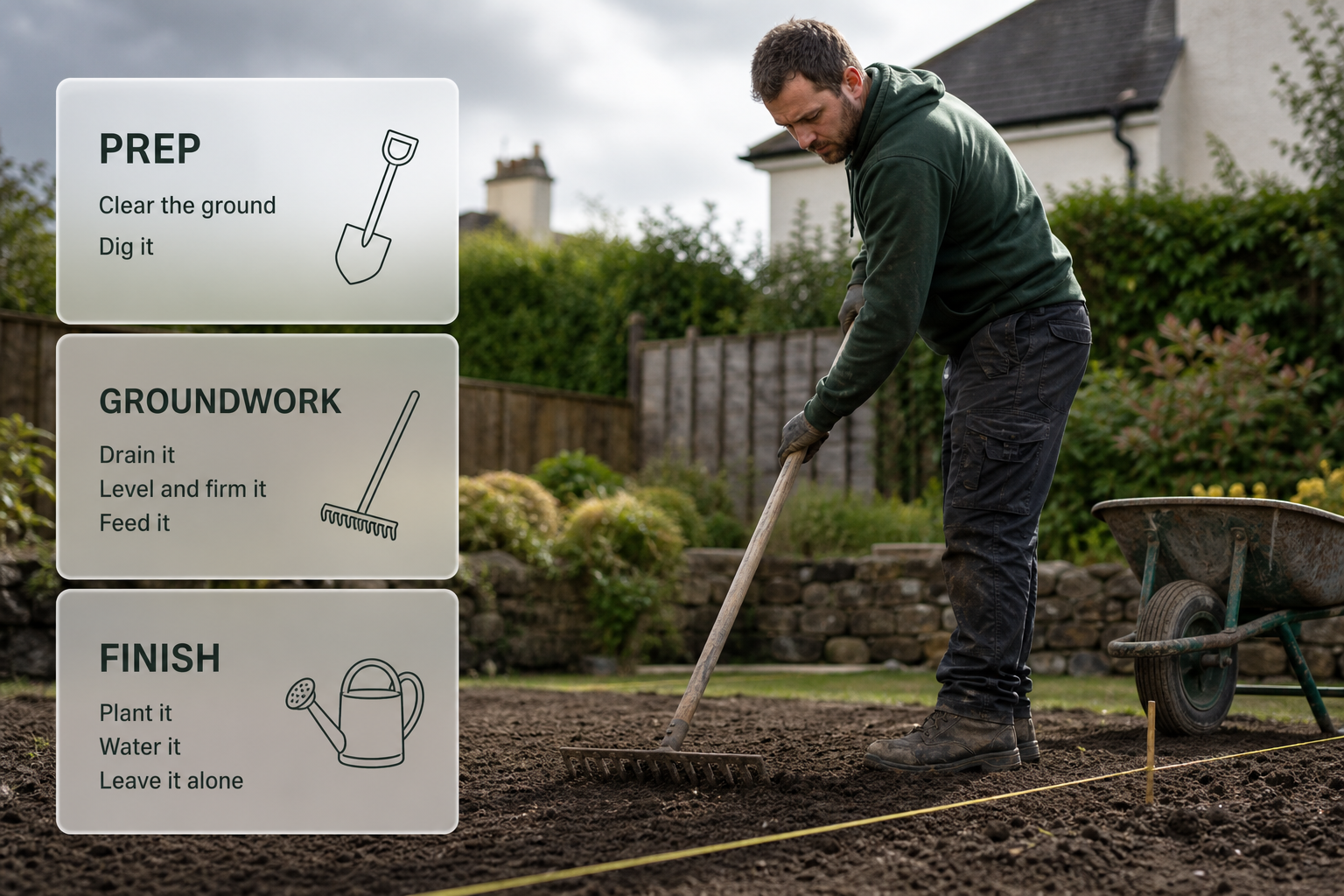
How to lay a lawn: the method, step by step
Turf and seed follow the same sequence: clear the ground, dig it, drain it, level and firm it, feed it, plant it, then water it and leave it alone.
What to have on site. A spade and fork, a garden rake and a wider landscape rake, a wheelbarrow, a garden roller or a flat board for firming, a string line and pegs, a half-moon edging tool, a sharp knife for trimming turf, and a hose with a fine spray or a sprinkler. Wear gloves and eye protection, and a dust mask when spreading dry lime or fertiliser in still air. Materials are turf or grass seed, topsoil or a soil-and-sand mix for hollows, a pre-seeding fertiliser, and coarse sand or grit if drainage needs help.
1. Clear the old surface. Cut existing growth low, then strip the sward with a spade or a hired turf cutter, or kill it off and let it die back completely. If a contact weedkiller is used, wait the interval printed on the label before planting.
2. Dig the topsoil. Turn it over with a fork or spade, breaking lumps and removing rubble, roots and stones bigger than a walnut. Never dig or rake soil wet enough to stick to the spade; working wet ground smears it into a pan that roots struggle to push through.
3. Deal with drainage before levelling. Watch the plot for a day or two after rain. If water sits, fix it now rather than after planting — more on that below.
4. Level and firm. Rake in one direction and then across it, filling hollows with the soil-and-sand mix. Firm the bed with a roller or by treading it in a grid, then rake again. It is ready when it is level, free of soft dips, and firm enough that a heel leaves only a shallow print.
5. Feed the bed. Work a pre-seeding fertiliser into the surface; whether lime is needed is decided by a soil test, not by habit.
6. Lay the turf or sow the seed. Turf goes down in a tight brick pattern, joints butted and edges trimmed. Seed is spread at the rate on the pack, half one way and half across, then raked lightly and firmed.
7. Water and leave it alone. Water with a fine spray and keep traffic off until the roots have taken hold.
Turf or seed for a typical small home garden
In a small garden the choice usually comes down to time, season and shape rather than area. Turf is the faster route: the lawn is green the day it is laid, it can be used sooner, and it is far easier to get neat edges and an even finish around narrow strips, awkward corners and gentle slopes. It does need to be laid on the day it arrives, because stacked turf heats up and spoils, and it must be watered from day one since it has no roots in its new ground.
Seed suits a larger, simpler rectangle and a homeowner who is content to wait. It allows a mixture chosen for shade, for family wear or for a finer finish, and there is no delivery deadline — you sow when the bed and the weather are right. The trade-off is exposure: seed takes weeks to become a lawn, dries out in a warm spell, and gives birds, heavy rain and weeds a chance before it thickens. A common compromise is turf where the lawn is seen and used, and seed on an out-of-the-way strip along a boundary or behind a shed.
Preparing, levelling and draining the ground
Keep topsoil and subsoil separate if you are stripping the site, and finish with a reasonable depth of topsoil across the whole area rather than a thin skim over rubble. Compaction is the quiet killer of new lawns: keep wheelbarrows, machinery and heavy footsteps off a prepared bed, work from boards laid as you go, and never rake or firm saturated soil.
If water stands after rain, fix it before planting. Mild cases are usually opened up by working coarse sand or grit through the top layer. A heavier, wetter site needs somewhere for the water to go — a shallow gravel-filled trench with a perforated land drain, laid to fall towards a soakaway or a suitable outlet at the low corner of the garden. Drainage added after the bed is firmed rarely works. Check too that the finished level stays clear of the damp-proof course at the house and falls gently away from the walls.
Soil testing and seedbed fertility
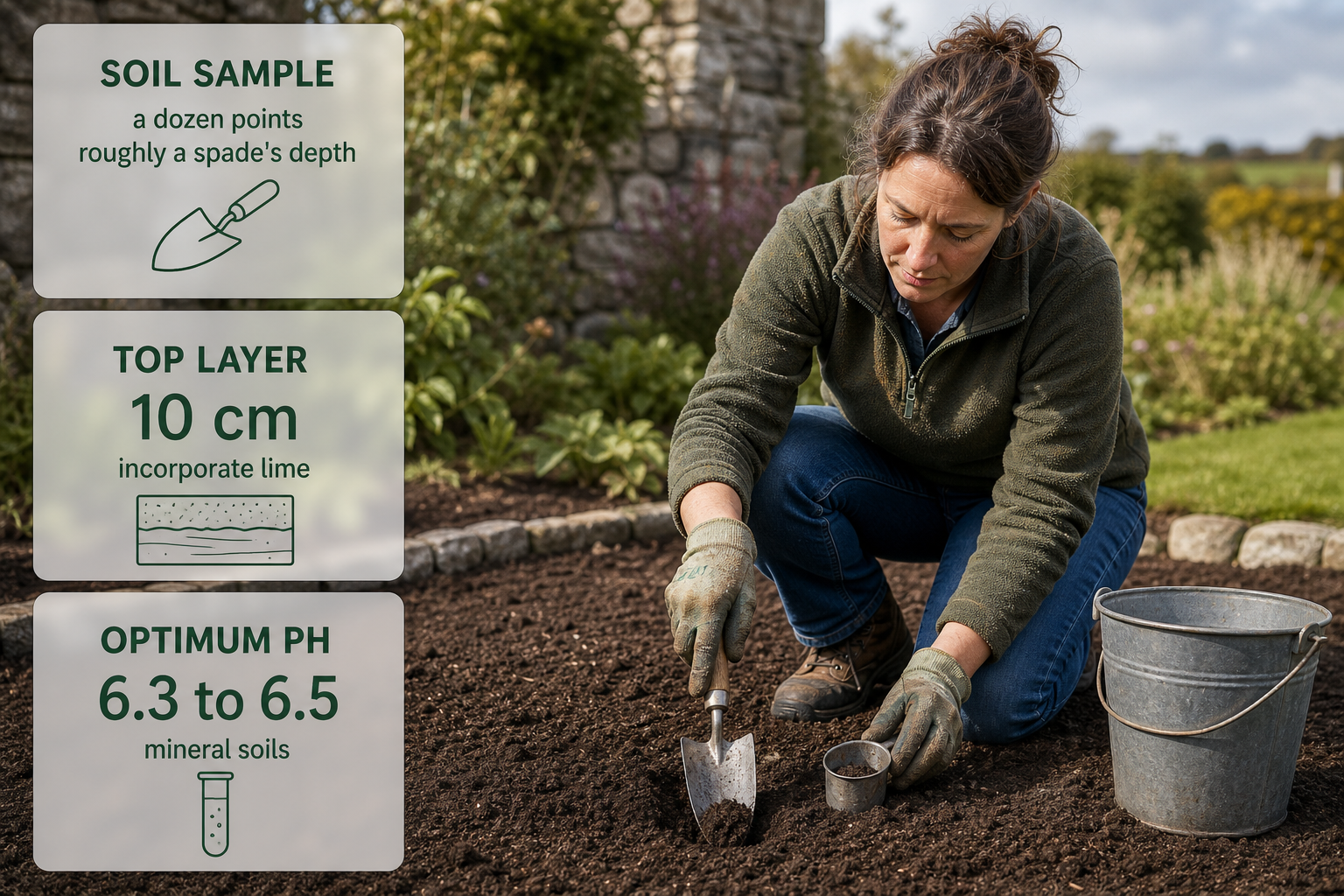
Testing the soil is worth doing before anything is sown or laid, and it tells you the two things that matter: pH and general nutrient level. Take one representative sample rather than several spot tests — lift slices with a clean trowel from a dozen points across the area to roughly a spade's depth, mix them in a clean bucket, and take a subsample from that. A garden test kit gives a pH reading and a rough nutrient guide; a soil laboratory gives fuller figures. Test before adding anything, and do not lime out of habit, because over-liming is as unhelpful as a bed that is too acidic.
For grass establishment, Teagasc advises applying lime to the seedbed and incorporating it into the top 10 cm of soil, and gives an optimum soil pH range for grass of 6.3 to 6.5 on mineral soils (Teagasc). Lime is slow to act, so it belongs in the preparation rather than being sprinkled on afterwards. A pre-seeding fertiliser worked into the top layer gives new roots something to work with, and the bed should be sown or laid promptly once it is ready, because a bare, fed seedbed is an open invitation to weeds.
Where drainage or groundwork turns into a bigger job than expected, it can help to look at the wider range of home services rather than patching something that will come back.