ShamFix
Back to insights

How to Build a Raised Bed in an Irish Garden

Pick a level, sunny spot, build a 300mm to 400mm treated timber frame, line the base and fill with topsoil, compost and grit for a bed that drains.

9 min read
How to Build a Raised Bed in an Irish Garden

Building a raised bed is a weekend job for anyone comfortable with a saw, a drill and a spirit level: choose a level, sunny spot, build a treated timber frame roughly 300mm to 400mm deep, line the base to hold back weeds, and fill it with a mix of topsoil, compost and grit. Because the frame is bottomless, roots still reach the ground below and water drains away, while the raised soil warms earlier in a wet Irish spring and saves a lot of bending. Homeowners who would rather not take on the carpentry and the soil shifting can have the work built through landscaping and garden design services, and the steps below are the same ones a careful builder follows.
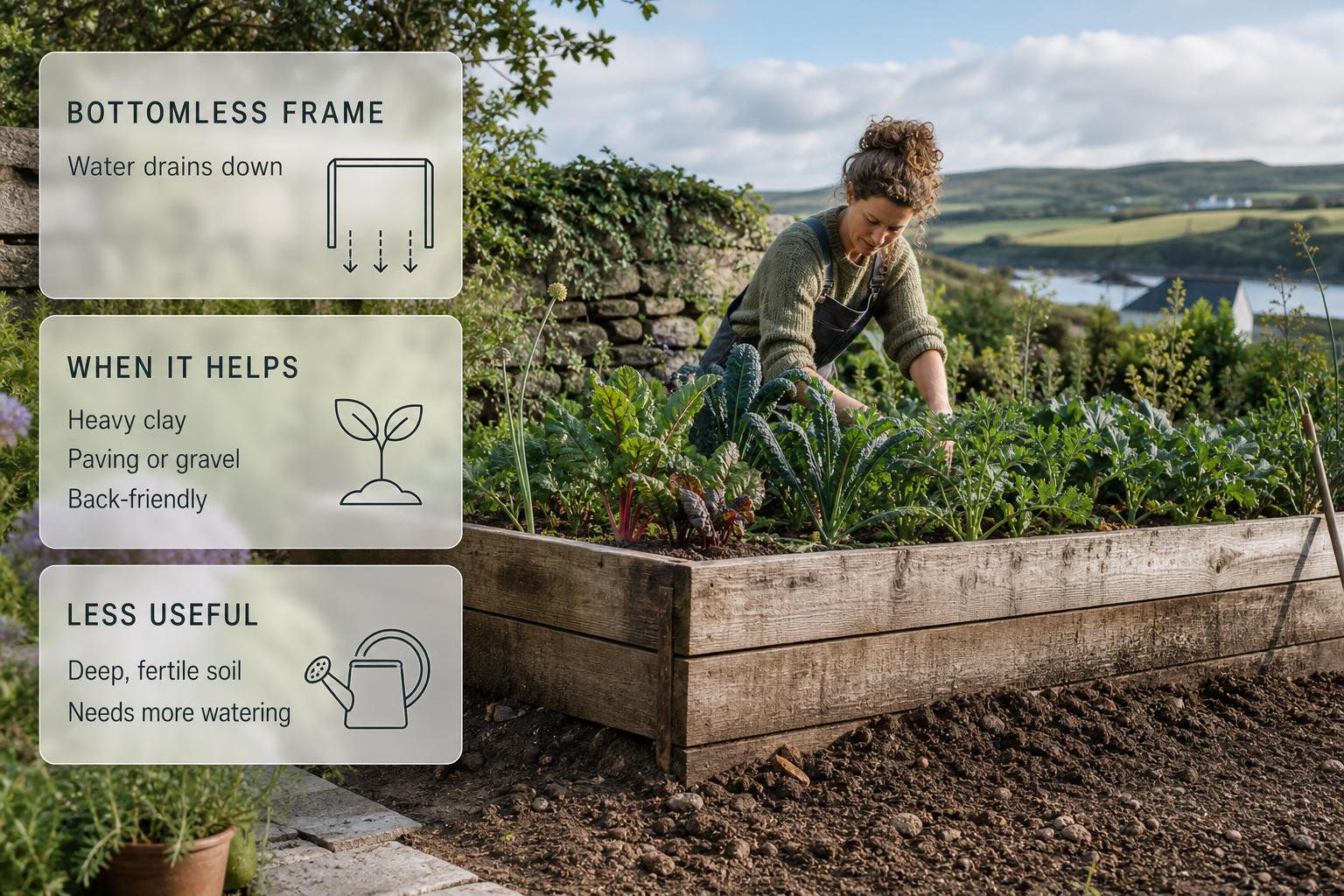
An infographic about what a raised bed is and when it helps, with a gardener in an Irish garden and floating cards explaining the key points.

What a raised bed is and when it helps

A raised bed is a bottomless frame, usually timber, standing above the existing ground level and filled with soil. It is not a planter box: there is no base, so water drains straight down into the subsoil and worms and deep roots move freely between the bed and the ground underneath.

It earns its place where the ground is heavy clay, stony, shallow or waterlogged, or where the garden is mostly paving, gravel or decking and there is no open soil to dig. It helps where access matters, whether for a wheelchair user, a seated gardener or anyone whose back no longer enjoys forking over a border, and it lets different crops be given different soil, which suits acid-loving plants such as blueberries.

It is less useful where the ground is already deep, fertile and well drained, because a border costs nothing to build and does not dry out as fast. Raised beds need more watering in summer, so a tap within hose reach matters, and they need filling, which is the single biggest cost in most builds.
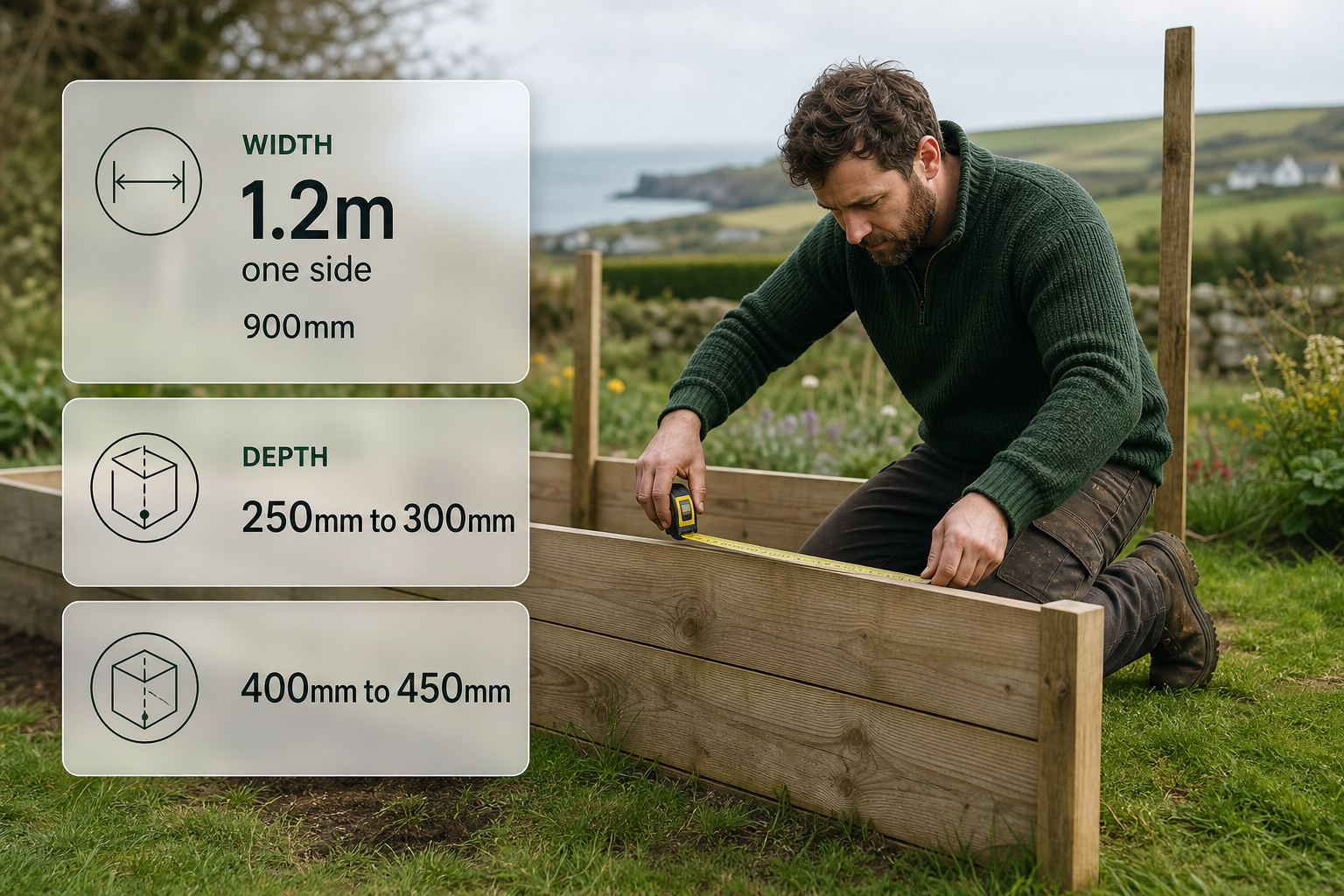
An infographic about the right dimensions for a raised bed, showing a gardener measuring timber in an Irish garden with clear explanatory cards.

Choosing the right dimensions

Width is the decision that matters most. Keep beds at 1.2m wide so an adult can reach the centre from both sides without stepping on the soil. Where a bed backs onto a wall or fence and can only be worked from one side, keep it to 900mm.

Length is flexible, but working in multiples of the board length avoids waste and cutting; a 2.4m bed is a common choice. On runs longer than about 2.4m, set an extra post at mid-span so the boards cannot bow outwards once the soil pushes against them.

Depth depends on what will grow in it:

  • 150mm suits herbs, lettuce and other shallow salad crops.
  • 250mm to 300mm suits most vegetables, including beans, onions, beetroot, chard and salad crops.
  • 400mm to 450mm is the target for carrots, parsnips, maincrop potatoes and anything with a long taproot, and it is also the height that lets a seated gardener work without stooping.

Leave 600mm between beds for a wheelbarrow, and closer to 900mm on a main route. On sloping ground, either step the beds down the slope or dig the higher side in so the top rail stays level; a bed sitting proud on one corner will shift as the soil settles.

Best timber, fasteners and materials

Treated softwood boards of 45mm x 150mm are the workhorse choice, with 50mm x 200mm giving a taller bed from a single board. Two stacked 150mm boards give a 300mm bed; three give 450mm. Corner posts of 75mm x 75mm or 100mm x 100mm hold everything square, and thicker boards simply last longer in wet ground.

What matters more than appearance is whether the timber is rated for ground contact. Ask the supplier which use class the boards are treated to, and avoid timber sold as untreated for garden use. Hardwoods such as oak or larch last well but cost considerably more, while concrete blocks or galvanised steel panels are options for a bed that will outlive the house.

Fasteners decide how long the frame holds together. Use stainless steel or hot-dip galvanised screws of 75mm to 100mm for fixing boards to posts, and M8 or M10 coach screws of 100mm to 150mm with washers for the corner joints. Plain zinc-plated or bare steel screws rust through within a few seasons and take the joint with them. Pre-drill the board ends to stop splitting, and drive two screws into every joint rather than one. Galvanised angle brackets are useful inside corners where the boards meet at right angles.

Reuse is worth considering before buying anything at all. The SEAI's Climate SOS publication suggests making a raised bed for growing things out of an old car tyre (SEAI). That is a reuse idea rather than a general rule: a tyre suits herbs and shallow salads, is awkward to line neatly, and cannot match the size, depth or working height of a timber frame.

Step-by-step: building the bed

  1. Mark out the footprint with a string line and check it is square using the 3-4-5 method, measuring 600mm along one side and 800mm along the next from the same corner and confirming the diagonal between those two points is exactly 1m.
  2. Strip the grass and the top layer of weeds inside the footprint, or smother them with a thick layer of cardboard if digging is not an option.
  3. Fork over the subsoil to about 200mm to 300mm deep and break up any compacted layer. On heavy clay, fork in coarse grit at this stage.
  4. Cut the corner posts to length: the finished height of the bed plus 300mm to go into the ground. If the bed sits on paving, cut the posts to the finished height instead.
  5. Set the four corner posts, checking level and square as you go, and brace the frame diagonally while it is still loose.
  6. Fix the bottom board around the perimeter, then the second, staggering the joints so they do not all land on the same post. Add mid-span posts on long beds.
  7. Re-check the diagonals before final tightening; a frame that is out of square by 20mm looks wrong for years.
  8. Fit a cap rail, a board laid flat along the top edge. It protects the end grain, gives somewhere to rest a trowel and doubles as a seat.
  9. Backfill around the posts, firm the soil in, then fill and settle the bed as described below.

For larger builds, or where soil has to be removed rather than reused, it is worth comparing quotes for the groundworks through home services rather than assuming the planting side covers it.

Drainage, lining and filling

Never seal the base. A raised bed must drain downwards, and a plastic sheet across the bottom turns it into a sump that waterlogs in wet weather. Where the bed sits on heavy clay, dig out 100mm to 150mm first and add 50mm to 75mm of coarse gravel or broken stone; on concrete or paving, simply lay the gravel layer across the base.

Line the sides, not the floor, with a permeable membrane if treated timber is used. This keeps soil out of the joints and reduces drying at the edges, but it must let water pass. Across the base, a single layer of cardboard or woven weed membrane suppresses perennial weeds without blocking drainage; do not use a solid sheet.

Fill with a mix rather than pure compost, which shrinks, dries out and slumps. A workable starting point is roughly 40% topsoil, 40% compost or well-rotted manure and 20% grit or sharp sand, increasing the grit on heavy clay. Fill in layers, water each one in, and stop 25mm to 50mm below the top rail so there is room for mulch and for water to pool without running off. Expect the fill to settle by 25mm or more in the first few weeks, and top it up before sowing rather than after.

What to plant in Ireland by season

Spring, from March onwards, is for lettuce, radish, spinach, beetroot, short-rooted carrots, onion sets, peas, broad beans and early potatoes. Raised beds warm and drain faster than open ground, so sowing a couple of weeks earlier than in a border is realistic, provided seedlings are hardened off.

Summer is for succession sowing of salad every two to three weeks, plus French and runner beans, courgettes, leeks, kale for winter, chard and turnips. Watering becomes the main job, and a mulch of compost or grass cuttings holds moisture.

Autumn is the planting window for garlic in October and November, overwintering broad beans, spring cabbage and winter salads under a cloche. Empty beds benefit from a green manure such as field beans or grazing rye rather than being left bare over winter.

Winter is for harvesting leeks, kale, parsnips and sprouts, mulching empty beds with compost, and planning a rotation. Move crop groups — legumes, brassicas, roots and potatoes — around the beds each year to limit pests and disease. In an exposed garden, a windbreak of netting on the prevailing wind side makes more difference to yields than extra feeding.

What it costs to build a raised bed

The figures below are an aggregate Irish market estimate for one 1.2m x 2.4m timber bed built with new materials, given as ranges rather than quoted prices.

Item Typical range
Treated boards and corner posts, 300mm to 400mm deep €80 to €160
Stainless or galvanised screws, coach screws and brackets €15 to €35
Weed membrane, side lining and drainage gravel €20 to €50
Topsoil, compost and grit to fill the bed €90 to €220
Delivery or bulk-load charge €25 to €60
Building labour, if a tradesperson does the work, per day €250 to €450

A homeowner building one bed alone is typically looking at €200 to €550 for materials and fill, with a contingency allowance of about 10% for a split board or an extra bag of compost. Adding labour takes the same job to roughly €450 to €1,000. The things that move the figure most are height, since each extra row of boards adds roughly a third to a half to the first line of the table, and fill: reusing garden soil and homemade compost can remove the largest line entirely, while buying bagged topsoil at a garden centre is far dearer than a bulk delivery.

Getting the build done for you

Carpentry is only part of the job: digging out, barrowing soil and filling a bed is the part most homeowners underestimate. Where the work is more than one weekend can cover, or where a long run of beds is planned, the whole build can be listed as a job and quotes taken from there.

Whoever is hired, agree in writing what is included: removal of old material, the soil supply, the finished depth of the frame, the fixings being used and how the site will be left. The fill is the line most likely to be left out of a quote, and it is the one that adds most to the final bill.

FAQ

How deep does a raised bed need to be for carrots and parsnips?

Aim for 400mm to 450mm of loose soil for full-length maincrop roots, or work with what is there by choosing short-rooted varieties in a 250mm to 300mm bed. Depth is measured in settled soil, not in the height of the frame, so a 300mm frame over a forked subsoil can still grow decent roots. Where depth is limited, grow potatoes, salads and beans instead.

Can a raised bed be built on a patio or concrete?

Yes, but treat it as a very large container and plan for drainage and watering. Lay 75mm to 100mm of gravel or broken stone across the base, sit the timber on a strip of damp-proof membrane so it is not permanently wet, and expect to water more often than a bed sitting on open ground. Avoid sealing the base, which traps water against both the timber and the roots.

When is the best time of year to build a raised bed in Ireland?

Late autumn or late winter works best, so the fill has settled before spring sowing and the ground is not being trampled while it is wet. A bed built in spring is fine provided it is filled, watered in and left for a fortnight before planting. Building in the depths of winter is possible, but frozen or waterlogged ground makes setting posts far harder.

What usually goes wrong with a timber raised bed?

Posts rot first, because they sit in the ground, followed by joints where plain steel screws have been used. Bowing boards on long runs, soil that settles to half its depth, and a bed placed where a wall shades it for most of the day are the other common regrets. Check light levels and reach before cutting any timber.

Keep reading