An aggregate Irish market estimate for hedge trimming prices puts a typical one-off garden hedge trim at €150 to €450, while tall, overgrown or hard-to-reach hedges are quoted at €500 to €1,200. What separates those two figures is rarely the hourly rate: height, length, density, access and the disposal of the cuttings do most of the work. Homeowners comparing local grass cutting and hedge trimming get further by comparing quotes built on the same scope than by chasing the lowest headline number.
What a hedge trimming quote includes and leaves out
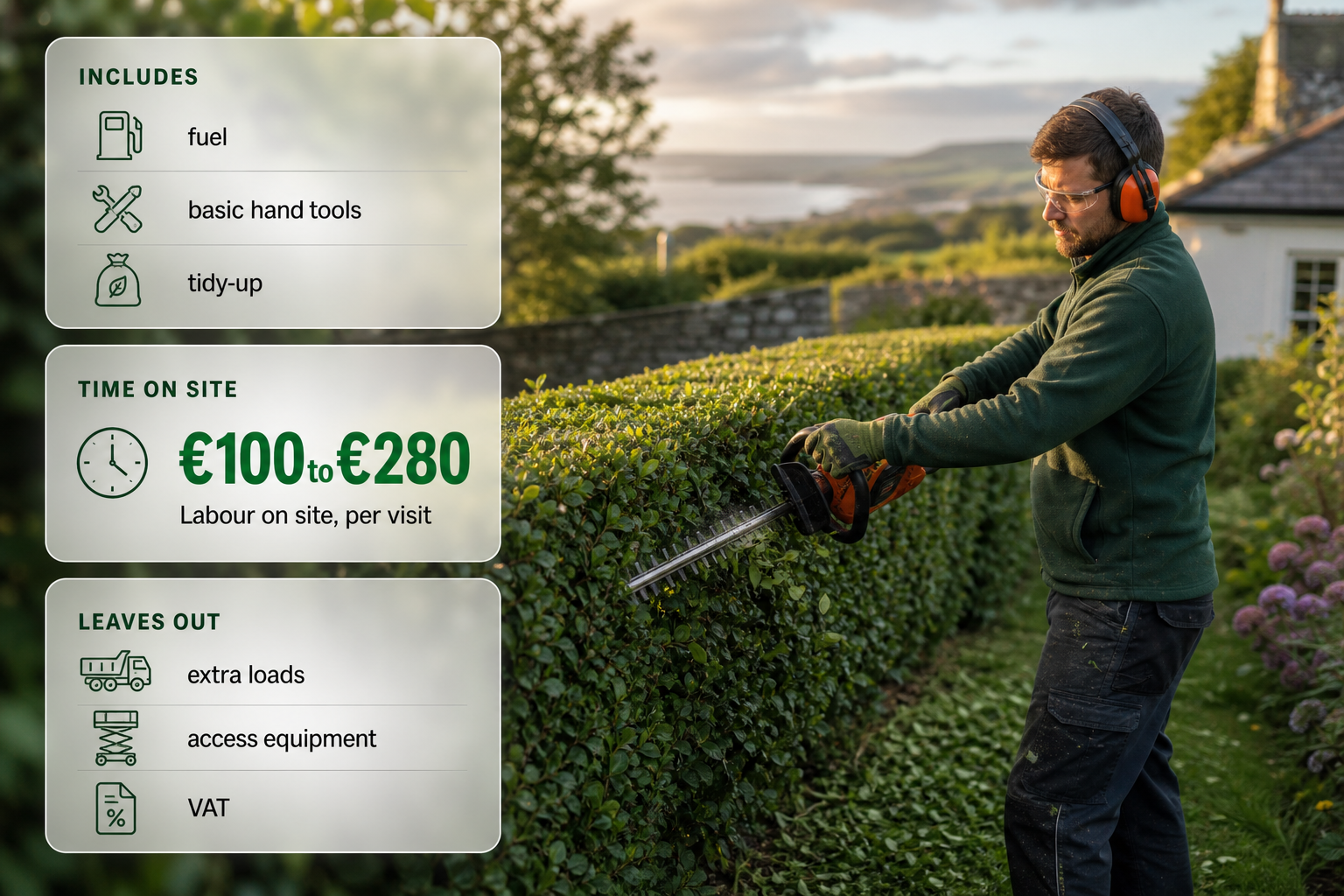
A standard quote covers the contractor's time on site, fuel, and basic hand tools such as a hedge trimmer, shears, a rake and a groundsheet, plus a tidy-up of the ground around the hedge. Many quotes build in one trailer load or a set number of bags of green waste. The pricing format matters as much as the figure: an hourly quote puts the risk of slow work on the homeowner, a per-metre quote puts it on the contractor, and a fixed price for the whole job usually sits towards the top of the band on a small hedge because the contractor carries the risk.
The table below is an aggregate Irish market estimate of the lines a homeowner would expect to see on a hedge trimming quote. Not every line appears on every quote.
| Quote line | Typical range |
|---|---|
| Labour on site, per visit | €100 to €280 |
| Equipment, fuel and blade wear, per visit | €20 to €50 |
| Green waste removal and disposal, per trailer load | €40 to €120 |
| Access equipment such as a long-reach trimmer, platform or climbing gear, per visit | €80 to €250 |
| Call-out or minimum charge | €50 to €120 |
| Contingency allowance for extra growth, extra loads or obstacles | 10% to 20% of the quoted figure |
A straightforward garden hedge that needs no access equipment, produces a single trailer load of cuttings and attracts no minimum charge lands inside the €150 to €450 headline. Add a platform, three or four loads of waste or a long boundary run and the job moves into the €500 to €1,200 band. The call-out line normally sits inside the labour figure on a full-size job and is quoted separately only where a contractor sets a minimum charge for a visit.
Where budgets stretch is in what is left out. Extra loads beyond the first are charged at the green waste removal rate in the table above, while access equipment, long-reach work beyond the contractor's usual setup, a second operative and any traffic management needed beside a public road appear at the access and labour rates above. So do tree surgery, stump grinding, removal of ivy or invasive species, repair of fencing or plants damaged before the visit, emergency or weekend call-outs, and VAT where the contractor is registered.
Ask for the inclusions and exclusions in writing. A single figure with no breakdown gives no way of knowing whether waste, access or a second visit is inside it.
What moves the price: height, length, thickness, access and waste
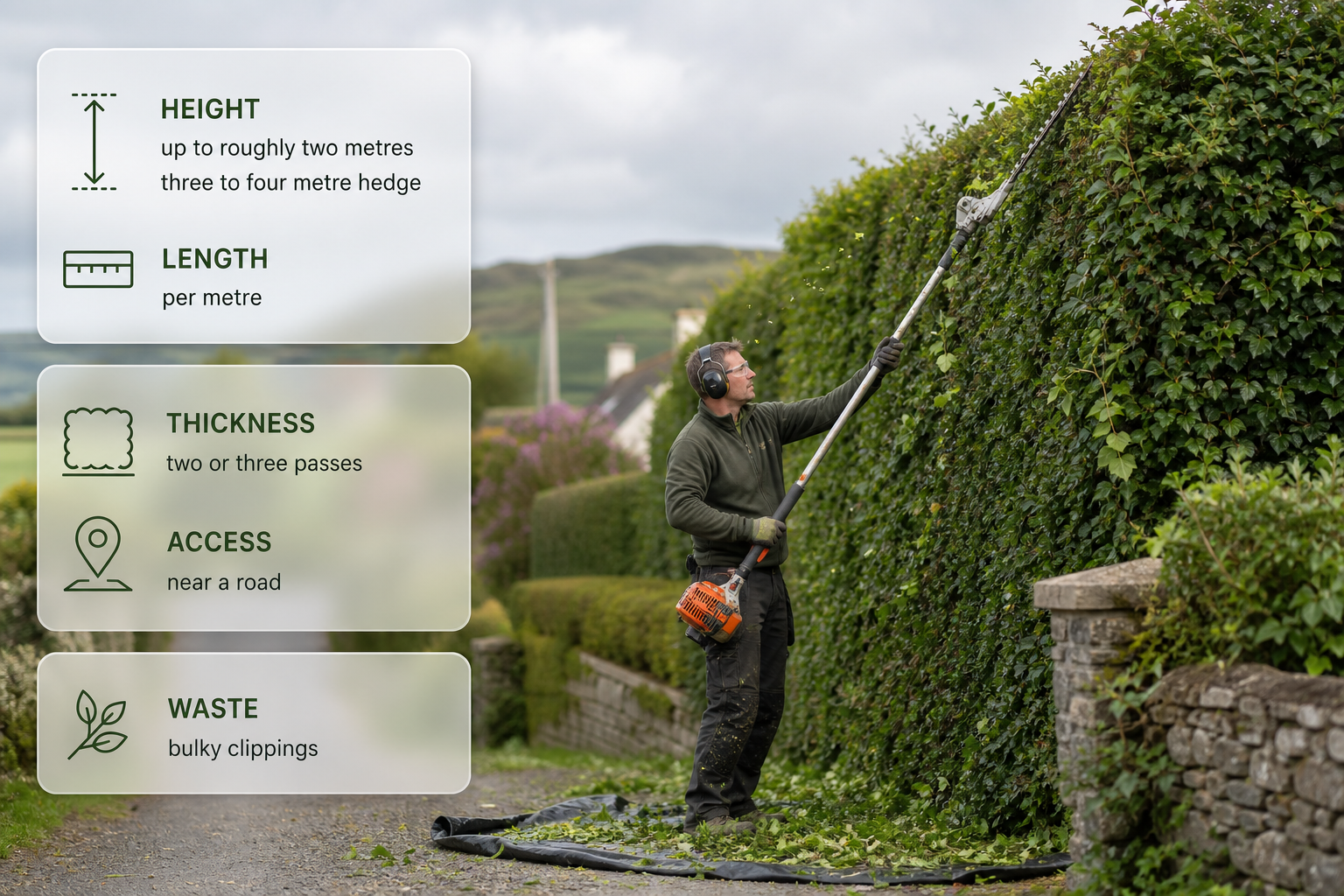
Height is the clearest driver. A hedge up to roughly two metres can usually be cut with both feet on the ground using hand-held equipment. A three to four metre hedge may need a long-reach trimmer, a small platform or work from a ladder, which brings in the access line above and slows every pass. Above that, professional access equipment and often a second person come into the quote, and the job can leave the €150 to €450 band entirely.
Length is usually priced by the metre on long runs. Ten metres of boundary hedge is a different job from fifty or a hundred, not only because there is more to cut but because the volume of clippings grows with it. Measuring the hedge before requesting quotes, or asking the contractor how many metres are being priced, removes most of the guesswork.
Thickness and density decide how many passes are needed. A light, open shrub takes one, while a dense conifer, laurel or hawthorn that has not been cut for several years may need two or three, blunts blades and produces far more waste, which then feeds into the trailer-load range above.
Access separates quotes most sharply. A hedge beside a wide driveway is quick work. A hedge behind a narrow side gate, on a steep slope, over a pond, hard against a window, under overhead electricity wires or along a footpath is slower and may need extra equipment, a second person or a partial road closure. Parking, the distance from the van to the hedge, and whether clippings must be carried through a house or up steps all add time.
Waste is the quiet cost. Hedge clippings are bulky and awkward to transport. A quote that removes everything and a quote that leaves a pile behind are not the same job, even when the two figures look similar.
One-off trims versus recurring trims
A one-off trim carries the full call-out or minimum charge, a complete setup, a single waste run and the travel time for one job, which can push even a modest hedge towards the top of the €150 to €450 band. Single visits are often quoted as a flat figure, and the call-out line above is most likely to apply here.
Recurring work is priced differently. Where a contractor returns two, three or four times a year, travel and setup are spread across the visits, the hedge never gets away, and the job is less likely to need the access or contingency lines above. Recurring quotes may be given per visit, per metre or as an annual figure, so compare the same number of visits, the same cutting height and the same waste terms. A cheap one-off that leaves the cuttings behind is not cheaper than a slightly dearer recurring quote that removes them.