
Three quotes land in the inbox for the same house in Ireland. One is cheap but thin on detail, one looks sensible until the small print appears, and one seems expensive because it includes the work that matters. That is the usual shape of heat pump installation Ireland planning, and the wrong quote can fail you long before the unit is switched on.
The sensible approach is to treat this as a heat-loss problem, a grant problem, and a commissioning problem, in that order. The heat pump itself is only one part of the job. If the survey is weak, the emitters are undersized, or the paperwork is incomplete, the install can look fine on paper and still perform badly in the house.
Heat pumps are no longer a niche technology in Ireland - they are the default in new builds and increasingly common in retrofit. The problem now is not whether heat pumps work, it is whether the right system is matched to the right building.
Introduction and Project Overview
A homeowner usually starts here, staring at three quotes that don't line up. One installer prices the unit only. Another adds radiators, controls, electrical work, and the paperwork that the first quote omits. The third quote looks dear until it becomes clear that it reflects the actual job, not just the headline equipment.
That is why heat pump installation Ireland needs to be handled like a retrofit project, not a boiler swap. SEAI's own implementation guidance says the process should start with a formal feasibility study that checks the heat source, heat distribution system, building heat load, and permissions before any equipment is chosen, with heat-loss calculations first (SEAI Heat Pump Implementation Guide). Skip that step and the quote is already on the wrong footing.
Practical rule: if a contractor cannot explain the home's heat loss before naming a model, the quote is too early.
The bigger issue is that grant money doesn't fix bad design. The SEAI grant has improved the economics, but it hasn't changed physics. A home still needs suitable insulation, emitters, controls, and a lawful installation pathway before the system can work as intended.
This guide sticks to the decisions that matter. It covers which heat pump type suits which home, how the SEAI grant bundle works, what the survey should include, how to compare installers without being misled by a low headline price, and what handover checks should happen before anyone signs off. It's written for homeowners who want the job done properly the first time.
Understanding Heat Pump Types and System Eligibility
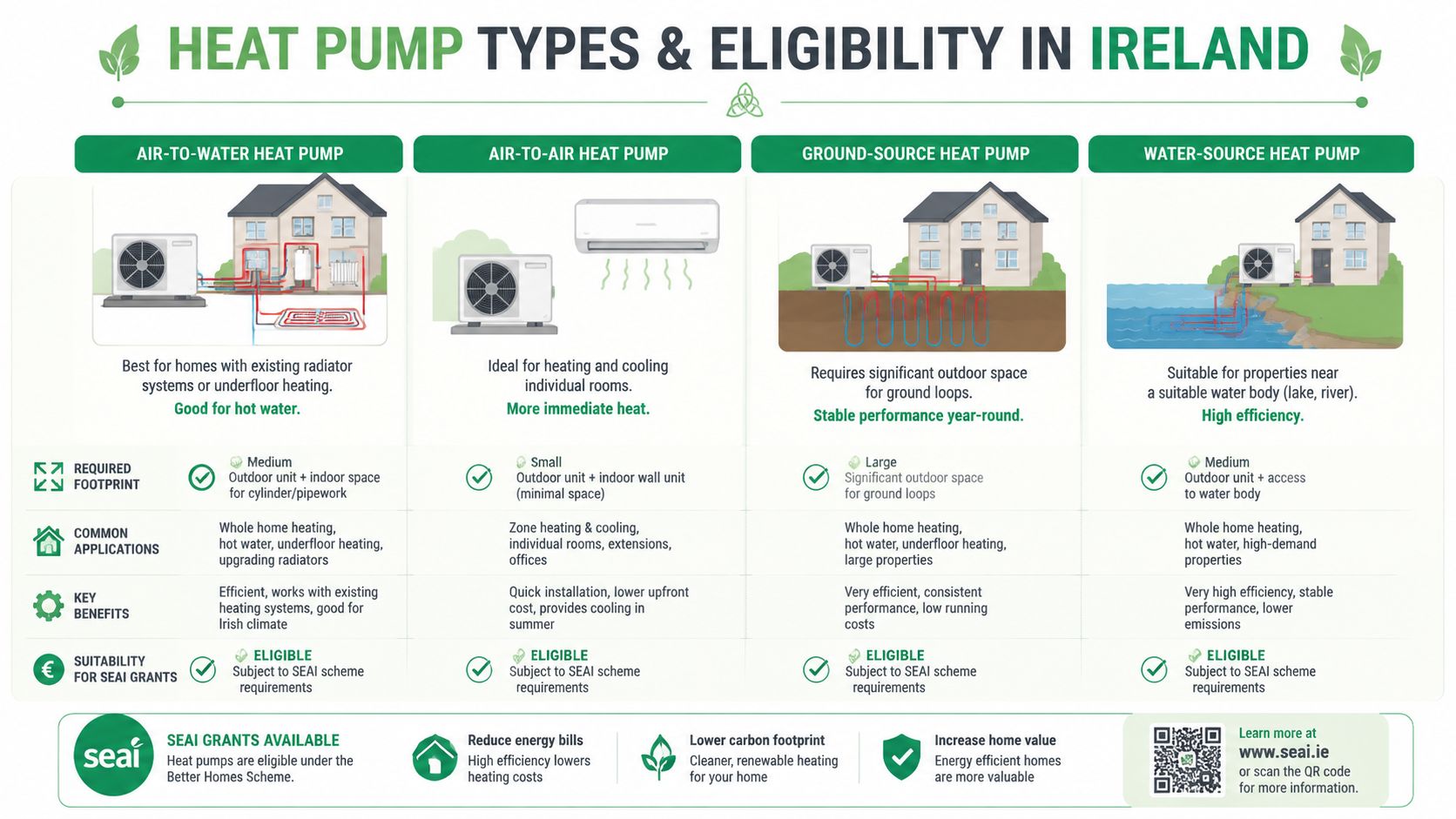
Air-to-water is the default choice for most homes
For most Irish retrofits, air-to-water is the first system to assess. It suits homes that need whole-house heating and hot water, especially where existing radiators can be matched to lower flow temperatures or where underfloor heating is already in place. It is also the format most homeowners hear about first, which is why it dominates retrofit discussions.
That does not make it right for every house. A home with poor emitters, weak insulation, or a tight external layout can still be a poor fit unless the rest of the system is upgraded around it. The unit choice matters, but the building match matters more.
Before any quote is taken seriously, the installer should show how the house will run at lower temperatures, not just name a model. If they cannot explain that clearly, the system design is incomplete.
Ground-source and water-source need stronger site conditions
Ground-source and water-source heat pumps can perform well, but they depend on site conditions that many urban and suburban homes do not have. Ground-source needs boreholes or collector space, which pushes the work into specialist territory. Water-source depends on a suitable body of water, which narrows the options again.
That is why these systems need careful design, not enthusiasm. If the property cannot support the footprint, access, or excavation requirements, the quote rises quickly and the project risk rises with it. On many Irish sites, the practical answer is still air-to-water.
Air-to-air is different, and the hot water question matters
Air-to-air suits homes where the goal is room heating or cooling rather than a full wet heating system. It gives quick warmth and can be useful in some layouts, but it does not provide hot water. That single point rules it out for many domestic retrofit plans.
A heat pump should be chosen for the home's actual heating pattern, not for the cheapest headline number on a brochure.
A proper BER assessment helps confirm whether the property is ready for a heat pump or needs upgrades first. For homeowners who want that checked before they commit, a local BER assessor and energy rating service is the right place to start.
Navigating SEAI Heat Pump Grants and Conditions
SEAI's current Heat Pump System grant is the number that changes the conversation, but it only pays out when the project is designed and documented properly. The bundle can reach up to €12,500 for most dwelling types, and it is split across the heat pump unit, central heating upgrades where needed, and a Renewable Heat Bonus for homes replacing an existing fossil-fuel or electric storage system. The official SEAI heat pump grant page is the source to check before any quote is accepted.
Grant breakdown by system and dwelling
| System Type | Detached/Semi Grant | Mid-Terrace Grant | Apartment Grant |
|---|---|---|---|
| Air-to-water, ground source to water, exhaust air to water, water to water | Up to €12,500 | Up to €12,500 | Up to €9,500 |
| Air-to-air | €7,500 | €7,500 | €7,500 |
The grant also includes a €200 Technical Assessment and a €50 post-works BER contribution, which are part of the same route to payment. To qualify, the home must have been built and occupied before 2021 and have an MPRN, and grant approval must be in place before any work starts. The offer then has to be accepted within 30 days and drawn down within eight months.
The Climate Change Advisory Council reports that deep retrofits reached 57,932 by the end of 2024, or 11.5% of the 2030 target, which shows how far the wider retrofit programme still has to travel (CCAC Annual Review 2025, Built Environment, Industry and Waste).
What the grant does not forgive
The grant is not a blank cheque. It cannot exceed the total cost of the works, and a Tax Clearance Certificate is needed where grant payments exceed €10,000 in a calendar year. Replacing an existing heat pump that was never grant-aided is capped separately at €6,500, or €4,500 for apartments, with no Renewable Heat Bonus and no central heating grant.
For the BER side of the process, homeowners can use ShamFix's BER assessor and energy rating service page to find the kind of service that handles the post-works rating step, but the grant rules still sit with SEAI, not with a marketplace.
Pre-Installation Technical Survey and Requirements
A heat pump quote that starts with a price and only later gets around to the survey is backwards. A proper contractor begins with a room-by-room heat-loss calculation, because the system has to match the house, not the other way around. SEAI's implementation guide says the feasibility study comes first, and it has to check the heat source, distribution system, building heat load, and permissions before any equipment is chosen.
What the survey should actually cover
The survey needs to be specific. It should assess the insulation in the walls, attic, floor, and glazing, the current heating emitters, the hot water cylinder, the electrical supply, and the outdoor unit location. It also has to establish whether the existing radiators can deliver enough heat at low flow temperatures or whether the property already has underfloor heating.
A weak survey leaves out the details that decide whether the system will work well. If the contractor has not identified the coldest rooms, the home's hot water demand, and the siting constraints for the outdoor unit, the job is not properly scoped.
The outdoor unit location deserves proper scrutiny. Boundary distance, noise to neighbouring windows, airflow clearance, and condensate drainage all need to be checked before anything is ordered. A low quote that ignores siting often grows once the installer has to relocate the unit or carry out extra enabling works.
The Irish threshold that catches a lot of homes
For homes built before 2007, SEAI requires a Technical Assessment unless a valid BER shows a Heat Loss Indicator of 2.3 W/(K.m²) or lower. Homes built from 2007 onwards use a Self-Declaration Form instead. The Technical Assessment comes with a €200 grant, and it is there to stop a blind install.
Homes that fail this check are not being awkward. They are showing that the fabric needs attention before the system size is fixed. If the heat-loss figure is too high, the contractor should spell out what insulation or other fabric work is needed first. Skip that step and you risk paying for a system that runs too hard or never quite heats the house properly.
Planning can also trip people up, especially where the external unit, boundary lines, or exemptions are in question. A homeowner should deal with that early through ShamFix's planning permission assistance page, because permission risk should be checked before equipment is ordered.
Choosing and Vetting Qualified Installers
A heat pump quote should read like a design brief, not a sales pitch. The installer must show how the survey turns into a specific system size, because the Heat Pump Association of Ireland Code of Practice says the heat pump has to cover at least 100% of the calculated design space-heating requirement, with emitters sized for the full heat loss and tied into one control system (HPAI Heat Pump Code of Practice).
A decent installer will also explain where the hidden costs sit. If the quote leaves out cylinder changes, radiator upgrades, electrical upgrades, scaffold, making good, or drainage work, expect the final bill to climb once the job starts. That is where homeowners get caught.
What to verify before any deposit changes hands
Ask for proof of the basics before you pay anything:
SEAI registration: grant-funded work needs the correct registration, and you should verify it yourself.
Electrical compliance: electrical work should be carried out by a Safe Electric registered electrician, and the certificate should be handed over.
Written scope: scaffolding, access, waste removal, making good, and enabling works should all be listed clearly.
Commissioning documents: the handover pack should include the Designer Installer form and the Eco Design data sheet.
Public liability insurance: confirm it directly. Heat pump work pulls in plumbing, general building and groundworks that sit outside any regulated trade register in Ireland.
That last point is where many homeowners get exposed. Heat pump jobs pull in plumbing, builders' work and external groundworks, and those parts are not regulated in Ireland in the same way as electrical work. For that reason, you need insurance evidence, a written scope, and real customer feedback. The homeowner still has to check the paperwork and the contract before signing.
Why the cheapest quote is often the wrong one
A low quote usually means something has been left out. It can hide missing emitter upgrades, no cylinder replacement, no electrical upgrade, or no proper handover paperwork. That is not a bargain, it is a stripped-down job that will cost more later.
Compare quotes only on like-for-like scope. One contractor may be pricing the heat pump itself, while another is pricing the full install, commissioning, and sign-off. Those are not the same offer, and treating them as if they are will lead to bad decisions.
One option for collecting local offers is a marketplace such as ShamFix, which routes homeowner requests to local providers, but it does not carry out the work or guarantee it. Use it as a way to get names on the table, then interrogate each installer on design, grant paperwork, commissioning, and aftercare.
Installation Sequence Commissioning and Post-Install Care
The right sequence starts before a shovel or drill enters the picture. SEAI grant approval must be in place first, because the works have to fit the approved grant route. Only then should the contractor lock in the design, confirm fabric upgrades if needed, and plan the install around the survey findings.
What the homeowner should expect, in order
Grant approval and funding secured. No work starts before approval.
Detailed design from the survey. The heat-loss data drives the system choice.
Fabric upgrades where needed. Insulation or ventilation work may be needed to bring the home into shape.
Outdoor unit base and siting. This includes clear airflow and sensible drainage.
Indoor unit, cylinder, and pipework. The hydronic side has to be neat and serviceable.
Emitter upgrades where required. Radiators or underfloor runs get sized for the design load.
Electrical connection. This must be done to the proper standard.
Commissioning. Flow temperatures, controls, weather compensation, and system balance are set.
Handover and post-works BER. The paperwork is part of the job, not an afterthought.
A homeowner should not let commissioning slide. A heat pump set up to run like a boiler, with high flow temperatures and poor weather compensation, will be expensive to operate. The handover should also include a check that the Designer Installer form and Eco Design data sheet are handed over, because SEAI requires both for the grant claim.
What to check at handover
The important handover checks are straightforward. Confirm the flow temperature currently set on the system, confirm weather compensation is enabled, confirm the emitters are balanced, and check the hot water settings and any legionella cycle are sensible. The outdoor unit noise should also be checked at the boundary, not just beside the machine.
If the system has been left behaving like a boiler, the settings are wrong.
Running cost expectations also need to be realistic. Irish consumer guidance says a standard 3-bed home often faces annual electricity costs of roughly €600 to €1,000, excluding servicing, and that the system often performs best when left on continuously rather than switched on and off like a boiler (South Dublin County Council heat pump myths guidance). That makes behaviour and controls part of the economics, not just the equipment.
What can still drive costs up
The common surprise costs are usually predictable. Undersized radiators may need replacing, the electrical supply or consumer unit may need upgrading, the hot water cylinder may need swapping for a heat-pump-compatible model, and awkward outdoor siting can add work if boundary distance, noise, or condensate drainage need attention. Ground-source systems can also run into rock, a high water table, or not enough garden space, which is why they carry more site risk than air-to-water work.
The post-works BER is mandatory before the grant is drawn down, and it attracts the €50 contribution noted earlier. That final rating is not a formality, it is part of the proof that the house and system now match the grant claim.
Homeowner Checklist and Questions for Quotes
A homeowner should walk into every quote meeting with the same demands. Ask for the heat-loss report, the HLI or Technical Assessment outcome if relevant, the exact heat pump type, the emitter strategy, the electrical scope, the hot water cylinder plan, and the full list of exclusions. If the contractor can't answer those points plainly, the quote is not ready.
A good final question is blunt: what has been left out of the price? That usually exposes scaffolding, making good, waste removal, or electrical upgrade costs before they turn into arguments later.
Use these questions on every installer:
Can the heat-loss report be shown in full?
What flow temperature will the system be set to?
Are weather compensation and balancing included?
Does the quote include the cylinder, controls, electrical work, and commissioning paperwork?
What gets charged separately, if anything?
Will the post-works BER and grant paperwork be handled?
A clean heat pump installation Ireland project is one where the design, the grant, the installation, and the handover all match the same technical reality. Get the survey right, insist on a written scope, and compare quotes only after the hidden costs are visible.
ShamFix is an Ireland-only marketplace based in Clifden, County Galway, founded in 2025. It does not carry out, manage, vet, verify or guarantee the work. Providers state their own credentials, and customers should confirm insurance and SEAI registration directly. Trust on the platform comes from a two-sided review system, with providers and customers rating each other after completed work. For a heat pump project, describe the house and the existing heating system rather than just asking for a price, insist on the heat-loss report, and compare quotes only once the exclusions are visible.