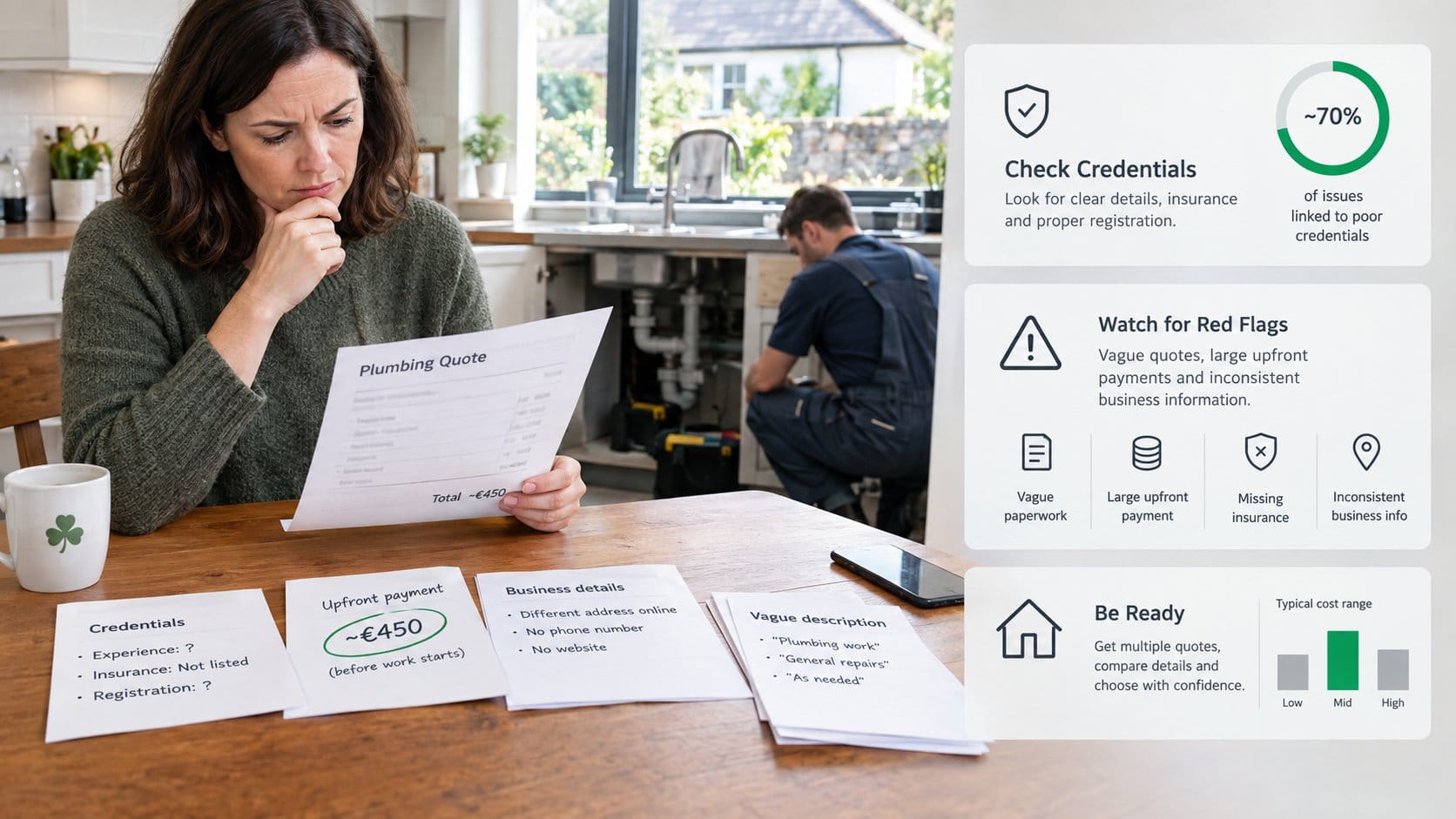
A leak under the sink, a boiler that's acting up, or a bathroom refit that suddenly needs a plumber right now. That's usually when bad hiring decisions get made, because the pressure is on and the phone starts ringing.
In Ireland, the right plumber isn't the one who sounds cheapest on the first call. The right plumber is the one who can prove the job is appropriate for their trade, show the right registration where the work is regulated, give a written scope, and stand behind recent customer feedback. ShamFix publishes this guide.
The Reality of Hiring a Plumber in Ireland
A homeowner with a leaking cylinder or a blocked drain usually wants one thing, fast help. The problem is that plumbing in Ireland isn't one neat category. Some work is straightforward and unregulated, while gas-related, electrical, and retrofit-adjacent jobs sit under formal controls, which changes how the job should be screened.
That's why price alone is a weak filter. In a regulated home-services market, registration and compliance matter more than a friendly voice on the phone or a low opening number. Safe Electric shows the shape of that system well, because it operates under the Energy (Miscellaneous Provisions) Act 2006 and ties registration to competence and inspection rather than self-declared ability, which is exactly the kind of standard homeowners should expect where safety is involved. For plumbing-adjacent work, the lesson is simple, a trade claim only counts once it's been checked against the relevant Irish registration or certification regime.
Trust in Ireland starts with proof, not promises
A good plumber should be able to back up the job with something tangible. That means a real business identity, a clear scope, and the right Irish registration where the work requires it. It also means evidence of insurance, because if a trade causes damage, the homeowner wants a route to resolution that isn't based on goodwill alone.
Practical rule: If the work touches gas, electricity, or a retrofit system, treat the first question as “what registration applies here?” not “what's the price?”
That approach is more protective than relying on recommendation chains or directory badges. A name on a list doesn't tell a homeowner whether the trade is appropriate for that specific job, and in Ireland that distinction matters. The most costly mistakes usually start with the wrong person doing the wrong task, then improvising the rest of the job on site.
Verifying Credentials and Trade Registrations
The cleanest way to screen a plumber in Ireland is to separate the job into two questions. First, is the person suitable for the work? Second, can the person prove the relevant registration or certification for anything regulated? That order matters because a marketplace or directory doesn't verify documents for the homeowner.

Use the right Irish authority for the job
For gas-related plumbing work in the Republic of Ireland, the key check is direct and specific. The Commission for Regulation of Utilities says gas installers must be registered with the Registered Gas Installers of Ireland (RGII), and consumers should check the installer's RGII registration number before work is carried out. That is the sort of hard credential that should never be left to a casual assumption.
A homeowner should ask for the registration number first, then confirm it with the relevant Irish scheme or authority before work starts. For general plumbing, the trade may not be formally regulated in the same way, but once the job crosses into gas, heating controls, or electrical interfaces, the standard rises immediately. That's where the difference between “seems competent” and “is authorised for this job” becomes essential.
The other check is insurance. A plumber who can't state clearly what cover they hold, or who gets vague when asked for proof, is not a safe bet. Insurance doesn't replace competence, but it does protect the homeowner from a bad day turning into a bigger one.
What ShamFix is in Ireland explains the marketplace model behind the platform, but the homeowner still has to do the credential check.
A simple verification workflow
- Confirm the job type. If it involves gas, treat it as a regulated task and ask for the relevant registration number.
- Check the registration yourself. Don't rely on a listing description or a badge on a profile.
- Ask for insurance details. The plumber should be able to describe cover without hesitation.
- Match the name on the quote to the name on the registration. Small inconsistencies matter.
- Get the scope in writing before booking. A written agreement is the cleanest protection against dispute.
That process sounds basic because it is basic, and basic is what saves money. The number of times a homeowner has trusted a polished profile and skipped the paperwork is exactly why this step stays at the top of the screen.
Mastering the Three-Quote Comparison Protocol
A single quote is not a comparison. It's a guess, and sometimes a dangerous one. The sensible move is to shortlist at least three plumbers and ask each for a written, itemized quote, then compare the scope line by line rather than staring at the bottom number.
The reason is straightforward. A cheap quote often looks attractive only because it leaves out the expensive parts, then the job grows through extras and variation orders once work starts. The more detailed the quote, the easier it is to see whether one plumber is cheaper or less complete.
What a proper quote should break out
A homeowner should insist that each written quote separates the essentials. That means scope, call-out or service charge, labour, materials, and any extras that could reasonably arise. If VAT applies, it should be shown clearly enough that the homeowner knows whether it sits inside or outside the displayed amount.
Plumber hourly rates in Ireland 2026, full cost benchmarks is useful background reading for understanding how pricing structures can be presented, but the quote itself is what matters on the day.
| Plumbing Quote Comparison Framework | Quote A | Quote B | Quote C |
|---|---|---|---|
| Scope of work | |||
| Call-out or service charge | |||
| Labour | |||
| Materials | |||
| Extras or exclusions |
Read for scope, not just for price
A fair comparison only works if each plumber is quoting for the same job. A written estimate for a tap swap is not comparable with a written estimate that also includes pipe alterations and making good. The homeowner should ask each plumber to confirm what's included and what's excluded in plain language.
If two quotes look different, the first suspicion should be scope, not arithmetic.
That's the discipline that stops an apparently cheap job from becoming the expensive one. A plumber who explains the quote well is usually easier to deal with when the work starts, and clarity at the quotation stage is one of the strongest signs of a professional job.